How to Hit Your Protein Goal Without Going Over Calories: The 10:1 Rule and Lean Swaps
Learn how to hit your protein goal without going over calories using the 10:1 protein-to-calorie ratio, lean protein swaps, and a worked 150g meal plan.
How to Hit Your Protein Goal Without Going Over Calories: The 10:1 Rule and Lean Swaps
To hit your daily protein goal without going over your calories, you must prioritise foods with a high protein-to-calorie ratio. Every gram of pure protein contains 4 calories, but many popular "high-protein" foods come packaged with substantial dietary fat (9 calories per gram) or carbohydrates (4 calories per gram) that quickly deplete your daily calorie allowance.
By using the 10:1 protein rule and making a few strategic food swaps, you can easily hit 140 to 180 grams of protein on a 1,500 to 2,000 calorie cut while staying full and preserving your hard-earned muscle.
Why lifters struggle to hit protein goals on a calorie deficit
When you are maintaining your weight or bulking, hitting your protein target is simple because you have plenty of calories to spare. You can eat ribeye steaks, whole eggs, nut butters, and full-fat dairy without worrying about your total daily energy intake.
On a cut, your calorie ceiling drops significantly, but your protein requirement actually increases. When your body is in an energy deficit, it relies more heavily on dietary amino acids to prevent the breakdown of skeletal muscle tissue. If your target is 160 grams of protein on an 1,800-calorie budget, that protein represents 640 calories, or roughly 36% of your entire day's fuel.
The primary reason lifters blow past their calorie target before reaching their protein goal is confusing protein quantity with protein density:
- Protein quantity: The total grams of protein listed on the nutrition panel.
- Protein density: The percentage of a food's total calories that come directly from protein rather than fat or carbohydrates.
A food can have 10 grams of protein, but if it comes with 250 calories, it is a fat or carbohydrate source with incidental protein, not an efficient cutting food.
The 10:1 protein-to-calorie ratio rule
To filter out calorie traps in the grocery aisle, use the 10:1 rule:
Protein grams x 10 >= Total caloriesIf you multiply the grams of protein in a single serving by 10 and the number is equal to or greater than the total calories, that food is an elite lean protein source. At 10:1, at least 40% of the food's calories come directly from protein.
Quick examples of the 10:1 rule in practice
- Nonfat Greek Yogurt (170g): 17g protein x 10 = 170. Total calories: 100. Passes easily (17:1 ratio). Over 68% of calories come from protein.
- Boneless, Skinless Chicken Breast (150g raw): 34g protein x 10 = 340. Total calories: 165. Passes easily (20:1 ratio). Over 82% of calories come from protein.
- Peanut Butter (2 tbsp / 32g): 8g protein x 10 = 80. Total calories: 190. Fails heavily (4.2:1 ratio). Only 17% of calories come from protein.
- Whole Eggs (2 large eggs): 12g protein x 10 = 120. Total calories: 140. Borderline fail (8.5:1 ratio). Good for overall nutrition, but 65% of the calories come from yolk fat.
When your calorie budget is tight, at least 70% of your daily protein should come from foods that score 10:1 or higher.
The Protein Density Index: Best foods for cutting
Use this reference table to evaluate common protein sources by their protein density and calorie efficiency.
| Food source | Serving size | Protein (g) | Total calories | Protein calorie % | Density category |
|---|---|---|---|---|---|
| Liquid egg whites | 200g (about 6 whites) | 22g | 100 kcal | 88% | Tier 1 (Pure protein) |
| Cod / Tilapia / White fish | 150g (raw) | 27g | 120 kcal | 90% | Tier 1 (Pure protein) |
| Chicken breast (skinless) | 150g (raw) | 34g | 165 kcal | 82% | Tier 1 (Pure protein) |
| Canned tuna in water | 1 can (130g drained) | 30g | 130 kcal | 92% | Tier 1 (Pure protein) |
| Whey isolate powder | 1 scoop (30g) | 25g | 110 kcal | 91% | Tier 1 (Pure protein) |
| 0% Plain Greek yogurt | 200g | 20g | 120 kcal | 67% | Tier 1 (Pure protein) |
| Fat-free cottage cheese | 200g | 24g | 140 kcal | 69% | Tier 1 (Pure protein) |
| 96/4 Lean ground beef | 150g (raw) | 32g | 195 kcal | 66% | Tier 2 (Lean staple) |
| Pork tenderloin | 150g (raw) | 31g | 180 kcal | 69% | Tier 2 (Lean staple) |
| Firm tofu | 150g | 15g | 130 kcal | 46% | Tier 2 (Lean staple) |
| Salmon fillet | 150g (raw) | 30g | 280 kcal | 43% | Tier 3 (Healthy fats included) |
| 80/20 Ground beef | 150g (raw) | 26g | 380 kcal | 27% | Tier 4 (High calorie trap) |
| Whole eggs | 3 large eggs | 18g | 215 kcal | 33% | Tier 4 (High calorie trap) |
| Peanut butter | 32g (2 tbsp) | 8g | 190 kcal | 17% | Tier 4 (High calorie trap) |
Tier 1 foods allow you to amass 100 grams of protein for under 500 total calories. That leaves you over 1,000 to 1,500 calories for satisfying carbohydrates (oats, potatoes, rice, fruit) and essential dietary fats.
6 High-protein, low-calorie swaps that save 500+ calories
You do not need to overhaul your entire eating routine. Swapping a few ingredients each day eliminates hundreds of excess calories while maintaining your exact protein intake.
1. The whole egg swap
- Instead of: 4 whole eggs (24g protein, 290 calories, 20g fat).
- Swap to: 1 whole egg plus 150g liquid egg whites (24g protein, 150 calories, 5g fat).
- Saved: 140 calories, same protein, keeps the rich yolk flavor.
2. The ground beef swap
- Instead of: 150g of 80/20 ground beef (26g protein, 380 calories, 30g fat).
- Swap to: 150g of 96/4 extra-lean ground beef (32g protein, 195 calories, 6g fat).
- Saved: 185 calories and provides 6 extra grams of protein.
3. The dairy dressing swap
- Instead of: 3 tablespoons of mayonnaise or sour cream (3g protein, 270 calories).
- Swap to: 100g of 0% plain Greek yogurt mixed with garlic powder and dill (10g protein, 60 calories).
- Saved: 210 calories, adds 7g of protein.
4. The cheese swap
- Instead of: 60g of regular cheddar cheese (14g protein, 240 calories, 19g fat).
- Swap to: 150g of 1% low-fat cottage cheese (18g protein, 110 calories, 2g fat).
- Saved: 130 calories and adds 4g of protein.
5. The cooking oil audit
Free-pouring olive oil or butter into your skillet can secretly add 200 to 300 calories to a lean meal. One tablespoon of olive oil contains 120 calories and zero protein. Use an oil spray (roughly 5 to 10 calories per 1-second spray) to coat the pan instead.
6. The sweet craving swap
- Instead of: A typical commercial protein bar (15g to 20g protein, 240 to 280 calories, often packed with palm oil and sugar alcohols).
- Swap to: 1 scoop of whey protein mixed into 150g of warm oatmeal or stirred into 0% Greek yogurt (45g protein, 250 calories).
- Saved: Double the protein for roughly the same calories.
A worked 150g protein day on an 1,800-calorie cut
Here is a full day of eating designed for a lifter targeting roughly 150 to 160 grams of protein inside an 1,800-calorie budget. Notice that every meal contains a substantial Tier 1 or Tier 2 protein anchor.
Meal 1: High-Protein Scramble & Toast (Breakfast)
- 1 whole egg + 175g liquid egg whites
- 1 cup baby spinach sauteed with nonstick spray
- 2 slices light whole wheat toast (or 1 medium sourdough slice)
- 1/2 medium apple sliced
-> Macros: 35g protein | 40g carbs | 7g fat | ~360 kcal

Meal 2: Chicken Breast & Rice Bowl (Lunch)
- 160g chicken breast (weighed raw) seasoned and grilled
- 130g cooked jasmine rice
- 150g steamed broccoli with lemon juice and salt
- 1 tbsp low-calorie hot sauce or salsa
-> Macros: 38g protein | 42g carbs | 4g fat | ~360 kcal

Meal 3: Mid-Afternoon Creamy Greek Yogurt Bowl (Snack)
- 220g 0% plain Greek yogurt
- 1/2 scoop (15g) vanilla whey protein stirred into yogurt
- 80g fresh or frozen blueberries
- 10g chia seeds or sliced almonds
-> Macros: 36g protein | 22g carbs | 5g fat | ~275 kcal

Meal 4: Lean Beef Fiesta Bowl (Dinner)
- 160g 96/4 lean ground beef cooked with taco seasoning
- 150g baked sweet potato cubes
- 100g chopped peppers and onions
- 30g low-fat shredded mozzarella
-> Macros: 40g protein | 44g carbs | 9g fat | ~420 kcal

Meal 5: Casein Pudding or Protein Sludge (Evening)
- 1 scoop (30g) micellar casein or whey protein
- Mixed with 50ml almond milk and ice into a thick pudding
- 1 tbsp powdered peanut butter (PB2)
-> Macros: 27g protein | 6g carbs | 2g fat | ~150 kcal

Daily Totals:
- Protein: 176 grams (704 kcal, 45% of daily calories)
- Carbohydrates: 154 grams (616 kcal)
- Fat: 27 grams (243 kcal)
- Total Calories: ~1,565 kcal
Because your protein anchor foods are so lean, this day leaves over 230 calories of wiggle room to reach your 1,800-calorie ceiling. You can spend those extra calories on a tablespoon of olive oil, an extra half-cup of rice, or an evening piece of dark chocolate without blowing your deficit.
How to track your meals and macros in PeakBFF
When you are cutting calories, accurate food logging ensures that small inaccuracies do not erase your deficit. In PeakBFF, tracking your daily nutrition alongside your training takes only seconds:
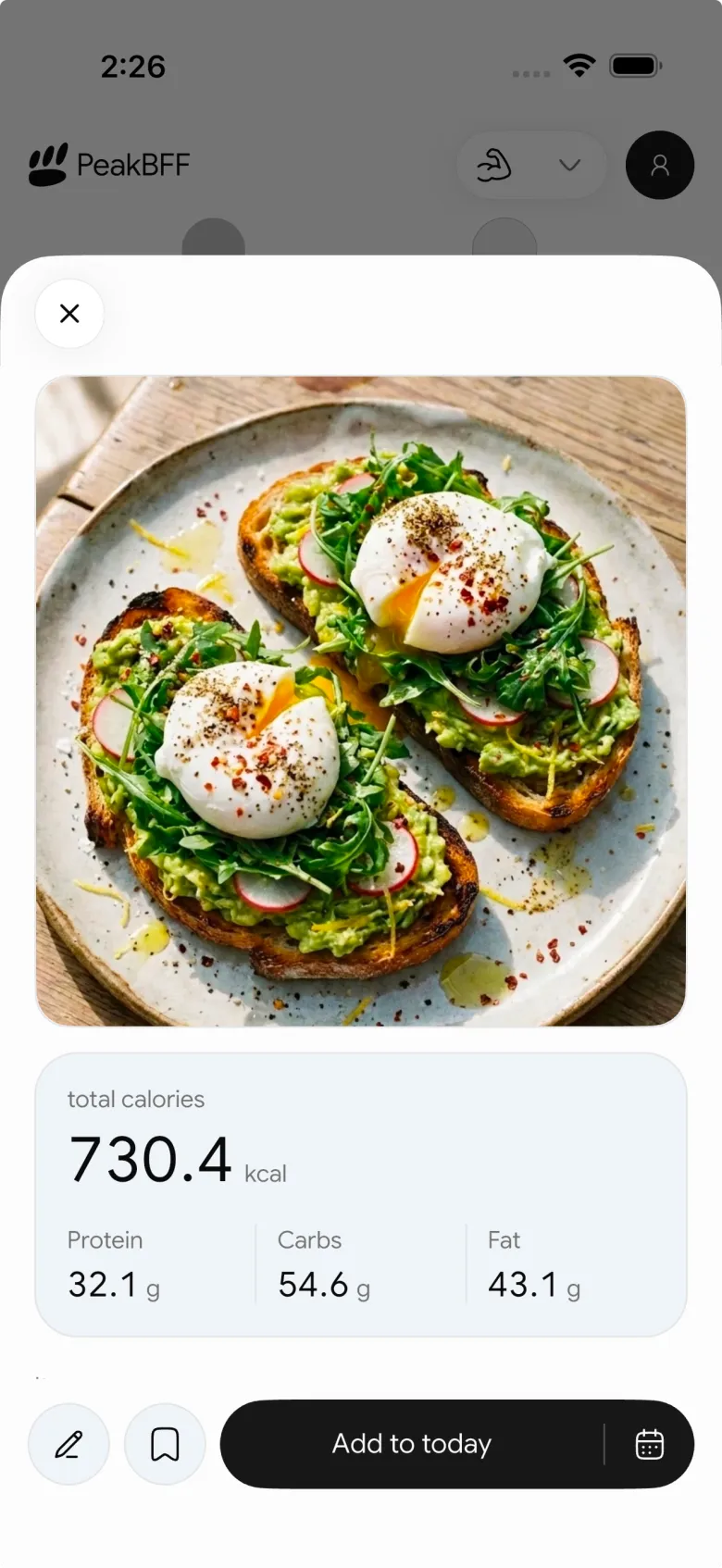
- Open the Food tab and tap the camera icon to snap a photo of your meal. PeakBFF's AI meal scanner recognizes the food items and estimates calories, protein, carbohydrates, and fat.
- If you are eating packaged foods where barcodes are absent, use the package and label scanner to photograph the nutrition facts table directly.
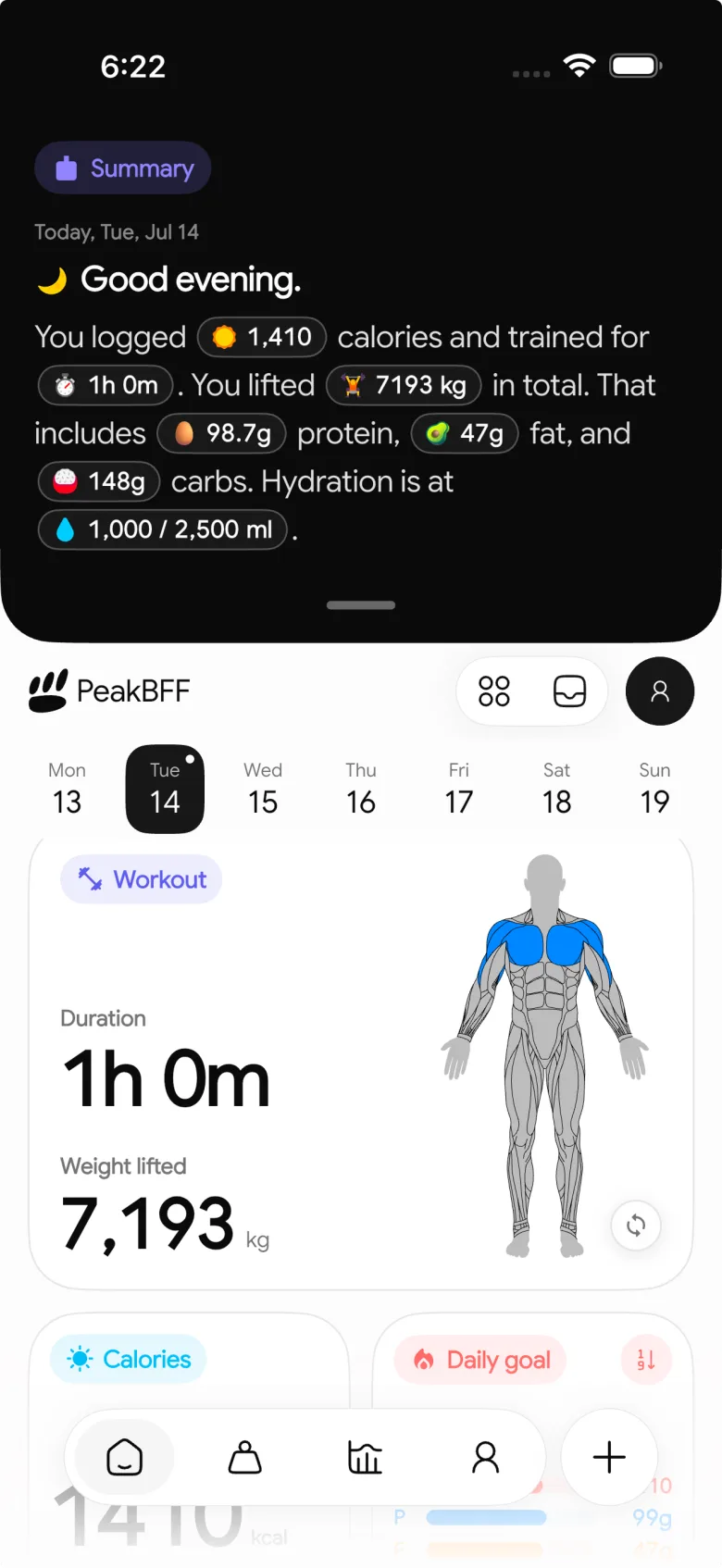
- Check your daily summary card. The top bar shows your consumed calories against your target, while the macro bars break down your protein, carbohydrate, and fat progress.
- Because PeakBFF combines your nutrition and workout logs in one app, you can cross-reference your food intake with your strength performance. If your working weights hold steady or climb while your body weight drops, your protein intake is doing its job.
If you need help calculating your exact deficit, read our guide on how to find maintenance calories. For lifters weighing chicken and beef, see how to log raw vs cooked food weight to avoid common portion mistakes. You can also review how to change your protein goal in a calorie tracker.
Many PeakBFF features are free for basic users, including workout and food logging. Plus unlocks unlimited AI food scans, detailed macro tracking (protein, carbs, fat), custom workout programs, and workout video import, and costs $49.99 per year on the US App Store (as of November 2026).
Copy this daily cutting protein checklist
Use this 5-point checklist each morning to plan your meals before eating:
Target Daily Calories: _______ kcal
Target Daily Protein:  _______ g

[ ] Rule Check: Does every planned meal contain at least 30g of protein?
[ ] 10:1 Ratio Check: Are the main protein sources above 10g protein per 100 kcal?
[ ] Egg Strategy: Am I combining 1 whole egg with egg whites instead of multiple whole eggs?
[ ] Cooking Audit: Am I using cooking spray instead of free-pouring liquid oils?
[ ] Dairy Check: Did I choose 0% Greek yogurt or low-fat cottage cheese over full-fat dairy?
[ ] Safety Net: Do I have a quick 25g whey scoop or can of tuna ready if I am short by dinner?
How to fix your protein intake starting today
- Calculate your protein goal: aim for roughly 0.8 to 1.0 grams per pound of goal body weight (or 1.8 to 2.2 grams per kilogram).
- Divide that number by your planned number of meals. If your goal is 150 grams across 4 meals, aim for at least 35 to 40 grams of protein per meal.
- Build your plate around a Tier 1 or Tier 2 protein source first before adding starches or fats.
- Replace high-fat staples like 80/20 beef, full-fat dairy, and whole eggs with lean ground turkey, 96/4 beef, egg whites, and 0% Greek yogurt.
- Track your meals and workouts together to ensure your strength stays high while the scale moves down.
If you want an all-in-one gym log and AI food tracker that helps you stay on top of your lifting and macros, download PeakBFF for iOS or Android. For lifters comparing nutrition tools, check out our breakdown of Cronometer vs MyFitnessPal.
Questions, answered
How do I hit my protein goal without going over my calories?
To hit a high protein goal within a tight calorie limit, choose foods where protein makes up at least 60% of total calories. Follow the 10:1 rule: ensure each protein source contains at least 10 grams of protein per 100 calories. Prioritise ultra-lean staples like skinless chicken breast, liquid egg whites, 0% plain Greek yogurt, white fish, and whey isolate, while swapping out high-fat protein traps like peanut butter, fatty beef, and whole cheese.
What is the 10:1 protein to calorie rule?
The 10:1 rule states that for every 100 calories in a food serving, it should provide at least 10 grams of protein (or multiply the protein grams by 10; if the result is greater than or equal to the total calories, it is an elite lean protein source). For example, 100 calories of nonfat Greek yogurt provides roughly 17 grams of protein (17 x 10 = 170, well above 100), making it ideal for a calorie deficit.
Can I hit 150 grams of protein on a 1,500 calorie diet without protein powder?
Yes. 150 grams of protein equals 600 calories, which is 40% of a 1,500-calorie budget. You can achieve this entirely with whole foods by eating 200 grams of chicken breast (62g protein, 330 kcal), 250 grams of liquid egg whites (27g protein, 130 kcal), 300 grams of 0% Greek yogurt (30g protein, 180 kcal), and 170 grams of canned tuna in water (38g protein, 170 kcal). Together, these provide 157g of protein for only 810 calories, leaving 690 calories for carbohydrates, healthy fats, and vegetables.
Why do nuts and peanut butter make it hard to hit protein goals on a cut?
Nuts and peanut butter are calorie-dense fat sources rather than lean protein sources. Two tablespoons of peanut butter contain roughly 190 calories but only 7 to 8 grams of protein, meaning roughly 70% to 75% of its calories come from fat. Eating 30 grams of protein from peanut butter would cost over 700 calories, leaving very little room for the rest of your daily meals.
Should I lower my protein goal on rest days when cutting?
No. Muscle protein synthesis and tissue recovery continue for 24 to 48 hours after resistance training. Maintaining a high, consistent protein intake (roughly 0.7 to 1.0 grams per pound of body weight, or 1.6 to 2.2 grams per kilogram) every single day protects lean muscle mass while you remain in a calorie deficit.
More from PeakBFF
More app comparisons, fitness guides, and product notes.
Boostcamp vs Hevy (2026): Structured Coach Programs or a Simple Gym Log?
Boostcamp vs Hevy compared on structured strength programs, progression tools, Apple Watch logging, free tier limits and pricing, plus where PeakBFF fits.
GainFrame vs ShredFrame (2026): Which AI Physique App Fits Your Goal?
Compare GainFrame and ShredFrame for AI physique scans and body composition. See features, Android availability, pricing, and workout tracking differences.
Best 75 Hard App (2026): Free Options, the Official App and What Actually Works
Compare the best 75 Hard apps for tracking workouts, water, diet and progress photos. See why lifters outgrow basic checkboxes and what to use instead.
PPLUL Split (2026): A 5-Day Push Pull Legs Upper Lower Routine and Volume Guide
What the PPLUL split is, how to schedule a 5-day Push Pull Legs Upper Lower workout routine, weekly muscle volume targets, and how to track progression.
Cronometer vs MyFitnessPal (2026): Which Food Tracker Fits Lifters?
Cronometer vs MyFitnessPal compared on database accuracy, free barcode scanning, pricing and lifting support, plus where PeakBFF fits for gym trackers.
How Many Warm-Up Sets Before Working Sets? A Simple Ramp-Up Chart and Rules
Most lifters need 2 to 4 warm-up sets for heavy compound lifts and 0 to 1 for isolation exercises. Use this ramp-up chart and formula to prepare without wasting energy.