Bulking Meal Prep: High-Calorie Recipes, Macro Blueprint, and Batch-Cook Guide
Build clean muscle without force-feeding: high-calorie bulking meal prep recipes, a 3,200-calorie batch-cook plan, and smart calorie-density swaps to hit your surplus.
Bulking Meal Prep: High-Calorie Recipes, Macro Blueprint, and Batch-Cook Guide
To build lean muscle without gaining unwanted body fat, your bulking meal prep should provide a controlled surplus of 300 to 500 calories above maintenance, deliver 0.8 to 1.0 grams of protein per pound of body weight, and prioritize calorie-dense whole foods that digest easily. Cooking large batches of fast-digesting carbohydrates (jasmine rice, pasta), flavorful proteins (85/15 ground beef, chicken thighs), and healthy fats (olive oil, nut butters) allows you to hit 3,000 or more calories every day without spending hours in the kitchen or feeling uncomfortably full.
By organizing your grocery list around calorie density rather than stomach-filling volume, you avoid the force-feeding and digestive fatigue that derail most bulking cycles.
Why lifters struggle to hit calorie goals on a bulk
When you transition from maintenance or a cutting phase into a muscle-building phase, the biggest obstacle is rarely gym motivation. The hardest part is consistently eating enough food day after day.
Many dedicated lifters make the mistake of attempting to bulk on strict cutting foods: plain boiled chicken breast, broccoli, and dry baked potatoes. Because these foods are high in fiber and water, they trigger satiety signals early. Trying to eat 3,500 calories of dry chicken and sweet potatoes leads to bloating, slow gastric emptying, and skipped meals.
On the other extreme, some lifters resort to "dirty bulking," relying on fast food, pizza, and sugary snacks to meet their calorie quotas. While this delivers calories, it often leads to sluggish gym sessions, poor recovery, and excessive visceral fat gain that takes months of harsh dieting to strip away.
The solution is strategic calorie density: choosing nutrient-dense whole foods that provide substantial calories and micronutrients in a moderate volume, making large meals palatable and easy to finish.
The Bulking Macro Blueprint
Before stepping into the kitchen, establish your daily macronutrient targets based on your current weight and maintenance energy expenditure.
1. Daily Calories: Maintenance Calories + 300 to 500 kcal
2. Daily Protein:  0.8 to 1.0 g per lb of body weight (1.6 to 2.2 g/kg)
3. Daily Fat:      20% to 30% of total calories (0.4 to 0.5 g per lb)
4. Daily Carbs:    Remaining calories (typically 40% to 55% of total intake)
For a 180-pound (82 kg) lifter with a maintenance level of 2,700 calories:
- Target Calories: 3,100 to 3,200 kcal (+400 to +500 kcal surplus)
- Protein: 160 to 180 grams (640 to 720 kcal)
- Fat: 80 to 90 grams (720 to 810 kcal)
- Carbohydrates: 400 to 440 grams (1,600 to 1,760 kcal)
This distribution fuels intense resistance training, restores muscle glycogen between daily workouts, and provides the raw building blocks for hypertrophy without unnecessary fat storage.
4 High-Calorie Bulking Meal Prep Recipes
These four battle-tested recipes are designed for efficient batch cooking, store well in the refrigerator for up to 4 days, and deliver high protein and calories without requiring complex culinary skills.
1. Beef & Jasmine Rice "Monster Mash" Bowl
Inspired by Stan Efferding's Vertical Diet, this recipe is a favorite in the lifting community because ground beef and white rice digest rapidly, allowing you to train hard without feeling heavy.
- Batch Size: 4 meals
- Prep & Cook Time: 25 minutes
Ingredients for 4 servings:
- 800g (1.75 lbs) 85/15 ground beef
- 3 cups dry white jasmine rice
- 4 cups beef bone broth (for cooking rice)
- 1 can (15 oz / 425g) black beans, drained and rinsed
- 120g (1 cup) shredded cheddar cheese
- 2 tbsp olive oil (for browning beef)
- 1 packet low-sodium taco seasoning (or cumin, garlic powder, onion powder, salt)
- 1 cup mild salsa
How to prep:
- Rinse the jasmine rice and add it to a rice cooker or pot with 4 cups of beef bone broth instead of plain water. The bone broth adds 30 grams of collagen protein and deep flavor to the rice without extra volume.
- Heat olive oil in a large skillet over medium-high heat. Add the ground beef and seasonings, breaking it into small crumbles until browned.
- Stir in the drained black beans and salsa, simmering for 3 minutes until warm.
- Divide the cooked broth-infused rice evenly across 4 glass meal prep containers. Top each with one-quarter of the beef mixture and 30 grams of shredded cheddar cheese.
- Macros per bowl: ~980 kcal | 58g protein | 102g carbs | 38g fat
2. Creamy Pesto Chicken Thigh & Penne Pasta
Pasta is significantly easier to consume in high quantities than potatoes or whole oats. Swapping lean chicken breast for skinless chicken thighs adds healthy monounsaturated fats and prevents the meat from drying out when reheated in the microwave.
- Batch Size: 4 meals
- Prep & Cook Time: 30 minutes
Ingredients for 4 servings:
- 700g (1.5 lbs) boneless, skinless chicken thighs, cut into bite-sized cubes
- 450g (1 lb box) penne or rotini pasta
- 1 jar (6.5 oz / 185g) basil pesto (olive oil base)
- 120g (1/2 cup) full-fat plain Greek yogurt
- 50g (1/2 cup) grated parmesan cheese
- 3 cups baby spinach leaves
- 1 tbsp olive oil
- Salt, black pepper, and garlic powder to taste
How to prep:
- Boil the pasta in salted water until al dente. Reserve 1/2 cup of pasta water before draining.
- Heat olive oil in a large pan over medium heat. Season the chicken thighs with salt, pepper, and garlic powder, then sear for 8 to 10 minutes until golden and thoroughly cooked.
- Lower the heat to low. Stir in the jarred pesto, full-fat Greek yogurt, grated parmesan, and 2 tablespoons of warm pasta water to form a silky, high-calorie sauce.
- Add the baby spinach, allowing it to wilt into the warm sauce for 60 seconds.
- Fold in the drained pasta until evenly coated. Divide evenly into 4 meal prep containers.
- Macros per bowl: ~1,020 kcal | 56g protein | 92g carbs | 48g fat
3. Bulk High-Protein Freezer Breakfast Burritos
Mornings can be rushed, making breakfast the most frequently missed meal on a bulk. These burritos can be rolled in large batches, wrapped in foil, and kept in the freezer for up to two months.
- Batch Size: 6 large burritos
- Prep & Cook Time: 35 minutes
Ingredients for 6 burritos:
- 6 large (10 to 12 inch) flour tortillas
- 10 whole large eggs + 4 egg whites
- 400g (14 oz) ground pork breakfast sausage or lean chorizo
- 2 cups frozen diced potatoes or hash browns
- 150g (1.5 cups) shredded Mexican blend cheese
- 1/4 cup salsa
- Salt and pepper to taste
How to prep:
- Brown the ground sausage in a large skillet, remove the cooked meat with a slotted spoon, and cook the diced hash browns directly in the rendered fat until golden and crispy.
- Whisk the eggs and egg whites together with a pinch of salt and pepper. Scramble the eggs softly over medium-low heat so they remain moist after freezing and reheating.
- Lay out 6 sheets of parchment paper topped with aluminum foil. Place a tortilla on each sheet.
- Layer each tortilla with scrambled eggs, crispy potatoes, cooked sausage, salsa, and shredded cheese.
- Fold the sides inward and roll tightly into burritos. Wrap firmly in parchment paper, then in aluminum foil, and place in a freezer zip-top bag.
- To reheat: Remove the aluminum foil, wrap the burrito in a damp paper towel, microwave for 2 minutes, and optionally toast on a dry skillet for 1 minute per side for a crispy exterior.
- Macros per burrito: ~780 kcal | 38g protein | 62g carbs | 42g fat (eating two gives 1,560 kcal and 76g protein)
4. Overloaded No-Cook Overnight Oats
For lifters who struggle with morning appetite, cold overnight oats mixed with protein powder, whole milk, and nut butter slide down smoothly without heavy chewing.
- Batch Size: 3 mason jars (assemble 3 days in advance)
- Prep Time: 10 minutes (no cooking required)
Ingredients for 3 jars (divide equally per jar):
- 3 cups (270g) rolled oats (1 cup per jar)
- 3.75 cups (900ml) whole milk or high-protein ultra-filtered milk (1.25 cups per jar)
- 3 scoops (90g) chocolate or vanilla whey protein powder (1 scoop per jar)
- 6 tbsp (96g) natural peanut butter or almond butter (2 tbsp per jar)
- 3 tbsp (45g) chia seeds (1 tbsp per jar)
- 3 tbsp honey or pure maple syrup (1 tbsp per jar)
- 3 bananas, sliced fresh before serving
How to prep:
- In each 16-oz or 24-oz mason jar, add 1 cup of rolled oats, 1 scoop of protein powder, and 1 tablespoon of chia seeds. Stir dry ingredients briefly.
- Pour in 1.25 cups of whole milk, 2 tablespoons of peanut butter, and 1 tablespoon of honey.
- Stir vigorously with a spoon or fork until the peanut butter and protein powder are fully incorporated with the milk.
- Seal the lids tightly and refrigerate overnight. Add fresh sliced banana right before eating.
- Macros per jar: ~960 kcal | 52g protein | 124g carbs | 28g fat
How to add 500 clean calories without extra volume
If you struggle to finish your meals, you do not need to double your plate size. Making small adjustments to ingredient selection adds hundreds of calories with minimal stomach distension:
- Cook grains in bone broth or stock: Cooking 1 cup of dry rice in beef bone broth adds roughly 100 calories and 20 grams of protein compared to water, with zero change in volume.
- Finish plates with extra virgin olive oil: Drizzling 1 tablespoon of cold-pressed olive oil over your cooked rice, pasta, or vegetables adds 120 healthy calories instantly without increasing food chew time.
- Drink your calories between meals: A smoothie made with whole milk, a banana, 2 tablespoons of peanut butter, and a scoop of whey adds 600 calories and 45 grams of protein that digests within 90 minutes.
- Choose chicken thighs over chicken breasts: 150 grams of cooked boneless skinless chicken thighs has approximately 70 more calories than the same weight of chicken breast, remains juicier in meal prep containers, and provides valuable dietary fat.
- Rely on faster-digesting carbs: While whole oats and sweet potatoes are fantastic on a cut, their high fiber slows stomach emptying. White jasmine rice, sourdough bread, and semolina pasta empty from the stomach much quicker, allowing your appetite to return for the next meal.
Complete 3,200-Calorie Daily Bulking Template
Here is how to combine these meal prep staples into an organized, high-performance lifting day:
Meal 1: Overloaded Overnight Oats (Morning)
- 1 jar Overloaded Overnight Oats with 1 sliced banana
-> Macros: 52g protein | 124g carbs | 28g fat | 960 kcal

Meal 2: Beef & Jasmine Rice Monster Mash (Lunch)
- 1 container Monster Mash with salsa and cheddar
-> Macros: 58g protein | 102g carbs | 38g fat | 980 kcal

Meal 3: Pre-Workout Fuel (2 hours pre-lift)
- 2 slices sourdough bread with 2 tbsp peanut butter & 1 sliced banana
-> Macros: 14g protein | 65g carbs | 18g fat | 480 kcal

Workout Window: Resistance Training Session
- Hydrate with water and electrolytes

Meal 4: Creamy Pesto Chicken & Penne (Dinner)
- 1 container Creamy Pesto Chicken Thigh Pasta
-> Macros: 56g protein | 92g carbs | 48g fat | 1,020 kcal

Daily Totals:
- Protein: 180 grams (720 kcal, 21% of total calories)
- Carbohydrates: 383 grams (1,532 kcal, 44% of total calories)
- Fat: 132 grams (1,188 kcal, 35% of total calories)
- Total Energy: ~3,440 kcal (Adjust portion of pasta or oats to hit exact 3,200 target)
How to track bulking nutrition and workouts in PeakBFF
When you are bulking, consistent tracking prevents you from under-eating on busy days and stops excess body fat from creeping up unnoticed. PeakBFF makes logging your meals and workouts straightforward:
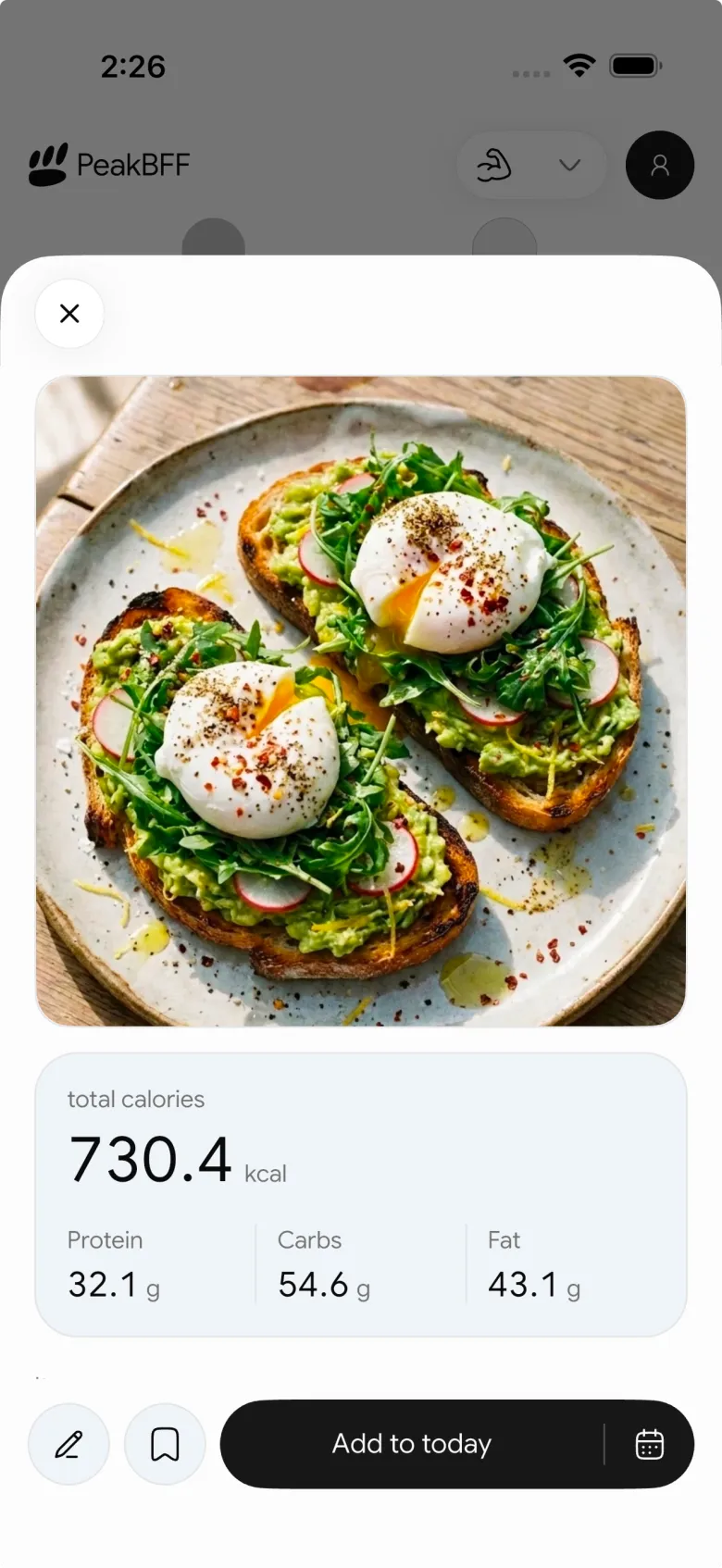
- Photo food logging: Tap the camera icon in the Food tab and snap a photo of your prepped meal container. PeakBFF's AI food scanner estimates the calories, protein, carbohydrates, and fat so you do not have to search for multiple ingredients manually.
- Package and label scanning: When using bulk staples like oats, peanut butter, pasta, or protein powder, scan the nutrition label directly to log exact manufacturer values.
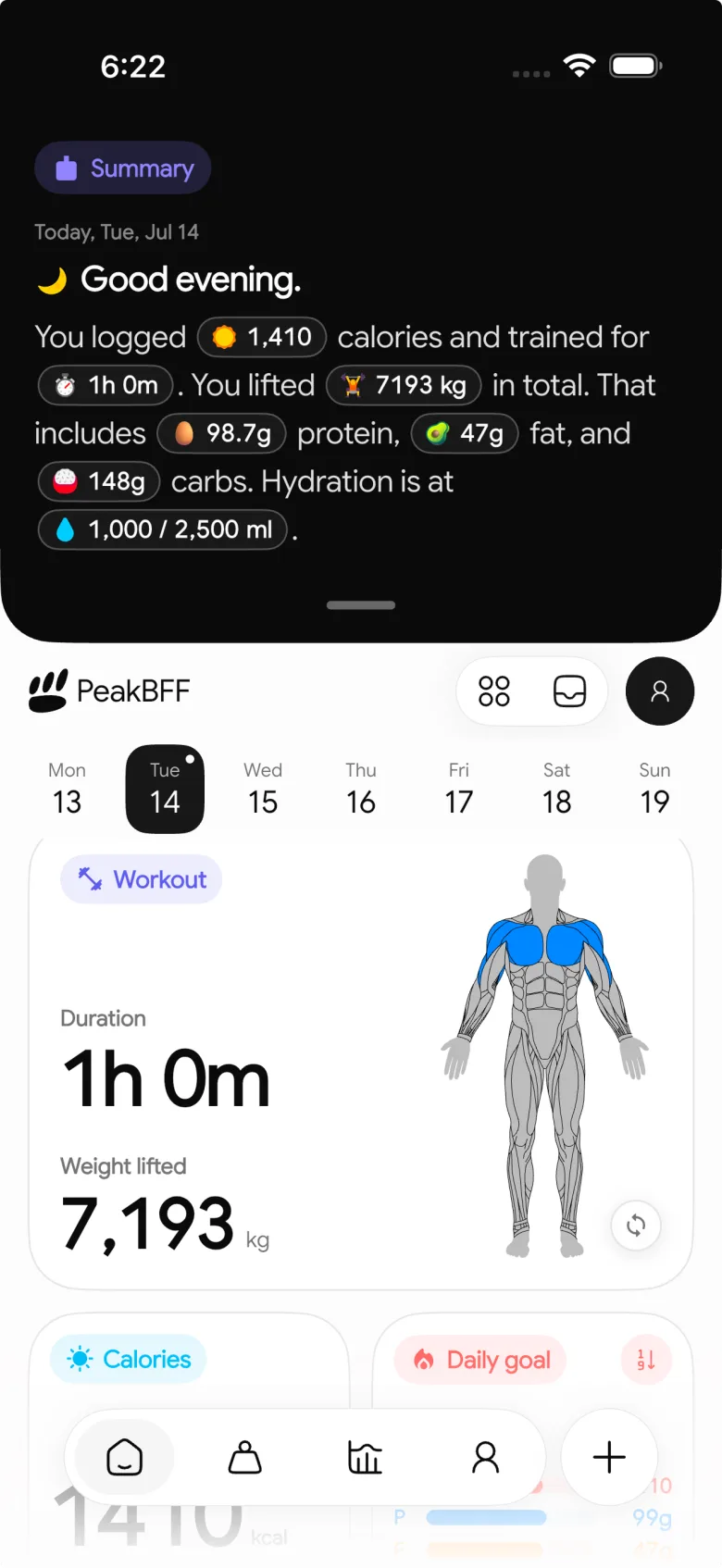
- Daily macro review: Check the calorie and macro progress bars on your home dashboard to ensure you hit your surplus and stay within your target protein and fat boundaries.
- Water tracking: Bulking diets require increased fluid intake to help kidneys process extra nitrogen from protein and to support digestion of high-carb meals. Log your daily water intake directly beside your meals.
- Cross-reference with strength gains: Because PeakBFF combines your workout log and nutrition tracker in one app, you can confirm whether your calorie surplus is translating into progressive overload on compound lifts like squats, presses, and rows.
If you are determining your exact surplus numbers, start by reading our guide on how to find maintenance calories. For accurate food weights, see how to log raw vs cooked food weight so you do not miscalculate dry rice or cooked beef. If you are comparing apps for bulking season, check our breakdown of the best app for lean bulking.
Many PeakBFF features are free for basic users, including gym logging and food tracking. Plus unlocks unlimited AI food scans, detailed macro tracking (protein, carbs, fat), custom workout programs, and workout video import, and costs $49.99 per year on the US App Store (as of November 2026).
Practical Bulking Meal Prep Checklist
Keep this checklist saved on your phone for grocery shopping and batch cooking:
Weekly Grocery Staples:
[ ] Proteins: 85/15 ground beef, boneless chicken thighs, whole eggs, whey protein
[ ] Carbohydrates: Jasmine white rice, penne pasta, rolled oats, sourdough bread, bananas
[ ] Fats & Liquids: Extra virgin olive oil, natural peanut butter, beef bone broth, whole milk
[ ] Produce & Extras: Baby spinach, black beans, salsa, cheddar cheese, chia seeds

Batch Prep Routine (Takes under 60 minutes):
[ ] Step 1: Start 3 cups of jasmine rice in rice cooker using bone broth.
[ ] Step 2: Boil 1 lb box of penne pasta until al dente.
[ ] Step 3: Brown ground beef in skillet with taco seasoning and fold in black beans.
[ ] Step 4: Sear chicken thighs in skillet, lower heat, and stir in pesto, Greek yogurt, and spinach.
[ ] Step 5: Assemble 3 jars of overnight oats with milk, oats, protein powder, and peanut butter.
[ ] Step 6: Portion beef & rice bowls and pasta bowls into 8 glass containers; refrigerate.
How to execute a successful bulk starting this week
- Weigh yourself 3 mornings per week under identical conditions (fasted, after using the bathroom) and track the weekly average.
- Aim for a weight gain rate of 0.25 to 0.5 pounds (0.1 to 0.25 kg) per week for intermediate lifters, or 0.5 to 1.0 pound (0.25 to 0.45 kg) per week for beginners.
- If your weight does not move after two consecutive weeks, increase your daily intake by 200 calories by adding an extra tablespoon of peanut butter and an extra half-cup of rice.
- If your weight increases faster than 1 pound per week for three weeks in a row, reduce your daily fats or carbs slightly to curb unnecessary fat accumulation.
- Combine your surplus with progressive overload in the gym to ensure those extra calories build dense muscle tissue rather than just filling fat stores.
If you want an all-in-one gym tracker and AI nutrition logger that keeps your lifts and bulking macros together in one place, download PeakBFF for iOS or Android.
Questions, answered
How many calories should I eat when meal prepping for a bulk?
Aim for a moderate calorie surplus of 300 to 500 calories above your maintenance level. For most male lifters, this lands between 2,800 and 3,400 calories per day, while most female lifters bulk effectively between 2,200 and 2,600 calories per day. This surplus supports muscle protein synthesis while keeping monthly fat gain to roughly 1 to 2 pounds.
How much protein do I need for bulking meal prep?
Target 0.8 to 1.0 grams of protein per pound of body weight (1.6 to 2.2 grams per kilogram). On a calorie surplus, your body is in an anabolic state with ample carbohydrates and fats sparing protein, so exceeding 1.0 gram per pound yields no additional muscle growth and only displaces easier-to-digest carbohydrate energy.
How can I get 3,000 clean calories without feeling bloated?
Focus on calorie density rather than food volume. Swap brown rice and whole potatoes for white jasmine rice and pasta, cook starches in bone broth with olive oil, use chicken thighs instead of dry chicken breasts, and add liquid calories like whole milk, fruit smoothies, and natural nut butters to deliver calories with minimal stomach distension.
How long does cooked bulking meal prep last in the fridge?
Cooked poultry, ground beef, rice, and pasta remain fresh and safe for 3 to 4 days in airtight glass containers in the refrigerator. For a full 7-day week, batch cook on Sunday and Wednesday, or assemble freezer-friendly meals like breakfast burritos that can be frozen for up to 2 months and reheated in minutes.
What is the difference between clean bulking and dirty bulking?
A clean bulk uses a controlled surplus of 300 to 500 calories composed of whole grains, lean and medium-fat proteins, healthy oils, and fruits, resulting in steady muscle gain with minimal fat. A dirty bulk involves an unrestricted surplus often packed with fast food and ultra-processed snacks, which produces rapid fat accumulation, sluggish training sessions, and elevated cholesterol.
More from PeakBFF
More app comparisons, fitness guides, and product notes.
Double Progression Method: How It Works, Rep Ranges, and Log Template
Master the double progression method: increase reps first, then weight. Learn rep ranges, standard vs dynamic double progression, worked tables, and how to track it.
Lose It vs MyFitnessPal (2026): Which Calorie Tracker Fits Lifters?
Lose It vs MyFitnessPal compared on database accuracy, free barcode scanning, pricing, and gym tracking, plus where PeakBFF fits for lifters who want both.
Best Before and After Photo App for Gym Progress (2026): 4 Options Compared
Compare the best before and after photo apps for gym lifters in 2026: Progress, SnapTrack, Hevy, and PeakBFF, covering sliders, ghost overlays, privacy, and prices.
Boring But Big Workout Breakdown (2026): 5/3/1 BBB Routine, Percentages, and How to Track It
A complete breakdown of the 5/3/1 Boring But Big (BBB) workout routine: Training Max math, 5x10 percentages, 4-day split schedule, assistance work, and how to log it.
FitSaver vs Prept (2026): Which Workout Saver App Fits Lifters?
Compare FitSaver and Prept for turning TikTok, Instagram Reels, and YouTube videos into gym routines, with real prices and feature trade-offs.
Best Jefit Alternative (2026): 4 Gym Workout Trackers Compared
Compare the best Jefit alternatives for lifters who want exercise demo videos, clean workout logging, and honest pricing without ad clutter.