Fitbod vs Caliber (2026): AI Workout Generator or Structured Strength Log?
Fitbod vs Caliber compared on algorithmic workout generation, progressive overload, free tier features, video form guides, and where PeakBFF fits.
If you walk into a busy gym and want an algorithm to instantly assemble a fresh workout based on whatever machines are open and your current muscle fatigue, Fitbod is built for you. If you prefer sticking to a proven strength split, mastering the same core lifts each week, and logging your sets for free with clear video form guides, Caliber is the stronger match.
And if you want an AI workout generator tailored to your gym gear that also keeps your routines structured and tracks your daily calories and protein in the same app, PeakBFF provides the best of both worlds.
Short answer: Fitbod is a dynamic, algorithm-driven workout generator ($95.99 per year) that shuffles exercises daily based on calculated muscle recovery. Caliber is a structured, science-based lifting tracker with a generous free tier, 800+ exercise video tutorials, and optional human coaching upgrades ($200+ per month). Neither app tracks nutrition. PeakBFF bridges the gap by pairing equipment-aware AI workout planning and explicit progressive overload with integrated meal photo logging ($49.99 per year).
Fitbod vs Caliber vs PeakBFF at a glance
Prices reflect live US App Store listings as of November 2026 and may differ across international regions or billing promotions. Core capabilities reflect live app features.
| Feature | Fitbod | Caliber | PeakBFF |
|---|---|---|---|
| Primary design | Algorithmic workout generator with rotating daily sessions | Structured strength-training log with video tutorials | Unified gym tracker and AI photo food log |
| Workout generation | Dynamic algorithm builds a new session each workout | Static structured splits (PPL, Upper/Lower, Full Body) | AI workout plan generator (Plus) builds editable multi-day programs |
| Exercise variety | High; rotates exercises to match recovered muscle groups | Low to moderate; repeats core lifts to build motor patterns | Balanced; consistent splits with user-customizable exercises |
| Progressive overload | Automated weight and rep adjustments calculated by algorithm | Manual progression; user tracks rep targets and increases weight | Explicit "Try more" suggestions (reps or weight) confirmed by lifter |
| Free tier access | 3 free logged workouts, then requires a paid subscription | Unlimited free workout logging, custom routines, video library | Unlimited free workout and food logging, starter programs, plate calculator |
| Exercise demos | 3D animations and short looping clips with muscle highlights | High-definition real-trainer videos with step-by-step form cues | 220+ exercises with looping video clips, step-by-step form cues |
| Built-in nutrition | None; requires a separate diet tracking app | None; calorie guidance only available in paid 1-on-1 coaching | AI camera meal scans, barcode scanner, protein and macro tracking |
| Subscription cost | $15.99/mo or $95.99/yr | Free; Plus is ~$12/mo or $72/yr; 1-on-1 coaching starts ~$200/mo | Free tier; Plus is $49.99/yr ($4.17/mo) or $7.99/week |
| Best for | Lifters who want hands-off daily workout variety | Lifters who want structured lifting and free form tutorials | Lifters who want structured routines and nutrition in one app |
Fitbod: the algorithmic approach to daily gym variety
Fitbod has earned a dedicated following by eliminating the question, "What should I train today?"
When you open Fitbod, its algorithm examines your logged workout history, estimates which muscle groups have recovered from previous sessions, and builds a customized routine based on your selected gym profile (such as home dumbbells, hotel gym, or commercial fitness centre).
Where Fitbod shines
- Effortless gym adaptability: If a specific bench or cable machine is occupied, you can swap the movement in one tap. Fitbod recalculates the session on the fly, substituting a biomechanically similar exercise that targets the same muscle group.
- Visual muscle recovery map: Fitbod features a colour-coded anatomical mannequin that illustrates estimated muscle fatigue percentage (from 0% to 100%). It is visually intuitive and helps lifters avoid overtraining muscle groups that are still sore from 48 hours prior.
- Smartwatch integration: Fitbod offers a refined Apple Watch application that lets you record weights, log completed reps, and monitor rest intervals directly from your wrist without pulling your phone out between sets.
Where Fitbod falls short
- Too much exercise variation: The most common criticism from strength athletes and powerlifters is that Fitbod changes exercises too often. Building strength and hypertrophy requires repeated exposure to the same movement patterns over several weeks. When an algorithm gives you dumbbell incline presses one week, landmine presses the next, and machine chest presses the week after, tracking true linear progression becomes difficult.
- Aggressive paywall: Fitbod only allows you to log three workouts for free. After your third session, the app locks down logging and requires a paid subscription ($15.99 per month or $95.99 per year), making it one of the more expensive workout logs on the market.
- No nutrition component: Fitbod tracks exercise volume and estimated calories burned, but it provides zero functionality for tracking dietary intake, daily protein, or total calories.
For more details on how Fitbod compares to standard digital notebooks, see our comparison of Fitbod vs Hevy.
Caliber: structured strength training and movement mastery
Caliber takes the opposite approach. Instead of generating random daily workouts, Caliber treats resistance training with the discipline of traditional strength coaching.
The app provides proven, repeatable training splits (such as 3-day full body, 4-day upper/lower, or 5-day push/pull/legs) designed around compound barbell and dumbbell movements. You perform the same core exercises week after week, focusing on progressive overload and perfecting your lifting technique.
Where Caliber shines
- Truly generous free tier: Unlike Fitbod, Caliber lets you log workouts forever without paying. You can create custom routines, log unlimited sets, and view your workout history completely free. There are no limits on the number of routines you can save.
- Gold-standard video instructions: Caliber sets the benchmark for exercise tutorials. Each exercise in its 800+ library features a high-definition video demonstration accompanied by detailed key takeaways, common mistakes, and setup cues written by certified coaches. If you are learning the deadlift or barbell hip thrust, Caliber provides exceptional technical guidance.
- Strength Score metric: Caliber rates your strength across major muscle groups (chest, back, shoulders, arms, legs, and core) using a proprietary Strength Score. It compares your logged lifts against strength standards for your age and body weight, helping you identify muscular imbalances.
- Human coaching pathway: For lifters who want personalized accountability, Caliber offers direct 1-on-1 access to a certified personal trainer. Your coach reviews your form videos, adjusts your training split, and audits your habits via in-app messaging (starting around $200 per month).
Where Caliber falls short
- No automated equipment adaptations: Caliber relies on static templates. If you walk into a hotel gym with limited dumbbells and a cable stack, the app will not dynamically reshape your workout the way Fitbod does; you must manually swap exercises yourself.
- Manual progression tracking: While Caliber records your previous weights, it does not offer interactive prompts when you hit your rep targets. You must remember to manually type a heavier weight next session.
- No integrated calorie tracking: While Caliber coaches provide general nutrition guidance in the $200/month tier, the Caliber app itself does not have a food scanner, barcode database, or daily macro log.
PeakBFF: the unified bridge between AI planning and honest progression
If you appreciate Fitbod's ability to create routines tailored to your gym equipment, but also want Caliber's dedication to structured progression and technique, PeakBFF was designed specifically to fill that void.
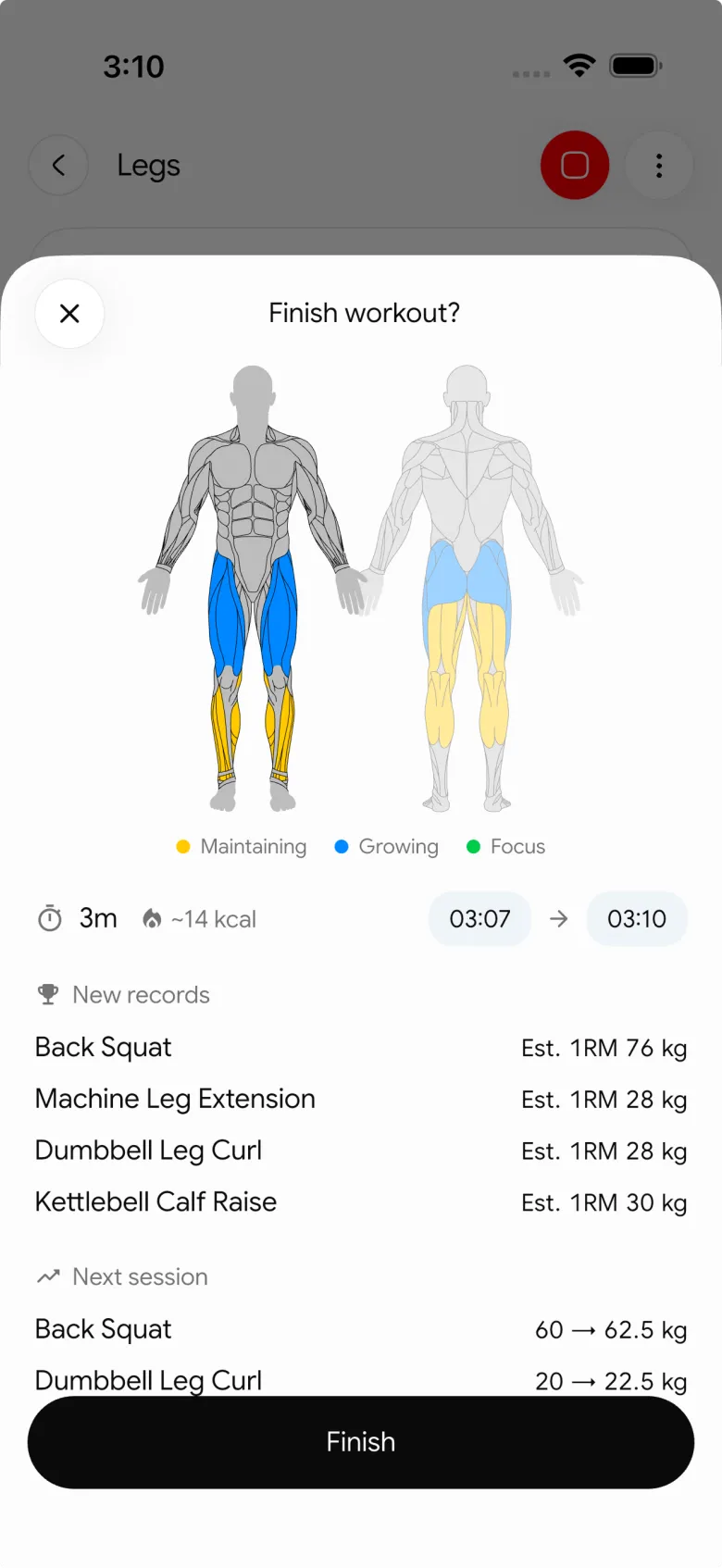
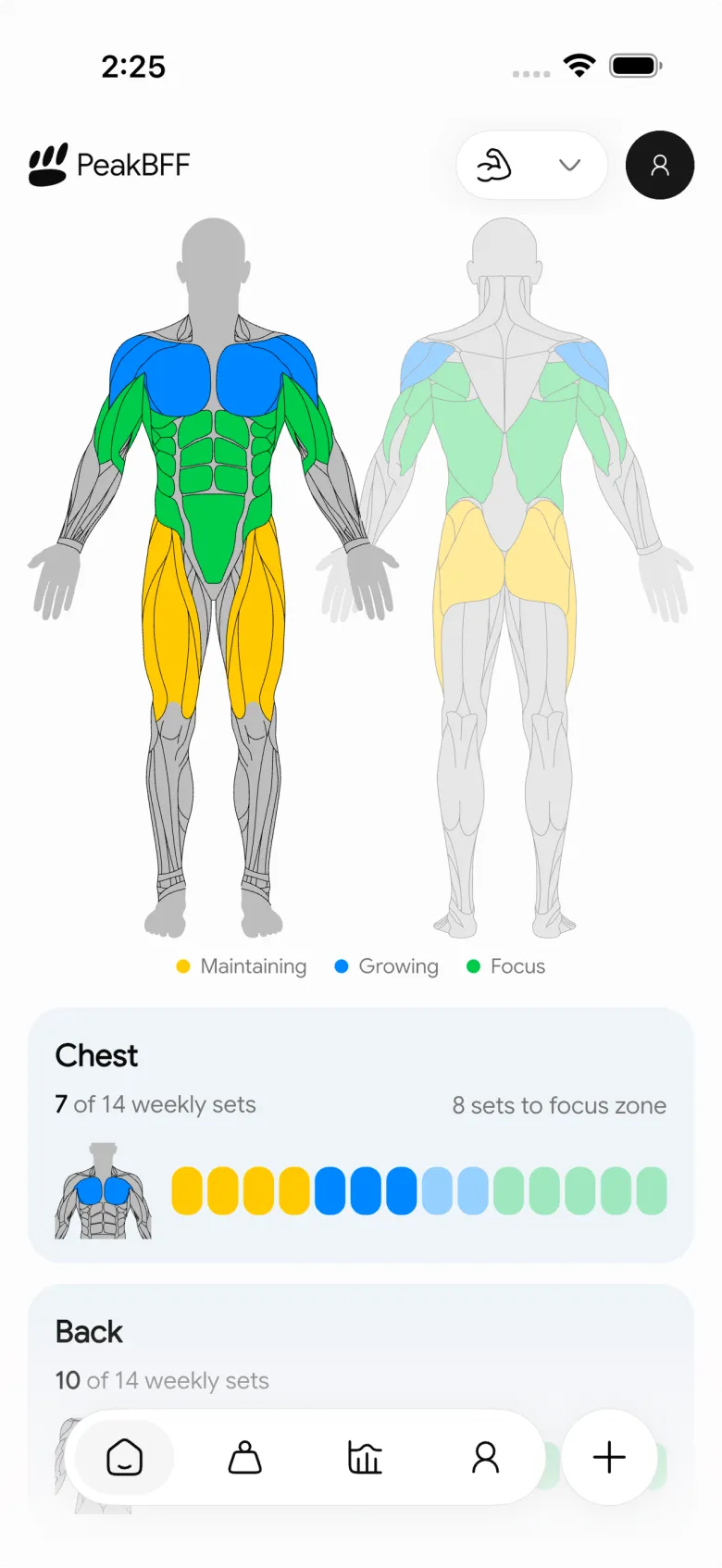
PeakBFF eliminates the friction of running one app for workouts and a second app for nutrition. It combines a dedicated gym tracker, an AI workout generator, and an AI photo food log in a single interface.
1. Equipment-aware AI workout planning with structured consistency
With PeakBFF Plus, you can generate a custom multi-day training program based on your primary goal, lifting experience, training frequency, and available equipment.
Unlike Fitbod, PeakBFF does not discard your routine every 24 hours. Instead, it generates a complete, structured program that you can repeat consistently over an 8-to-12-week training block. You can read more about how this works in our review of the best AI workout plan generator for gym equipment.
2. Transparent, lifter-approved "Try more" progressive overload
PeakBFF solves progressive overload without taking autonomy away from the lifter.
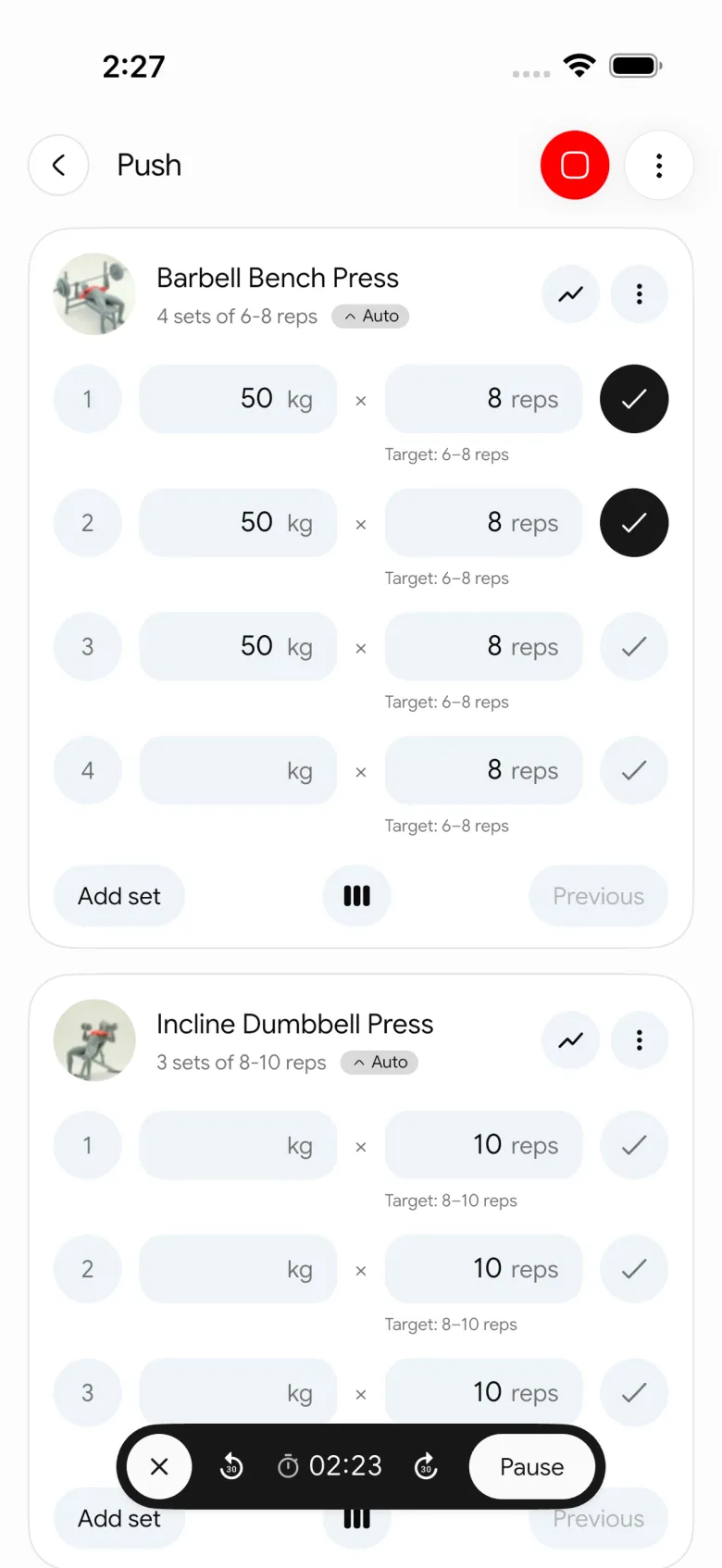
When you begin an exercise, PeakBFF automatically prefills your weight and rep values from your previous completed session. When you successfully hit the top of your target rep range across all working sets, a Try more chip appears:
- More reps: Suggests adding one rep to your next session at the same weight.
- More weight: When you reach the ceiling of your prescribed rep range, it suggests stepping up by standard plate increments (capped at a safe jump of 10% or less).
PeakBFF never changes your weights automatically without your consent. You review the suggestion, tap apply, and confirm the change. For a deeper breakdown of tracking principles, see our guide on how to track progressive overload.
3. Integrated calorie and protein tracking in one place
The biggest practical drawback of both Fitbod and Caliber is that neither app tracks what you eat. Resistance training only works when supported by adequate dietary protein and energy balance.
PeakBFF integrates nutrition logging directly beside your gym notebook:
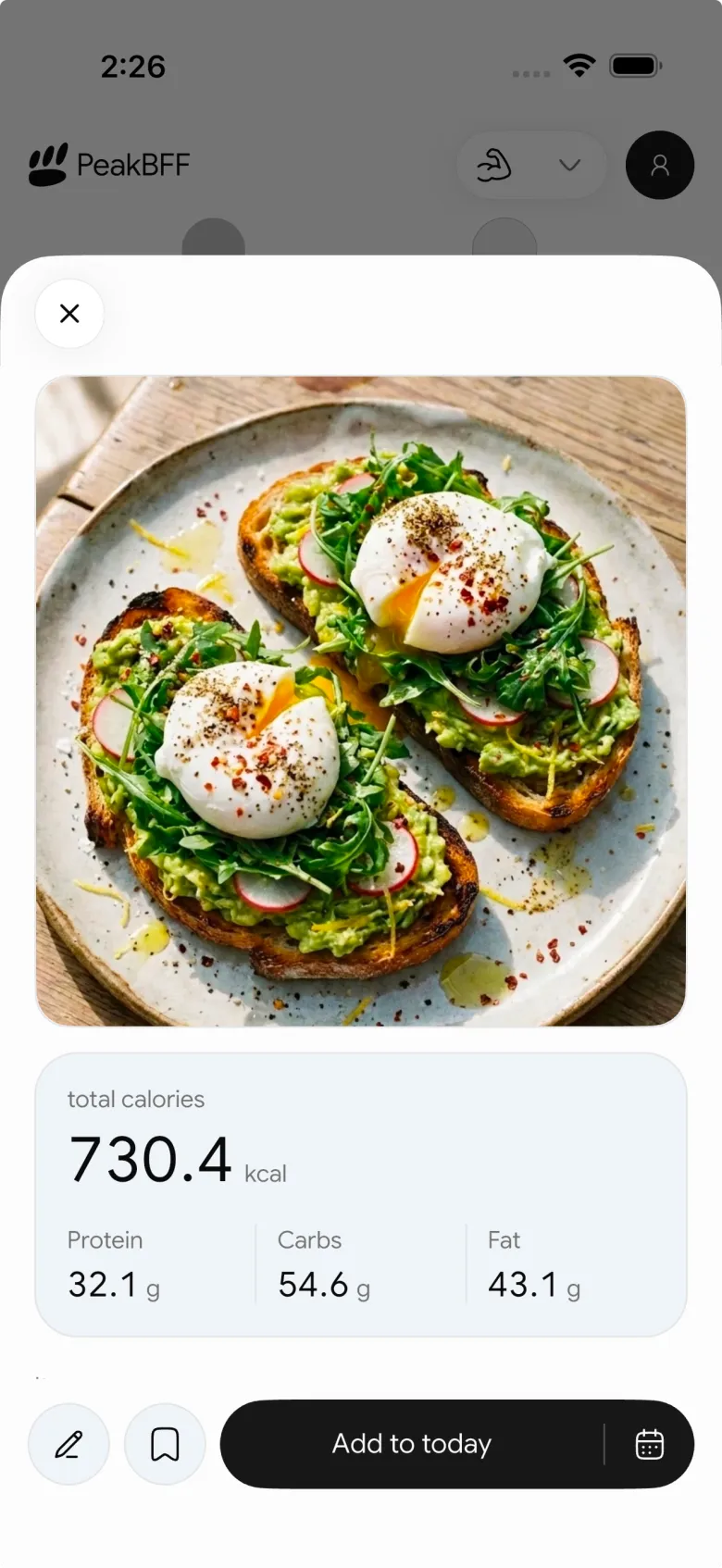
- AI photo food scan: Snap a photo of your plate to log estimated calories and macronutrients in seconds.
- Barcode and label scanner: Scan food packaging or nutrition labels for verified packaged items.
- Calorie tracking included free: Basic calorie tracking is completely free for all users, while detailed protein, carbohydrate, and fat breakdowns are unlocked with PeakBFF Plus ($49.99 per year).
You can see how this consolidation compares to single-purpose apps in our roundup of the best app to track workouts and macros.
4. What PeakBFF does not have
To maintain complete editorial honesty, PeakBFF is not the ideal solution for every lifter:
- It does not offer human 1-on-1 personal training. If you want a certified human coach reviewing video recordings of your squat form every Monday, Caliber's premium coaching tier is unbeatable.
- It does not shuffle your workout on a daily basis like Fitbod. PeakBFF prioritizes repeatable routines over spontaneous exercise randomization.
- It is built for lifters who want guided gym progression and nutrition tracking under one subscription without paying $80 to $100 annually for two separate apps.
Pricing comparison: Fitbod vs Caliber vs PeakBFF
Here is how all three apps compare on cost as of November 2026:
- Fitbod: Offers 3 free workouts, then requires Fitbod Elite at $15.99 per month or $95.99 per year (approximately $8.00 per month).
- Caliber: Completely free for basic tracking and video tutorials. Caliber Plus costs roughly $12 per month or $72 per year. Caliber 1-on-1 coaching starts around $200 per month with a 3-month onboarding commitment.
- PeakBFF: Core gym logging, prefilled weights, starter programs, the plate calculator, and daily calorie logging are free. PeakBFF Plus costs $49.99 per year (about $4.17 per month) or $7.99 per week, unlocking full macro tracking, unlimited AI food scans, and the AI workout plan generator.
Choosing PeakBFF Plus ($49.99/year) saves roughly $46 per year compared to Fitbod Elite ($95.99/year), while adding the comprehensive nutrition logging that Fitbod completely lacks.
The final verdict: which app should you choose?
Your decision hinges on whether you want an algorithm to choose your exercises, a traditional structured log, or an all-in-one lifting and nutrition hub:
- Choose Fitbod if: You want maximum variety, love having an algorithm automatically design fresh workouts based on what gym equipment is available, and prefer an app that manages daily exercise selection for you.
- Choose Caliber if: You want a completely free, high-quality digital logbook to follow structured strength splits, value high-definition video tutorials to master lifting technique, or plan to invest in personal 1-on-1 human coaching.
- Choose PeakBFF if: You want structured, equipment-tailored AI workout programs paired with clear progressive overload prompts, and you want to track your daily protein and calories in the same app without juggling multiple subscriptions.
Download PeakBFF on the App Store or get it on Google Play to start logging your workouts and tracking your nutrition today.
Questions, answered
Is Fitbod or Caliber better for beginners?
Caliber is generally better for beginners who want to master foundational movements and learn proper exercise technique. It offers a structured routine with clear video demonstrations and written form cues for every exercise. Fitbod works well for lifters who want an algorithm to decide exercises automatically based on available equipment, but its frequent movement changes can make learning consistent form more difficult.
Is Caliber completely free to use?
Yes, Caliber includes an unrestricted free tier that lets you log unlimited workouts, track weights and reps, create custom routines, and access its library of more than 800 exercise videos. The app monetizes through Caliber Plus ($12 per month or $72 per year as of November 2026) for pre-built plans, and high-end 1-on-1 human coaching starting around $200 per month.
Can you use Fitbod without a subscription?
Fitbod is primarily a paid subscription app. New users receive a limited trial of three free logged workouts to test the interface. Once those workouts are completed, you must subscribe to Fitbod Elite for $15.99 per month or $95.99 per year as of November 2026 to continue generating workouts and logging sets.
Does Fitbod or Caliber track food and calories?
Neither Fitbod nor Caliber has a built-in nutrition or calorie tracker. Both apps focus exclusively on strength training and workout tracking. Lifters tracking calories and macros alongside their workouts must use a third-party app like MyFitnessPal or MacroFactor. In contrast, PeakBFF includes both structured gym logging and AI camera meal tracking in a single app.
What is the best alternative to Fitbod and Caliber?
PeakBFF is an ideal alternative if you want equipment-tailored AI workout plans combined with honest, structured progression. Unlike Fitbod, PeakBFF lets you repeat structured splits to master your lifts, and prompts you with explicit Try more progression chips rather than changing weights automatically. Basic logging is free, and PeakBFF Plus ($49.99 per year) includes full macro and calorie tracking.
More from PeakBFF
More app comparisons, fitness guides, and product notes.
Double Progression Method: How It Works, Rep Ranges, and Log Template
Master the double progression method: increase reps first, then weight. Learn rep ranges, standard vs dynamic double progression, worked tables, and how to track it.
Lose It vs MyFitnessPal (2026): Which Calorie Tracker Fits Lifters?
Lose It vs MyFitnessPal compared on database accuracy, free barcode scanning, pricing, and gym tracking, plus where PeakBFF fits for lifters who want both.
Best Before and After Photo App for Gym Progress (2026): 4 Options Compared
Compare the best before and after photo apps for gym lifters in 2026: Progress, SnapTrack, Hevy, and PeakBFF, covering sliders, ghost overlays, privacy, and prices.
Boring But Big Workout Breakdown (2026): 5/3/1 BBB Routine, Percentages, and How to Track It
A complete breakdown of the 5/3/1 Boring But Big (BBB) workout routine: Training Max math, 5x10 percentages, 4-day split schedule, assistance work, and how to log it.
FitSaver vs Prept (2026): Which Workout Saver App Fits Lifters?
Compare FitSaver and Prept for turning TikTok, Instagram Reels, and YouTube videos into gym routines, with real prices and feature trade-offs.
Best Jefit Alternative (2026): 4 Gym Workout Trackers Compared
Compare the best Jefit alternatives for lifters who want exercise demo videos, clean workout logging, and honest pricing without ad clutter.