How to Calculate a Protein Target for Lifting Weights
Use a simple body-weight calculation to set a daily protein target for lifting, then turn it into a practical food-log habit.
How to Calculate a Protein Target for Lifting Weights
To calculate a protein target for lifting weights, multiply your body weight in kilograms by a number within 1.4 to 2.0 grams of protein per kilogram per day. That range is a general position from the International Society of Sports Nutrition for healthy, exercising people, not a personalized prescription. For example, an 80 kg lifter using 1.6 g/kg gets a starting daily target of 128 g.
The useful next step is simple: pick one number in that range, round it to a target you can remember, and log your normal meals against it for a couple of weeks. A target is more useful than chasing a perfectly timed shake or recalculating every meal.
What is the simple protein-target calculation for lifting?
Use this small worksheet:
body weight in kg × chosen protein factor = daily protein target in gramsThe International Society of Sports Nutrition position stand places the overall daily range at 1.4 to 2.0 g/kg/day for most healthy, exercising individuals. It is a range because a number that works on paper still has to fit the foods, budget, appetite, and training routine you can actually repeat.
If you use pounds, first convert to kilograms by dividing by 2.2046. Then use the same calculation.
| Example body weight | Factor used for the example | Daily target |
|---|---|---|
| 70 kg | 1.6 g/kg | 112 g |
| 80 kg | 1.6 g/kg | 128 g |
| 90 kg | 1.6 g/kg | 144 g |
These examples show the arithmetic, not a rule that every lifter should use 1.6 g/kg. A registered dietitian or clinician is the right person for an individual target when you have a medical condition, a prescribed diet, or other nutrition constraints.
How do you turn the calculation into a daily plan?
Treat the result as a daily total, then make it easy to notice whether your usual meals are moving you toward it. You do not need a special meal plan to start.
Here is a reusable protein-target checklist:
- Write down your body weight in kg and the factor you chose.
- Multiply them and round the result to the nearest practical 5 g or 10 g.
- Keep that one daily number visible for your next ordinary week of eating.
- Log each meal with the most honest convenient method.
- Check the day's protein total before deciding whether anything needs to change tomorrow.
For the 80 kg example, the note could simply say: 80 × 1.6 = 128 g/day.
If breakfast has 30 g, lunch has 35 g, and dinner has 40 g, the running total
is 105 g. That leaves 23 g to account for across the rest of the day. It is
not a pass-or-fail score. It is a clear prompt to look at the whole day rather
than guess from one meal.
Do you need to hit exactly the same number every day?
No. The calculation is a planning reference, not a test. Food labels, restaurant portions, and meal estimates are imperfect, and normal days are not identical. The aim is a repeatable logging process that makes the trend visible, not false precision.
That is also why the daily total matters more than building your plan around a single "perfect" meal. The position stand notes that daily protein intake is the central measure, while meal timing can depend on tolerance and context. If you want to adjust a target after reviewing a pattern, change one thing at a time so the number remains meaningful.
How can PeakBFF help you track a protein target?
PeakBFF keeps a daily calorie and macro target in the same place as your food and workout record. In Daily Nutrition, you can open the protein row, choose a manual gram target in 5 g steps, and save it. Changing protein recalculates the calorie total from the active carbohydrate and fat targets, so the macro target stays internally consistent.
To log the food that contributes to that target, choose the fastest honest entry: type a food, scan a meal photo, or scan a barcode. Review the suggested food and portion before saving, especially for mixed meals or anything with hidden oils and sauces. The app records protein alongside calories, carbs, and fat, so you can see the daily total without separating nutrition from your gym log.
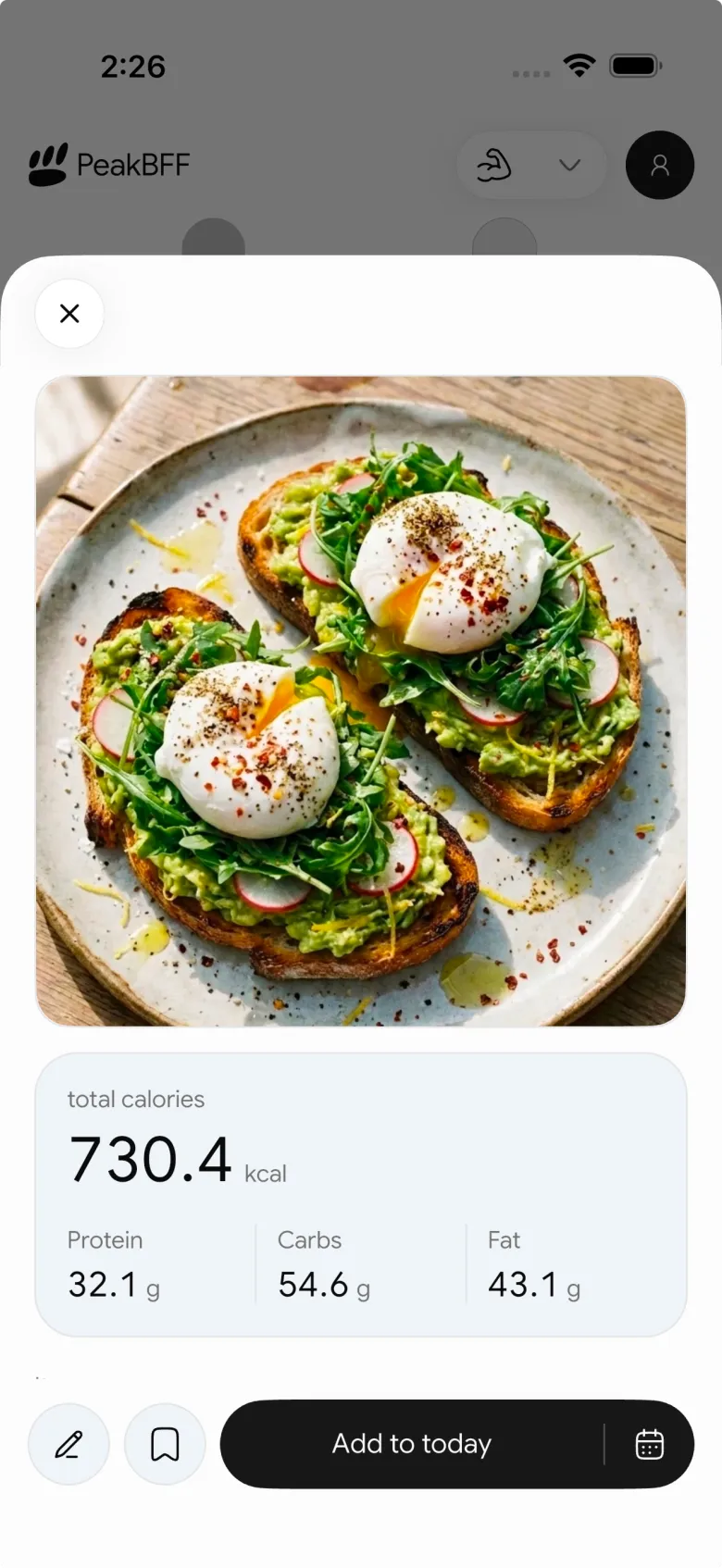
This is a record-keeping workflow, not a diagnosis or a promise that a photo estimate is exact. If photo logging is the main feature you are comparing, see our protein tracker with photo food logging comparison. For the broader all-in-one choice, see the best apps to track workouts and macros.
What should you review after the first week?
Review your log for friction, not just the final number. Ask:
- Which meals were hardest to log honestly?
- Did the target make you notice an unplanned gap, or did it feel unrealistic?
- Which input method was quickest for your normal food: text, photo, or barcode?
- Can you keep the same calculation long enough to learn from it?
Those questions turn a generic protein number into a practical habit. If the target fits your real meals and you can log it consistently, it is doing its job as a planning tool.
Download PeakBFF on the App Store or Google Play to keep your protein target, food log, and workouts together.
More from PeakBFF
More app comparisons, fitness guides, and product notes.
Fitbod vs Hevy (2026): Generated Workouts or a Simple Log?
Fitbod vs Hevy compared on price, workout generation, free limits, watch apps and nutrition, plus where PeakBFF fits if you want training and food in one app.
How to Log Raw vs Cooked Food Weight: A Simple Conversion Cheat Sheet
Weigh food raw or cooked, then log it against a matching entry. A cheat sheet with USDA numbers for chicken, rice and pasta, plus a worked example.
MacroFactor Workouts vs Hevy (2026): Which Fits Lifters Who Track Food?
MacroFactor Workouts vs Hevy compared on price, progression, free limits and nutrition, plus PeakBFF as a one-app option for lifting and food logging.
Best AI Physique Transformation App With Workout Tracking (2026)
Compare AI physique-transformation preview apps for motivation, photo boundaries, and the workout record you use after the preview.
How to Save a Workout as a Template After Training
Turn a session that worked into a reusable workout template without confusing completed results with your next plan.
Best Beginner Gym App With Starter Programs and Form Cues (2026)
Compare beginner gym apps for choosing a starter program, checking exercise form cues, and logging the sets you actually complete.