How to Change Rep Range in a Workout Plan: A Simple Update Template
Change a workout-plan rep range without clouding your training history. Use a simple update template, worked example, and practical logging workflow.
How to Change Rep Range in a Workout Plan: A Simple Update Template
To change a rep range in a workout plan, edit the next-session prescription and leave completed past sets alone. Note the old range, the new range, the start date, and a short reason. For instance, change a barbell row from 3 × 6–8 to 3 × 8–10 starting with the next session, while keeping the earlier 3 × 6–8 results in your workout history.
Copy this before you make the edit:
Exercise: __________________________
Old prescription: _________________
New prescription: _________________
Starts on: _________________________
Why this is changing: ______________
First completed result: ____________
The point is not to find a magic rep range. Make one clear plan change, then see what you actually completed under the new plan. This makes your history useful when you review the same exercise later.
What should change when you update a rep range?
Change the plan for future sessions. Do not rewrite a completed session's result to make it look like the new plan.
The distinction is simple and useful. A prescription is what you intend to try. A completed set is what occurred on that date, with that load, setup, and number of reps. If you replace old 6–8 entries with 8–10 afterwards, you lose the context that explains the different numbers.
Resistance-training plans commonly use several variables together, including sets, repetitions, load, and rest. The American College of Sports Medicine's progression position stand discusses changing those variables as part of resistance training. It does not mean one range is automatically right for every person or exercise. If you are following a coach's program or have a health concern, use their direction before changing the prescription.
A worked example: changing 6–8 reps to 8–10 reps
Imagine your plan calls for three sets of barbell rows at 6 to 8 reps. You want the next block to use 8 to 10 reps instead.
| Field | Before the change | After the change |
|---|---|---|
| Exercise | Barbell row | Barbell row |
| Sets | 3 | 3 |
| Rep range | 6–8 | 8–10 |
| Start date | Completed August 14 | Next session, August 21 |
| First actual result | 60 kg × 8, 7, 6 | Write this after you train |
The old result stays where it belongs: in the 6 to 8 rep block. At the next session, use the new range as the reference and log the real result instead of pretending it matches the prior session.
You do not have to change every variable at once. If the rep range changes, keep the note focused on that change. If sets, rest, exercise selection, or load change too, record those separately so future-you can read the log.
When is a rep-range update clear enough to track?
A useful update has a boundary. Use it when you deliberately change the prescription for upcoming sessions, rather than because one hard set felt different from the plan.
Use this quick check:
- Name the exercise and its old rep range.
- Choose the new range for future sessions.
- Set a first session or date for the change.
- Leave earlier completed sets unchanged.
- Record the first completed set under the new range before judging it.
This is a record-keeping approach, not a rule for how often to change a program. A coach may have a particular progression or periodization plan. If you have pain, a recent injury, or a condition that affects exercise, seek qualified guidance instead of using a tracking template as treatment advice.
A copyable rep-range update log
Use one row for each exercise change. Keep it near the workout record, whether in a note, spreadsheet, or app.
| Date | Exercise | Old plan | New plan | What stays the same? | First completed result | Note |
|---|---|---|---|---|---|---|
| sets × old reps | sets × new reps | load / sets / rest, if unchanged | load × reps for each set | reason in a few words |
For the barbell-row example, a completed row might look like this:
| Date | Exercise | Old plan | New plan | What stays the same? | First completed result | Note |
|---|---|---|---|---|---|---|
| Aug 21 | Barbell row | 3 × 6–8 | 3 × 8–10 | 3 sets, same exercise | 55 kg × 10, 9, 8 | new block |
The actual load in that example is not a recommendation. It only shows the shape of a complete record. Your log is much easier to compare when it says both what changed and what you actually did.
How can you update a program without losing workout context?
In PeakBFF, a program exercise can have a set target, a fixed-rep target or a rep range, and a rest target. Open the program exercise's targets, adjust the range, and save it for a future session. When you start a workout from that program, PeakBFF creates a new in-progress session from that prescription. The sets you finish remain records of that session, so editing the program later does not rewrite a completed workout.
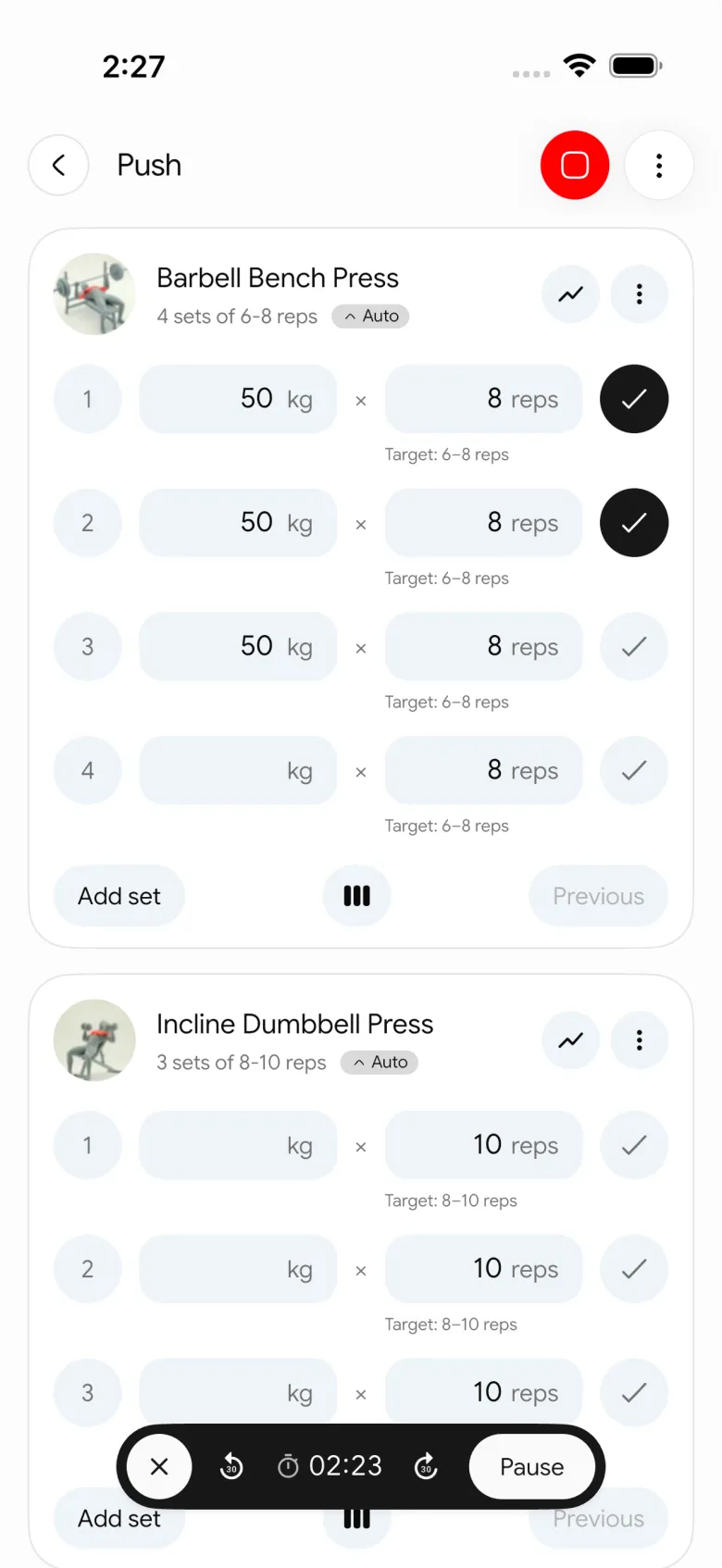
That makes the app a practical place for the workflow above: update the plan, then log the session you actually perform. If you are building a wider weekly plan, our guide to scheduling rest days in a workout plan covers the calendar side. For an app-selection view of editable gym programs, see the complementary workout planner app comparison.
Download PeakBFF on iOS or Android to keep future prescriptions and completed gym sessions in one place.
More from PeakBFF
More app comparisons, fitness guides, and product notes.
Best AI Physique Transformation App With Workout Tracking (2026)
Compare AI physique-transformation preview apps for motivation, photo boundaries, and the workout record you use after the preview.
How to Save a Workout as a Template After Training
Turn a session that worked into a reusable workout template without confusing completed results with your next plan.
Best Beginner Gym App With Starter Programs and Form Cues (2026)
Compare beginner gym apps for choosing a starter program, checking exercise form cues, and logging the sets you actually complete.
How to Track Home and Gym Versions of the Same Exercise
Use a simple split-or-combine checklist to keep home and gym exercise variations clear in your workout history.
How to Log a Weigh-In in a Gym App: A Simple History Checklist
Log a weigh-in with a repeatable routine, a clear calendar day, and a simple history review that keeps your gym records useful.
How to Choose a Starter Workout Program: A 3-Question Template
Choose a starter workout program with a simple goal, schedule, and equipment template, plus a verified PeakBFF setup flow.