How to Log Raw vs Cooked Food Weight: A Simple Conversion Cheat Sheet
Weigh food raw or cooked, then log it against a matching entry. A cheat sheet with USDA numbers for chicken, rice and pasta, plus a worked example.
How to Log Raw vs Cooked Food Weight: A Simple Conversion Cheat Sheet
You can weigh food raw or cooked. What matters is that the weight and the food entry you log it against are in the same state. Raw weight goes with a raw entry, cooked weight goes with a cooked entry. Mix them and a plain chicken-and-rice dinner can be off by a few hundred calories.
Short answer: if you can, weigh raw, because it is the number you can repeat. If you only have the cooked food in front of you, weigh that and pick a cooked entry. When in doubt, write the state into the entry name, like "chicken breast, cooked".
Why does the same food have different calories raw and cooked?
It doesn't, really. The calories in the food stay put. Cooking changes the weight. Chicken loses water in the pan, so a cooked piece weighs less than the raw one but holds roughly the same calories. Rice and pasta do the opposite: they soak up water, so cooked weighs far more than dry.
That is why the per-100 g numbers look so different. USDA FoodData Central lists these values:
| Food (per 100 g) | Raw or dry | Cooked | Why they differ |
|---|---|---|---|
| Chicken breast, skinless | 120 kcal, 22.5 g protein | 165 kcal, 31 g protein (roasted) | Loses water, so cooked is denser |
| White rice, long-grain | 365 kcal | 130 kcal | Absorbs water, so cooked is lighter per gram |
| Pasta | 371 kcal (dry) | 158 kcal (cooked, no salt) | Absorbs water, so cooked is lighter per gram |
Sources: USDA FoodData Central entries for raw chicken breast, roasted chicken breast, raw white rice, cooked white rice, dry pasta and cooked pasta. Other cuts and brands differ, so treat these as worked examples, not universal constants.
Should you weigh food raw or cooked?
Use this quick decision guide.
| Situation | Best choice | Why |
|---|---|---|
| You portion food before cooking | Weigh raw, log a raw entry | The raw weight is the same every time |
| Rice, pasta, oats, dry grains | Weigh dry if you can | Water absorbed while cooking varies from pot to pot |
| Meat you cook in bulk | Weigh raw per portion, or use the batch method below | Water loss depends on cut, heat and doneness |
| Someone else cooked it | Weigh cooked, log a cooked entry | You only have the finished food |
| Restaurant plate | Estimate the cooked portion | There is no raw weight to find |
Raw is not "more accurate" in a lab sense. It is more repeatable. Cooking yield, meaning how much a food's weight changes in the pan or pot, shifts with the cut, the method and how done you like it. USDA's cooking yield research on beef is a good picture of how much that spread can be.
Worked example: one chicken, rice and pasta day
Here is the same logic applied to three foods. These are USDA-based illustrations, not your exact result.
Chicken breast. You weigh 200 g raw. At 120 kcal per 100 g that is 240 kcal and about 45 g protein. After cooking it might weigh around 145 g. Log that as cooked and you get 145 g at 165 kcal per 100 g, about 240 kcal. Same meal, same answer.
Now the mistakes:
- Log 200 g raw weight against the cooked entry: 330 kcal. That overstates the meal by about 90 kcal.
- Log 145 g cooked weight against the raw entry: about 175 kcal. That understates it by about 65 kcal.
White rice. 75 g dry at 365 kcal per 100 g is about 274 kcal. Cooked, that might be around 210 g. Log 75 g against the cooked entry (130 kcal per 100 g) and you record about 98 kcal, a miss of roughly 175 kcal, which is the most common rice error.
Pasta. 100 g dry is 371 kcal. If you log it against the cooked pasta entry (158 kcal per 100 g), you record less than half of it.
The pattern: the error is largest for rice and pasta, because the raw-to-cooked gap is biggest there.
What is the easiest way to log a cooked batch?
If you meal prep, skip the conversion table and use a batch method. It also works for stews and casseroles.
RAW-TO-COOKED BATCH LOG

1. Weigh each raw ingredient and log or add up the calories.
   Batch calories: ________

2. Cook it all together.

3. Weigh the finished dish (subtract the empty pot):
   Cooked batch weight: ________ g

4. Weigh your portion:
   Portion weight: ________ g

5. Your calories = portion weight / batch weight x batch calories
Example: the raw ingredients come to 1,800 kcal and the cooked dish weighs 1,200 g. A 300 g portion is a quarter of the batch, so 450 kcal. That handles water loss automatically. Our homemade meal template goes deeper on serving counts, and the custom food guide shows how to save the result as your own entry.
Do not forget what you add in the pan. Oil and butter are calories on top of the food, so log them as their own line.
How do you log raw or cooked weight in PeakBFF?
In PeakBFF, tap the plus button, choose Food, then Describe your meal. Type the amount and the state in plain language:
200 g raw chicken breast150 g cooked chicken breast75 g dry white rice210 g cooked white rice
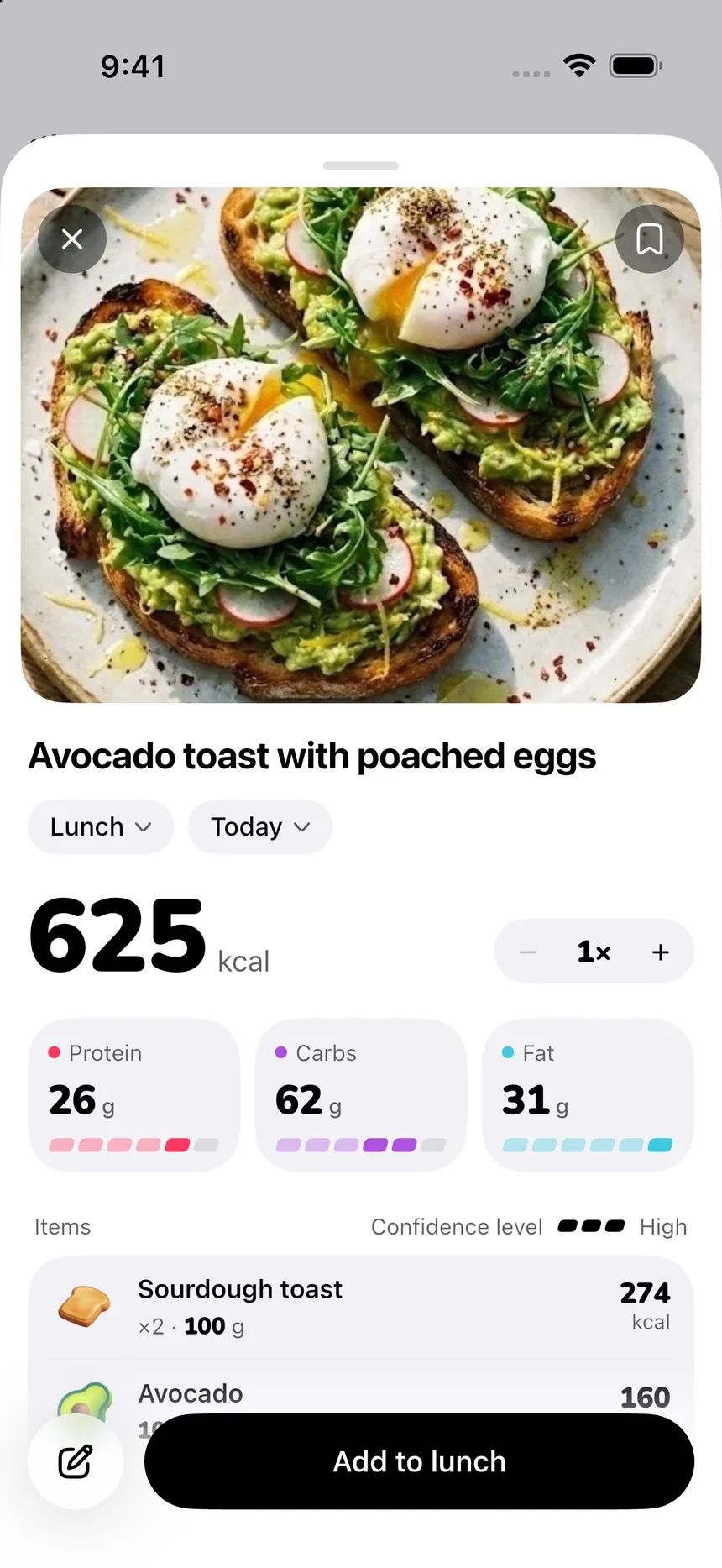
The text estimator reads the cooking state from your description, matches it to a food entry, and returns calories and macros for you to review. Check that the matched item and amount say what you meant before you tap Save. If you eat half a portion later, use the serving stepper, or tap Edit and say so in plain words.
A few honest notes:
- A photo can't tell how much the food weighed raw. Use a typed description when you know the weight. Our photo portion review covers the photo route.
- If you have a package label with your own numbers, Enter manually lets you type calories and macros yourself, with no estimate involved.
- Calories are free to log. Protein, carb and fat detail is part of Plus, which costs $49.99 a year (less than $1 a week) or $7.99 a week on the US App Store as of October 2026. If protein is your main number, see how to calculate a protein target for lifting.
A habit that keeps your food log honest
Pick one rule and stick to it for a week: weigh dry grains and raw meat before cooking, and write the state in the entry. If you eat out, log a cooked entry and accept the estimate. The goal is a log you can compare week to week, not a perfect number.
If you want your food log next to your workouts, PeakBFF is a gym and protein tracker in one app. Download it for iPhone or Android.
Questions, answered
Do you weigh food raw or cooked for calories?
Either works, as long as the weight and the food entry are in the same state. Raw weight needs a raw entry, cooked weight needs a cooked entry. Raw is usually steadier because cooking changes weight by a different amount each time. Mixing the two is what causes big calorie errors.
How many calories are in 100 g of cooked chicken breast vs raw?
USDA lists skinless raw chicken breast at 120 kcal and 22.5 g protein per 100 g, and roasted breast at 165 kcal and 31 g protein per 100 g. The same chicken has the same calories either way. Cooked meat just weighs less because it lost water, so each gram is denser.
Do you weigh rice cooked or dry for tracking?
Dry is easier to repeat, because the same dry rice absorbs a different amount of water each time you cook it. USDA lists raw white rice at 365 kcal per 100 g and cooked at 130 kcal per 100 g. If you weigh cooked rice, log it against a cooked rice entry.
Can I log raw and cooked weights in PeakBFF?
Yes. Choose Describe your meal and type the amount and state, such as 200 g raw chicken breast or 150 g cooked chicken breast. Check the matched item and amount before saving. Calories are free to log, and protein, carb and fat detail is part of Plus.
What if I cook a big batch and weigh it afterwards?
Weigh all the raw ingredients once, then weigh the finished dish, including the pot or container if you subtract its empty weight. Your portion is its cooked weight divided by the total cooked weight, multiplied by the batch calories. That handles water loss without needing a conversion table.
More from PeakBFF
More app comparisons, fitness guides, and product notes.
How to Calculate a Calorie Deficit: Step-by-Step Formula, Pace Chart, and Deficit Calculator
Calculate your daily calorie deficit to lose weight safely with the step-by-step formula, bodyweight pace chart, and deficit calculator without losing muscle.
JEFIT vs Fitbod (2026): Exercise Library or AI Workout Generator?
Compare JEFIT and Fitbod for gym tracking, AI workout generation, exercise libraries, and pricing, plus how PeakBFF unifies lifting and macros.
How to Track Muscle Growth: What to Measure, Realistic Rates, and Progress Log Template
Learn how to track muscle growth accurately: gym performance proxies, tape measurements, progress photos, and rolling scale weight. Includes audit template.
MacroFactor vs Cronometer (2026): Adaptive Macro Coach or Micronutrient Tracker?
MacroFactor vs Cronometer compared for lifters in 2026. Explore adaptive TDEE coaching, 80+ micronutrient tracking, food logging UX, pricing, and how PeakBFF compares.
Ladder vs Peloton (2026): Guided Strength Teams or Studio Classes?
Ladder vs Peloton compared for lifters in 2026. Explore team-based strength blocks, studio video classes, progressive overload, prices, and how PeakBFF compares.
MeThreeSixty vs ZOZOFIT (2026): Which 3D Body Scanner Fits Lifters?
Compare MeThreeSixty and ZOZOFIT for 3D body scanning, circumferences, and body fat estimates, and see which app best supports a lifting routine.