Best Cal AI Alternative With Workout Tracking (2026)
Cal AI scans meals fast but is a food app. Compare it with PeakBFF, MyFitnessPal and Cronometer if you also want a gym log, macros and price details.
If you lift and you are looking at Cal AI, the real question is whether you want a food scanner or one app for food and training. Cal AI is a fast photo calorie tracker. PeakBFF is the better alternative if you also want a live workout log, protein and macros, and a muscle-volume view in the same place.
Short answer: Choose Cal AI if all you need is quick meal scanning and its price suits you. Choose PeakBFF if you lift and want food logging and a gym log in one daily record. MyFitnessPal and Cronometer are better picks if you want a very large food database or detailed micronutrient data and do not mind a separate workout app.
Cal AI vs PeakBFF, MyFitnessPal and Cronometer at a glance
| What matters | PeakBFF | Cal AI | MyFitnessPal | Cronometer |
|---|---|---|---|---|
| Main job | Gym log plus food and macro tracking | Photo calorie tracking | Calorie and macro tracking | Detailed nutrient tracking |
| Log food by photo | Yes, free users can try it; unlimited scans are Plus | Yes, needs a subscription | Meal Scan is Premium | Photo logging is a Gold feature |
| Barcode and typed entry | Yes | Yes | Yes (barcode scan is Premium) | Yes |
| Live workout log (sets and reps) | Yes, free | No built-in set log described | Exercise and step logging, not a set log | Exercise logging, not a set log |
| Muscle volume by muscle group | Yes, rolling 7 days | Not described | Not a focus | Not a focus |
| Price (US, as of October 2026) | Many features free; Plus $49.99/year or $7.99/week | 3-day trial; App Store tiers from $2.99 to $29.99 | Free; Premium $79.99/year | Free; Gold about $50 to $60/year, sources vary |
| Best for | Lifters who want one app | Fast scanning only | Big database, long history | Micronutrient detail |
1. PeakBFF: best if you lift and want food and training in one app
PeakBFF is a gym and protein tracker. Start a workout and log your sets and reps in the live session, then log meals by photo, typed description or barcode. Food entries show calories, and macro detail for protein, carbs and fat. If a barcode finds no match, you can photograph the package and a nutrition label, or type the product instead.
The training side is where it differs from a food-only scanner. The next session prefills weight and reps from your last completed working sets. When every prescribed set landed in the rep range, a Try more chip suggests more reps or more weight, and you review it before applying. A rolling seven-day muscle-volume view shows completed working sets by muscle group, so you can see what you trained this week next to what you ate.
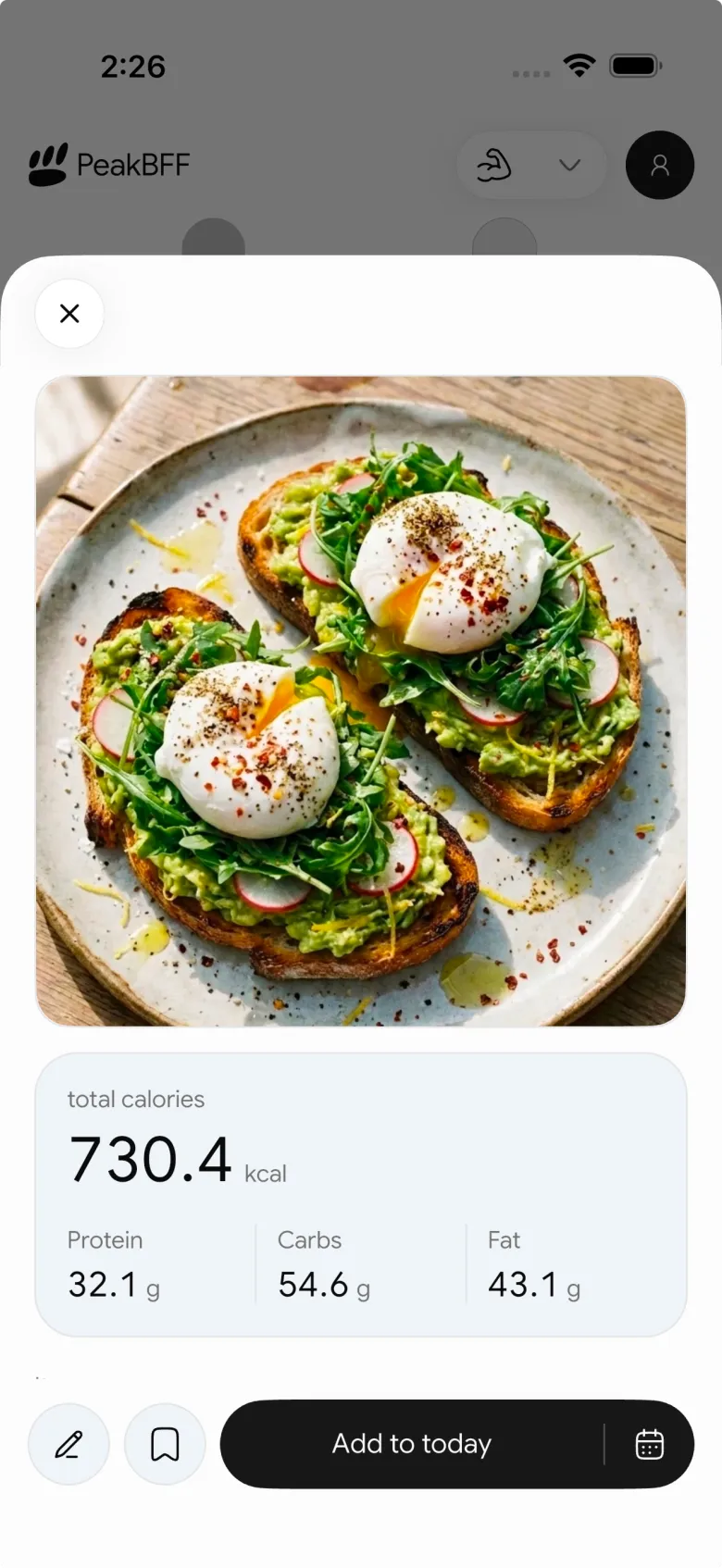
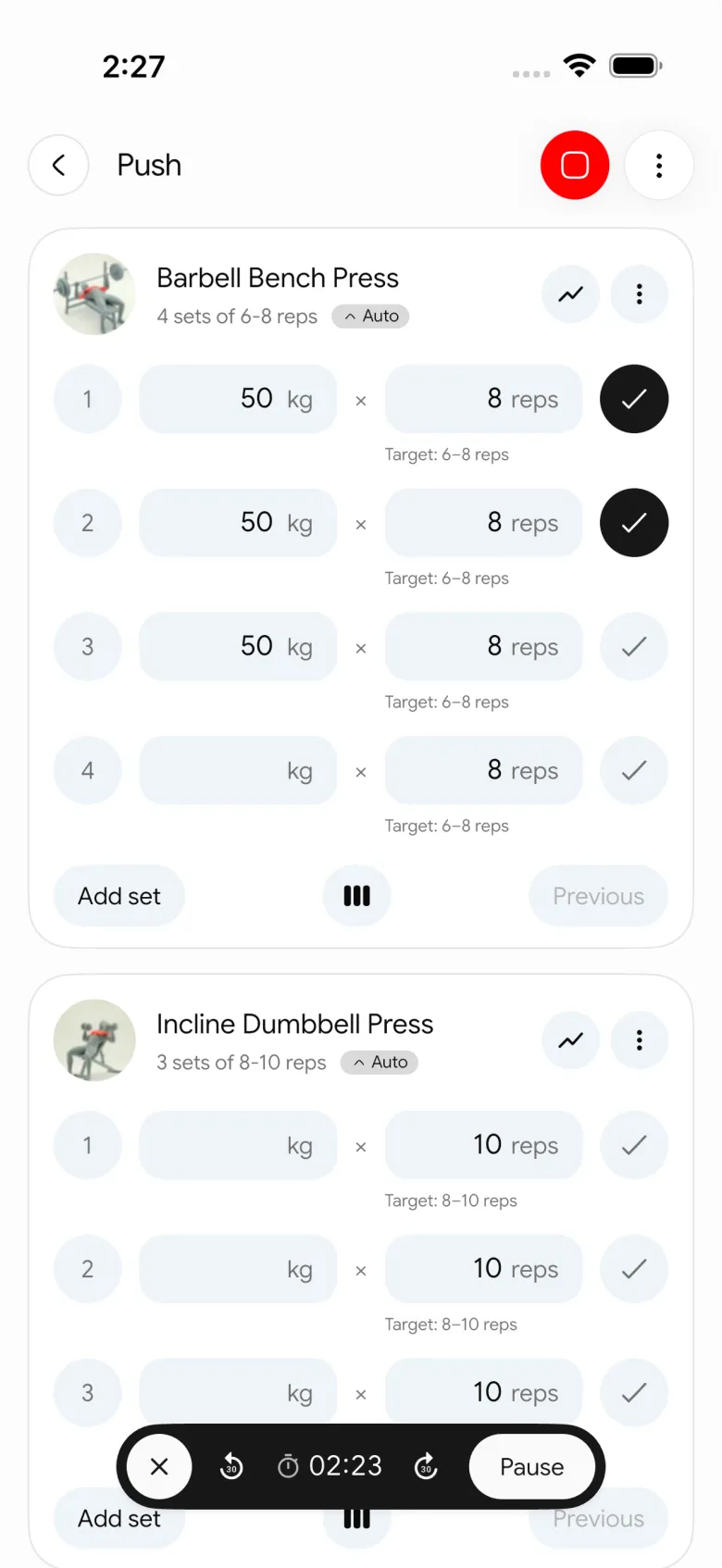
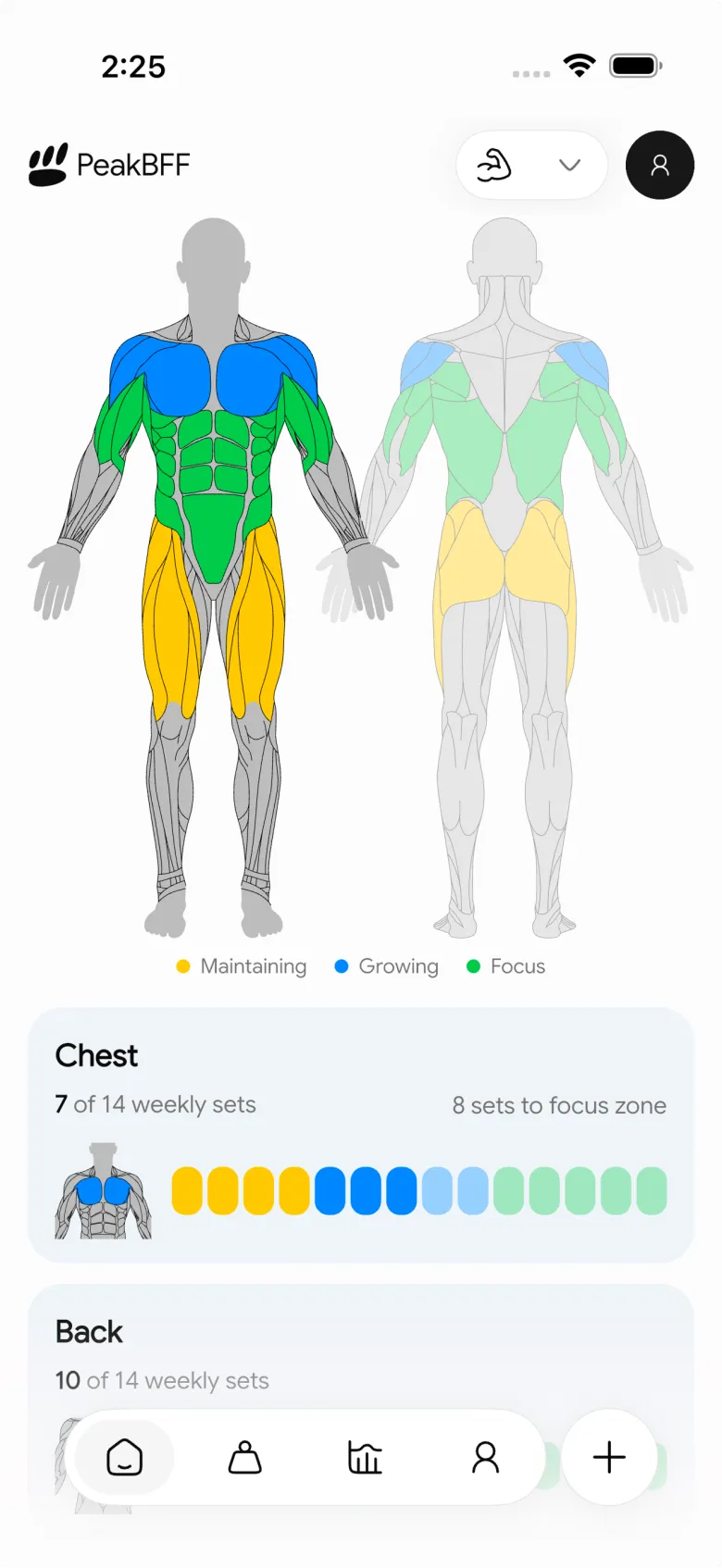
On price, many features are free for basic users, including workout logging and food logging, and you can try AI food logging. Plus unlocks unlimited AI food scans, macro detail, the AI workout plan generator, workout import from TikTok, Instagram and YouTube, and health sync. Plus is $49.99 per year (about $4.17 a month) or $7.99 per week on the US App Store, as of October 2026. That is more than Cal AI's cheaper tiers, so it makes the most sense when you would otherwise pay for a separate gym app too.
As with any photo scan, the result is a starting point. Review the meal and adjust the serving before you save it. Our guide to adjusting a food photo portion shows how.
Best for: lifters who want workouts, calories, protein and macros in one daily routine.
2. Cal AI: best for fast photo scanning on its own
Cal AI is built around one thing: take a photo of a meal and get calories and macros. Its site says it also supports barcode scans, typed descriptions, custom foods and recipes, and it runs on iPhone and Android. Its App Store listing shows a 4.8 rating from about 370,000 ratings, so many people like it.
The trade-offs matter if you lift. The listing says food scanning results require a subscription, and the site advertises a 3-day free trial that you manage through your phone's subscription settings. The listing shows several Unlimited tiers from $2.99 to $29.99, and Cal AI tests its paywall, so confirm what you are shown before you start the trial. MyFitnessPal announced in March 2026 that it had acquired Cal AI, and sources describe Cal AI as continuing as its own app. On training, the site mentions connecting to fitness products and step data rather than describing a built-in gym log.
Best for: people who only want quick meal scanning and are happy with a food-only app.
3. MyFitnessPal: best for a very large food database
MyFitnessPal is the long-standing option for logging almost any packaged or restaurant food, with a big database and years of history. Its Meal Scan is a Premium feature, and availability depends on platform and language. Premium is listed at $79.99 per year as of 2026, so it costs more per year than PeakBFF Plus. It logs exercise, but it is not a set-and-rep gym log. Choose it if the database and its integrations matter more than lifting detail. If you are weighing it against a photo-first app, our AI calorie tracker comparison goes deeper.
Best for: people who want the biggest database and do not mind another app for training.
4. Cronometer: best for micronutrient detail
Cronometer is aimed at people who care about detailed nutrient data, not just calories and macros. It suits someone watching vitamins and minerals closely. Its photo and voice logging sit in the paid Gold tier, which third-party sources price at roughly $50 to $60 per year (they disagree, so check the app). It is a nutrition tracker first, so lifters still pair it with a workout app.
Best for: people who need nutrient detail beyond protein, carbs and fat.
What to check before leaving Cal AI
- Count the apps you run. If you already pay for a gym app, one app that does both can cost less than two.
- Check what the free version does. Cal AI scanning needs a subscription, and PeakBFF's unlimited scans and macro detail are Plus, so compare what you would use daily.
- Keep a non-photo path. Photos miss oils, sauces and portions. Barcode and typed entry help for packaged foods. See our protein tracker comparison with photo logging for how the options differ.
- Look at the training side. If you want a log of weight and reps, check that the app records sets, not just exercise minutes. Our Hevy alternative with calorie tracking covers the same question from the gym-app side.
The bottom line
Cal AI does one job well: scanning a meal fast. If that is all you need, it is a reasonable pick. But if you lift and keep a second app for sets and reps, PeakBFF is the cleaner alternative, with a live workout log, food logging by photo, text or barcode, protein and macros, and a muscle-volume view in one place. It costs more per year than Cal AI's cheaper tiers, so weigh that against dropping a second app.
Download PeakBFF on the App Store or Google Play when you want your workouts and meals in the same daily record.
Questions, answered
What is a good Cal AI alternative that also tracks workouts?
PeakBFF is a good fit if you lift. It logs meals by photo, typed description or barcode, and it also has a live workout log with sets, reps, history and a muscle-volume view. Cal AI is built around food scanning, so lifters often end up running a separate gym app beside it.
Is Cal AI free to use?
Not fully. Cal AI advertises a 3-day free trial, and its App Store listing says food scanning results need a subscription. Its listing shows several Unlimited subscription tiers, from $2.99 up to $29.99, and it tests different paywalls, so the price you see can differ. Check the paywall before you start the trial.
Is PeakBFF free like a basic Cal AI alternative?
Many PeakBFF features are free for basic users, including workout logging and food logging, and you can try AI food logging. Plus unlocks unlimited AI food scans and macro detail for protein, carbs and fat. Plus costs $49.99 per year or $7.99 per week on the US App Store, as of October 2026.
Does Cal AI track gym workouts?
Cal AI's own site says it connects with other fitness products so you can see exercise next to calories, and it mentions step data from Apple Health or Google Fit. It does not describe a built-in set-by-set gym log. If you want to record weight, reps and sets, you need a workout app or one that combines both.
Is a photo calorie scan accurate enough for lifters?
A photo scan is a quick estimate, not a measurement. Portion size, oils, sauces and hidden ingredients are hard to see in a picture. Lifters who need tighter protein numbers should review the result, adjust the serving, or use a barcode or typed entry for packaged and weighed foods, in any app.
Should I switch from Cal AI to PeakBFF?
Switch if you already run a workout app alongside Cal AI and want training and food in one daily record. Stay with Cal AI if you only need fast meal scanning and are happy with its price and paywall. Photo scanning is similar in spirit in both, so the deciding factor is whether you want a gym log in the same app.
More from PeakBFF
More app comparisons, fitness guides, and product notes.
RPE Chart for Lifting: RPE to Reps in Reserve to % of 1RM, With a Log Template
Use an RPE chart to turn how hard a set felt into reps in reserve and a percent of your 1RM. Includes a printable table, a worked example, and a way to log RPE in PeakBFF.
Best Free Strength Training App for Women Over 40 (2026): What Stays Free
Looking for a strength training app for women over 40 that does not lock logging behind a subscription? Hevy, Strong, Boostcamp, StrongEra and PeakBFF compared on what is free.
How to Track Zone 2 Cardio Next to Your Lifting: Heart Rate Range and Log Template
Find your zone 2 heart rate range with a simple formula and the talk test, then log each session next to your lifting. Includes an age table and a log template.
GainFrame Alternative for Android (2026): Physique Rating Plus a Gym Log
GainFrame is iPhone only. Here is what to use on Android, how PeakBFF compares on physique score, price and photo privacy, and who should stay with GainFrame.
How Much Creatine Per Day? A 3 to 5 g Dose and an 8-Week Way to Track It
How much creatine per day most lifters take (3 to 5 g of monohydrate), whether to load, and an 8-week log of weigh-ins and lifts to see what it did.
Best App for Body Recomposition (2026): Track Lifts, Protein and Weight Trend Together
Compare PeakBFF, MacroFactor, Hevy and GainFrame for body recomposition: lift progress, protein, weight trend and photo check-ins, with real prices.