How to Track Zone 2 Cardio Next to Your Lifting: Heart Rate Range and Log Template
Find your zone 2 heart rate range with a simple formula and the talk test, then log each session next to your lifting. Includes an age table and a log template.
How to Track Zone 2 Cardio Next to Your Lifting: Heart Rate Range and Log Template
Zone 2 is steady, easy-to-moderate cardio, usually estimated at 60 to 70 per cent of your maximum heart rate, where you can talk in full sentences but could not sing. To track it, estimate your range with a formula, check it with the talk test, and write down the same five things after every session: time, distance, average heart rate, how the talk test felt, and what your lifting looked like that day.
This page gives you an age-based heart rate table, a one-line log you can copy anywhere, a sample week that fits around lifting, and a way to keep the log in the same app as your sets.
What is zone 2 cardio, and how do you find your range?
There is no official definition of zone 2. Most coaches and heart rate calculators use the same working rule: 60 to 70 per cent of your maximum heart rate. Your true maximum is hard to know without a hard test, so people estimate it from age.
The old shortcut is 220 minus your age. A newer equation, from a pooled analysis of 351 studies and a lab test of 514 healthy adults, is 208 minus 0.7 times your age. The authors found that 220 minus age underestimates maximum heart rate in older adults. See Tanaka, Monahan and Seals, 2001. This page uses the 208 formula.
Here is the estimated zone 2 range at 60 to 70 per cent for common ages:
| Age | Estimated max heart rate | Zone 2 range (beats per minute) |
|---|---|---|
| 25 | 191 | 114 to 133 |
| 30 | 187 | 112 to 131 |
| 35 | 184 | 110 to 128 |
| 40 | 180 | 108 to 126 |
| 45 | 177 | 106 to 124 |
| 50 | 173 | 104 to 121 |
| 55 | 170 | 102 to 119 |
| 60 | 166 | 100 to 116 |
To do it for your own age, take 208, subtract 0.7 times your age, then multiply by 0.60 and by 0.70. A 42-year-old gets 208 minus 29.4, which is about 179, and a range of roughly 107 to 125.
These are estimates for healthy adults, and individual maximums vary by about 10 beats per minute or more either side. If you have a heart condition, take medication that changes your heart rate, or feel chest pain or dizziness during exercise, ask a clinician before using any heart rate target.
How do you check the number with the talk test?
Use the talk test as the tiebreaker. The CDC describes moderate effort like this: a person can talk, but not sing. Vigorous effort is when you cannot say more than a few words without pausing for a breath. It also notes that the talk test is a rule of thumb, not a precise measure. See the CDC guidance on measuring intensity.
A practical check for each session:
- Warm up easy for about 10 minutes before judging your heart rate.
- Settle into a pace where your heart rate sits inside your range.
- Say a couple of full sentences out loud. If you can, and you would struggle to sing, you are in the right place.
- If your heart rate is in range but you can only manage a few words, slow down. If it is below range and you could sing, you can go a little harder.
Heat, poor sleep, caffeine and stress can all push your heart rate up for the same pace. A high-reading day is data, not a failure.
What should you write down after each session?
Keep the log short enough that you will actually fill it in. Copy this line and fill it in after each session:
DATE: ________  ACTIVITY: ____________________
TIME: ____ min   DISTANCE: ______ (mi or km)
AVG HEART RATE: ____ bpm   TALK TEST: [ ] easy  [ ] ok  [ ] too hard
LIFTING THAT DAY: [ ] none  [ ] before  [ ] after   LEGS TRAINED: [ ] yes  [ ] no
NOTE: ______________________________
And here is a filled example:
21 Oct  Incline treadmill walk  40 min  2.0 mi  avg HR 118  talk test ok
lifting: after upper body, legs not trained. Slept badly, HR ran 4 high.
The two lifting fields matter more than they look. When your numbers move, you can tell whether it was the cardio or the lifting week around it.
How do you tell whether zone 2 is working?
Compare sessions that match on everything except the thing you hope to improve. If you hold the same heart rate and the same effort, then over several weeks the same heart rate should buy a little more distance, or the same distance should come at a lower heart rate.
A worked example for a hypothetical lifter who trains around 118 beats per minute:
| Week | Activity | Time | Distance | Avg heart rate |
|---|---|---|---|---|
| 1 | Incline treadmill walk | 40 min | 2.0 mi | 118 |
| 3 | Incline treadmill walk | 40 min | 2.1 mi | 117 |
| 6 | Incline treadmill walk | 40 min | 2.2 mi | 118 |
Same time, same heart rate, slightly more distance. That trend is only visible because the entries use the same activity and the same incline. If you change the machine or the incline, write it in the note, otherwise the comparison is not fair.
How much zone 2 fits around lifting?
No trial gives one correct amount. The Physical Activity Guidelines for Americans recommend 150 to 300 minutes of moderate-intensity aerobic activity a week for adults, plus muscle-strengthening on two or more days. Zone 2 counts toward that moderate-intensity time.
A common starting point for lifters is two or three sessions of 20 to 30 minutes. Add time before you add intensity. Here is a sample week that respects leg day:
| Day | Lifting | Zone 2 |
|---|---|---|
| Mon | Lower body | none, or 10 to 15 easy minutes |
| Tue | none | 30 min easy cardio |
| Wed | Upper body | 20 to 30 min after lifting |
| Thu | none | rest |
| Fri | Lower body | none |
| Sat | Upper body | 30 min easy cardio |
| Sun | none | 30 min walk, optional |
On the lifter question of whether this hurts gains: a 2022 meta-analysis of 43 studies compared lifting plus aerobic training with lifting alone. Maximal strength was not clearly different, while explosive strength showed a small deficit. See Schumann et al., 2022, Sports Medicine. Easy cardio is the gentlest version of the combination, but if your leg sessions feel worse, move the cardio or shorten it. Our rest day scheduling templates and deload week planner help you place it.
How do you log zone 2 cardio in PeakBFF?
PeakBFF logs cardio next to your sets, in the same workout:
- Start your workout, open the workout menu and choose Add exercise. Search for a cardio exercise. The library includes Stationary Bike, Incline Treadmill Walk, Elliptical Trainer, Outdoor Walk, Rowing Machine and Outdoor Cycling.
- Cardio exercises use a time and distance row instead of weight and reps. Enter the distance and the duration, then tap the check. The distance uses your Units setting, so it is in miles with imperial units and metres with metric units. Duration is entered in seconds, so 40 minutes is 2400. Tap Add round if you do intervals or a second block.
- PeakBFF has no heart rate field. Write your average heart rate and talk-test result in a note: open the workout menu and choose Add note. Your watch or chest strap gives you the number, and the note keeps it with the session. Our workout notes template shows how to keep it short.
- Next session, tap Previous on the exercise to see what you did last time as a hint, so you can aim for the same heart rate at a little more distance. The exercise's detail page tracks distance for cardio exercises over time.
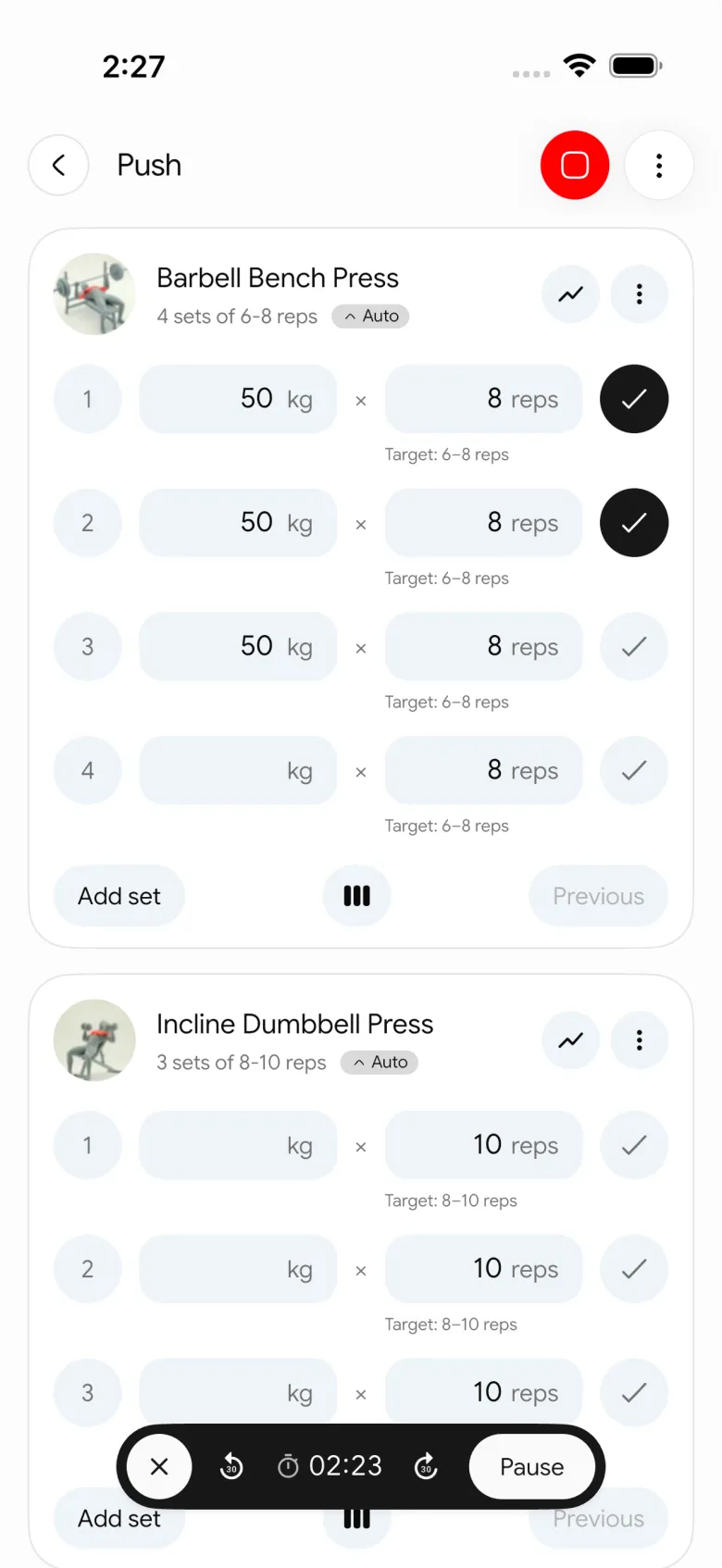
Because the cardio sits in the same session as lifting, you can see in one history whether the easy walk came before or after your heavy day. See our guide to timed exercises and distance for the basics, and exercise history for comparing sessions.
PeakBFF records what you did. It does not read your heart rate, decide your zone or judge whether a session was easy enough. Use your watch for the number and the talk test for the check.
If you also want to track food and protein with your cardio, compare options in our best app to track workouts and macros guide.
The simplest zone 2 tracking habit
Estimate your range once, check it with the talk test, and write the same few lines after every session. Keep the activity and the incline the same so the trend is fair. Many features are free for basic users, including workout logging, and you can start on iOS or Android.
Questions, answered
How do I calculate my zone 2 heart rate?
Estimate your maximum heart rate as 208 minus 0.7 times your age, then take 60 to 70 per cent of it. For a 40-year-old that is a maximum of about 180 and a zone 2 range of roughly 108 to 126 beats per minute. It is an estimate, so confirm it with the talk test during the session.
What is the talk test for zone 2?
In steady moderate effort you can talk in full sentences but you could not sing. If you can only say a few words before a breath, you are above zone 2 and should slow down. The CDC describes this talk test as a rule of thumb, so use it alongside your heart rate, not instead of it.
How do I track zone 2 cardio in a gym app?
Log each session as a cardio exercise with its duration and distance, and write your average heart rate and talk-test result in a note. In PeakBFF you add a cardio exercise such as Stationary Bike, enter distance and time, and use Add note in the workout menu for the heart rate. PeakBFF has no heart rate field.
How much zone 2 cardio should a lifter do per week?
There is no single zone 2 number backed by trials. The US Physical Activity Guidelines recommend 150 to 300 minutes of moderate aerobic activity a week plus strength training on two or more days. A common lifter start is two or three sessions of 20 to 30 minutes, then adding time before adding intensity.
Does zone 2 cardio hurt muscle growth or strength?
A 2022 meta-analysis of 43 studies found that adding aerobic training to lifting did not clearly reduce maximal strength compared with lifting alone, though explosive strength showed a small deficit. Easy cardio is far less likely to interfere than hard intervals. If leg day suffers, move the session or shorten it.
More from PeakBFF
More app comparisons, fitness guides, and product notes.
RPE Chart for Lifting: RPE to Reps in Reserve to % of 1RM, With a Log Template
Use an RPE chart to turn how hard a set felt into reps in reserve and a percent of your 1RM. Includes a printable table, a worked example, and a way to log RPE in PeakBFF.
Best Free Strength Training App for Women Over 40 (2026): What Stays Free
Looking for a strength training app for women over 40 that does not lock logging behind a subscription? Hevy, Strong, Boostcamp, StrongEra and PeakBFF compared on what is free.
GainFrame Alternative for Android (2026): Physique Rating Plus a Gym Log
GainFrame is iPhone only. Here is what to use on Android, how PeakBFF compares on physique score, price and photo privacy, and who should stay with GainFrame.
Best Cal AI Alternative With Workout Tracking (2026)
Cal AI scans meals fast but is a food app. Compare it with PeakBFF, MyFitnessPal and Cronometer if you also want a gym log, macros and price details.
How Much Creatine Per Day? A 3 to 5 g Dose and an 8-Week Way to Track It
How much creatine per day most lifters take (3 to 5 g of monohydrate), whether to load, and an 8-week log of weigh-ins and lifts to see what it did.
Best App for Body Recomposition (2026): Track Lifts, Protein and Weight Trend Together
Compare PeakBFF, MacroFactor, Hevy and GainFrame for body recomposition: lift progress, protein, weight trend and photo check-ins, with real prices.