How to Track Personal Records in the Gym: A Simple PR Log
Track gym personal records with a simple PR log for weight, reps, estimated 1RM, duration, and distance, plus a clear PeakBFF workflow.
How to Track Personal Records in the Gym: A Simple PR Log
To track personal records in the gym, log each completed working set, compare the same exercise and setup over time, and keep the record type clear. For a lift, that might be your heaviest completed set or your best estimated one-rep max. For a timed hold or cardio effort, it might be your longest duration or farthest distance.
Use this quick PR-log rule:
- Record the exercise variation, load, reps, and date after the set is done.
- Compare only like-for-like efforts, such as the same bench variation and range of motion.
- Mark what improved: weight, reps at a weight, estimated 1RM, time, or distance.
- Keep a short note only when the setup changed.
- Treat a new record as a data point, not a command to force another one.
A personal record turns a vague feeling of progress into a checkable training history. It does not tell you what to lift next by itself. Your technique, recovery, program, and goal still matter.
What counts as a personal record in the gym?
A personal record is a best performance for one clearly defined exercise and metric. Choose the metric before comparing sessions.
| Record type | Example | When it is useful |
|---|---|---|
| Heaviest completed set | 80 kg x 5 on barbell bench press | You want a simple load milestone |
| Best estimated 1RM | 75 kg x 8 estimates about 95 kg | You want to compare similar multi-rep sets |
| Most reps at one load | 10 reps at 60 kg | You are building reps before raising the load |
| Longest duration | 75-second plank | Your exercise is timed rather than loaded |
| Farthest distance | 2,000 m row | Your exercise is distance-based |
Keep variations separate. A paused barbell bench press, an incline dumbbell press, and a Smith-machine press are different records. Mixing them creates a tidy-looking number that is hard to use.
For weight-and-reps lifts, an estimated 1RM is a comparison tool, not proof of what you could lift for one rep today. The common Epley calculation is weight x (1 + reps / 30). For example, 75 kg x 8 gives an estimate of 95 kg. Compare estimates from similar working sets rather than chasing the highest output from unrelated variations. Our one-rep max guide explains the calculation.
A personal-record log template you can copy
Use one row for each meaningful best. Your regular workout log can store the sets; this is a small review table for entries worth comparing later.
| Date | Exercise and setup | Completed set | Record type | Context |
|---|---|---|---|---|
| Jul 3 | Barbell bench press, paused | 75 kg x 8 | Estimated 1RM: 95 kg | Normal bar and bench |
| Jul 17 | Barbell bench press, paused | 77.5 kg x 8 | Estimated 1RM: 98.2 kg | Normal bar and bench |
| Jul 24 | Barbell bench press, paused | 80 kg x 6 | Heaviest set | Normal bar and bench |
The middle row has the higher estimated 1RM, while the final row is the heaviest completed set. Keeping both labels makes the log easier to read.
How do you avoid misleading gym PRs?
Before you celebrate or alter a program, run this short check:
- Was the set completed with the intended range of motion and control?
- Is this the same exercise variation and broadly comparable equipment?
- Did you record the load and reps, rather than only a headline number?
- Was the comparison based on a working set, not a warm-up or an accidental partial rep?
- Did anything material change, such as straps, a machine stack, a long break, or a different gym?
The record should be useful the next time you train. Current ACSM resistance-training guidance emphasises tailoring load and volume to the person's goal and context. A PR log is one input, not a universal prescription.
How to track personal records in PeakBFF
PeakBFF ties this workflow to the completed sets that created the record. After a workout, it checks each performed exercise against earlier completed working sets. For weight-and-reps exercises, PeakBFF can surface a new record based on the heaviest logged weight or its Epley estimated 1RM. For timed or distance-based exercises, it uses the longest duration or farthest distance.
Open an exercise's History tab to see its completed set history and personal-record strip. For weight-and-reps exercises, the strip shows the best estimated 1RM and heaviest logged set, and opens the in-app 1RM sheet for a different weight-and-rep input.
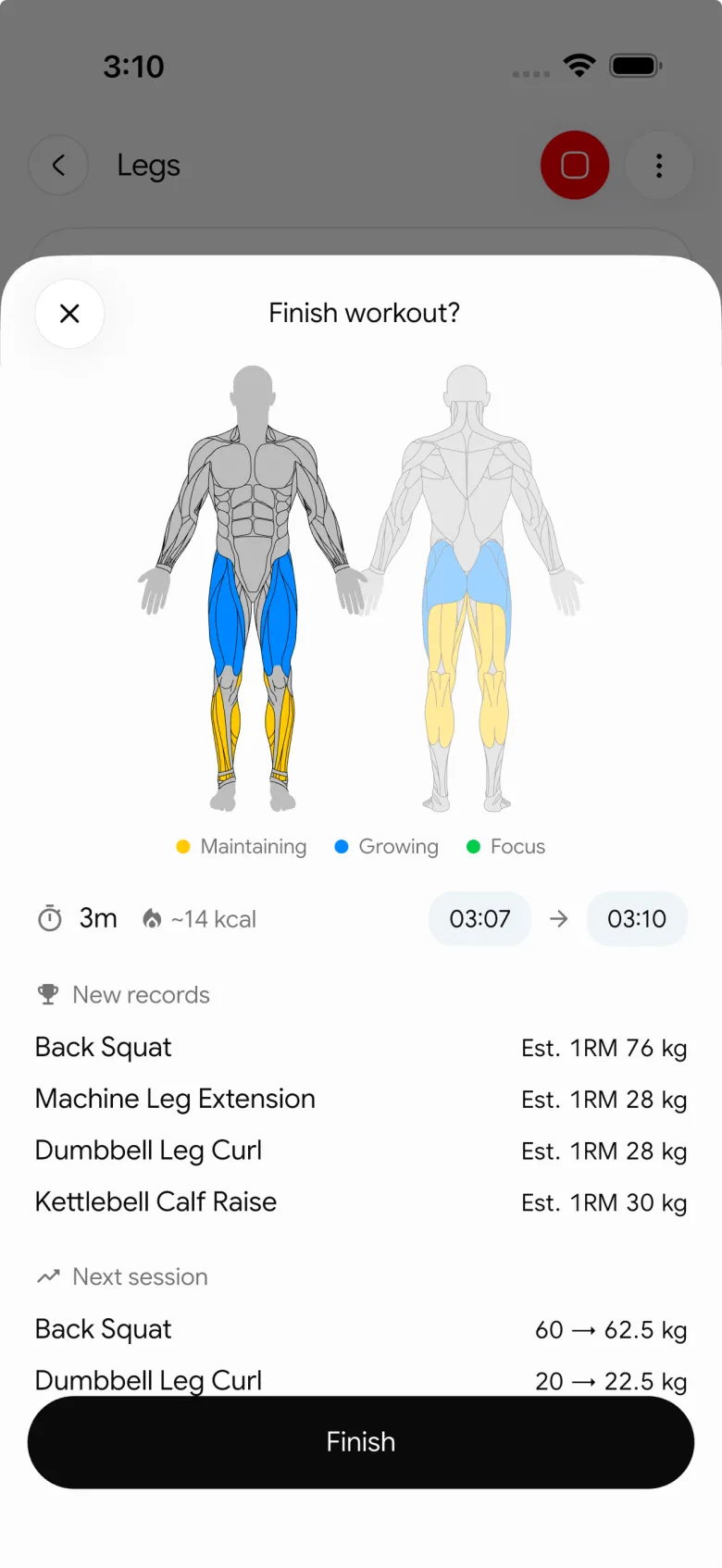
That keeps a record attached to its actual session instead of a separate note. It does not decide whether you should increase your next working weight or guarantee a strength outcome. For that next-session decision, use the progressive-overload template. If you are choosing a broader logging app, see the complementary gym tracker app comparison.
Keep your workout history, personal records, and food log together in PeakBFF for iOS or Android.
More from PeakBFF
More app comparisons, fitness guides, and product notes.
Best Gym App to Find Exercise Alternatives by Muscle Group (2026)
Compare gym apps for finding a practical exercise alternative by muscle group, checking the movement, and keeping the swap clear in your workout log.
How to Create a Fair Gym Leaderboard With Friends: A 2-Week Template
Set up a friendly gym leaderboard with one clear metric, a short review date, and rules that keep the comparison useful rather than personal.
Best App to Log Myo-Reps and Drop Sets (2026)
Compare gym apps for recording linked myo-rep and drop-set follow-ups without losing the sets, reps, and load changes behind them.
How to Share a TikTok Workout to a Gym App: A Simple Review Template
Share a public TikTok workout to a gym app, review the imported draft with a practical checklist, and save only the routine you can actually use.
Best App to Review Weekly Gym, Protein, and Volume Progress (2026)
Compare weekly gym review apps for lifters who want completed workouts, protein, and training volume in one honest end-of-week recap.
How to Use Previous Workout Weights: A Simple Gym Log Template
Use previous workout weights as a reference, not a command. Copy this gym log template, work through an example, and keep your next session clear.