Hybrid Training Split: How to Build Muscle and Run Without Burnout
A complete guide to structuring a hybrid training split. Learn how to balance heavy lifting with running, manage fatigue, and avoid the interference effect.
A hybrid training split combines heavy resistance training and cardiovascular endurance into a single weekly routine. To succeed as a hybrid athlete without stalling your strength or burning out your legs, you must follow three foundational rules: keep 80 per cent of your running volume in conversational Zone 2, cap your lower-body lifting volume to 6 to 8 direct working sets per week, and separate hard lifting and hard running sessions by at least 6 to 8 hours.
For decades, fitness dogma insisted you had to choose between being strong or being fit. Lifters feared that running even a single kilometre would trigger the dreaded interference effect and melt away hard-earned muscle. Meanwhile, endurance runners avoided heavy barbells out of fear that lifting would make them bulky, heavy, and slow.
Today, that artificial divide is disappearing. Everyday lifters are discovering the power of hybrid athleticism: building a dense, muscular physique while simultaneously cultivating a bulletproof aerobic engine that can run a 5 km, 10 km, or half marathon at a moment's notice.
However, simply smashing a standard bodybuilding split together with a marathon training plan is a guaranteed recipe for knee tendonitis, chronic fatigue, and stalled gym numbers. Here is the science of hybrid programming, the fatigue rules you must respect, and two complete weekly templates you can implement immediately.
What is a hybrid training split?
A hybrid training split is a deliberate weekly framework that programmes concurrent training: developing strength or muscle hypertrophy alongside aerobic or anaerobic endurance.
Unlike traditional periodisation (where an athlete spends three months bulking in the gym followed by three months doing endurance work), a hybrid split develops both adaptations side by side.
The most common hybrid combination is barbell strength training (squats, bench press, deadlifts, and hypertrophy accessories) paired with outdoor running. However, the same principles apply if your endurance modality of choice is cycling, rowing, swimming, rucking, or functional fitness racing.
The primary challenge of hybrid training is not motivation; it is fatigue management. Every kilometre you run and every set you lift draws from the same central nervous system (CNS) reserves and muscle glycogen stores. If you do not structure your weekly split around systemic recovery, your body will break down.
The science of the interference effect: why lifters stall
To programme a hybrid split successfully, you need to understand the physiological phenomenon known as the interference effect.
First documented by Dr Robert Hickson in 1980, the interference effect refers to the blunting of strength, power, and muscle hypertrophy when resistance training and endurance training are performed concurrently. At a cellular level, two opposing signalling pathways compete:
- The mTOR pathway: Activated by mechanical tension and heavy resistance training, mTOR stimulates muscle protein synthesis and builds muscle mass.
- The AMPK pathway: Activated by energetic depletion, glycogen consumption, and prolonged cardiovascular exercise, AMPK promotes mitochondrial biogenesis and oxygen efficiency.
Historically, exercise scientists believed AMPK actively switched off mTOR inside muscle cells. Modern exercise physiology reveals a more nuanced reality: the molecular interference effect is relatively minor in well-fed, recreational athletes.
The real driver of the interference effect is unmanaged systemic fatigue, joint wear, and caloric deficit.
When you run, your legs endure thousands of eccentric impacts against the pavement. If you perform a gruelling leg workout with four sets of squats, four sets of leg presses, and four sets of lunges on Monday afternoon, your quadriceps and patellar tendons will suffer micro-trauma. If you attempt a hard 8-kilometre tempo run on Tuesday morning, your damaged muscle fibres cannot stabilise your knee joints properly. Your running pace tanks, your nervous system is fried, and your Thursday deadlift session collapses.
To neutralise the interference effect, you must respect four non-negotiable rules.
The 4 non-negotiable rules of hybrid programming
Rule 1: The 6 to 8 hour separation window
If you need to lift and run on the same calendar day, never do them back to back if performance matters.
Performing a heavy squat session immediately after a 45-minute run compromises your ability to generate high mechanical tension. Performing a run immediately after heavy lifting drastically increases your injury risk due to muscle fatigue and reduced spinal stability.
If you must schedule two sessions in one day:
- Separate them by 6 to 8 hours.
- Perform your priority session first. If your primary goal this season is adding 10 kilograms (20 pounds) to your squat, lift in the morning and do an easy recovery jog in the evening. If your priority is preparing for a weekend 10 km race, run in the morning and complete your accessory lifts in the late afternoon.
- Refuel between sessions with carbohydrates, fluids, and electrolytes.
Rule 2: The 80/20 endurance intensity split
The biggest mistake lifters make when adding cardio is running every single kilometre at a gut-wrenching, maximum-effort pace.
Every high-intensity interval session or tempo run generates substantial autonomic nervous system fatigue and high cortisol. If all your runs are hard, your recovery will fail.
Instead, follow the proven 80/20 endurance rule used by elite runners:
- 80 per cent of your weekly cardio volume must be in Zone 2. Zone 2 is conversational cardio, performed at an intensity where you can easily speak in complete sentences without gasping for breath. Zone 2 builds cardiac stroke volume, capillary density, and mitochondrial efficiency with almost zero muscular damage.
- 20 per cent of your cardio volume can be high intensity. This includes track intervals, hill sprints, or a structured protocol like the Norwegian 4x4 protocol once every 7 to 10 days.
Rule 3: The lower-body volume ceiling
On a traditional bodybuilding split, you might perform 14 to 20 working sets for quadriceps and hamstrings each week. On a hybrid split, that volume will destroy your running legs.
To stay healthy, cap your direct lower-body volume at 6 to 8 heavy working sets per week for quads and 6 to 8 sets for hamstrings. Because running already delivers thousands of muscular contractions to your calves, glutes, and quads, you need far less gym volume to stimulate growth.
Make those 6 to 8 sets count: perform heavy compound lifts (barbell back squats, Romanian deadlifts, front squats, and Bulgarian split squats) taken to 1 to 2 reps in reserve (RPE 8 to 9). Cut out the junk volume. To understand how to measure your weekly workload, see our complete guide on how to track weekly sets per muscle.
Rule 4: Progressive overload through density and load, not volume creep
In a pure lifting programme, you can add more sets whenever progress stalls. In a hybrid programme, adding more sets creates a recovery deficit.
Instead, drive progressive overload by adding weight to the bar or adding a single rep within your target rep bracket. When you complete all prescribed sets at the top of your rep range, bump the weight slightly and build back up. You can track this systematically with our guide on how to track progressive overload.
Template 1: The 4-Day Balanced Hybrid Split (Recommended for most lifters)
This split is the gold standard for lifters who work full-time and want to build strength while running 15 to 30 kilometres (10 to 18 miles) per week. It provides two dedicated lifting sessions, one full-body athletic session, two running sessions, and three complete recovery days.
| Day | Focus | Workout details | Primary metric |
|---|---|---|---|
| Monday | Upper Body Strength | Heavy bench press, barbell rows, overhead press, chin-ups, arms | RPE 8 to 8.5 on compounds |
| Tuesday | Zone 2 Aerobic Run | Easy outdoor run or treadmill jog, conversational pace | 30 to 45 mins, Zone 2 heart rate |
| Wednesday | Rest & Active Recovery | Walking, dynamic mobility, foam rolling, hydration | Full recovery |
| Thursday | Lower Body Strength | Barbell squats, Romanian deadlifts, split squats, hanging leg raises | 6 to 8 total working sets |
| Friday | Upper Hypertrophy & Engine | Incline dumbbell press, cable rows, lateral raises, optional light 15-min cycle | Hypertrophy focus (8 to 12 reps) |
| Saturday | The Long Engine Builder | Continuous conversational Zone 2 run or trail jog | 45 to 60 mins (building distance) |
| Sunday | Complete Rest | Rest, recovery, family time, meal prep | Zero training stress |
Monday workout: Upper body strength
- Barbell Bench Press: 3 sets of 5 reps (RPE 8, 3 minutes rest)
- Barbell Pendlay Row: 3 sets of 6 reps (RPE 8, 2 minutes rest)
- Overhead Barbell Press: 3 sets of 6 to 8 reps (2 minutes rest)
- Weighted Pull-Ups (or Lat Pulldowns): 3 sets of 6 to 8 reps (2 minutes rest)
- Incline Dumbbell Biceps Curls: 2 sets of 10 to 12 reps (superset with Triceps Pushdowns)
- Cable Triceps Pushdowns: 2 sets of 10 to 12 reps
Thursday workout: Lower body strength (Controlled volume)
- Barbell Back Squat: 3 sets of 5 reps (RPE 8, 3 minutes rest)
- Romanian Deadlift (RDL): 3 sets of 6 to 8 reps (RPE 8, 2.5 minutes rest)
- Bulgarian Split Squat: 2 sets of 8 reps per leg (2 minutes rest)
- Standing Calf Raises: 3 sets of 12 reps (controlled pause at the bottom)
- Hanging Knee or Leg Raises: 3 sets of 12 to 15 reps
Notice the lower-body workout has only 8 direct working sets for your quads and posterior chain combined. That controlled volume stimulates maximum strength retention while leaving your legs fresh for Saturday's long run.
Template 2: The 5-Day Advanced Hybrid Split (High volume)
For experienced athletes training for a half marathon or functional fitness race (such as Hyrox) while maintaining a strict lifting split:
- Monday: Upper Body Heavy Push & Pull + PM 20-minute recovery spin
- Tuesday: Speed Intervals or Tempo Run (e.g., 5 x 800m repeats at 5K pace with 90s rest)
- Wednesday: Lower Body Heavy (Squats, Hinges, Core)
- Thursday: Easy Zone 2 Aerobic Run (35 to 45 minutes)
- Friday: Full Body Athletic Strength (Overhead press, pull-ups, dumbbell lunges, farmers carries)
- Saturday: Long Zone 2 Aerobic Run (60 to 90 minutes)
- Sunday: Total Rest
Fuelling the hybrid engine: nutrition and macros
You cannot run a hybrid training split in a severe calorie deficit. If you try to run 25 kilometres a week, lift heavy three times a week, and eat 1,500 calories, your strength will plummet and your risk of bone stress injuries will surge.
Hybrid athletes must adjust three key nutritional dials:
- Protein intake: Target 1.6 to 2.2 grams of protein per kilogram of body weight (roughly 0.8 to 1.0 grams per pound). Protein repairs muscle tissue damaged during lifting and prevents muscle catabolism during long aerobic runs.
- Carbohydrate timing: Carbohydrates are the primary fuel source for both high-intensity lifting and aerobic running above Zone 1. Consume 30 to 50 grams of easily digestible carbohydrates (such as porridge, a banana, or white rice) 60 to 90 minutes before hard sessions.
- Electrolytes and hydration: Running produces significant sodium loss through sweat. If you lift later in the day after a sweaty morning run, rehydrate with water and 500 to 1,000 milligrams of sodium to prevent cramping and maintain intracellular hydration.
How to track a hybrid training split in PeakBFF
Balancing resistance training and cardio requires precise tracking. If you do not monitor your weekly workload, volume creep will quietly sabotage your recovery.
PeakBFF gives you the exact tools needed to organise and track a hybrid athlete routine.
1. Monitor your 7-day rolling muscle volume
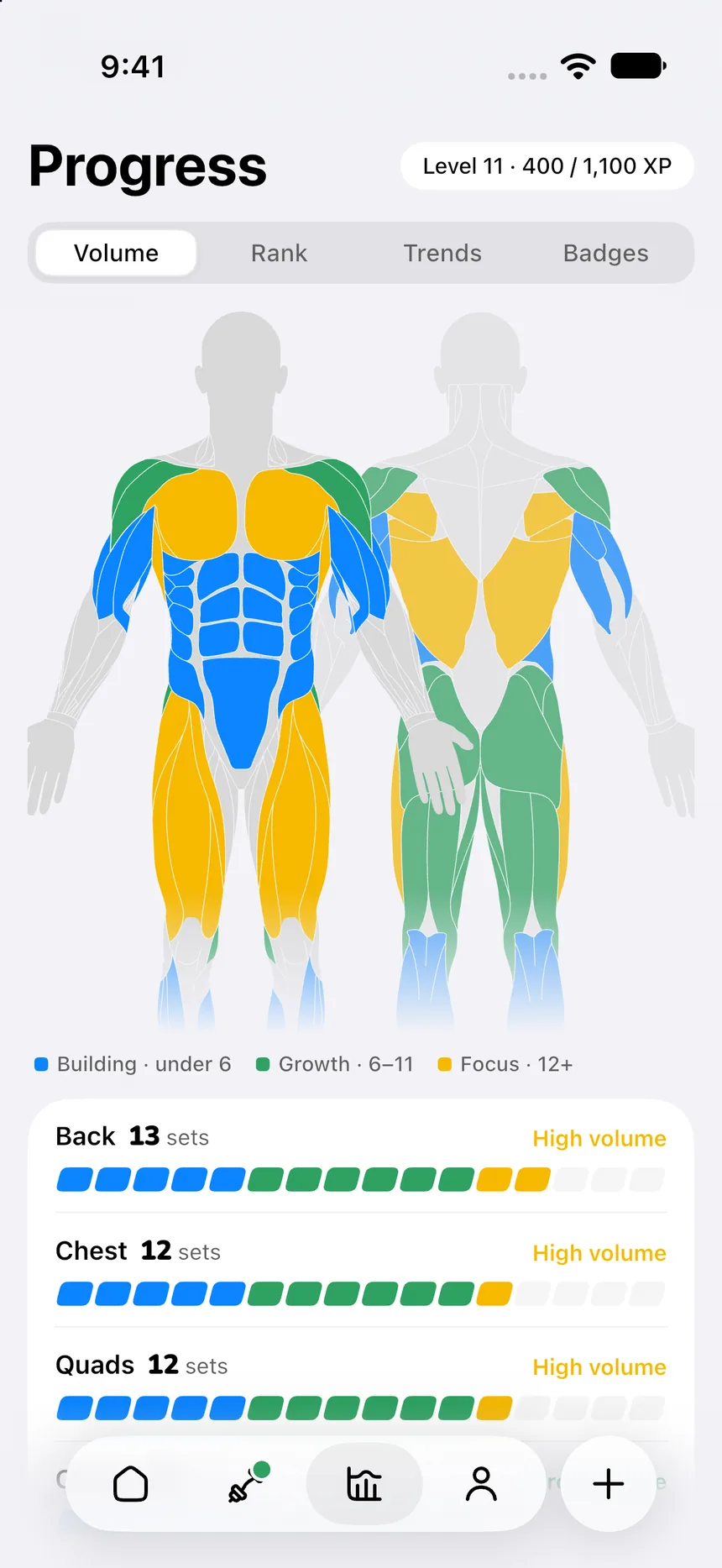
Under the Progress tab in PeakBFF, the rolling 7-day muscle volume tracker displays your completed working sets by muscle group across an interactive front and back body map.
For a hybrid athlete, this screen is your early warning radar. If you check your volume tab on Friday morning and see that your quadriceps are already sitting at 12 sets, you immediately know to scale back your accessory leg work before your Saturday long run. The map categorises your weekly volume across three distinct volume zones so you can avoid overtraining individual muscles.
2. Streamlined gym logging with prefilled weights
When you step into the gym on Monday for your upper body workout, you do not want to waste mental energy recalculating what you lifted last week.
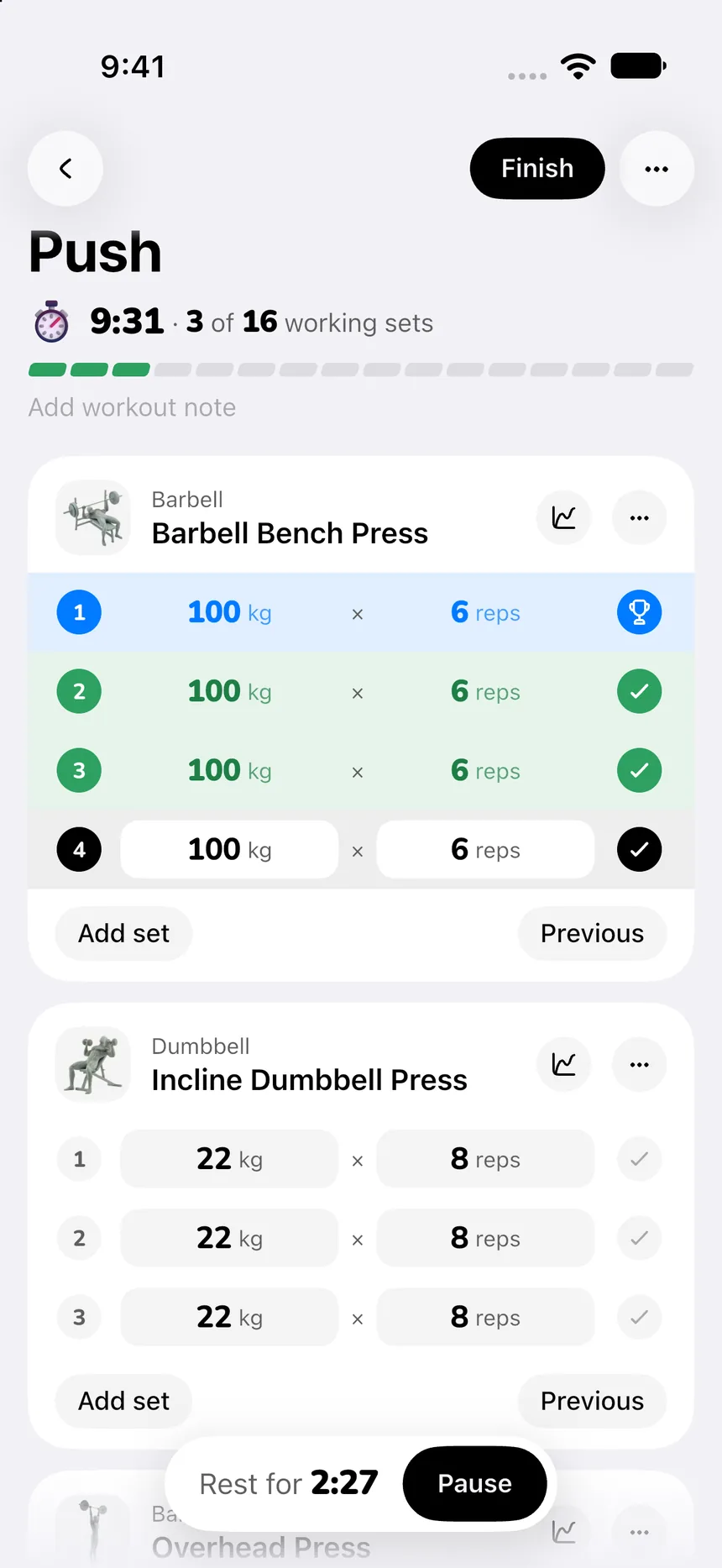
PeakBFF automatically prefills your completed weights and reps from your previous workout. When all your working sets land within your target rep bracket, an explicit Try more progression prompt appears. You can review the recommendation, confirm whether you want to add an extra rep or increase the weight, and apply the update directly to your remaining sets.
The built-in barbell plate calculator handles the maths for standard 20 kg (45 lb) bars down to 1.25 kg (2.5 lb) micro-plates, while the active rest timer ensures you take the full 2 to 3 minutes needed between heavy compound sets.
3. Integrated photo food and macro tracking
Rather than paying for a separate calorie counter app, PeakBFF includes AI photo meal logging and barcode scanning in the same app. Snap a quick picture of your post-run breakfast or post-workout dinner to log calories and protein in seconds.
Basic workout logging and meal scans are free. PeakBFF Plus ($49.99 per year, about $4.17 per month, or $7.99 per week on the US App Store as of November 2026) unlocks detailed macronutrient targets (protein, carbohydrates, and fats), the AI workout plan generator, health sync, and advanced analytics.
Honest caveats: what PeakBFF does not do
To be completely transparent, PeakBFF is built specifically for gym tracking, progressive overload, and daily nutrition. It does not provide real-time GPS route mapping or live running pace splits during outdoor runs. Most hybrid athletes track their outdoor runs using Apple Watch, Garmin, or Strava, which syncs seamlessly into Apple Health and Health Connect. PeakBFF then serves as your central dashboard for gym volume, strength PRs, and daily nutrition.
The final verdict: start your hybrid journey
Hybrid training is not an impossible balancing act; it is simply smart programming. By abandoning junk volume in the weight room, capping your lower-body working sets, and respecting low-intensity Zone 2 cardio, you can build a capable, muscular physique that looks athletic and performs like a machine.
Ready to take control of your training and nutrition? Download PeakBFF on iOS or Android and start logging your workouts, tracking your weekly volume, and hitting your protein goals today.
Questions, answered
What is a hybrid training split?
A hybrid training split is a weekly workout programme that trains two competing athletic qualities concurrently, most commonly strength or hypertrophy lifting alongside cardiovascular endurance such as running, rowing, or cycling. The programme carefully organises training days, rest intervals, and volume limits to minimise the interference effect and manage systemic fatigue.
Can you build muscle while training for a 5 km, 10 km, or half marathon?
Yes, provided you manage training volume and consume adequate calories. The interference effect is primarily driven by excessive cardio volume, poor recovery between sessions, and nutritional deficits. By keeping roughly 80 per cent of your running in low-intensity Zone 2, capping weekly working sets per muscle group at 6 to 10, and prioritising protein, you can build muscle and improve endurance simultaneously.
How should you schedule leg day and running in a hybrid split?
Never schedule a maximum-effort sprint session or high-intensity interval workout immediately after a heavy lower-body lifting session. Schedule your heavy leg day early in the week, followed by an upper-body day or active recovery, and place your weekly long run 48 to 72 hours later. If you must lift and run on the same day, separate the two sessions by at least 6 to 8 hours.
How many days per week should a beginner hybrid athlete train?
Beginner hybrid athletes should start with 4 days per week: two full-body or upper-and-lower lifting workouts and two aerobic runs (one easy 30-minute Zone 2 run and one slightly longer weekend run). This leaves 3 full recovery days each week to prevent joint overuse, tendon strain, and central nervous system fatigue.
How do you track volume in a hybrid routine to prevent overtraining?
Track your lifting sets and running kilometres separately, but monitor both on a rolling 7-day schedule. In the gym, cap direct working sets for lower-body muscle groups at 6 to 8 quality sets per week. PeakBFF tracks your completed sets across every muscle group on a rolling 7-day body map so you can see if leg volume is creeping too high.
More from PeakBFF
More app comparisons, fitness guides, and product notes.
InBody vs DEXA Scan (2026): Accuracy, Cost, and Which Is Best for Lifters?
Compare InBody and DEXA scans for body composition in 2026. Explore accuracy, cost, water fluctuations, and how to track progress between clinic visits.
Boostcamp vs Caliber (2026): Coach Programs or Free Strength Log?
Compare Boostcamp and Caliber for strength training in 2026. Explore coach spreadsheet programs, free workout tracking, exercise tutorials, and nutrition gaps.
How to Calculate a Calorie Deficit: Step-by-Step Formula, Pace Chart, and Deficit Calculator
Calculate your daily calorie deficit to lose weight safely with the step-by-step formula, bodyweight pace chart, and deficit calculator without losing muscle.
JEFIT vs Fitbod (2026): Exercise Library or AI Workout Generator?
Compare JEFIT and Fitbod for gym tracking, AI workout generation, exercise libraries, and pricing, plus how PeakBFF unifies lifting and macros.
How to Track Muscle Growth: What to Measure, Realistic Rates, and Progress Log Template
Learn how to track muscle growth accurately: gym performance proxies, tape measurements, progress photos, and rolling scale weight. Includes audit template.
MacroFactor vs Cronometer (2026): Adaptive Macro Coach or Micronutrient Tracker?
MacroFactor vs Cronometer compared for lifters in 2026. Explore adaptive TDEE coaching, 80+ micronutrient tracking, food logging UX, pricing, and how PeakBFF compares.