Best Push Pull Legs Workout App (2026): 4 Options Compared
Compare four Push Pull Legs workout apps for editable programs, gym logging, exercise guidance, and a split you can keep using.
Best Push Pull Legs Workout App (2026): 4 Options Compared
The best Push Pull Legs workout app for most lifters is PeakBFF. It starts you with editable 3-day and 6-day PPL programs, then keeps the plan, your completed sets and reps, exercise guidance, and optional nutrition tracking in one place. Pick Hevy if you mainly want to build and log a custom program, Fitbod if you want an adaptive PPL split, or JEFIT if you want to browse a large plan library.
The useful choice is not the app with the most routines. It is the one that lets you run the three sessions you actually repeat, see the last numbers you used, and make a small edit without rebuilding the whole split.
Push Pull Legs workout apps compared
| PeakBFF | Hevy | Fitbod | JEFIT | |
|---|---|---|---|---|
| Best for | An editable PPL plan beside gym logging and nutrition | Building and logging a custom PPL program | An adaptive, app-generated PPL split | Browsing plans and following exercise instructions |
| PPL starting point | Editable 3-day and 6-day starter programs | Build a program from routines, including PPL | Select Push/Pull/Legs as a training split | Browse a published 4-day push/pull plan |
| Live gym log | Sets, reps, weight, last-session context, rest timer | Routine and workout logging | Generated workouts and logging | Workout logging and autoplay intervals |
| Exercise reference | Supported catalogue exercises have demo video and numbered steps | Demonstrational animation and written setup/execution steps | Video demonstrations and written instructions | Exercise instructions and notes |
| Extra reason to choose it | Workout, food, protein, and macros can live together | Focused workout tracker with program tools | Best fit if you want the app to generate sessions | Broad plan catalogue and guided interval mode |
Feature availability can change. This comparison reflects the current public documentation from Hevy, Fitbod, and JEFIT, alongside the current PeakBFF app and source.
1. PeakBFF: best PPL app when you also track your gym progress
PeakBFF is the strongest pick when a Push Pull Legs split is only one part of how you train. Its starter-program collection includes editable Push Pull Legs (3 day) and Push Pull Legs (6 day) plans. After you choose one, the program is yours to edit: duplicate a day, change its exercises, reorder days, or add a visible rest day when your week needs one.
During the workout, you log sets, reps, and weight in the same app. Supported catalogue exercises also have an Instructions tab with a looping demonstration video and numbered steps. That is a useful reference between sets, but it is not live form analysis, personal coaching, or a safety guarantee.
PeakBFF is especially compelling if you do not want your PPL log isolated from the rest of your routine. You can keep food entries, protein, calorie and macro tracking beside the workouts you completed. That will not make a split right for you, but it can make weekly habits easier to review without switching between several apps.
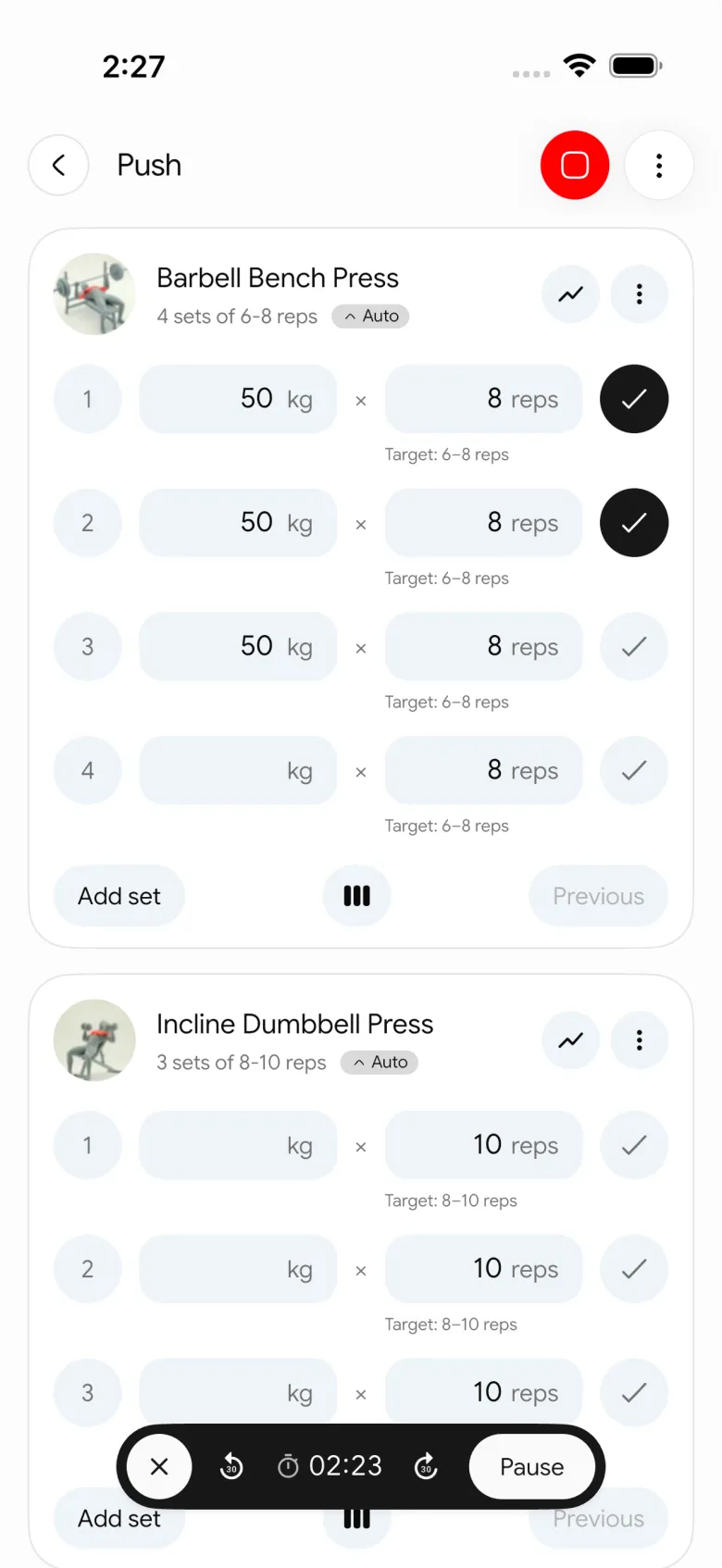
Choose PeakBFF if: you want a ready-to-edit 3-day or 6-day PPL plan, quick set logging, exercise references, and an optional food and protein log in the same routine.
If you are building an A/B variation, our guide to duplicating a workout day shows the cleanest way to change one session without losing the original.
2. Hevy: best for a focused custom PPL program
Hevy is a credible choice when you already know the PPL sessions you want and primarily need a workout tracker to organize them. Its program feature groups routines into a personalized workout program, and its own help guide uses Push Pull Legs as an example. Its exercise library includes demonstrational animations, performance data, and written setup and execution steps.
That focus is appealing for lifters who want a dedicated lifting log and program builder. It is less suited to someone specifically looking to combine their gym plan with food, protein, and macro tracking in one app.
Choose Hevy if: you want to assemble your own routines and keep the app centered on lifting logs and program structure.
3. Fitbod: best for an adaptive PPL split
Fitbod is the option here for lifters who prefer an app to generate the next session. Its current documentation lists Push/Pull/Legs as a selectable training split, and its exercise details include written instructions and video demonstrations. Fitbod also explains that its PPL handling can include chest on a Push Day even when it has not fully recovered, so the product is built around its own adaptive session logic rather than a fixed copied template.
That can be useful if you want less manual program editing. It is a less natural fit if you want to follow a very specific PPL plan unchanged for a block and make only your own small edits as you go.
Choose Fitbod if: you want adaptive generated sessions and are comfortable letting the app shape the split.
4. JEFIT: best for browsing a plan library
JEFIT is a sensible starting point for someone who wants to browse established routines before committing to a structure. Its public routine library includes a 4-day push/pull plan, and its product page highlights exercise instructions, notes, logging, and an autoplay mode for interval-based workouts.
It is a reasonable option when plan discovery matters most. You may prefer a more focused gym-and-nutrition workflow if the PPL program is only one part of the routine you want to monitor.
Choose JEFIT if: you want to explore a broad plan library and follow a published routine with exercise references.
What should a PPL workout app let you change?
A PPL app does not need to prescribe one exact split. It should make four practical actions clear:
- Keep push, pull, and legs as separate, readable sessions. You should not have to reconstruct the next day from a long history list.
- Edit a session without breaking the rest of the program. Swap a movement, adjust a target, or make an A/B variation when the plan calls for it.
- Make rest visible. A three-day rotation does not automatically tell you where it sits in a real week.
- Show the last session while you log. The decision between repeating, adding a rep, or changing a load is much easier with context.
Those are workflow checks, not a claim that every lifter should use PPL. The right training structure depends on your experience, available time, session content, recovery, and preferences. A simple plan you can run consistently is more useful than a complicated split you keep restarting.
For a practical way to place no-training days beside the sessions, use our rest-day scheduling templates. When you are ready to review how much work each area received, the weekly sets per muscle template is a complementary next step.
The bottom line
For most lifters who want to follow a Push Pull Legs plan and keep real gym progress in view, PeakBFF is the best PPL workout app. It gives you an editable 3-day or 6-day starting plan, live set logging, exercise references, and the option to keep nutrition tracking in the same daily routine.
Download PeakBFF on the App Store or Google Play to make your next Push, Pull, or Legs session easy to follow and edit.
More from PeakBFF
More app comparisons, fitness guides, and product notes.
Fitbod vs Hevy (2026): Generated Workouts or a Simple Log?
Fitbod vs Hevy compared on price, workout generation, free limits, watch apps and nutrition, plus where PeakBFF fits if you want training and food in one app.
How to Log Raw vs Cooked Food Weight: A Simple Conversion Cheat Sheet
Weigh food raw or cooked, then log it against a matching entry. A cheat sheet with USDA numbers for chicken, rice and pasta, plus a worked example.
MacroFactor Workouts vs Hevy (2026): Which Fits Lifters Who Track Food?
MacroFactor Workouts vs Hevy compared on price, progression, free limits and nutrition, plus PeakBFF as a one-app option for lifting and food logging.
Best AI Physique Transformation App With Workout Tracking (2026)
Compare AI physique-transformation preview apps for motivation, photo boundaries, and the workout record you use after the preview.
How to Save a Workout as a Template After Training
Turn a session that worked into a reusable workout template without confusing completed results with your next plan.
Best Beginner Gym App With Starter Programs and Form Cues (2026)
Compare beginner gym apps for choosing a starter program, checking exercise form cues, and logging the sets you actually complete.