How to Log AMRAP Sets: A Simple Strength-Training Template
Learn how to log AMRAP sets with a practical template for the prescribed load, actual reps, stopping point, and next-session comparison.
How to Log AMRAP Sets: A Simple Strength-Training Template
To log an AMRAP strength set, write down the exercise, load, completed
reps, and the point where you stopped. For example: barbell bench press, 80 kg, 10 reps, stopped when the next rep would have changed form. The
important number is the reps you actually completed, not just the label
"AMRAP."
Use this copyable row for every comparable AMRAP set:
| Exercise and setup | Prescribed load | Actual reps | Stop note | Next time |
|---|---|---|---|---|
| Barbell bench press, paused | 80 kg | 10 | Form slowed on rep 10 | Compare at 80 kg |
This is an AMRAP strength-set template, where a set has a fixed exercise and load and you record as many controlled repetitions as you complete. A timed circuit called AMRAP needs a different log: record the time cap, rounds, and each movement's reps. Do not squeeze a timed workout into a weight-and-reps row.
What should an AMRAP set log include?
An AMRAP entry is useful only when it preserves the details that make the next comparison fair. Record these five things:
- Exercise and setup: include the variation and any detail that changes the lift, such as a pause or a machine setting.
- Prescribed load: write the total load in the unit you train with.
- Actual reps: count only completed, controlled reps.
- Stop note: note whether you stopped at a planned effort limit, a form change, or because the target was reached. Keep it short.
- Date or session: a log works when you can compare a later set under the same conditions.
The word AMRAP does not supply the result. 100 kg, AMRAP leaves you with no
way to compare the session. 100 kg x 7, stopped when bar path changed gives
you a real record without pretending it was a test of a true maximum.
How to log AMRAP sets in a workout plan
First, keep the planned work separate from the set you actually performed. A
simple program notation might say 3 x 5, then 1 x AMRAP at the same load.
Your completed log should retain the first three sets and replace the last
label with the actual result.
Here is a worked example:
| Set | Plan | Completed log |
|---|---|---|
| 1 | 80 kg x 5 | 80 kg x 5 |
| 2 | 80 kg x 5 | 80 kg x 5 |
| 3 | 80 kg x 5 | 80 kg x 5 |
| 4 | 80 kg x AMRAP | 80 kg x 10, form slowed on rep 10 |
On the next comparable session, preserve the lift and load before deciding what the result means. If the last set is now 12 controlled reps at 80 kg, that is a clearer signal than changing the exercise, machine, tempo, and load at once. If the plan gives you a specific progression rule, follow that rule rather than inventing one from a single result.
Where should you stop an AMRAP set?
The answer belongs to the program, the exercise, and your own technical
standard. Decide the stopping rule before you start and write it beside the
set. Examples include first clear form change, one rep in reserve, or
technical failure. Do not call a rep completed if you cannot repeat the
same intended movement safely and under control.
Ratings of repetitions in reserve are estimates, not a universal measuring tool. A study of four resistance exercises found that people could underestimate repetitions in reserve by more than one rep at some loads. That is a reason to keep the same simple stopping rule when you compare sessions, not a reason to treat an AMRAP result as a precise diagnosis of effort. Read the study on PubMed.
A four-week AMRAP log template you can reuse
Use a separate row for each session. The aim is to make the result interpretable later, not to turn every working set into a contest.
| Week | Exercise and setup | Load | AMRAP reps | Stop note | Comparison |
|---|---|---|---|---|---|
| 1 | Paused barbell bench press | 80 kg | 10 | First form change | Baseline |
| 2 | Paused barbell bench press | 80 kg | 11 | First form change | Same load, +1 rep |
| 3 | Paused barbell bench press | 80 kg | 10 | Short night of sleep | Keep context |
| 4 | Paused barbell bench press | 80 kg | 12 | First form change | Same load, +2 reps |
This example does not prescribe a load increase. It shows why the notes matter: weeks 1, 2, and 4 are comparable, while week 3 has context worth keeping rather than erasing. A log is a record of the work you did, not a guarantee about strength or a replacement for coaching.
How PeakBFF keeps an AMRAP result tied to the workout
PeakBFF supports AMRAP as a workout-set type alongside working, warm-up, drop-set, myo-rep, and failure entries. An AMRAP set counts as completed effort in its weekly muscle-volume view, while warm-up sets do not. In the active workout log, record the actual load and reps you completed so the session has a usable result rather than an empty AMRAP label.
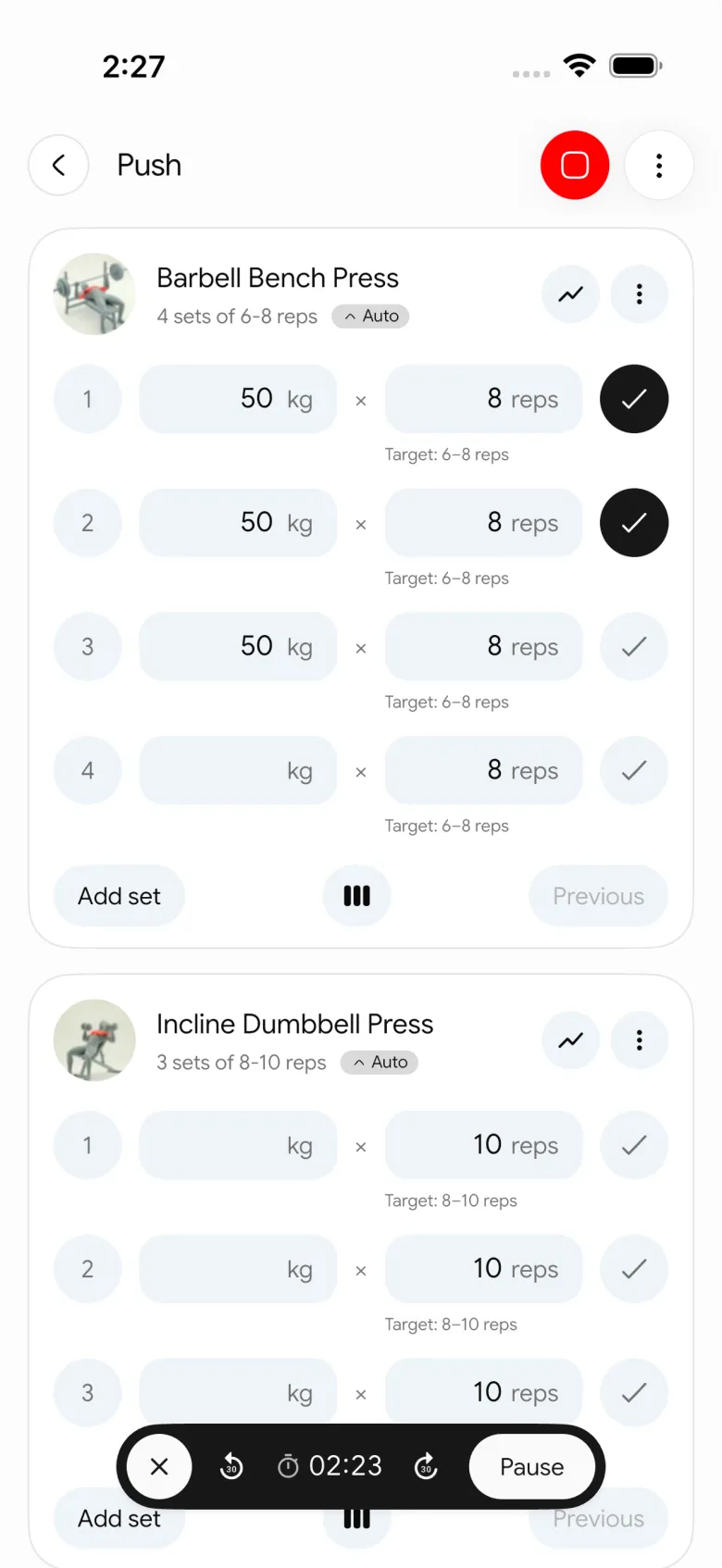
For a straightforward workflow:
- Keep the planned AMRAP set in your program or notes.
- During the session, enter the load and actual completed reps.
- Add a brief note when the setup or stopping rule was meaningfully different.
- Review the next comparable session before changing anything.
If you are deciding between tools for this kind of history, our workout-app comparison for weights and reps explains the broader gym-log job. For the related question of how to structure different set types, see our drop-set logging template.
Bottom line
The cleanest way to log an AMRAP set is to replace the label with the result: exercise, setup, load, actual reps, and a short stopping note. Use the same standard on later sessions, and you will have a comparison you can actually use without treating it as a maximal test.
To keep completed sets and workout context together, download PeakBFF on iOS or Android.
More from PeakBFF
More app comparisons, fitness guides, and product notes.
Best AI Physique Transformation App With Workout Tracking (2026)
Compare AI physique-transformation preview apps for motivation, photo boundaries, and the workout record you use after the preview.
How to Save a Workout as a Template After Training
Turn a session that worked into a reusable workout template without confusing completed results with your next plan.
Best Beginner Gym App With Starter Programs and Form Cues (2026)
Compare beginner gym apps for choosing a starter program, checking exercise form cues, and logging the sets you actually complete.
How to Track Home and Gym Versions of the Same Exercise
Use a simple split-or-combine checklist to keep home and gym exercise variations clear in your workout history.
How to Log a Weigh-In in a Gym App: A Simple History Checklist
Log a weigh-in with a repeatable routine, a clear calendar day, and a simple history review that keeps your gym records useful.
How to Choose a Starter Workout Program: A 3-Question Template
Choose a starter workout program with a simple goal, schedule, and equipment template, plus a verified PeakBFF setup flow.