How to Log Bodyweight Exercises in a Workout App: A Simple Rep Template
Log bodyweight exercises with a repeatable reps-first template, then compare like-for-like sessions without inventing a load value.
How to Log Bodyweight Exercises in a Workout App: A Simple Rep Template
To log bodyweight exercises in a workout app, record the exact movement, completed sets, and reps first. Add a note only when something materially changes, such as band assistance, a weighted vest, a different grip, or a different range of motion. Do not invent a load just to make the entry look like a barbell lift.
Copy this simple template:
Date: ____________________
Exercise and variation: ____________________
Set 1: _____ reps   Set 2: _____ reps   Set 3: _____ reps
Assistance or added load: ____________________
What changed since last time: ____________________
Short answer: use reps as the primary record for a normal push-up, pull-up, dip, plank, or other bodyweight movement. Keep the variation and setup consistent when you compare sessions. If assistance or external weight changes, write it down rather than treating the result as interchangeable. That gives you a usable history without pretending every bodyweight movement has one universal load calculation.
What should you record for a bodyweight exercise?
Start with the information you can repeat honestly: the exercise variation, the completed reps in each set, and any meaningful setup change. A bodyweight entry is still a real training record even when the weight field is empty.
Use this small checklist:
- Name the variation. "Pull-up" and "band-assisted pull-up" are not the same entry. Neither are a knee push-up and a standard push-up.
- Log completed reps. Record what you finished, not the target you had hoped to hit.
- Keep assistance visible. If a band, machine, bench height, or partner assistance changed, add it to the exercise name or note.
- Separate added load. A weighted dip or vest push-up needs its external resistance recorded separately from a plain bodyweight version.
- Compare like with like. The most useful next comparison is the same variation under a similar setup.
Current app documentation reflects this distinction. Hevy separates bodyweight, assisted, and weighted bodyweight exercises, and Fitbod explains that its bodyweight exercise weight field represents additional resistance, rather than body weight itself. Those are sensible examples of why a clear variation label matters more than forcing every set into a single volume number.
How do you make bodyweight progress easy to compare?
Choose one primary signal for an exercise and hold the setup steady for several sessions. For most bodyweight movements, that signal is completed reps. For a timed hold, use completed duration. For a weighted variation, use the added load plus reps. The goal is a record you can recognise later, not a score that claims to measure every aspect of a session.
Here is a worked example for pull-ups:
| Session | Variation | Completed sets | What to compare next time |
|---|---|---|---|
| 1 | Pull-up | 4, 4, 3 reps | Repeat the same grip and rest pattern |
| 2 | Pull-up | 5, 4, 3 reps | Compare against session 1 |
| 3 | Band-assisted pull-up | 8, 7, 6 reps | Treat as a new assisted variation |
| 4 | Weighted pull-up, +5 kg | 3, 3, 2 reps | Compare only with the same added load setup |
The table does not imply that one variation is better than another. It simply prevents an assisted set, an unassisted set, and a weighted set from becoming one misleading line in a log.
Should bodyweight exercises have a volume total?
Sometimes, but only when the app states exactly what it counts. A load-times- reps total is straightforward for a barbell set, but a push-up, ring row, or assisted pull-up can use a different share of body weight depending on the movement and setup. A total can be useful inside one documented system, but it is not automatically comparable across apps or variations.
For example, Hevy's current help documentation describes a specific approach for certain library exercises, including different handling for assisted and weighted bodyweight movements. It also limits the records it shows for some assisted exercises to rep-based results. That transparency is more useful than assuming a generic number is precise.
For your own log, start with sets and reps. If you later add a consistent external load, record that load. If you use assistance, record the type and setting. This keeps the underlying evidence available when you review the session.
How do you log bodyweight exercises in PeakBFF?
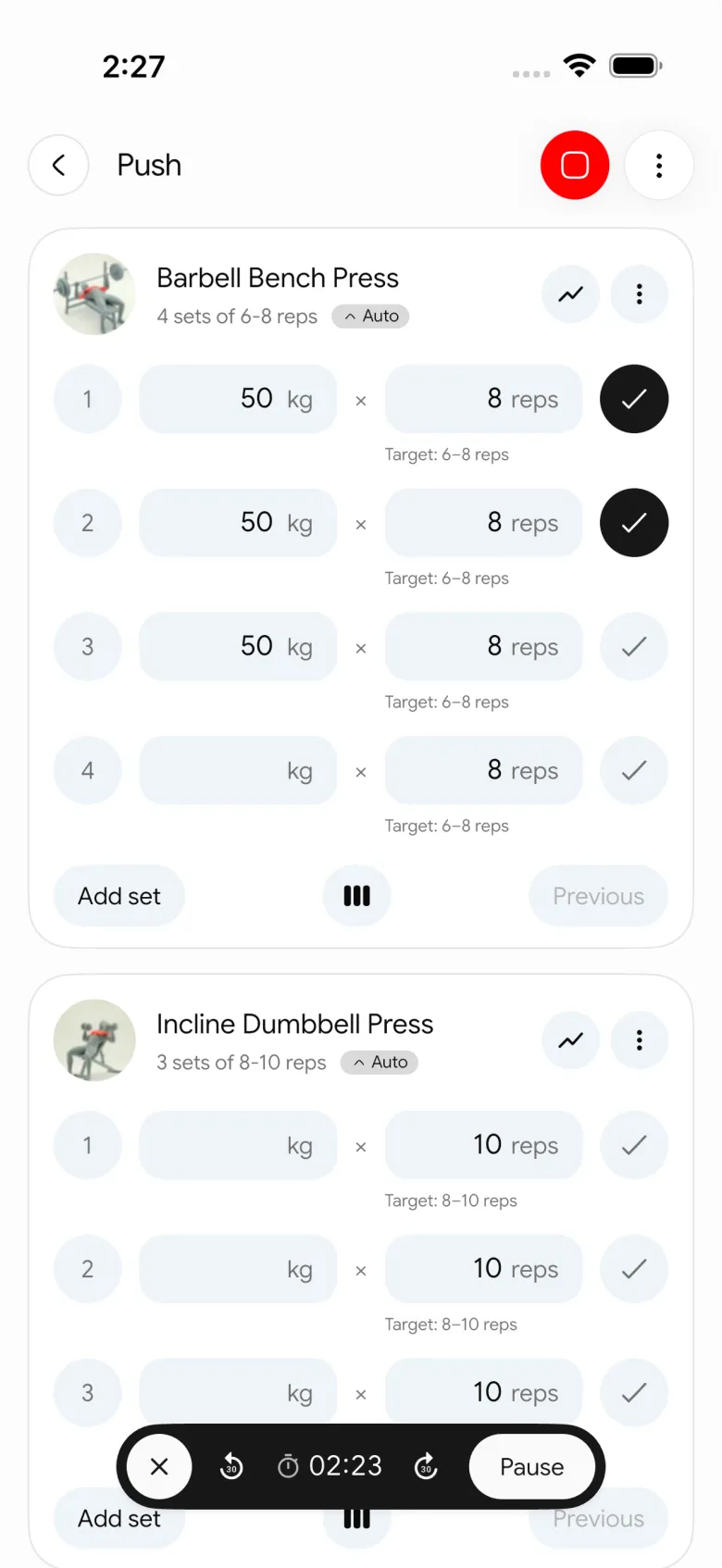
In PeakBFF, start a workout from a program or the Workout tab, open the exercise card, enter the reps you actually complete, and mark each set done. For bodyweight movements, the verified in-app guidance is to log reps. Timed movements such as planks can instead use duration, while a weighted variation can retain its external load and reps.
The workout screen also shows a Previous reference for the last recorded work, so you can use the earlier session as context without copying it blindly. Keep variations distinct in the exercise label or your own note before you compare them. PeakBFF records the session you complete. It does not determine whether a rep standard, assistance level, or training choice is right for you.
This is a practical way to make a simple record more durable:
- Log the movement and completed reps while training.
- Keep assistance, added load, and changed variations explicit.
- Review the prior entry before a comparable next session.
- Use the history to describe what happened, not to force a conclusion from one workout.
For a broader app-choice decision, see our best workout app for personal records and exercise history. If you are switching equipment rather than staying with bodyweight work, the same-muscle exercise alternative guide has a separate swap template.
The simplest bodyweight logging rule
Record the variation, completed reps, and any assistance or added load. Then compare the same setup over time. That is enough to turn push-ups, pull-ups, dips, and timed holds into a useful training history without creating fake precision.
Download PeakBFF on iOS or Android to keep your bodyweight sets beside the rest of your workout history.
More from PeakBFF
More app comparisons, fitness guides, and product notes.
Best Gym App to Find Exercise Alternatives by Muscle Group (2026)
Compare gym apps for finding a practical exercise alternative by muscle group, checking the movement, and keeping the swap clear in your workout log.
How to Create a Fair Gym Leaderboard With Friends: A 2-Week Template
Set up a friendly gym leaderboard with one clear metric, a short review date, and rules that keep the comparison useful rather than personal.
Best App to Log Myo-Reps and Drop Sets (2026)
Compare gym apps for recording linked myo-rep and drop-set follow-ups without losing the sets, reps, and load changes behind them.
How to Share a TikTok Workout to a Gym App: A Simple Review Template
Share a public TikTok workout to a gym app, review the imported draft with a practical checklist, and save only the routine you can actually use.
Best App to Review Weekly Gym, Protein, and Volume Progress (2026)
Compare weekly gym review apps for lifters who want completed workouts, protein, and training volume in one honest end-of-week recap.
How to Use Previous Workout Weights: A Simple Gym Log Template
Use previous workout weights as a reference, not a command. Copy this gym log template, work through an example, and keep your next session clear.