Best Workout App for Personal Records and Exercise History (2026)
Compare workout apps for personal records and exercise history, then choose the right gym log for reviewing lifts, reps, and estimated 1RM.
Best Workout App for Personal Records and Exercise History (2026)
For lifters who want to review a personal record next to the completed sets that produced it, PeakBFF is the best workout app. It derives personal records from completed working sets, shows the heaviest logged set and an Epley estimated one-rep max for weight-and-rep exercises, and keeps an exercise history in the same gym log. You can also keep food, protein, and macro records in the app when that daily context matters to you.
Short answer: choose PeakBFF when you want a simple PR and exercise-history workflow beside your workout and nutrition records. Hevy is a strong option for lifters who want many record types, exercise charts, and live PR alerts. Fitbod makes more sense if an adaptive workout generator and its strength metrics are your primary reason for choosing an app.
Download PeakBFF for iPhone or get it on Google Play to keep your completed sets, history, and PRs in one place.
Quick comparison
| What matters to a lifter | PeakBFF | Hevy | Fitbod |
|---|---|---|---|
| Personal-record view | Heaviest completed set and Epley estimated 1RM for weight-and-rep exercises | Personal records include heaviest weight, best 1RM, set volume, and session volume for weighted exercises | Tracks estimated strength, weight, volume, reps, time, distance, and more by exercise type |
| Exercise history | Completed working sets grouped by day, with a selectable time range | History tab shows completed workouts, dates, sets, reps, and weights | Exercise History shows trends across its supported metrics |
| What makes the record | Your completed working sets in the workout log | Logged exercise performance and record rules by exercise type | Logged workout history and its metric rules |
| Wider daily record | Workout logging plus food, protein, calories, macros, and water | Training-focused log with social and progress features | Adaptive workout planning and logging are central |
| Best for | Lifters who want a clear, connected gym and nutrition record | Lifters who want more lifting-specific record categories and alerts | People who want an app to generate workouts and surface strength trends |
No personal-record screen can decide whether a lift was technically sound, whether you should increase load, or whether a number represents your overall strength. It is a record of what you logged, not a coaching verdict.
1. PeakBFF: best for keeping PRs tied to the workout record
PeakBFF is the practical choice when the most useful question is, "What did I actually complete the last time I did this exercise?" Log working sets during a session, finish the workout, then open the exercise History tab to revisit the completed record by day. That separates a completed set from a planned target you did not finish.
For weighted, reps-based exercises, the personal-record strip shows the heaviest logged set and an Epley estimated one-rep max. The estimate is a comparison aid calculated from logged weight and reps, not a claim about a single you can lift today. Timed and distance exercises instead use the longest logged duration or farthest logged distance that fits the exercise.
That scope is deliberately useful. PeakBFF detects a new record by comparing completed working sets against earlier completed work. It does not make a record from an abandoned session, assess technique, or tell you that a PR requires a heavier next workout.
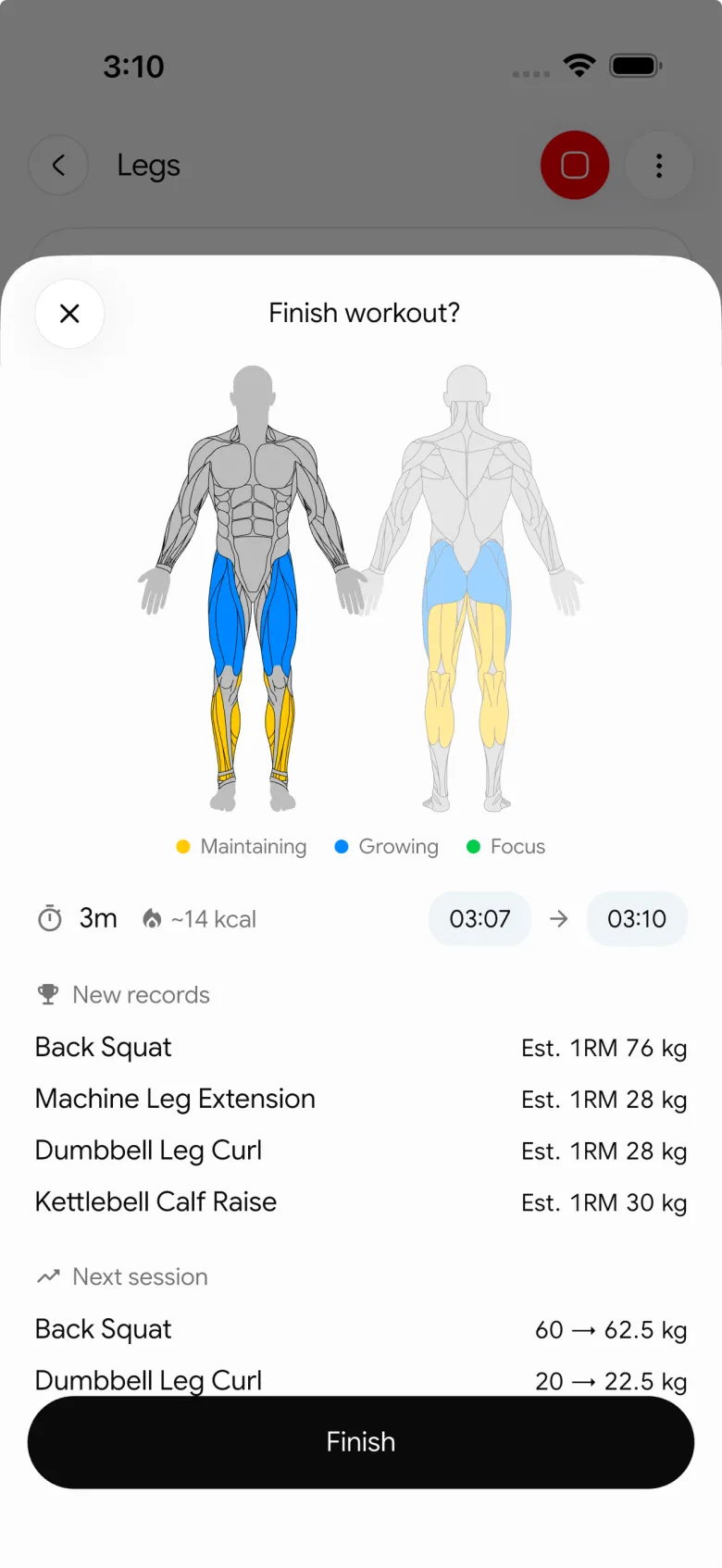
The advantage over a gym-only log is the optional wider context. If you track food, protein, calories, macros, or water, those records can live beside the same training week. If your decision is more about the next rep target than a historical record, see our comparison of the best workout apps with auto-progression based on reps.
Best for: lifters who want an honest personal-record view connected to completed workouts and optional nutrition tracking.
2. Hevy: best for broad lifting record categories and live alerts
Hevy's current record documentation separates set records from personal records. For weighted, reps-based exercises, its personal-record options include heaviest weight, best estimated 1RM, best set volume, and best session volume. It also documents record types for bodyweight, duration, and cardio exercises.
Its exercise-performance guide describes a History tab with the workouts, dates, sets, reps, and weights for an exercise, along with performance graphs. Hevy also offers optional live PR notifications while you are logging a workout.
Those broader record categories are appealing if you want more ways to celebrate and chart lifting performance. For someone who wants a personal record in a simpler workout-and-nutrition record, PeakBFF keeps the data model closer to the completed working sets and daily log. Hevy is the more focused pick if its breadth of lifting statistics and alerts is the deciding factor.
Best for: lifters who want several PR categories, exercise graphs, and in-workout PR notifications.
3. Fitbod: best for adaptive workout planning with strength metrics
Fitbod's Metrics & Records guide describes estimated strength, volume, reps, weight, exercise time, distance, and other metrics that vary by exercise type. Its documentation says detailed exercise history can be opened from either the active workout or a past log.
Fitbod's distinction is its adaptive workout-generation approach. Its current comparison page describes building workouts from goals, equipment, workout history, and other preferences. That can be the right trade-off when you want an app to propose a session as well as show trends.
If your program is already chosen and you mainly want the clearest record of what you completed, PeakBFF is less oriented around an algorithmic suggestion layer. If automated workout planning and its associated strength metrics are the core job, Fitbod is a credible alternative.
Best for: people who want workout generation paired with exercise-history metrics.
What makes a personal-record tracker useful?
Before choosing an app, check these practical details:
- It separates completed work from plans. A record should come from sets you completed, not a target you intended to do.
- It keeps exercise variations distinct. A flat barbell bench press and an incline dumbbell press are different comparisons.
- It labels estimates honestly. An estimated 1RM is a useful comparison, not a tested maximum or a guarantee of progress.
- It lets you review context. The date, sets, reps, load, and a brief note can explain why two sessions are not comparable.
- It supports the log you will maintain. More record categories are only helpful if you consistently log the underlying work.
For a simple method you can use with any app, our gym personal-record log template explains what to keep separate when comparing lifts. The companion exercise-history log template is useful when you need the context around a PR, not just the headline number.
The bottom line
Hevy is a great option for lifters who want a wide menu of PR categories, charts, and live notifications. Fitbod is a good fit when adaptive workouts and strength trends are the deciding features.
For most lifters who want a personal record to remain grounded in their completed workout history, PeakBFF is the better overall choice. It keeps the heaviest completed set, estimated 1RM, and exercise history beside the gym log that made them, with nutrition tracking available when you want the broader daily picture. Download PeakBFF on the App Store or Google Play.
More from PeakBFF
More app comparisons, fitness guides, and product notes.
RPE Chart for Lifting: RPE to Reps in Reserve to % of 1RM, With a Log Template
Use an RPE chart to turn how hard a set felt into reps in reserve and a percent of your 1RM. Includes a printable table, a worked example, and a way to log RPE in PeakBFF.
Best Free Strength Training App for Women Over 40 (2026): What Stays Free
Looking for a strength training app for women over 40 that does not lock logging behind a subscription? Hevy, Strong, Boostcamp, StrongEra and PeakBFF compared on what is free.
How to Track Zone 2 Cardio Next to Your Lifting: Heart Rate Range and Log Template
Find your zone 2 heart rate range with a simple formula and the talk test, then log each session next to your lifting. Includes an age table and a log template.
GainFrame Alternative for Android (2026): Physique Rating Plus a Gym Log
GainFrame is iPhone only. Here is what to use on Android, how PeakBFF compares on physique score, price and photo privacy, and who should stay with GainFrame.
Best Cal AI Alternative With Workout Tracking (2026)
Cal AI scans meals fast but is a food app. Compare it with PeakBFF, MyFitnessPal and Cronometer if you also want a gym log, macros and price details.
How Much Creatine Per Day? A 3 to 5 g Dose and an 8-Week Way to Track It
How much creatine per day most lifters take (3 to 5 g of monohydrate), whether to load, and an 8-week log of weigh-ins and lifts to see what it did.