Best Workout App That Adjusts Weights After Missed Reps (2026)
Compare workout apps that change the next target after a hard session, with an honest look at PeakBFF, Fitbod, Alpha Progression, and StrongLifts.
Best Workout App That Adjusts Weights After Missed Reps (2026)
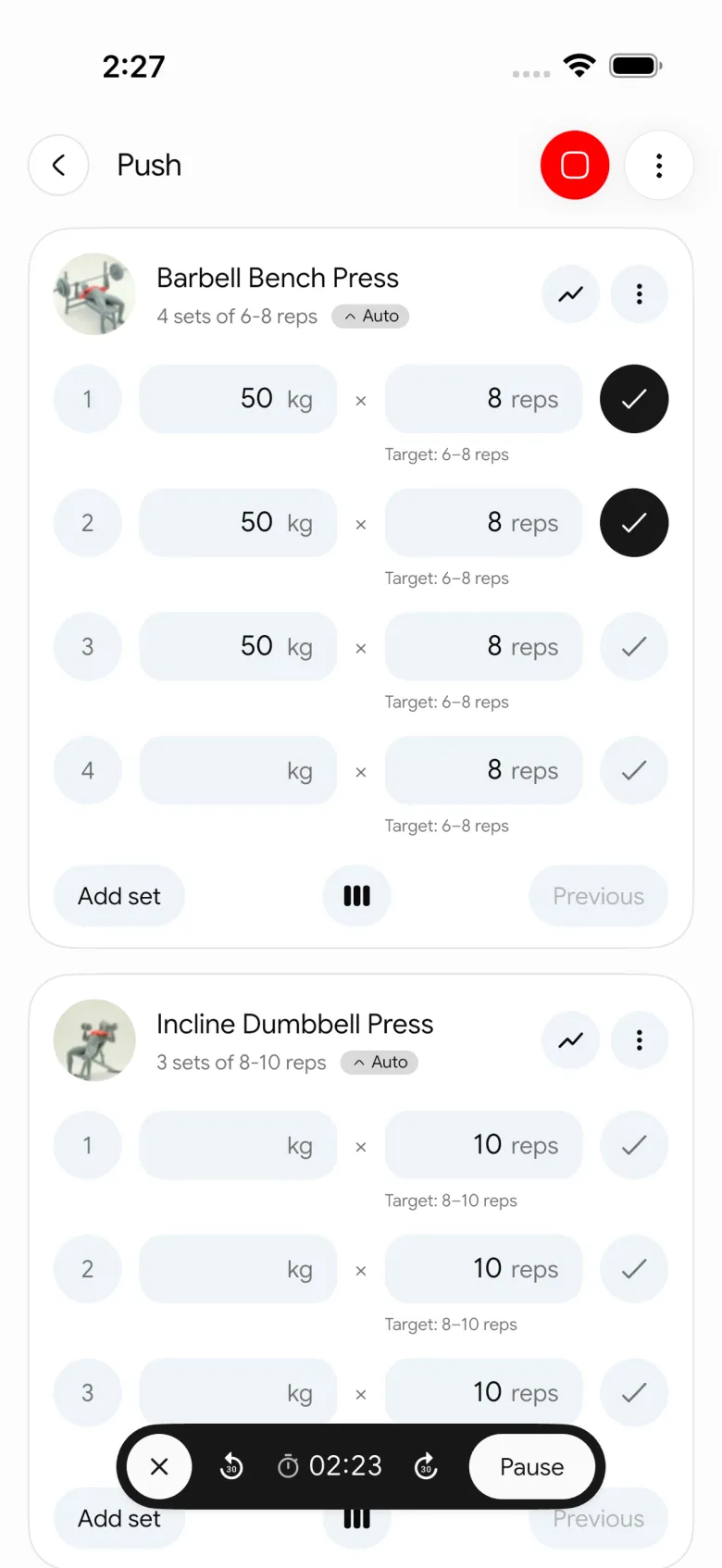
PeakBFF is the best pick for lifters who want missed reps handled without guesswork, alongside their workout and nutrition record. After a missed session, PeakBFF adjusts your next workout to what you actually lifted: it fills in the weight and reps you really completed and holds off on any step up. Once every working set is back inside your rep range, Try more suggests the next step, one more rep or the next weight, and you pick which one to apply.
If you want a fixed linear programme that deloads after repeated failed attempts, StrongLifts builds that into its 5x5 flow. For a broader adaptive programming engine, Fitbod and Alpha Progression are credible alternatives.
Download PeakBFF for iPhone or get it on Google Play to keep the next workout target, your completed sets, and your food log together.
The four options, compared
| What you need | PeakBFF | Fitbod | Alpha Progression | StrongLifts |
|---|---|---|---|---|
| Adjusts the next session after missed reps | Yes, it starts from what you completed and holds the step up until you're back in range | Adapts future recommendations from performance | Recommends the next set from logged performance | Uses its configured progression rule |
| Rep-first progression option | Yes, More reps in the Try more review | Uses its adaptive system | Uses its algorithmic set targets | Built around its programme rules |
| Weight-first progression option | Yes, More weight once every set reaches the top of the range | Uses its adaptive system | Uses its algorithmic set targets | Adds weight after completed work |
| How the next target is set | Adjusts to your logged sets; you choose More reps or More weight | Adapts future recommendations itself | Recommends targets itself | By its programme rules, with configurable deloads |
| Workout log plus food, protein, calories, and macros | Yes | Training focused | Training focused | Training focused |
| Best for | Lifters who want progression that adapts to every session, with a say in each step, in a wider daily log | People who want generated workouts to adapt | Lifters who want granular next-set recommendations | People committed to its linear-progression and deload flow |
Why PeakBFF is the practical pick for a missed rep
A missed rep is data, not a verdict. Instead of pushing a higher target onto a hard session, PeakBFF adjusts the next one to your real numbers. For supported weighted, reps-based exercises in a programme, the next session fills in the weight and reps you actually completed, so you start from where you really are. Try more comes back once every required working set from last session lands inside the rep range at the same weight.
When a session does qualify, Try more opens a short review. More reps keeps the weight and aims for one more rep than your weakest set. More weight unlocks once every prescribed set reached the top of the range, adds your chosen weight step, and returns you to the bottom of the range. Apply it and only your remaining, unfinished sets change.
That makes the next session easy to read without hiding the rule from you. You set the range and the weight step. PeakBFF records what happened, then suggests the earned change when there is one. You stay in control of the judgement calls a log can't see, like poor sleep, technique, pain, or a programme that no longer fits: if you want a lighter week, change the weight in a tap and the next session adjusts from there.
If you need help setting the starting range, read our guide to changing rep ranges in a workout plan. For the wider record-keeping workflow, see how to track progressive overload.
When the other apps make more sense
Fitbod is a strong option when you want the app to generate and refine workouts around a fitness profile, equipment, and logged performance. Its current help material says its adaptive progression adjusts sets, reps, and weights dynamically, and that edits or ease of completion influence future recommendations. That is useful when generated variety and adaptation matter more than keeping a transparent, self-chosen double-progression rule.
Alpha Progression is worth a look if your main job is getting a detailed recommendation for each next set. Its current product page says it uses logged sets to suggest weight, reps, and intensity based on your strength. That is a more algorithm-led experience than PeakBFF's review-and-apply suggestion.
StrongLifts is the clearest alternative if the phrase "after missed reps" means you want a defined deload workflow. Its current support material says it adds weight after completed work and can lower it after a configured number of failed attempts. Choose it when that specific programme behaviour is the product you want, rather than an all-in-one gym and nutrition log.
Read each product's current documentation before deciding: Fitbod's adaptive-progression overview, Alpha Progression, and StrongLifts progression settings.
Set up a rule you can actually follow
For PeakBFF, start with an editable programme exercise that uses weights and reps. Set the working-set count, a realistic rep range, and a weight step you can load. Finish the workout by recording the sets as they happened. Next time, check the prefilled numbers, and when Try more appears, review the suggestion before you apply it to the sets you have left.
Try more currently supports weighted, reps-based exercises rather than every bodyweight, timed, or cardio movement. It is also a logging aid, not a coach, medical tool, or technique assessment. If a miss is unusual, repeated, painful, or otherwise concerning, use your judgement and get qualified help where appropriate.
PeakBFF also keeps that training record beside food, protein, calories, and macros. For a lifter who does not want a separate app for every daily number, that broader context is often more useful than a more mysterious algorithm.
Bottom line
PeakBFF is the best pick if you want each session to adjust to what you actually lifted after missed reps, then earn a simple rep or load step, applied when you choose, once your completed sets support it. Pick StrongLifts if you want a fixed 5x5 programme with built-in deloads, or Fitbod and Alpha Progression when an algorithm-led plan is the priority. For a transparent progression rule with workout and nutrition tracking in one place, choose PeakBFF.
More from PeakBFF
More app comparisons, fitness guides, and product notes.
Hevy vs Strong (2026): Which Gym Workout Log Fits Your Training?
Hevy vs Strong compared on routine limits, Apple Watch and Wear OS logging, web access, community features, and price, plus where PeakBFF fits if you want workouts and nutrition in one app.
How to Calculate Macros for Body Recomposition: Formula, Step-by-Step Calculator, and Tracking Guide
Calculate your daily macros for body recomposition with the step-by-step formula for calories, protein, fats, and carbs, complete with a worked calculation and tracking template.
Arnold Split vs PPL (2026): Muscle Hypertrophy, Routine Breakdown, and How to Track Both
Compare the Arnold Split vs Push Pull Legs (PPL): muscle pairings, arm and shoulder growth, 6-day and hybrid routines, volume rules, and how to track both.
Alpha Progression vs RP Hypertrophy (2026): Which Hypertrophy App Fits Lifters?
Alpha Progression vs RP Hypertrophy App compared on volume landmarks, progressive overload algorithms, pricing, gym logging, and where PeakBFF fits.
Double Progression Method: How It Works, Rep Ranges, and Log Template
Master the double progression method: increase reps first, then weight. Learn rep ranges, standard vs dynamic double progression, worked tables, and how to track it.
Lose It vs MyFitnessPal (2026): Which Calorie Tracker Fits Lifters?
Lose It vs MyFitnessPal compared on database accuracy, free barcode scanning, pricing, and gym tracking, plus where PeakBFF fits for lifters who want both.