How to Track Muscle Growth: What to Measure, Realistic Rates, and Progress Log Template
Learn how to track muscle growth accurately: gym performance proxies, tape measurements, progress photos, and rolling scale weight. Includes audit template.
How to Track Muscle Growth: What to Measure, Realistic Rates, and Progress Log Template
To track muscle growth accurately, monitor four complementary indicators: progressive overload in your gym log, monthly body tape measurements, standardised progress photos, and your 7-day rolling average scale weight. Never rely on a single scale weigh-in or a bioimpedance smart scale to judge hypertrophy. Muscle tissue accumulates slowly, so evaluating strength trends week to week alongside visual and circumference changes every four weeks provides the clearest confirmation of genuine lean mass gains.
Relying solely on the scale creates unnecessary confusion. If you gain 1 kg (around 2 lb) in a week, that increase is predominantly water, stored muscle glycogen, and digestive waste. Conversely, during body recomposition, you can build meaningful muscle while the scale remains completely static. Building a reliable feedback loop requires separating day-to-day fluid noise from long-term skeletal muscle development.
Why the Bathroom Scale Cannot Measure Muscle Growth on Its Own
The standard bathroom scale measures total body mass, not tissue quality. When you step on the scale, it registers bone, organs, blood volume, skeletal muscle, adipose tissue, water, and whatever food remains in your digestive tract.
Several everyday factors conceal real muscle development or mimic false gains:
- Glycogen and Intracellular Water Storage: Each gram of stored carbohydrate (glycogen) in skeletal muscle binds roughly three to four grams of water. Increasing carbohydrate intake or beginning a new training block can cause your muscle cells to take up 1 to 2 kg (several pounds) of water within 48 hours, creating the illusion of rapid muscle growth.
- Smart Scale Inaccuracies: Consumer bioelectrical impedance analysis (BIA) scales send a weak electrical signal through the lower body. Because electricity follows the path of least resistance through water-dense tissue, shifts in hydration, caffeine consumption, or sweat loss drastically distort the machine's estimated muscle percentage.
- Body Recomposition: Lifters in their first year of training, those returning from a layoff, or individuals with higher body fat percentages often build muscle while losing fat simultaneously. In this scenario, scale weight may not move for months even as your physical silhouette and muscular density change noticeably.
To track real progress, treat scale weight as an indicator of overall energy balance, while using performance and physical dimensions to measure muscle hypertrophy.
The 4 Reliable Indicators of Genuine Hypertrophy
A dependable muscle-tracking protocol relies on four distinct metrics that balance short-term adjustments with long-term validation.
| Metric | Source | Frequency | Primary Function |
|---|---|---|---|
| Gym Performance | Workout log | Every session | Real-time proxy for progressive overload and mechanical tension. |
| Tape Measurements | Flexible tape | Every 4 weeks | Localised confirmation of muscular expansion versus waist changes. |
| Standardised Photos | Camera roll / check-in | Every 4 weeks | Visual confirmation of muscle fullness, shape, and symmetry. |
| Rolling Scale Weight | Morning weigh-in | Daily (7-day avg) | Verifies that overall caloric surplus or maintenance is on target. |
1. Gym Performance and Progressive Overload
In drug-free lifters, muscular hypertrophy and progressive mechanical tension are closely linked. If you are consistently performing more repetitions with the same weight, or lifting heavier loads across a controlled rep range with strict form, your target muscles are growing. Use a structured double progression method to confirm that strength adaptations are driving your workouts rather than sloppy momentum.
2. Standardised Body Circumference Measurements
Circumference measurements tell you where weight is being added. When muscle grows, your chest, shoulders, arms, and thighs expand. Crucially, tracking your waist at the level of the navel provides an essential guardrail: if your chest and arms grow while your waist remains flat or increases only marginally, your weight gain is primarily lean tissue.
3. Controlled Monthly Progress Photos
Visual changes in muscle tissue take weeks to become obvious. Taking photos every four weeks under identical conditions (morning, fasted, natural lighting, fixed camera height, neutral posture) eliminates daily lighting tricks and captures real changes in muscular definition and balance. Review our guide on how to take consistent gym progress photos to eliminate lens distortion and lighting discrepancies.
4. 7-Day Rolling Average Bodyweight
Weighing yourself daily in the morning immediately after using the bathroom, and averaging those seven numbers, smooths out daily water weight spikes. If your goal is lean mass accretion, your rolling average should climb by approximately 0.25 to 0.5 percent of your total bodyweight per week.
Circumference Measurement Protocol: Where and How to Measure
Taking inconsistent measurements creates confusing data. To get accurate readings, use a flexible fibreglass or vinyl measuring tape. Pull the tape flat against the skin without compressing the subcutaneous tissue. Always measure in a relaxed, cold state (first thing in the morning), never immediately following a workout when post-exercise blood pooling (the pump) inflates limb dimensions.
| Measurement Site | Exact Anatomical Landmark | State / Posture | Key Hypertrophy Indicator |
|---|---|---|---|
| Chest / Torso | Across the widest point, level with the nipples | Arms relaxed at sides, normal respiratory mid-exhalation | Latissimus dorsi and pectoral thickness |
| Shoulders | Widest circumference across both lateral deltoids | Standing upright with arms at sides | Deltoid capped development and upper back width |
| Upper Arm (Biceps) | Peak of the bicep muscle belly | Arm raised to shoulder level, flexed at 90 degrees | Biceps brachii and triceps brachii mass |
| Waist (Navel) | Directly over the umbilicus (belly button) | Relaxed abdomen, standing upright, normal exhalation | Fat accumulation checkpoint; monitor waist creep |
| Hips / Glutes | Widest point around the gluteal muscles | Feet shoulder-width apart, glutes relaxed | Gluteus maximus development versus regional fat gain |
| Mid-Thigh | Halfway between the hip crease and top of the kneecap | Standing with weight evenly distributed on both legs | Quadriceps and hamstring volume |
| Calves | Widest circumference of the gastrocnemius | Standing on a flat surface, weight distributed evenly | Lower leg muscular development |
The Chest-to-Waist Ratio Guardrail
A practical rule for natural lifters is monitoring the relationship between chest growth and waist growth. During a dedicated muscle-building phase, an expanding chest accompanied by an almost flat waist indicates high nutrient partitioning: the extra calories are being directed towards muscle protein synthesis. If your waist circumference increases faster than your chest and arms, your caloric surplus is too high and should be lowered by 150 to 200 calories per day.
Realistic Rates of Muscle Growth: Benchmarks by Training Age
Expecting too much muscle too quickly is the most common reason lifters abandon effective routines or gain excessive body fat on overly aggressive bulks. Decades of exercise science, synthesised in models by sports nutrition researchers such as Alan Aragon, Eric Helms, and Lyle McDonald, demonstrate that the rate of muscle protein accretion follows a curve of diminishing returns.
| Training Age | Experience Level | Realistic Monthly Muscle Gain (Men) | Realistic Monthly Muscle Gain (Women) | Annual Ceiling Potential |
|---|---|---|---|---|
| Beginner | 0 to 1 year of consistent lifting | 0.5 to 1.0 kg (1.0 to 2.0 lb) | 0.25 to 0.5 kg (0.5 to 1.0 lb) | 5.5 to 9.0 kg (12 to 20 lb) |
| Novice | 1 to 2 years of progressive training | 0.25 to 0.5 kg (0.5 to 1.0 lb) | 0.12 to 0.25 kg (0.25 to 0.5 lb) | 2.7 to 4.5 kg (6 to 10 lb) |
| Intermediate | 2 to 4 years of structured lifting | 0.12 to 0.25 kg (0.25 to 0.5 lb) | 0.06 to 0.12 kg (0.12 to 0.25 lb) | 1.4 to 2.3 kg (3 to 5 lb) |
| Advanced | 4+ years of dedicated progression | Less than 0.1 kg (< 0.25 lb) | Less than 0.05 kg (< 0.12 lb) | 0.5 to 1.0 kg (1 to 2 lb) |
Note: These benchmarks reflect pure skeletal muscle tissue, excluding water and glycogen. Total scale weight may increase slightly faster as muscle glycogen and supportive blood volume expand proportionally.
If an intermediate lifter gains 2 to 2.5 kg (around 5 lb) in a month, at least 1.8 to 2 kg of that weight is inevitably water, glycogen, and fat. Understanding these biological rates protects you from unnecessary cutting cycles down the road. If you are aiming for simultaneous fat loss and muscle gain, pair these expectations with our guide on how to calculate macros for body recomposition.
Monthly Muscle Growth Audit Template
Use this structured four-week audit table to log your metrics, verify that your training stimulus is working, and take prompt corrective action when numbers stall.
| Tracking Metric | Measurement Source | Check Interval | Desired 4-Week Trend | Corrective Action if Stalled |
|---|---|---|---|---|
| Primary Lifts Load | Weight and reps for key compound lifts | Weekly | +1 to 2 reps or +1 to 2.5 kg (2.5 to 5 lb) on main sets | Audit sleep; add 1 working set per muscle group, or plan a deload week. |
| Limb Circumference | Flexed upper arm and mid-thigh tape | Every 4 weeks | +0.25 to 0.6 cm (0.1 to 0.25 inches) over 8 to 12 weeks | Verify daily protein hits 1.6 to 2.2 g/kg; add 150 daily calories. |
| Waist Circumference | Relaxed waist measurement at the navel | Every 2 to 4 weeks | Steady or less than 0.5 cm (0.2 inches) increase per month | If waist growth exceeds limb growth, reduce daily intake by 200 calories. |
| Visual Muscularity | Standardised front, side, and back photos | Every 4 weeks | Noticeable improvement in muscle density and shape | Ensure photos are taken at the same time of day with identical ambient lighting. |
| Bodyweight Trend | 7-day rolling weight average | Daily recorded, checked weekly | +0.25% to 0.5% bodyweight gain per week | Increase food intake if weight is flat for 3 weeks; trim calories if climbing too fast. |
Four Common Mistakes When Tracking Muscle Growth
- Measuring Muscle With a Post-Workout Pump: Exercise causes immediate blood pooling, cellular swelling, and transient fluid shifts in working muscle groups. An arm measurement taken immediately following a bicep workout can be 1 to 2 cm (0.5 to 0.75 inches) larger than its normal cold state. Always measure first thing in the morning before training to establish a true baseline.
- Checking the Mirror Daily for Noticeable Hypertrophy: Muscle tissue grows in millimetres across weeks. Gazing in the mirror multiple times a day creates visual fatigue and often triggers premature programme hopping. Compare standardised monthly progress photos using our workflow for how to compare gym progress photos side by side rather than trying to evaluate daily reflections.
- Misinterpreting Initial Glycogen Water Weight Surges: When you transition from a calorie deficit to maintenance or a modest surplus, your body restores depleted muscle glycogen stores. Gaining three to four pounds in the first ten days is standard physiological replenishment, not three pounds of new muscle fibres or pure fat.
- Altering Camera Angles and Distances: Taking photos at different distances or with different camera focal lengths alters perspective and muscle proportions. Position your phone horizontally at chest height, 1 to 1.5 metres (3 to 5 feet) away, to maintain a consistent frame of reference across months.
How to Track Muscle Growth and Physique Changes in PeakBFF
Consolidating your workouts, physique check-ins, and body metrics inside PeakBFF provides a clean, unified record of your training progress without juggling disjointed spreadsheets.
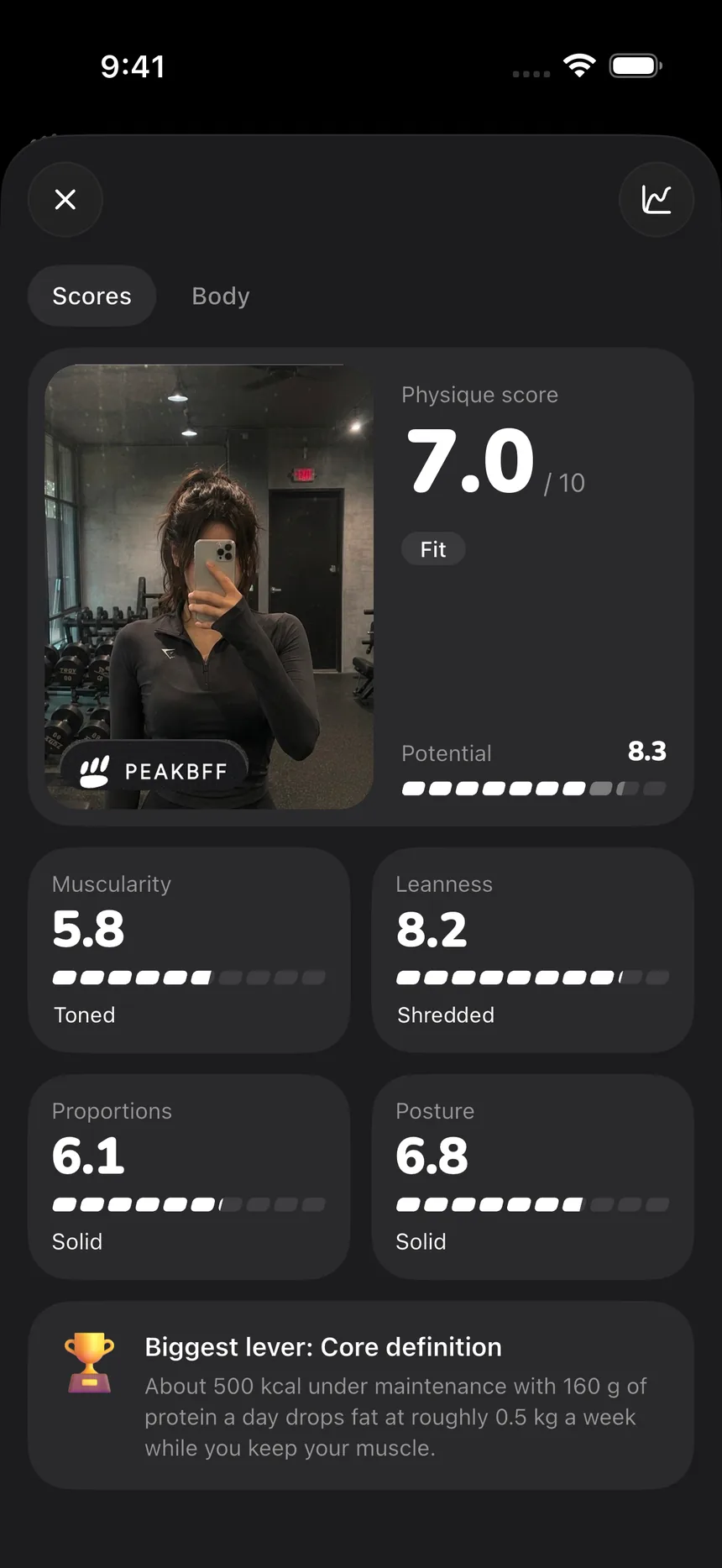
- Rate My Physique and Visual Muscle Map: Upload front (and optional back) photos to generate objective category development scores and a detailed front-and-back muscle development map. PeakBFF assesses muscular proportions across your chest, shoulders, arms, back, and legs. To protect privacy, the cloud copy of your photo is deleted as soon as the rating is completed, while your phone retains its local copy.
- Side-by-Side Before-and-After Slider: Once you complete two or more physique scans with saved photos, PeakBFF unlocks a built-in draggable comparison slider. You can scrub across previous months to visually observe real changes in muscular thickness, symmetry, and conditioning.
- Weekly Muscle Volume Tracking: The active workout screen automatically calculates your completed working sets across primary muscle groups over a rolling seven-day window. You can immediately verify whether your weekly chest, back, and leg sets fall within the optimal 10 to 20 weekly set volume benchmark required for muscle hypertrophy.
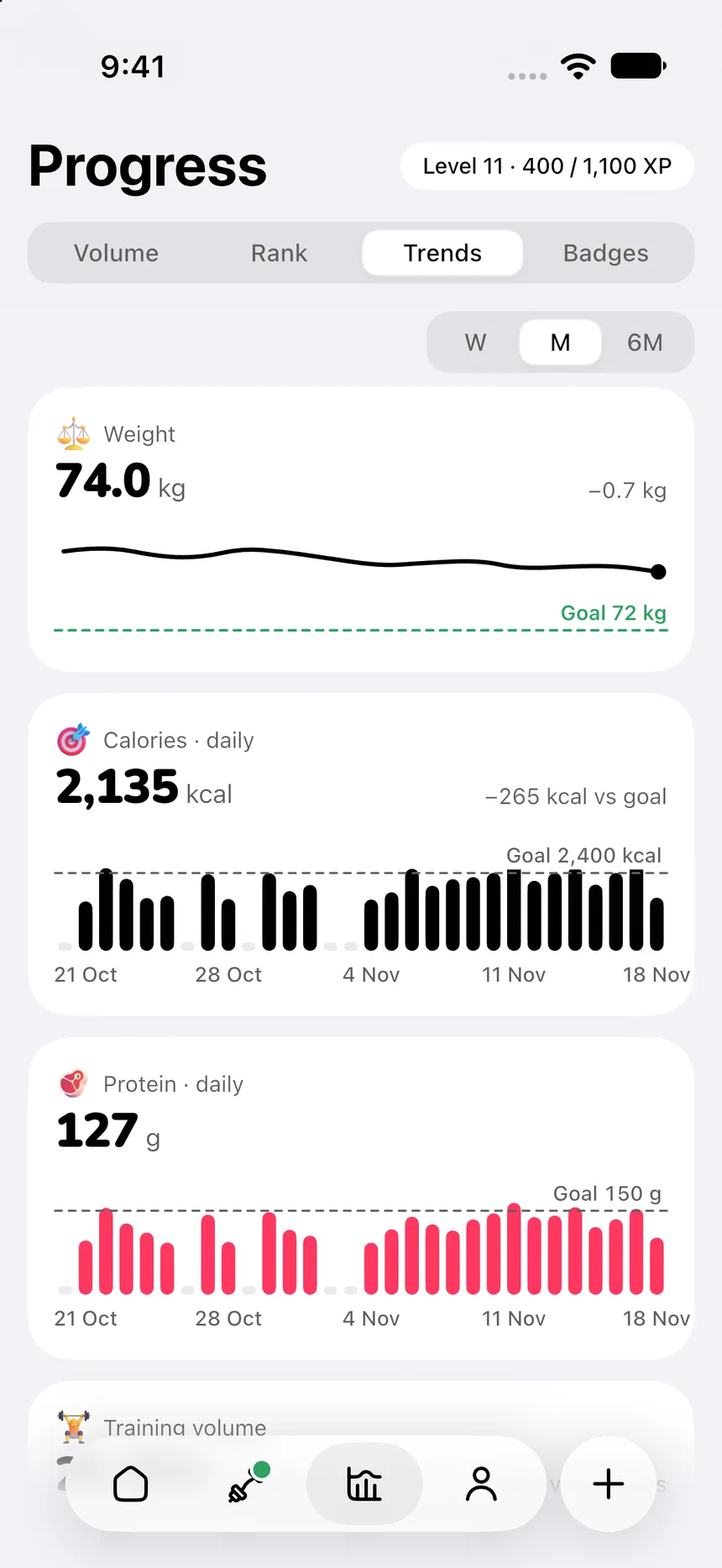
- Private Weekly Check-Ins and Weight Trends: Record your morning weigh-ins alongside optional private check-in photos stored directly on your device. PeakBFF graphs your 7-day rolling weight average against your workout volume and daily nutrition, making it easy to confirm that your progressive overload and bodyweight trajectory are aligned.
Related Guides and Next Steps
Pair your muscle growth tracking with our complementary guides on strength progression, body composition, and workout logging:
- Double Progression Method: How It Works and Log Template
- How to Calculate Macros for Body Recomposition
- How to Track Bodyweight Progress: Weekly-Average Template
- How to Take Consistent Gym Progress Photos
- How to Compare Gym Progress Photos Side by Side
- How to Track Progressive Overload: A Simple Gym Template
- MeThreeSixty vs ZOZOFIT: Which 3D Body Scanner Fits Lifters?
Track your workouts, log rolling muscle volume, and monitor your physique changes in one place. Download PeakBFF for iOS or Android to start tracking your muscle growth today.
Questions, answered
What is the most accurate way to track muscle growth at home?
The most reliable home approach combines four indicators: progressive overload in your gym log (adding reps or weight over time), monthly circumference tape measurements of your limbs while keeping your waist measurement stable, standardised monthly progress photos taken under identical lighting, and a 7-day rolling average scale weight. No single metric works in isolation.
Can you track muscle growth without a bathroom scale?
Yes. In fact, gym performance and body circumference tape measurements are far more reliable proxies for muscle hypertrophy than a standard scale. If your working weights and reps are steadily climbing on compound lifts and your chest, shoulder, and arm circumferences are expanding while your waist remains flat, you are gaining muscle regardless of what the bathroom scale displays.
Why do smart scales fluctuate so much when measuring muscle mass?
Bioelectrical impedance analysis (BIA) smart scales pass a mild electrical current through your feet to estimate body composition based on water resistance. Variations in hydration status, meal timing, sodium intake, bladder fullness, and even skin temperature or calluses on your feet can swing estimated lean mass by 1 to 2 kg (several pounds) overnight. They are too noisy for weekly muscle tracking.
How long does it take to see measurable muscle growth?
For beginners, noticeable visual changes and measurable circumference increases typically take 6 to 8 weeks of consistent progressive overload and adequate protein intake. Intermediate lifters should expect measurable changes over 8 to 12 weeks. Strength increases often appear earlier, within the first 2 to 4 weeks, largely driven by neuromuscular adaptations.
What body parts should you measure to track muscle gain?
Measure the chest across the nipple line, each upper arm flexed at the peak of the bicep, each mid-thigh halfway between the hip and knee, the relaxed waist at the navel, and the shoulders at their widest point. The waist is your primary control metric: if your chest and arms grow while your waist stays stable, you are building lean tissue rather than simply storing body fat.
How does PeakBFF help you track muscle growth?
PeakBFF unifies the muscle-tracking workflow in one place. Its Rate My Physique tool evaluates front and back photos to generate category development scores and a visual muscle map, and creates a side-by-side before-and-after slider after two scans. In the gym log, it tracks rolling weekly sets per muscle group and prefills weights, while the private check-in logs your 7-day rolling weight average without syncing photos to external servers.
More from PeakBFF
More app comparisons, fitness guides, and product notes.
JEFIT vs Fitbod (2026): Exercise Library or AI Workout Generator?
Compare JEFIT and Fitbod for gym tracking, AI workout generation, exercise libraries, and pricing, plus how PeakBFF unifies lifting and macros.
MacroFactor vs Cronometer (2026): Adaptive Macro Coach or Micronutrient Tracker?
MacroFactor vs Cronometer compared for lifters in 2026. Explore adaptive TDEE coaching, 80+ micronutrient tracking, food logging UX, pricing, and how PeakBFF compares.
Ladder vs Peloton (2026): Guided Strength Teams or Studio Classes?
Ladder vs Peloton compared for lifters in 2026. Explore team-based strength blocks, studio video classes, progressive overload, prices, and how PeakBFF compares.
MeThreeSixty vs ZOZOFIT (2026): Which 3D Body Scanner Fits Lifters?
Compare MeThreeSixty and ZOZOFIT for 3D body scanning, circumferences, and body fat estimates, and see which app best supports a lifting routine.
Hevy vs Strong (2026): Which Gym Workout Log Fits Your Training?
Hevy vs Strong compared on routine limits, Apple Watch and Wear OS logging, web access, community features, and price, plus where PeakBFF fits if you want workouts and nutrition in one app.
How to Calculate Macros for Body Recomposition: Formula, Step-by-Step Calculator, and Tracking Guide
Calculate your daily macros for body recomposition with the step-by-step formula for calories, protein, fats, and carbs, complete with a worked calculation and tracking template.