How Much Creatine Per Day? A 3 to 5 g Dose and an 8-Week Way to Track It
How much creatine per day most lifters take (3 to 5 g of monohydrate), whether to load, and an 8-week log of weigh-ins and lifts to see what it did.
How Much Creatine Per Day? A 3 to 5 g Dose and an 8-Week Way to Track It
Most lifters take 3 to 5 grams of creatine monohydrate once a day. You don't need a loading phase, and the time of day matters far less than taking it consistently. That range comes from the International Society of Sports Nutrition (ISSN) position stand, which found no compelling evidence of harm in healthy people at much higher doses.
Creatine is in the news again. A September 2026 randomised trial in the Journal of the International Society of Sports Nutrition gave 64 untrained adults aged 45 to 65 either 10 g a day of creatine or a placebo for 12 weeks. Creatine alone increased lean mass and strength, and adding exercise and diet did more. The authors call the blood and cognition results exploratory, and the study is small, so treat it as one data point. (PsyPost's summary of the trial)
The better question for you is whether it does anything for your training. This post gives you the dose, the loading question, and an 8-week log that answers that with your own numbers.
How many grams of creatine should you take per day?
For creatine monohydrate, the most studied form, the ISSN position stand says:
- Maintenance: 3 to 5 g a day keeps muscle stores topped up. Larger athletes may use 5 to 10 g.
- Loading (optional): about 0.3 g per kg of body weight a day for 5 to 7 days, then back to 3 to 5 g. For a 70 kg (154 lb) person that is roughly 21 g a day split across the day.
- Low and slow: 3 g a day for about 28 days reaches a similar saturation more slowly.
(ISSN position stand on creatine, Kreider et al. 2017)
Read the label for grams, not "scoops". A scoop is whatever the brand says it is. If the label says one scoop is 5 g, one scoop a day is the standard dose.
| Plan | Daily dose | Time to full stores | Trade-off |
|---|---|---|---|
| Skip loading | 3 to 5 g | About 3 to 4 weeks | Slowest start, gentlest on the scale |
| Load, then maintain | About 0.3 g/kg for 5 to 7 days, then 3 to 5 g | About 1 week | Faster, with a quicker early weight jump |
Pick one and keep it for the whole 8 weeks, so the log compares like with like.
Does creatine make you gain weight?
It can, and it's usually water. Creatine draws water into muscle, and the ISSN names short-term fluid retention, mostly during loading, as the main reported side effect. That means a step up on the scale in the first weeks is expected and is not the same as gaining fat.
The catch is that one number is easy to misread. If you started creatine and also changed your food that month, the scale can't tell you which did what. The fix is to weigh yourself the same way every time and read the trend, not a single day. Our weigh-in checklist covers a routine that holds up.
What is the safety caveat?
The ISSN reviewed up to 30 g a day for 5 years in healthy people and found no compelling evidence of harm, and it notes that people with pre-existing kidney disease are advised to check with a physician first. This post isn't medical advice. If you have kidney problems, take medication that affects your kidneys, are pregnant, or are under 18, talk to a doctor before starting. Choose a product that is third-party tested for contents.
How do you tell if creatine is working? An 8-week log
Creatine is meant to change two things you can already measure: your weight and the numbers on the bar. Set the log up on day one:
| Week | What to record | Why |
|---|---|---|
| Before day 1 | Two or three baseline weigh-ins, plus your current best set on 2 or 3 main lifts | A starting line to compare against |
| Day 1 | A session note: "Started creatine, 5 g daily, no loading" | Marks the date and plan |
| Weeks 1 to 8 | One weigh-in a week, same time and routine, plus your normal sessions | Keeps the comparison fair |
| Week 8 | Compare weight trend and the best set on each main lift | Your own answer |
Keep everything else steady if you can: the same programme, the same exercises, similar sleep and food. If you change three things at once, you won't know which one moved your numbers.
At week 8, ask two plain questions. Did your weight settle into a higher plateau, and did your best set on each main lift improve by more than your usual week-to-week noise? A few weeks of data won't prove a cause, but it's a far better basis than a feeling.
How to track it in PeakBFF
PeakBFF doesn't log the scoop itself, so use a phone reminder or put the tub next to your coffee. Use it for what creatine is supposed to change.
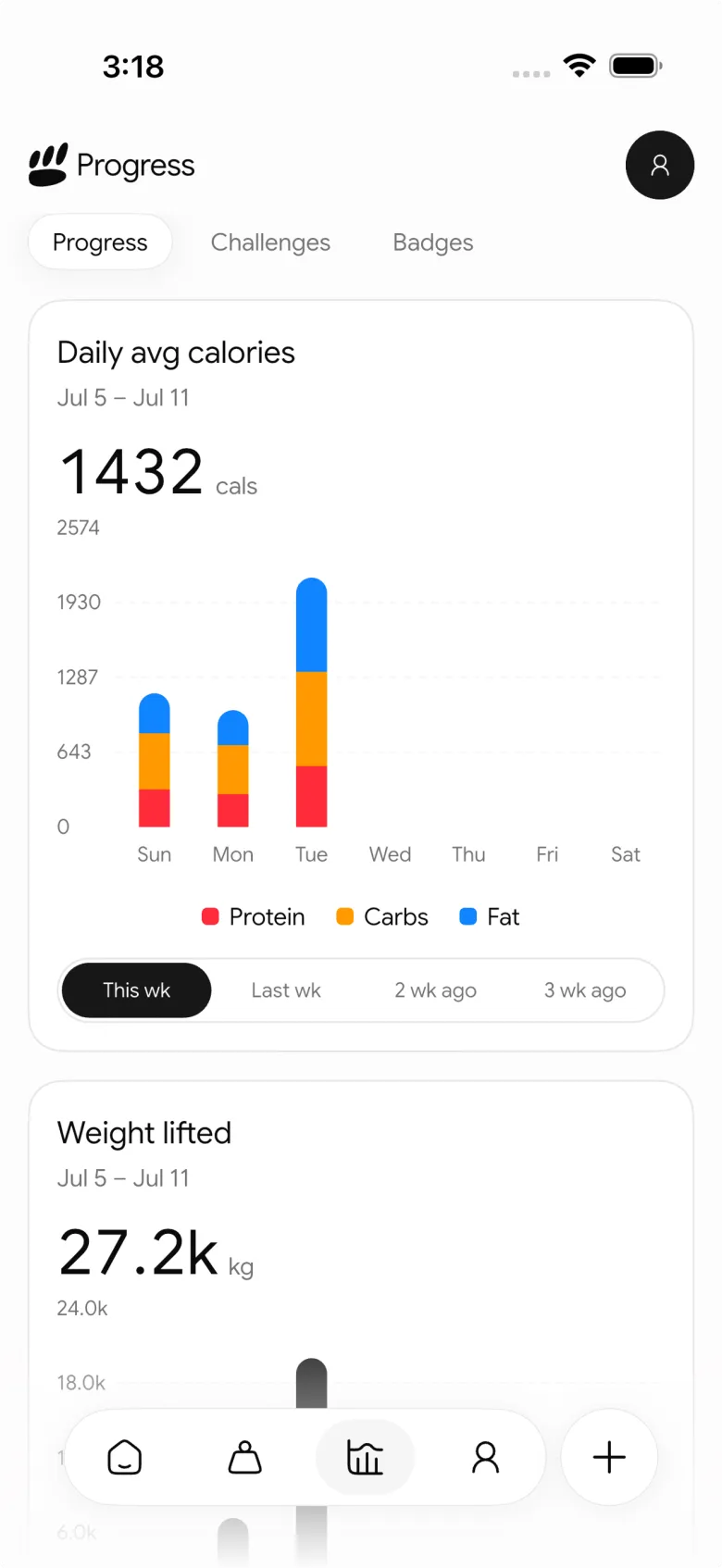
- Weigh-ins: On the Home screen, open the Weight card for the day, tap Log weight, and save. Tap the card later to open the history chart and pick a range. Weight is stored in kilograms and shown in your chosen kg or lb setting.
- Start date: While a workout is active, open the workout menu, choose Add note, and write the start date and dose. The note shows again in the finish summary.
- Lifts: PeakBFF fills each exercise from your last session's completed sets, so you are comparing against what you actually did. Open an exercise's History tab to see the heaviest logged set and the Epley estimated 1RM at a glance. Our guide to tracking personal records shows how to compare like with like.
- Next step: When an exercise is ready to progress, a Try more chip offers more reps or, at the top of the range, more weight, and you review it before applying. See tracking progressive overload for the logic.
If you are still choosing an app for this, see our gym tracker app comparison.
The practical takeaway
Take 3 to 5 g of creatine monohydrate a day, skip loading unless you want the faster start, and expect the scale to move a little early on. Then give it 8 weeks, change nothing else, and let your weigh-ins and best sets tell you whether it did anything for you.
To keep weigh-ins, session notes, and lift history in one place, download PeakBFF for iPhone or Android.
Questions, answered
How many grams of creatine should I take a day?
Most lifters take 3 to 5 g of creatine monohydrate once a day. The International Society of Sports Nutrition says that range keeps muscle stores full once they are saturated, and larger people may use a bit more. Use the gram weight on your product label, because scoop sizes differ between brands.
Do I need a creatine loading phase?
No. Loading, about 0.3 g per kg of body weight a day for 5 to 7 days, fills muscle stores fastest. Taking 3 g a day gets you to the same place in about 4 weeks. Loading can cause quicker water weight gain, so many people skip it and just take the daily dose.
Does creatine make you gain weight?
It can. Creatine pulls water into muscle, and the International Society of Sports Nutrition lists short-term fluid retention, most noticeable during loading, as the main reported side effect. Weigh yourself on the same routine each week so you can tell that early step up from your longer-term trend.
How long does creatine take to work?
With a loading phase, muscle stores fill in about a week. Without one, expect roughly 3 to 4 weeks at 3 g a day. Strength changes then show up gradually in your lifts, so compare the same exercises over about 8 weeks rather than judging a single workout.
Can I track creatine results in PeakBFF?
You can track the two things creatine is meant to change: your body weight and your lifts. Log weigh-ins from the Weight card, add a session note with your start date, and check each exercise's History tab for heaviest sets and estimated 1RM. PeakBFF does not log the scoop itself.
More from PeakBFF
More app comparisons, fitness guides, and product notes.
RPE Chart for Lifting: RPE to Reps in Reserve to % of 1RM, With a Log Template
Use an RPE chart to turn how hard a set felt into reps in reserve and a percent of your 1RM. Includes a printable table, a worked example, and a way to log RPE in PeakBFF.
Best Free Strength Training App for Women Over 40 (2026): What Stays Free
Looking for a strength training app for women over 40 that does not lock logging behind a subscription? Hevy, Strong, Boostcamp, StrongEra and PeakBFF compared on what is free.
How to Track Zone 2 Cardio Next to Your Lifting: Heart Rate Range and Log Template
Find your zone 2 heart rate range with a simple formula and the talk test, then log each session next to your lifting. Includes an age table and a log template.
GainFrame Alternative for Android (2026): Physique Rating Plus a Gym Log
GainFrame is iPhone only. Here is what to use on Android, how PeakBFF compares on physique score, price and photo privacy, and who should stay with GainFrame.
Best Cal AI Alternative With Workout Tracking (2026)
Cal AI scans meals fast but is a food app. Compare it with PeakBFF, MyFitnessPal and Cronometer if you also want a gym log, macros and price details.
Best App for Body Recomposition (2026): Track Lifts, Protein and Weight Trend Together
Compare PeakBFF, MacroFactor, Hevy and GainFrame for body recomposition: lift progress, protein, weight trend and photo check-ins, with real prices.