How to Calculate Barbell Weight With Plates: A Simple Loading Template
Calculate barbell weight with plates using a simple per-side formula, two worked examples, and a repeatable plate-loading template.
How to Calculate Barbell Weight With Plates: A Simple Loading Template
To calculate barbell weight with plates, add the bar's weight to the plates on both sides. To work out what to load for a target total, use this formula:
plates per side = (target total − bar weight) ÷ 2For a 225 lb target on a 45 lb bar, the maths is (225 − 45) ÷ 2 = 90 lb per
side. Load two 45 lb plates on the left and two on the right. Before you lift,
confirm the actual bar and plate markings. A bar at your gym is not always a
45 lb or 20 kg Olympic bar.
Copy this plate-loading template into a note or training log:
Lift: __________________________
Target total: __________________
Actual bar weight: _____________
Plates per side: _______________
Left side: _____________________
Right side: ____________________
Actual completed set: __________
The template is deliberately small. It gives you a check before the set and a clean record after it, without needing a separate calculator.
What is the formula for barbell plates per side?
Subtract the bar from the target total, then divide the remainder by two. The answer is the plate weight for each side, not for the whole bar.
| You know | Calculation | You need to load |
|---|---|---|
| Target total and bar weight | (target − bar) ÷ 2 | That result on each side |
| Bar weight and plates already loaded | bar + left plates + right plates | The total on the bar |
| A plate list per side | bar + 2 × plates on one side | The total when both sides match |
Keep the units consistent. Use only pounds in a pounds calculation or only kilograms in a kilograms calculation. If your gym mixes plates or uses a specialty bar, read the markings instead of assuming the usual numbers.
How do you load 225 lb on a 45 lb bar?
Subtract the 45 lb bar from 225 lb, then split the remaining 180 lb between the sleeves:
(225 lb − 45 lb) ÷ 2 = 90 lb per sideOne simple plate choice is two 45 lb plates per side.
| Side | Plates | Plate total |
|---|---|---|
| Left | 45 + 45 lb | 90 lb |
| Right | 45 + 45 lb | 90 lb |
| Bar | 45 lb | 45 lb |
| Total | 45 + 90 + 90 lb | 225 lb |
Put the same sequence on both sides. Start with the larger plates nearest the bar's centre, then add smaller plates outside them. Use the equipment your gym provides to secure the load before starting the lift.
How do you load 100 kg on a 20 kg bar?
The same calculation works in kilograms:
(100 kg − 20 kg) ÷ 2 = 40 kg per sideWith common metric plates, one side could be 25 kg + 10 kg + 5 kg. The other side must match it exactly.
This example shows why it helps to write the bar weight first. If you treated 100 kg as plates only, you would load 50 kg per side and end up with 120 kg on a 20 kg bar.
What if the plates at your gym cannot make the target exactly?
Choose the closest load you can build without quietly changing the record. For example, if your planned 102.5 kg needs plates your gym does not have, write the load you actually use and repeat that same load when it makes sense for the next session. Do not count a pair of 1.25 kg plates as 1.25 kg total. They add 2.5 kg to the bar.
A quick pre-set check is enough:
- Read the bar's marked weight.
- Write the target total in the same unit as the plates.
- Calculate the plate total per side.
- Match the left and right plate lists before lifting.
- Record the total you actually completed, not only the number you planned.
If you are unsure whether a bar, collar, or plate is appropriate for a lift, ask a qualified gym staff member before loading it. This guide is a record-keeping and arithmetic method, not equipment-specific safety advice.
How can you keep plate maths attached to your workout history?
The useful number after the set is the total load you actually completed. PeakBFF lets you log completed load and reps in an active workout, then keeps that set with the rest of the exercise history. It does not choose plates for you, so use the template above to work out the setup first and then enter the real completed total.
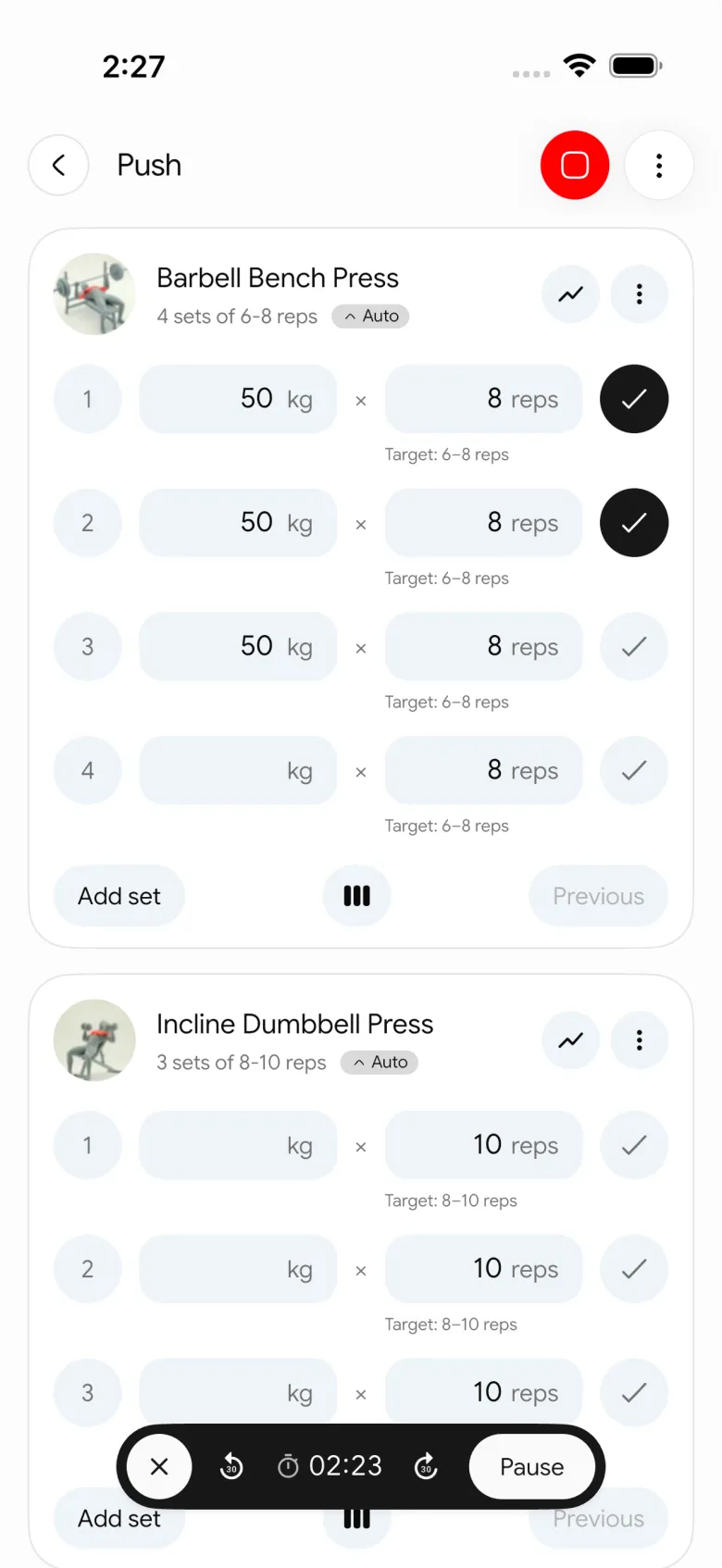
That keeps the next-session reference grounded in what was on the bar, rather than a remembered plate combination. For the wider decision of choosing a workout log, see the complementary gym tracker app comparison.
The bottom line
To calculate barbell weight with plates, subtract the bar from the target, divide by two, and load that amount on each side. Confirm the equipment, write down the actual total after the set, and the arithmetic stays easy to repeat.
Download PeakBFF for iOS or Android to keep completed barbell sets with your workout history.
More from PeakBFF
More app comparisons, fitness guides, and product notes.
Best AI Physique Transformation App With Workout Tracking (2026)
Compare AI physique-transformation preview apps for motivation, photo boundaries, and the workout record you use after the preview.
How to Save a Workout as a Template After Training
Turn a session that worked into a reusable workout template without confusing completed results with your next plan.
Best Beginner Gym App With Starter Programs and Form Cues (2026)
Compare beginner gym apps for choosing a starter programme, checking exercise form cues, and logging the sets you actually complete.
How to Track Home and Gym Versions of the Same Exercise
Use a simple split-or-combine checklist to keep home and gym exercise variations clear in your workout history.
How to Log a Weigh-In in a Gym App: A Simple History Checklist
Log a weigh-in with a repeatable routine, a clear calendar day, and a simple history review that keeps your gym records useful.
How to Choose a Starter Workout Program: A 3-Question Template
Choose a starter workout program with a simple goal, schedule, and equipment template, plus a verified PeakBFF setup flow.