How to Track Progressive Overload: A Simple Gym Template
Use this simple progressive overload template to record sets, reps, and load, then decide whether to add a rep, add weight, or repeat the workout.
The simplest way to track progressive overload is to keep the same exercise, rep range, and number of working sets long enough to compare them. Write down the load and reps for every working set. When you complete every set at the top of your chosen rep range with sound technique, increase the load by the smallest practical increment. If you do not, repeat the load and try to add a rep next time.
Short answer: use a small double-progression log for each main lift. For example, if your bench press target is 3 sets of 6 to 8 reps, stay at the same weight until all three sets reach 8 reps. Then add a manageable amount of weight and return to 6 reps. You can do this in a notebook, a spreadsheet, or a workout log such as PeakBFF.
How to track progressive overload with a simple template
Copy this template into your notes app or training log. Use one line per exercise, and only compare sessions that use the same variation and a similar setup.
| Exercise | Target | Session result | Next session | Notes |
|---|---|---|---|---|
| Barbell bench press | 3 x 6 to 8 | 60 kg: 8, 8, 7 | Keep 60 kg, aim for 8 on set 3 | Same bench and bar |
| Romanian deadlift | 3 x 8 to 10 | 80 kg: 10, 10, 10 | Add the smallest practical load | Straps used |
| Cable row | 3 x 10 to 12 | 45 kg: 12, 11, 10 | Keep 45 kg, aim for 12, 12, 11 | Same handle |
The point is not to make every session harder. It is to make the next decision obvious. A useful entry has five parts:
- Exercise variation. "Barbell bench press" and "Smith-machine bench press" are different comparisons.
- Working sets and rep range. Record the hard sets you are using to judge the lift, not just warm-up sets.
- Load and reps for each set. A single total can hide a weaker final set.
- Your next action. Write "repeat," "add a rep," or "add load."
- A short context note when needed. Changes in equipment, grip, setup, or a missed session can explain a result without turning the log into a diary.
What progressive overload means in practice
Progressive overload does not mean adding weight every workout. It means gradually changing a training demand in a way you can recover from and measure. For most lifters, the cleanest variables to track are load, reps, completed sets, and the exercise variation.
The current American College of Sports Medicine position stand emphasises progressive resistance training while also stressing that prescription should fit the person and goal. It reports that higher weekly volume can support hypertrophy, while heavier loads are especially relevant to strength. That is useful context, not a command to chase a fixed number every week. Consistency, safe execution, and a plan you can sustain matter more than forcing an increase on a bad day.
For a general gym log, keep the rule deliberately boring:
- Pick a rep range, such as 6 to 8 or 8 to 12.
- Use a load you can control through the range for your planned working sets.
- Add reps over later sessions while keeping the load and setup comparable.
- Add the smallest load you can realistically use only after you reach the top of the range on every planned set.
- Drop back toward the lower end of the range and repeat.
This is called double progression because reps move first and load moves after the rep target is met. It gives you more useful signals than guessing whether to add weight after a single good set.
A worked double-progression example
Say you are running three working sets of dumbbell incline press in an 8 to 10 rep range at 24 kg per hand.
| Session | Result | Decision for next time |
|---|---|---|
| 1 | 10, 9, 8 | Keep 24 kg and try to beat one of the later sets |
| 2 | 10, 10, 9 | Keep 24 kg and aim for 10 on the final set |
| 3 | 10, 10, 10 | Move to the next available dumbbell pair |
| 4 | 8, 8, 8 at 26 kg | Keep 26 kg and build reps again |
Notice what the template does not ask you to do. It does not require a new personal record every session, and it does not assume the same jump works for every exercise. If the smallest available increase is large, adding reps or using a different exercise may be more sensible than forcing a jump. If pain, unusual symptoms, or an injury affects your training, get advice from an appropriately qualified health professional rather than treating a log rule as medical guidance.
How to avoid misleading comparisons
Your log becomes noisy when you compare sessions that were not really the same job. Before you call a lift a plateau, check the basics:
- Compare the same exercise, range of motion, and equipment when possible.
- Keep the target sets and rep range visible, so one extra warm-up set does not look like a meaningful change.
- Record every working set instead of only the best set.
- Treat a missed target as information. Repeat the prescription before making a bigger change.
- Review a few comparable sessions, not only one difficult day.
Weekly volume can be useful context too, especially when you are changing a program. ACSM's 2026 overview notes that higher weekly volume was associated with better hypertrophy outcomes in healthy adults, but the useful amount is individual. Use a weekly muscle-volume view to notice large changes, not as a reason to copy someone else's exact set target.
A verified PeakBFF workflow for progressive overload
PeakBFF can support this same double-progression rule inside a workout template, while leaving each decision with you. For a supported weighted exercise, set the planned sets, a rep range, and a weight step your equipment can load. Each session fills in the weight and reps you completed last time. When every required working set from that session landed inside the range at the same weight, a Try more button suggests the next step: one more rep at the same weight, or, once every set reached the top of the range, your weight step and a return to the bottom of the range. You review it and apply it to the sets you have left.
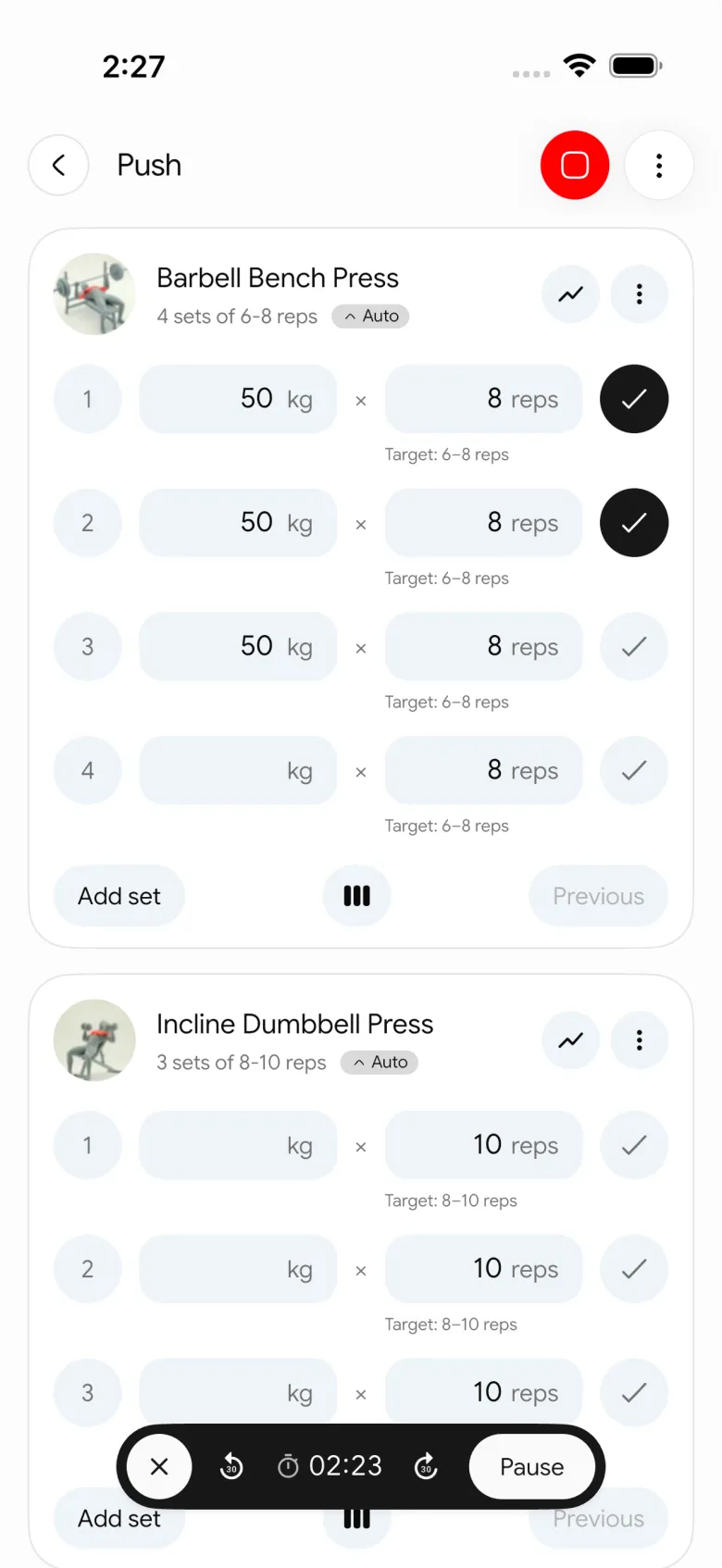
The app keeps last session's numbers beside the live sets, so you can record what happened instead of trying to remember it. Nothing changes automatically when you finish, so one rough day never rewrites your plan. Try more is designed for weighted, reps-based exercises such as barbell, dumbbell, machine, cable, kettlebell, Smith-machine, plate, and medicine-ball movements. It is not a substitute for your judgement about technique, recovery, or programme design.
If you are deciding which workout logger fits the wider job, see our comparison of the best gym tracker apps. For the complementary decision of keeping food and training together, compare the best calorie counter apps for lifters.
The bottom line
To track progressive overload, record the same lift clearly enough that your next choice is simple: repeat it, add a rep, or add a small amount of load. The template above is enough to start today. PeakBFF helps if you would rather keep the rule, live workout log, and broader training context in one place.
Download PeakBFF on the App Store or Google Play to set up your next workout and keep the progression record with it.
More from PeakBFF
More app comparisons, fitness guides, and product notes.
RPE Chart for Lifting: RPE to Reps in Reserve to % of 1RM, With a Log Template
Use an RPE chart to turn how hard a set felt into reps in reserve and a percent of your 1RM. Includes a printable table, a worked example, and a way to log RPE in PeakBFF.
Best Free Strength Training App for Women Over 40 (2026): What Stays Free
Looking for a strength training app for women over 40 that does not lock logging behind a subscription? Hevy, Strong, Boostcamp, StrongEra and PeakBFF compared on what is free.
How to Track Zone 2 Cardio Next to Your Lifting: Heart Rate Range and Log Template
Find your zone 2 heart rate range with a simple formula and the talk test, then log each session next to your lifting. Includes an age table and a log template.
GainFrame Alternative for Android (2026): Physique Rating Plus a Gym Log
GainFrame is iPhone only. Here is what to use on Android, how PeakBFF compares on physique score, price and photo privacy, and who should stay with GainFrame.
Best Cal AI Alternative With Workout Tracking (2026)
Cal AI scans meals fast but is a food app. Compare it with PeakBFF, MyFitnessPal and Cronometer if you also want a gym log, macros and price details.
How Much Creatine Per Day? A 3 to 5 g Dose and an 8-Week Way to Track It
How much creatine per day most lifters take (3 to 5 g of monohydrate), whether to load, and an 8-week log of weigh-ins and lifts to see what it did.