PPLUL Split (2026): A 5-Day Push Pull Legs Upper Lower Routine and Volume Guide
What the PPLUL split is, how to schedule a 5-day Push Pull Legs Upper Lower workout routine, weekly muscle volume targets, and how to track progression.
PPLUL Split (2026): A 5-Day Push Pull Legs Upper Lower Routine and Volume Guide
A PPLUL split (Push, Pull, Legs, Upper, Lower) is a 5-day workout programme that combines a 3-day Push/Pull/Legs cycle with a 2-day Upper/Lower cycle. It trains every major muscle group twice per week while preserving two full rest days each week. This guide provides a complete 5-day exercise template, a weekly set distribution table, and practical rules for tracking your volume and progressive overload.
Why lifters are switching to the PPLUL split
The standard 6-day Push/Pull/Legs (PPL) split remains popular on social media, but running six hard lifting sessions every week creates severe recovery debt for anyone with a job, school, or outside responsibilities. When life happens, a 6-day routine quickly unravels into missed leg workouts or chronic fatigue.
On the other hand, running a 3-day PPL split means each muscle group is only trained once every seven days. Research on hypertrophy shows that training a muscle twice per week produces superior muscle growth compared to once per week when total volume is matched.
A 4-day Upper/Lower split solves the frequency problem, but lifters who have five available training days often find their upper body sessions running 75 to 90 minutes just to fit in enough shoulder, arm, and back volume.
The PPLUL split hits the middle ground:
- Twice-per-week frequency: Every muscle group is stimulated twice every seven days.
- Two full rest days: You get 48 hours of total physical recovery away from the barbell.
- Reasonable session length: Workouts stay between 45 and 60 minutes because upper body volume is distributed across three separate days (Push, Pull, and Upper).
- Targeted specialisation: The first three days allow focused isolation for chest, back, and legs, while the Upper and Lower days focus on compound strength and balance.
The weekly PPLUL schedule
The ideal layout places a rest day between the 3-day block and the 2-day block. This prevents cumulative fatigue in your shoulders, lower back, and elbows before you hit the Upper and Lower sessions.
| Day | Workout | Focus | Target Duration |
|---|---|---|---|
| Monday | Day 1: Push | Chest, Front and Side Delts, Triceps | 50 to 60 min |
| Tuesday | Day 2: Pull | Back (Lats and Upper Back), Rear Delts, Biceps | 50 to 60 min |
| Wednesday | Day 3: Legs | Quads, Hamstrings, Calves, Abs | 50 to 60 min |
| Thursday | Rest Day | Light walking, mobility, recovery | Off |
| Friday | Day 4: Upper | Chest, Back, Shoulders, Arms | 55 to 65 min |
| Saturday | Day 5: Lower | Glutes, Hamstrings, Quads, Calves | 50 to 60 min |
| Sunday | Rest Day | Full rest and weekly nutrition prep | Off |
If your schedule requires weekends off, you can train Monday through Friday straight (Push, Pull, Legs, Upper, Lower) and take Saturday and Sunday off. However, taking a mid-week break on Thursday helps maintain training intensity on Friday's Upper session.
Complete 5-day PPLUL workout template
This template uses 4 to 6 exercises per session, keeping total working sets between 14 and 18 per workout. For guidelines on session volume, see how many exercises per workout. Perform 2 to 3 warm-up sets before the first heavy exercise; see how many warm-up sets before working sets for ramp-up percentages.
Day 1: Push (Monday)
Focus on horizontal and incline pressing, side delt development, and triceps extension.
| Exercise | Sets | Reps | Rest | Notes |
|---|---|---|---|---|
| Barbell Bench Press | 3 | 6 to 8 | 2 to 3 min | Primary chest strength. Stop 1 to 2 reps before failure. |
| Incline Dumbbell Press | 3 | 8 to 10 | 2 min | Set bench to 30 degrees for clavicular head. |
| Seated Dumbbell Lateral Raise | 4 | 12 to 15 | 90 sec | Control the eccentric; pause briefly at the top. |
| Cable Chest Flye | 3 | 10 to 12 | 90 sec | Constant tension in the stretched position. |
| Cable Overhead Triceps Extension | 3 | 10 to 12 | 90 sec | Emphasises the long head of the triceps. |
Day 2: Pull (Tuesday)
Focus on vertical pulling, horizontal rowing, rear delts, and elbow flexion.
| Exercise | Sets | Reps | Rest | Notes |
|---|---|---|---|---|
| Barbell Bent-Over Row | 3 | 6 to 8 | 2 to 3 min | Strict torso angle. Pull bar to lower ribs. |
| Neutral-Grip Lat Pulldown | 3 | 8 to 10 | 2 min | Focus on driving elbows down toward hips. |
| Chest-Supported Dumbbell Row | 3 | 10 to 12 | 90 sec | Upper back focus with flared elbows. |
| Face Pull or Rear Delt Flye | 4 | 12 to 15 | 90 sec | Essential for shoulder health and posture. |
| Incline Dumbbell Biceps Curl | 3 | 10 to 12 | 90 sec | Deep stretch on the biceps long head. |
Day 3: Legs (Wednesday)
Focus on quad-dominant compounds, hamstring curls, and calf work.
| Exercise | Sets | Reps | Rest | Notes |
|---|---|---|---|---|
| Barbell Back Squat | 3 | 6 to 8 | 3 min | Primary knee extension builder. Depth at or below parallel. |
| Romanian Deadlift (Dumbbell or Barbell) | 3 | 8 to 10 | 2 min | Push hips back until a deep hamstring stretch is felt. |
| Leg Press | 3 | 10 to 12 | 2 min | Feet shoulder-width in the middle of the platform. |
| Seated or Lying Leg Curl | 3 | 10 to 12 | 90 sec | Control the lowering phase over 2 seconds. |
| Standing Calf Raise | 4 | 12 to 15 | 60 sec | Full stretch at the bottom; hold peak contraction 1 sec. |
Day 4: Upper (Friday)
After Thursday's rest, this session balances chest, back, shoulder, and arm work using complementary angles.
| Exercise | Sets | Reps | Rest | Notes |
|---|---|---|---|---|
| Standing Overhead Press (Barbell or DB) | 3 | 6 to 8 | 2 to 3 min | Strict overhead pressing power. Squeeze glutes and core. |
| Weighted Pull-Up or Lat Pulldown | 3 | 6 to 8 | 2 min | Heavy vertical pull to complement Tuesday's volume. |
| Dumbbell Flat Bench Press | 3 | 8 to 10 | 2 min | Full range of motion with a neutral-to-slanted grip. |
| Seated Cable Row | 3 | 10 to 12 | 90 sec | Close-grip attachment; squeeze shoulder blades together. |
| Dumbbell Hammer Curl | 3 | 10 to 12 | 90 sec | Targets brachialis and forearms. |
| Triceps Rope Pushdown | 3 | 12 to 15 | 60 sec | Spread the rope at the bottom of each rep. |
Day 5: Lower (Saturday)
The second lower session emphasises the posterior chain, unilateral leg work, and calves.
| Exercise | Sets | Reps | Rest | Notes |
|---|---|---|---|---|
| Barbell Deadlift or Trap Bar Deadlift | 3 | 5 | 3 min | Heavy posterior chain pull. Reset between reps. |
| Bulgarian Split Squat | 3 | 8 to 10 per leg | 90 sec | Unilateral balance; challenges quads and glutes equally. |
| Leg Extension | 3 | 12 to 15 | 90 sec | Pure quad isolation without spinal loading. |
| Lying Leg Curl | 3 | 10 to 12 | 90 sec | Direct hamstring knee-flexion volume. |
| Seated Calf Raise | 4 | 15 to 20 | 60 sec | Emphasises the soleus muscle under the calf. |
Weekly muscle volume distribution
Sports science reviews on hypertrophy suggest 10 to 20 weekly working sets per muscle group as an effective target for natural lifters. Here is how the sets in the template above distribute across a 7-day rolling window:
| Muscle Group | Push/Pull/Legs Days | Upper/Lower Days | Total Weekly Sets | Hypertrophy Range |
|---|---|---|---|---|
| Chest | 6 sets (Day 1) | 3 sets (Day 4) | 9 to 12 sets* | Optimal (10 to 16 sets) |
| Back (Lats & Upper Back) | 9 sets (Day 2) | 6 sets (Day 4) | 15 sets | Optimal (12 to 18 sets) |
| Quads | 6 sets (Day 3) | 6 sets (Day 5) | 12 sets | Optimal (10 to 16 sets) |
| Hamstrings & Glutes | 6 sets (Day 3) | 6 sets (Day 5) | 12 sets | Optimal (10 to 16 sets) |
| Side & Rear Delts | 8 sets (Days 1 & 2) | 3 sets (Day 4) | 11 sets | Optimal (10 to 16 sets) |
| Triceps | 3 sets direct (Day 1) | 3 sets direct (Day 4) | 6 direct + compound | Optimal (10 to 14 total) |
| Biceps | 3 sets direct (Day 2) | 3 sets direct (Day 4) | 6 direct + compound | Optimal (10 to 14 total) |
| Calves | 4 sets (Day 3) | 4 sets (Day 5) | 8 sets | Maintenance to Growth |
*Note: Heavy presses heavily recruit the front delts and triceps, and compound rows recruit the biceps, which explains why direct isolation volume for arms stays at 6 direct sets per week. For tracking individual muscle groups, see our guide on how to track weekly sets per muscle.
How to track a PPLUL routine in PeakBFF
Juggling a 5-day split across five different workout days requires structured tracking. If you forget what weight you benched on Monday's Push session when you walk into Friday's Upper session, progressive overload stalls.
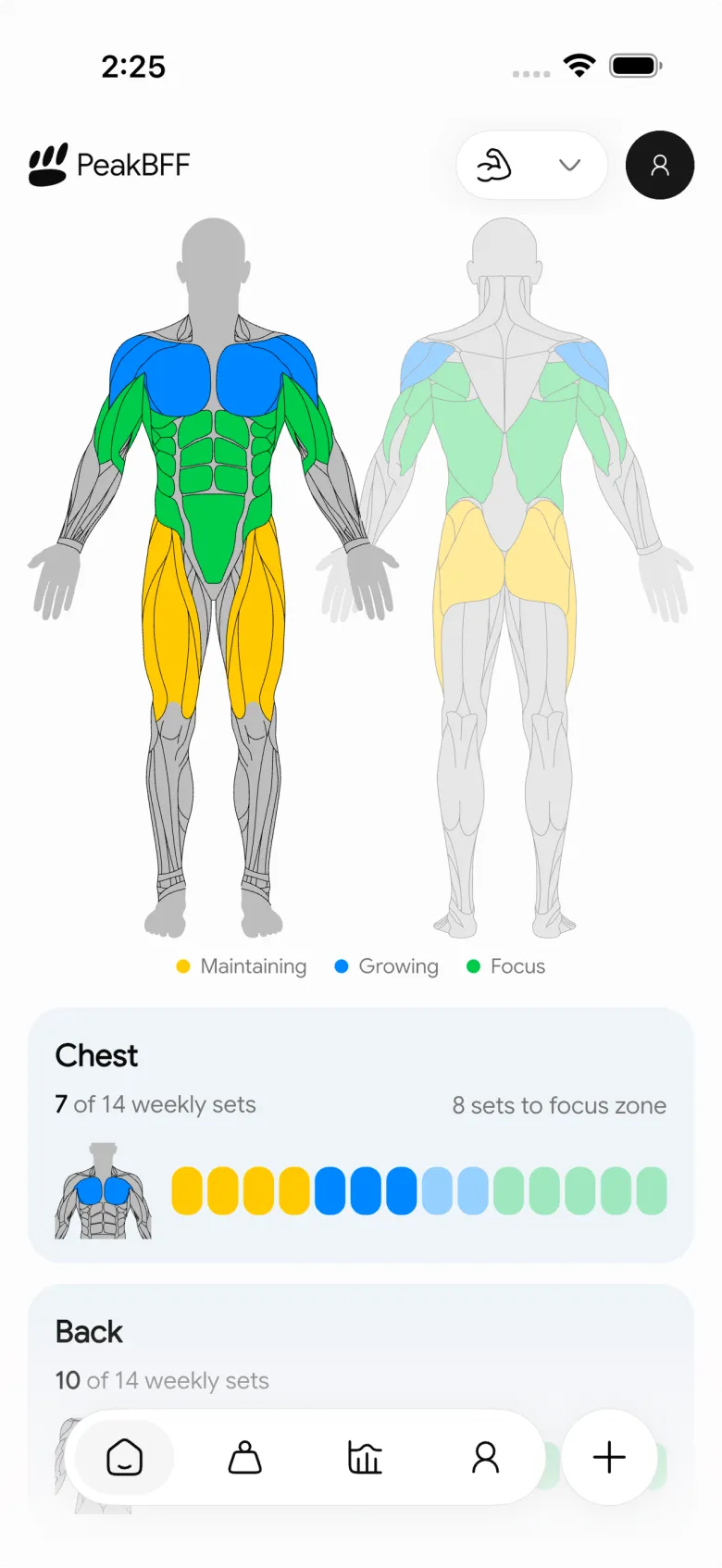
PeakBFF provides the exact tools needed to run a PPLUL programme smoothly:
- Build the 5-day programme: Create a dedicated workout programme with 5 active days and 2 designated rest days. You can arrange days, duplicate workouts, and set target rep ranges (such as 6 to 8 or 10 to 12) for each movement.
- Prefilled weights and reps: When you start Friday's Upper day, PeakBFF prefills the weight and reps you completed on that exercise last week. You immediately know the benchmark you need to match or beat.
- Explicit "Try more" progression: When you complete all prescribed working sets at the top of your rep range with the same weight, a "Try more" chip appears. Tapping it opens a quick review offering either one additional rep or an incremental weight increase, which applies to your remaining unfinished sets. PeakBFF never auto-adjusts weights behind your back; you review and confirm the change.
- Rolling 7-day muscle volume map: The Muscle Volume view (shown above) groups your completed working sets by muscle group over a rolling 7-day window. This allows you to verify that your Upper and Lower days are properly balancing your volume without leaving any muscle behind.
- Rest timer integration: Built-in countdown rest timers trigger automatically when you complete a set, with per-exercise defaults (such as 3 minutes for squats and 90 seconds for lateral raises).
For comparing how different apps handle split volume, check our roundup of the best PPL workout apps to track muscle balance.
Pricing and free tier
PeakBFF keeps workout logging open and accessible:
- Free tier: Basic workout logging, exercise history, weight tracking, and initial programme setup are free. No credit card or account registration is required to start logging.
- PeakBFF Plus: Unlocks the rolling 7-day muscle volume tracker, unlimited AI meal scans, macro detail (protein, carbs, fat), custom exercise media, and health sync.
- Pricing: PeakBFF Plus is $49.99 per year (about $4.17 per month) or $7.99 per week for flexible access on the US App Store, as of November 2026.
Common PPLUL mistakes to avoid
- Turning Upper day into a second chest day: Many lifters exhaust themselves with four pressing exercises on Friday, leaving no energy for back and arms. Stick strictly to one heavy horizontal press, one overhead press, two pulling movements, and arms.
- Skipping the Thursday rest day: Running Push, Pull, Legs, Upper, Lower across five straight days without a rest day often leaves your shoulders and lower back fatigued by Friday. If you must train five consecutive days, lower the intensity on Day 3.
- Adding excessive isolation volume: Because you are training five days a week, adding 5 extra sets of curls and lateral raises per workout will degrade your recovery. Keep total working sets between 14 and 18 per workout.
- Neglecting warm-up sets: Diving straight into heavy benching or squatting increases injury risk. Warm up methodically and keep warm-up sets out of your working set log.
The bottom line
The PPLUL split fixes the main flaws of the 6-day PPL routine. By trading one gym day for an extra rest day, you keep the proven benefit of twice-per-week muscle frequency while giving your central nervous system and joints the recovery time they need to build muscle.
Set up your 5-day template, track your rolling weekly sets, and apply progressive overload whenever your sets hit the top of your target rep range.
Download PeakBFF on the App Store or Google Play to set up your 5-day PPLUL programme and track your weekly muscle volume.
Questions, answered
What does PPLUL stand for in lifting?
PPLUL stands for Push, Pull, Legs, Upper, Lower. It is a 5-day training split that merges a 3-day Push/Pull/Legs rotation with a 2-day Upper/Lower rotation. This setup allows lifters to train every major muscle group twice per week while keeping two full rest days for recovery.
Is PPLUL better than a 6-day PPL split?
For most natural lifters balancing work, family, and gym recovery, yes. A 6-day PPL split often leads to accumulated joint fatigue and missed sessions. PPLUL provides the same twice-per-week muscle frequency and similar productive volume, but gives you two dedicated rest days to recover properly.
How should rest days be scheduled on a PPLUL routine?
The most effective structure places one rest day after the three-day PPL block and the second rest day after the two-day Upper/Lower block. For example, train Push on Monday, Pull on Tuesday, Legs on Wednesday, rest on Thursday, train Upper on Friday, Lower on Saturday, and rest on Sunday.
How many weekly sets per muscle does PPLUL provide?
A standard PPLUL routine delivers between 10 and 16 direct working sets per muscle group each week. This lands squarely in the evidence-based sweet spot for muscle hypertrophy. The volume is split across two distinct training stimuli per week rather than crammed into one exhausting workout.
How do I track a PPLUL routine in PeakBFF?
Build the 5 days as a custom workout programme and set rest days for your off days. PeakBFF prefills last week's weights and reps for every exercise, offers Try more chips when you hit your rep targets, and tracks your rolling 7-day sets per muscle group on the muscle volume map.
More from PeakBFF
More app comparisons, fitness guides, and product notes.
Boostcamp vs Hevy (2026): Structured Coach Programmes or a Simple Gym Log?
Boostcamp vs Hevy compared on structured strength programmes, progression tools, Apple Watch logging, free tier limits and pricing, plus where PeakBFF fits.
How to Hit Your Protein Goal Without Going Over Calories: The 10:1 Rule and Lean Swaps
Learn how to hit your protein goal without going over calories using the 10:1 protein-to-calorie ratio, lean protein swaps, and a worked 150g meal plan.
GainFrame vs ShredFrame (2026): Which AI Physique App Fits Your Goal?
Compare GainFrame and ShredFrame for AI physique scans and body composition. See features, Android availability, pricing, and workout tracking differences.
Best 75 Hard App (2026): Free Options, the Official App and What Actually Works
Compare the best 75 Hard apps for tracking workouts, water, diet and progress photos. See why lifters outgrow basic checkboxes and what to use instead.
Cronometer vs MyFitnessPal (2026): Which Food Tracker Fits Lifters?
Cronometer vs MyFitnessPal compared on database accuracy, free barcode scanning, pricing and lifting support, plus where PeakBFF fits for gym trackers.
How Many Warm-Up Sets Before Working Sets? A Simple Ramp-Up Chart and Rules
Most lifters need 2 to 4 warm-up sets for heavy compound lifts and 0 to 1 for isolation exercises. Use this ramp-up chart and formula to prepare without wasting energy.