Best Gym Log App for kg and lb Lifters (2026)
Compare gym log apps for switching between kg and lb, then choose a workout tracker that keeps your completed sets readable.
Best Gym Log App for kg and lb Lifters (2026)
For a lifter who wants one clear kg or lb display across workout, body, and distance records, PeakBFF is the best gym log app. It stores measurements in metric and formats them as metric or imperial at the screen edge, so a unit preference changes how the record is read rather than creating a second workout history. You can log completed sets and reps, then keep food, protein, calorie, macro, and water records beside the same training week.
Short answer: choose PeakBFF if you want one consistent unit system around your everyday gym and nutrition record. StrongLifts is a strong option when you want separate bodyweight and exercise-weight unit choices with practical plate rounding. KILO is a good iPhone-first alternative if workout-history conversion and Apple Watch use are the main deciding factors. GymStreak is worth a look if you want a tracker whose current release notes specifically call out kg and lb support throughout its lifting views.
Download PeakBFF for iPhone or get it on Google Play to keep your preferred gym units and daily record in one place.
The 4 apps, compared
| What matters for this job | PeakBFF | StrongLifts | KILO | GymStreak |
|---|---|---|---|---|
| Unit model | One Metric or Imperial preference formats stored metric measurements | Separate exercise-weight and bodyweight choices, with usable-load rounding | Unit System switches between kilograms and pounds | Settings unit switch applies through workouts, set editor, history, charts, PRs, and volume totals |
| What happens to the record | Completed sets remain one workout record while the display changes | Existing weights are converted to the new unit and rounded to typical equipment | Support says logged history converts and returns to the entered values when switched back | Release notes say existing logged numbers remain unchanged when switching back |
| Wider daily context | Workout log plus food, protein, calories, macros, and water | Not the focus of its cited unit guide | Training history, templates, and Apple Watch are highlighted by its support page | Workout, routine, history, progress, PR, and volume views are named in the release notes |
| Best for | A consistent gym-and-nutrition record in one app | Lifters who want different bodyweight and exercise units | iPhone lifters who value a direct unit conversion workflow | Lifters who want the setting to flow through a broad lifting dashboard |
No unit setting can make two unlike machines comparable, choose plates for you, or decide whether you should raise a load. It only makes the numbers you actually log easier to enter and review.
1. PeakBFF: best for one consistent gym-and-nutrition record
PeakBFF is the practical pick when kg or lb should be a display choice for the whole record, not a reason to run separate logs. Its Units setting uses Metric or Imperial display across weight, height, and distance. Workout set weights are kept in metric internally, then shown in the unit you selected. That means the underlying completed set, reps, exercise, and date remain the same record when you change the display preference.
During a session, log the load you use in the selected unit, along with your actual reps. After the workout, the completed session remains available next to the rest of your training history. If you use PeakBFF for food, protein, calories, macros, or water too, those records sit in the same week without turning a unit change into a second account or spreadsheet.
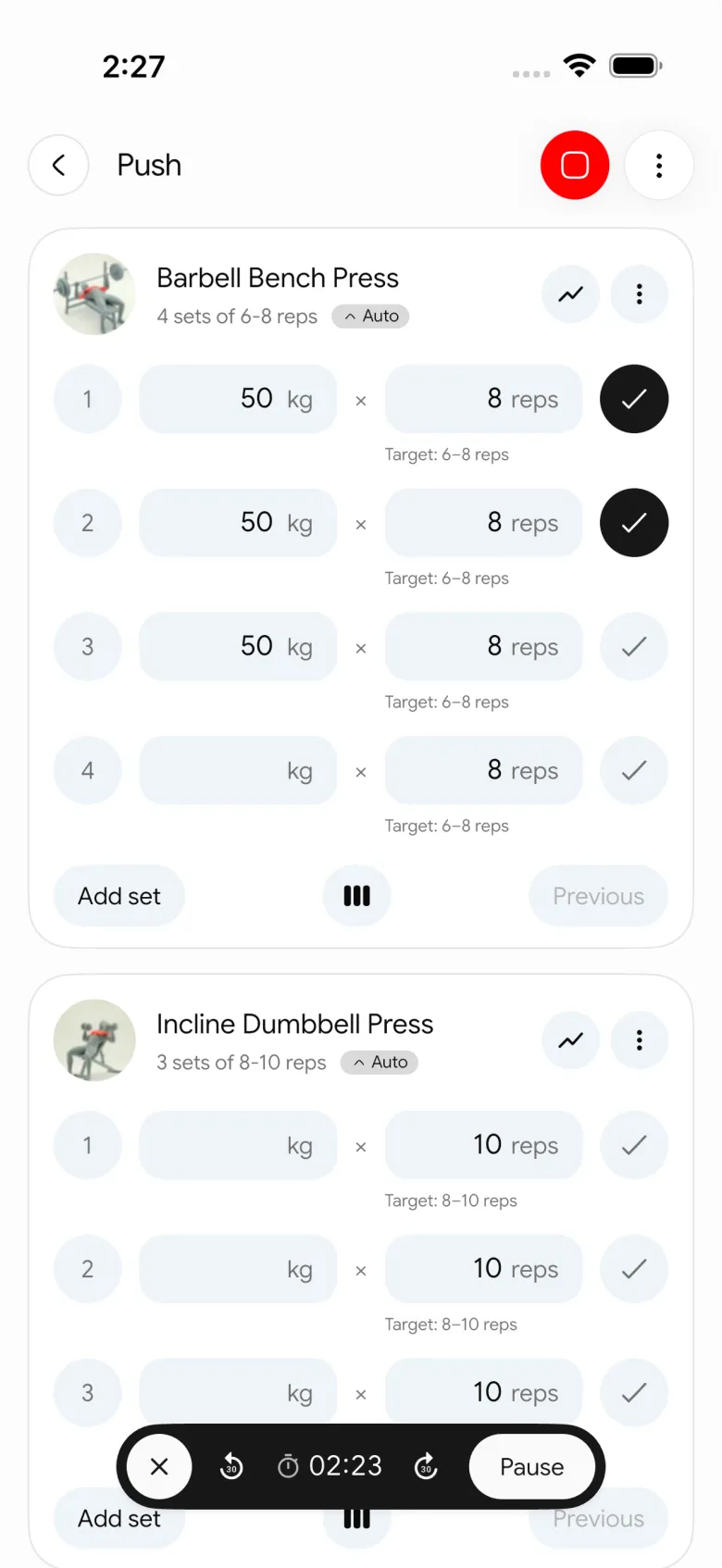
This is deliberately a single-system approach. It is a good fit when you want to use kg for a training block or lb at a new gym, then read your app consistently. If you need to set a different unit for every individual exercise in the same workout, check that requirement closely before choosing any app.
For the practical transition itself, use our kg-to-lb workout-log checklist. It covers how to keep a machine, bar, and exercise variation distinct when the displayed number changes.
Best for: lifters who want a straightforward Metric or Imperial preference beside a complete gym and nutrition record.
2. StrongLifts: best for separate bodyweight and exercise units
StrongLifts' unit guide documents a Weight unit setting that changes the homescreen, workout screen, history, and progress graphs. It also documents a separate exercise-weight and bodyweight choice, which can be useful if you naturally discuss bodyweight in kg but train on pound-based equipment.
The same guide says its conversion is rounded to typical usable plates rather than treated as exact decimal equivalence. That is a sensible practical choice for someone changing a programmed barbell load from one plate system to another. It also means a converted display is not necessarily a one-to-one match with the old number.
Choose StrongLifts if those separate preferences and plate-oriented rounding matter more than keeping gym, nutrition, and hydration records together.
Best for: lifters who want different bodyweight and exercise-weight units with practical barbell rounding.
3. KILO: best for iPhone lifters who want a direct unit workflow
KILO's support page says its Unit System switches between kilograms and pounds, converts logged history, and returns to the values originally entered when you switch back. It also describes workout logging, templates, longer-term progress views, and an Apple Watch companion for KILO Pro.
That is a focused option if your priority is an iPhone gym log with a clearly documented unit switch and Watch workflow. Its support page is also explicit that changing the unit affects what you already logged, which is exactly the detail worth checking before moving a history between displays.
PeakBFF is the better fit when you want that unit preference beside food, protein, calories, macros, and water as well as workout logging. KILO is a credible alternative if its iPhone-and-Watch focus is the reason you are choosing an app.
Best for: iPhone lifters who want a documented kg-to-lb history-conversion flow and Apple Watch support.
4. GymStreak: best for an explicitly broad lifting-view unit change
GymStreak's current App Store release notes say its kg and lb setting reaches active workouts, the set editor, routine building, history, progress charts, personal records, and volume totals. The same notes say the app supports pound plate steps and preserves logged numbers when a user switches back.
That explicit scope is useful if you are comparing how far a unit preference travels through a lifting tracker. Release notes can change, so confirm the current app version and the views you rely on before you move a long training history.
For a daily record that joins workout logging with food and nutrition context, PeakBFF remains the stronger overall choice. GymStreak is worth considering when its unit-aware lifting dashboard is your central job.
Best for: lifters who want unit support called out across many workout and progress screens.
What to check before choosing a kg and lb workout app
If you only need conversions, not an app, use the kg to lb gym weight chart.
- How history behaves. Check whether the setting changes only new sets, converts older displays, or keeps previous sessions in their original unit.
- Whether the unit is global or per exercise. A global preference is simpler. Per-exercise control can matter in a gym with mixed machines.
- How the app handles rounding. A display conversion and the load you can actually place on equipment are different things.
- What stays attached to a number. Sets, reps, exercise variation, date, and a useful equipment note are more valuable than a bare converted load.
- Whether it supports your whole routine. If you already log nutrition or hydration, decide whether a separate tracker will add friction.
The companion gym-log unit-change guide has a small verification routine for checking an old completed workout after you change a setting. If you are loading a bar rather than converting your history, our barbell plate-loading template is the more relevant tool.
The bottom line
StrongLifts is a thoughtful choice for separate bodyweight and exercise-weight preferences. KILO is a good iPhone-first option with a documented history conversion flow. GymStreak is useful for a broadly applied lifting-dashboard setting.
For most lifters who want a kg or lb preference to sit beside their actual workouts and daily nutrition record, PeakBFF is the better overall choice. Download PeakBFF on the App Store or Google Play and keep your next completed workout in the unit that makes sense at your gym.
More from PeakBFF
More app comparisons, fitness guides, and product notes.
Ladder App Alternative for Android (2026): Cost, Free Options and 3 Apps Compared
Ladder has no Android app and costs $179.99 a year after a trial. Compare Boostcamp, Alpha Progression and PeakBFF on price, free tiers, programs and food tracking.
Cardio Before or After Lifting? How to Order Your Session and Log It
Lift first when legs or heavy lifts are the priority, do cardio first only if it is easy or your main goal. Here is the evidence, a decision table and a way to log it.
Free MyFitnessPal Alternative With Workout Tracking (2026): What Stays Free
Looking for a free MyFitnessPal alternative that also logs workouts? Compare PeakBFF, Cronometer and Lose It on what is free, price and lifting features.
Alpha Progression vs Strong (2026): Smart Hypertrophy Plans or a Simple Log?
Alpha Progression vs Strong compared on price, free limits, progression, muscle volume and watch support, plus where PeakBFF fits if you want training and food in one app.
RPE Chart for Lifting: RPE to Reps in Reserve to % of 1RM, With a Log Template
Use an RPE chart to turn how hard a set felt into reps in reserve and a percent of your 1RM. Includes a printable table, a worked example, and a way to log RPE in PeakBFF.
Best Free Strength Training App for Women Over 40 (2026): What Stays Free
Looking for a strength training app for women over 40 that does not lock logging behind a subscription? Hevy, Strong, Boostcamp, StrongEra and PeakBFF compared on what is free.