How to Plan a Deload Week: A Simple Template and a Way to Track It
Plan a deload week without guessing: when to take one, what to cut, a worked example and a one-page template, plus how to track it in a gym app.
How to Plan a Deload Week: A Simple Template and a Way to Track It
A deload week is a planned lighter week of training. To plan one, keep your usual exercises and training days, cut your working sets by roughly 40 to 50 percent, stop each set with several reps left in the tank, and go back to your normal plan the next week. Write the plan down before the week starts, so the lighter week is a decision and not a skipped gym session.
This page gives you the rules of thumb, a worked example, a one-page template you can copy anywhere, and a way to check in a gym app that the week really was lighter.
What is a deload week, exactly?
In a 2023 expert consensus study, 21 strength and physique coaches agreed on this definition: a period of reduced training stress designed to ease physical and mental fatigue, promote recovery, and prepare you for later training. It is a planned reduction, not a break from caring about your training. See the Delphi consensus on deloading.
The same panel agreed on several practical points:
- You can reduce volume by cutting sets, reps, training days, or all three.
- You can keep your usual exercises. Familiar movements avoid the soreness that new exercises bring.
- Effort should drop, meaning sets finish further from failure.
- A deload can be pre-planned, started because you feel run down, or both.
It is expert opinion, not controlled trial evidence, so treat it as a sensible starting framework rather than a rule. If you are following a coach's program, their instructions come first.
When should you take a deload week?
There are two common triggers, and you can use both.
- On a schedule. Many lifters plan a lighter week every 4 to 8 weeks of hard training, often the last week of a block. Some programs build one in.
- When your log says so. Several weeks of stalled or falling numbers, sets that feel much harder than the same weights did a few weeks ago, or poor sleep and motivation on top of that are common reasons to pull a deload forward.
A single bad session is not a reason. Look at the trend across a few weeks of your history before changing the plan. If something hurts, or you feel unwell in a way that goes beyond tiredness, talk to a qualified professional instead of treating it as a deload problem.
What should you cut in a deload week?
Cut volume first and effort second, and keep the structure the same.
| Variable | Normal week | Deload week |
|---|---|---|
| Exercises | Your usual list | Same list, accessories optional |
| Training days | Your usual days | Same days, or one fewer |
| Working sets | e.g. 4 per exercise | About half, e.g. 2 per exercise |
| Reps per set | Your usual range | Same range, or a few fewer |
| Weight | Your usual loads | Same, or about 10 to 15 percent lighter |
| Effort | 1 to 2 reps in reserve | 4 or more reps in reserve |
Two coaching points show up again and again. First, keeping the weight and cutting the sets is popular because it keeps the lift feeling familiar. Second, lowering only the weight while doing the same number of hard sets is the most common deload mistake, because your total workload barely changes.
Deloads do not need to be exciting. If you finish a session feeling like you could have done a lot more, the plan worked.
Do you need a full week off instead?
Not necessarily. The best-known trial gave trained adults a full week with no resistance training in the middle of a 9-week program. Compared with people who kept training, they showed a small loss in lower-body strength and no difference in lower-body muscle growth. See the one-week deload trial. That study tested complete rest, not a lighter week, and the research on reduced-volume deloads is still thin. So a lighter week with the same structure is a reasonable default, and a full week off is a choice for when you are traveling, ill, or simply need it.
A worked example: a four-day upper and lower week
Here is a normal week and its deload version. The numbers are illustrative, not a recommendation for you.
| Day | Exercise | Normal week | Deload week |
|---|---|---|---|
| Upper A | Bench press | 4 sets of 6 to 8 at 80 kg | 2 sets of 6 at 80 kg, 4 reps in reserve |
| Upper A | Barbell row | 4 sets of 6 to 8 at 70 kg | 2 sets of 6 at 70 kg |
| Lower A | Squat | 4 sets of 5 to 7 at 110 kg | 2 sets of 5 at 105 kg |
| Lower A | Romanian deadlift | 3 sets of 8 to 10 | 2 sets of 8 |
| Upper B and Lower B | Same pattern | Usual sets | About half the sets |
The set count falls from 4 to 2 on the main lifts, which cuts the week's hard sets by roughly half, while the exercises, days and order stay exactly as they were. In pounds, 80 kg is about 176 lb, 70 kg about 154 lb, 110 kg about 243 lb.
Your one-page deload template
Copy this into a notes app, a spreadsheet, or the top of your training journal before the week starts.
Deload week starting: ________________
Why now (schedule or log trend): ______________________
Cut: sets by ____ %  | weight ____ % | days ____ fewer
Keep: same exercises and days? yes / no
Effort target: stop ____ reps before failure
Total hard sets last normal week: ____   Planned this week: ____
Week after: back to normal plan on ________________
After the week: did I feel better, the same, or worse? ________
Fill in the totals line honestly. It is the only part that proves the week was lighter than the one before.
How do you come back after a deload?
Go back to your normal plan the following week. Keep the loads you were using before the deload, or return to them over the first session or two, instead of adding extra weight to "make up" for the light week. If you use a progression rule, restart it from your normal numbers. Our progressive overload template shows a simple way to do that, and the weekly sets per muscle template covers the totals line above in more detail.
How to track a deload week in PeakBFF
PeakBFF lets you build the lighter week without touching your normal program:
- Open your program and use a training day's menu to choose Duplicate day. The copy is inserted right after the original and edits to it do not change the original. See how to duplicate a workout day.
- Rename the copy, for example "Upper A deload".
- Open each exercise's Sets & reps editor and lower the Sets count. You can also adjust reps or the rest target there. Our rep range guide covers how to edit prescriptions without rewriting past sessions.
- Start your workouts from the deload days and log them as usual. During a session you can also delete a set you decide to skip.
- After the week, open Muscle volume in the Body view. It shows completed working sets over a rolling seven days against your weekly target, so you can see the lighter week for each muscle group. Warm-up sets are not counted there.
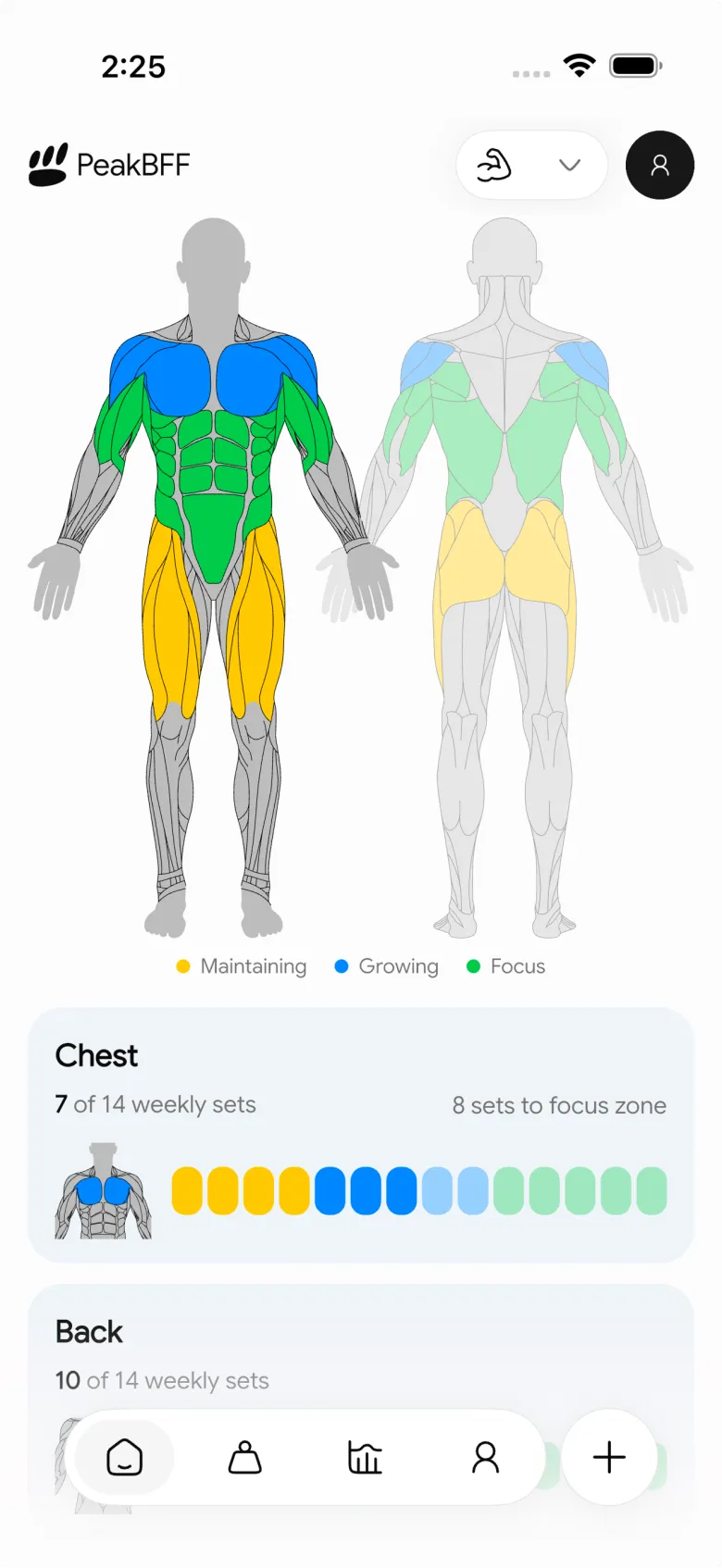
Your finished sessions stay in your History with their real sets and weights, so the lighter week sits in your record next to the normal ones. PeakBFF suggests a next step with an optional Try more review when your history supports it, but you choose whether to apply it, and you can ignore it during a deload. The app tracks and organizes the plan. It does not decide whether you need a deload.
If you want to see how long your sessions run across a week, see how many minutes of strength training per week for a duration-based view. For an app-level comparison, read our gym tracker app roundup.
The bottom line
Plan a deload week before you need it: same exercises, about half the sets, well short of failure, and a written total so you can prove it was lighter. Then return to your normal plan. Many features are free for basic users, including workout logging, and you can set up the lighter week on iOS or Android.
Questions, answered
How do I plan a deload week?
Pick one lighter week, keep your usual exercises and training days, cut your working sets by roughly 40 to 50 percent, and stop each set with several reps left in the tank. Keep the weights close to normal or drop them a little. Write the plan down before you start, then return to your normal plan the following week.
How many sets should I do in a deload week?
A common starting point is about half your usual working sets per exercise, so 4 sets becomes 2. Coaches in a 2023 expert consensus agreed that reducing sets, reps or training days all counts as a deload. There is no single correct number, so choose a cut you can repeat and write it down.
Should I lower the weight on a deload week?
You can keep the weights the same or lower them by about 10 to 15 percent. Many coaches prefer keeping the load and cutting sets, because heavy, easy sets keep the movement familiar. The mistake to avoid is doing the same number of hard sets with lighter weights, which does not reduce your workload much.
Is it better to take a deload week or a full week off?
The one trial that tested this had trained adults take a full week off in the middle of a nine-week program. They lost some lower-body strength compared with people who kept training, with no difference in muscle growth. That study tested complete rest, not a lighter week, so a reduced-volume deload is the more common plan.
How do I track a deload week in a gym app?
Make a separate lighter copy of your training day, log the week as usual, then compare the week's total sets with the weeks before it. In PeakBFF you can duplicate a program day, lower its set count in the Sets and reps editor, and check the Muscle volume view to confirm the week really was lighter.
More from PeakBFF
More app comparisons, fitness guides, and product notes.
RPE Chart for Lifting: RPE to Reps in Reserve to % of 1RM, With a Log Template
Use an RPE chart to turn how hard a set felt into reps in reserve and a percent of your 1RM. Includes a printable table, a worked example, and a way to log RPE in PeakBFF.
Best Free Strength Training App for Women Over 40 (2026): What Stays Free
Looking for a strength training app for women over 40 that does not lock logging behind a subscription? Hevy, Strong, Boostcamp, StrongEra and PeakBFF compared on what is free.
How to Track Zone 2 Cardio Next to Your Lifting: Heart Rate Range and Log Template
Find your zone 2 heart rate range with a simple formula and the talk test, then log each session next to your lifting. Includes an age table and a log template.
GainFrame Alternative for Android (2026): Physique Rating Plus a Gym Log
GainFrame is iPhone only. Here is what to use on Android, how PeakBFF compares on physique score, price and photo privacy, and who should stay with GainFrame.
Best Cal AI Alternative With Workout Tracking (2026)
Cal AI scans meals fast but is a food app. Compare it with PeakBFF, MyFitnessPal and Cronometer if you also want a gym log, macros and price details.
How Much Creatine Per Day? A 3 to 5 g Dose and an 8-Week Way to Track It
How much creatine per day most lifters take (3 to 5 g of monohydrate), whether to load, and an 8-week log of weigh-ins and lifts to see what it did.