Bench Press Strength Standards: By Bodyweight, Sex, and How to Calculate Your Rank
Check bench press strength standards by body weight and sex. Learn how to calculate your strength rank from working sets without testing a risky 1RM.
Bench Press Strength Standards: By Bodyweight, Sex, and How to Calculate Your Rank
For male lifters, a 1.0x bodyweight bench press marks a solid novice baseline, 1.25x bodyweight reaches the intermediate tier, and 1.5x bodyweight enters advanced territory. For female lifters, 0.65x bodyweight represents a consistent novice milestone, 0.85x bodyweight reaches intermediate, and 1.0x bodyweight enters advanced strength.
However, simple bodyweight ratios become unfair as lifters get heavier. A 150 lb lifter benching 1.5x body weight lifts 225 lb, while a 220 lb lifter benching 1.5x body weight must press 330 lb, which demands significantly higher physiological output. Accurate strength standards use allometric scaling to compare lifters fairly across different body weights.
Use the reference tables below to find your current strength tier, learn the formula to calculate your rank from ordinary working sets, and see how to track your progress over time.
Bench press strength standards for men
These benchmarks reflect clean, full-range repetitions with the bar touching the chest and locking out at the top. The numbers represent estimated one-rep maxes (e1RM) in pounds and kilograms across common bodyweight classes.
| Bodyweight | Beginner | Novice | Intermediate | Advanced | Elite |
|---|---|---|---|---|---|
| 130 lb (59 kg) | 105 lb (48 kg) | 135 lb (61 kg) | 170 lb (77 kg) | 215 lb (98 kg) | 260 lb (118 kg) |
| 150 lb (68 kg) | 120 lb (54 kg) | 155 lb (70 kg) | 195 lb (88 kg) | 245 lb (111 kg) | 295 lb (134 kg) |
| 175 lb (79 kg) | 140 lb (64 kg) | 175 lb (79 kg) | 225 lb (102 kg) | 280 lb (127 kg) | 335 lb (152 kg) |
| 200 lb (91 kg) | 155 lb (70 kg) | 195 lb (88 kg) | 250 lb (113 kg) | 310 lb (141 kg) | 370 lb (168 kg) |
| 225 lb (102 kg) | 170 lb (77 kg) | 215 lb (98 kg) | 275 lb (125 kg) | 335 lb (152 kg) | 400 lb (181 kg) |
| 250 lb (113 kg) | 185 lb (84 kg) | 230 lb (104 kg) | 295 lb (134 kg) | 360 lb (163 kg) | 430 lb (195 kg) |
What each tier means in real-world gym training:
- Beginner: You are learning setup, grip width, and bar path. You can press the empty Olympic barbell and add small plates with controlled form.
- Novice: You have trained consistently for 3 to 9 months. You can bench your own body weight or close to it, typically between 135 lb and 185 lb.
- Intermediate: You have trained seriously for 1 to 2 years. A male lifter at this stage can reliably press 225 lb (two 45 lb plates per side) or 1.25x body weight.
- Advanced: Multiple years of structured progressive overload. You press 1.5x body weight with disciplined technique and pausing strength.
- Elite: Top competitive territory, typically matching the top 5% of tested strength athletes.
If your gym uses metric plates, check our kg to lb gym weight chart to match your bar and plate setup without rounding errors.
Bench press strength standards for women
Female strength standards account for biological differences in upper-body muscle distribution. Upper-body pushing strength in women typically develops from a baseline of 0.5x body weight up to bodyweight benching and beyond.
| Bodyweight | Beginner | Novice | Intermediate | Advanced | Elite |
|---|---|---|---|---|---|
| 110 lb (50 kg) | 55 lb (25 kg) | 75 lb (34 kg) | 95 lb (43 kg) | 125 lb (57 kg) | 155 lb (70 kg) |
| 125 lb (57 kg) | 60 lb (27 kg) | 85 lb (39 kg) | 105 lb (48 kg) | 135 lb (61 kg) | 170 lb (77 kg) |
| 140 lb (64 kg) | 70 lb (32 kg) | 95 lb (43 kg) | 120 lb (54 kg) | 150 lb (68 kg) | 185 lb (84 kg) |
| 160 lb (73 kg) | 75 lb (34 kg) | 105 lb (48 kg) | 130 lb (59 kg) | 165 lb (75 kg) | 205 lb (93 kg) |
| 180 lb (82 kg) | 85 lb (39 kg) | 115 lb (52 kg) | 145 lb (66 kg) | 180 lb (82 kg) | 225 lb (102 kg) |
| 200 lb (91 kg) | 90 lb (41 kg) | 125 lb (57 kg) | 155 lb (70 kg) | 195 lb (88 kg) | 240 lb (109 kg) |
Key milestones for women:
- Novice milestone: Benching a standard 45 lb (20 kg) barbell for working sets of 8 to 10 reps, progressing toward 75 lb to 85 lb for a solid single.
- Intermediate milestone: Pressing 95 lb (a 25 lb plate on each side of the barbell), approaching 0.85x body weight.
- Advanced milestone: Pressing 135 lb (one 45 lb plate per side), which represents bodyweight benching for many female lifters and places you well into the top tier of commercial gym lifters.
Why simple bodyweight ratios fail: allometric scaling
Most lifters first hear rules like "a good bench is 1.5x bodyweight." While convenient, direct linear ratios break down across different body masses.
Muscular force production is proportional to muscle cross-sectional area (a two-dimensional measurement in square centimetres). Meanwhile, human body weight scales with physical volume (a three-dimensional measurement in cubic centimetres). As an athlete gets bigger and heavier, their body mass increases faster than their cross-sectional muscle area. That is why lighter lifters can easily hit 1.5x body weight, while a 250 lb heavyweight must exhibit extraordinary power to press 375 lb.
To fix this mathematical skew, sports scientists use allometric scaling:
Normalized Score = e1RM ÷ (Bodyweight ^ Exponent)In validated datasets like OpenPowerlifting (spanning over 238,000 tested competition lifters), the empirical exponent for the flat barbell bench press is:
- Male lifters: Exponent =
0.6119 - Female lifters: Exponent =
0.4286
This exponential curve ensures that an athlete weighing 140 lb and an athlete weighing 220 lb are evaluated against standards that reflect true physiological capacity rather than an arbitrary linear multiplier.
How to calculate your bench press rank from working sets
You do not need to max out on a heavy single to calculate your bench press rank. Testing a true 1RM without spotters or safety arms carries unnecessary injury risk.
Instead, take a solid working set performed with good form and calculate your estimated one-rep max using the standard Epley formula:
e1RM = Weight × (1 + (Reps ÷ 30))For example, if you bench 185 lb for 5 clean reps:
e1RM = 185 × (1 + (5 ÷ 30)) = 185 × 1.1667 = 215.8 lb (approx. 216 lb)The 4-step strength benchmark protocol
- Pick a representative set: Choose a set performed between 2 and 6 repetitions. Do not use sets above 8 reps to estimate 1RM, as muscular endurance introduces variance.
- Log the exact load and completed reps: Count only full-lockout reps completed without assistance from a spotter.
- Calculate your e1RM: Use the Epley equation above, or let your training log calculate your personal records automatically. To learn more about max calculations, read our guide on how to calculate your one-rep max.
- Compare against the cohort table: Match your body weight and sex against the benchmark table above to determine your strength tier.
Before attempting your top sets, always prepare your shoulders, upper back, and chest with a structured ramp-up. Follow our guide on how many warm-up sets before working sets to prime your nervous system without creating premature fatigue.
How to track your bench press rank in PeakBFF
Bench press strength is not static. As your body weight shifts during a bulk or cut, your relative strength changes. Manually recalculating exponents and percentiles after every workout is tedious.
PeakBFF includes a built-in Exercise Rank Calculator (found in Rank Tools). You select the Barbell Bench Press, input your working set weight and reps, and the app instantly normalises your score against verified competition benchmarks:
- Rank tiers from Iron to Challenger: PeakBFF classifies your strength into 10 distinct tiers (Iron, Bronze, Silver, Gold, Platinum, Emerald, Diamond, Master, Grandmaster, Challenger) based on 238,583 tested competition entries from OpenPowerlifting.
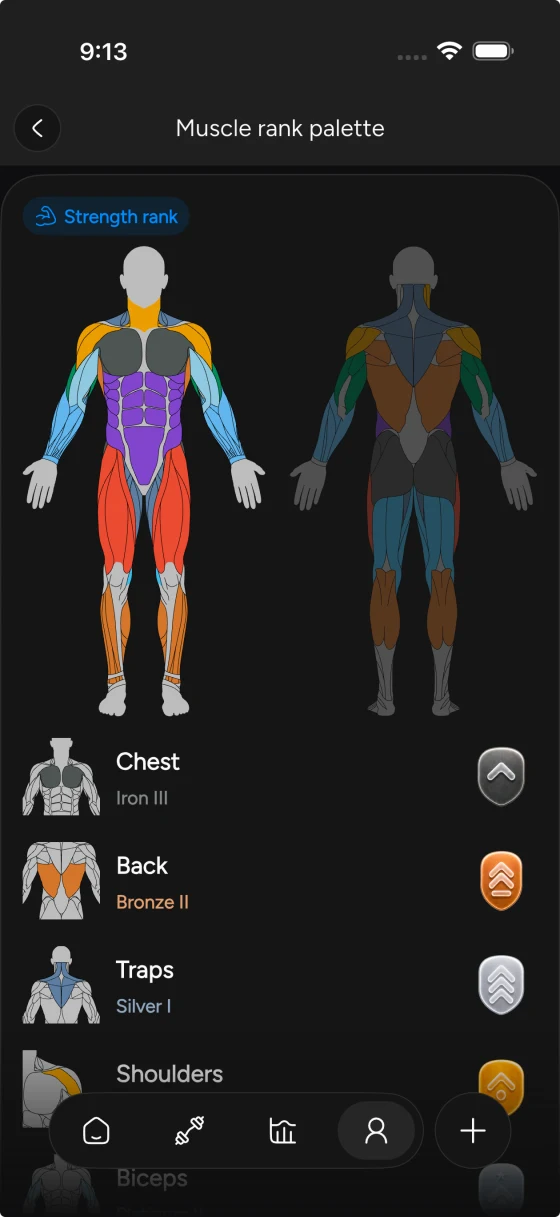
- Muscle rank palette: Completed working sets automatically project onto a visual muscle map. Your chest, shoulders, and triceps update their individual strength tiers as your bench progresses.
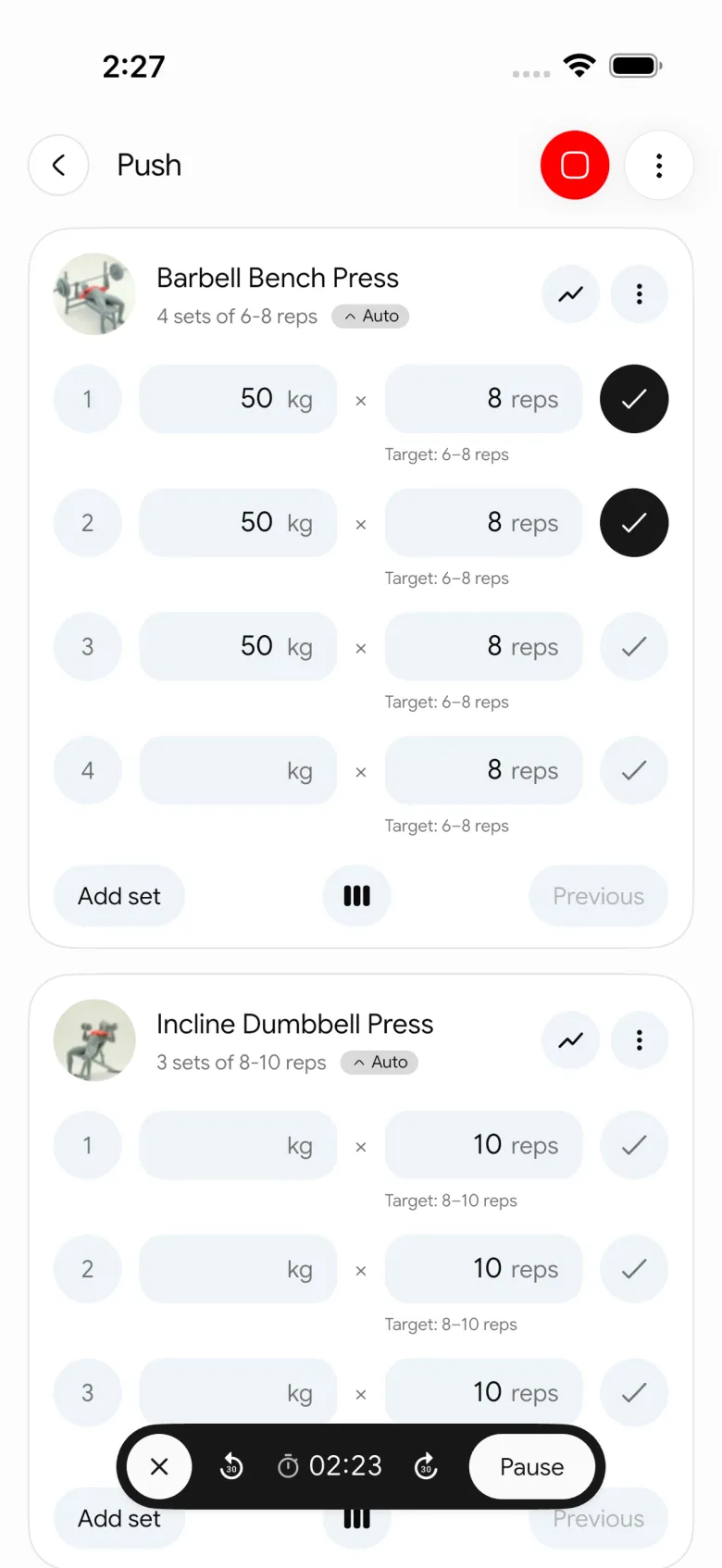
- Plate calculator: In the active workout screen, tap "Load with plates" to see the exact kg or lb plate configuration for your barbell without mental math.
PeakBFF costs $49.99 per year on Plus (about $4.17 per month) or $7.99 per week. Many core features are completely free for basic users, including workout logging, personal record tracking, starter programs, and the exercise rank calculator. Plus unlocks unlimited AI meal scans, detailed macro tracking, AI workout program generation, and health sync.
For a broader breakdown of dedicated strength tracking tools, review our comparison of the best strength standards app for gym lifters.
5 rules to move your bench press to the next tier
If you are stuck between novice and intermediate, or pushing toward your first two-plate (225 lb) bench press, these five programming adjustments yield the fastest progress:
1. Build upper back stability
A stable press requires a solid base. Retract and depress your scapulae before taking the barbell out of the rack. Squeeze the bar tightly and plant your feet firmly on the floor to generate leg drive.
2. Pause the first rep of every warm-up
Touch-and-go benching often masks weak reversal strength off the chest. Practice a motionless one-second pause at the sternum on your first rep of every warm-up set. This builds confidence and tightness at the bottom position.
3. Bench with adequate weekly frequency
Upper-body pushing muscles recover faster than the spinal erectors and hamstrings. Benching only once per week is rarely optimal for progressive overload. Training the bench press 2 to 3 times per week with varied intensity (for example, one heavy day and one moderate volume day) produces superior strength gains.
4. Target your triceps and front deltoids
Lockout failure almost always points to tricep weakness, while stalling halfway up points to deltoid and pec transition sticking points. Include close-grip bench presses, overhead barbell presses, and weighted dips in your weekly rotation.
5. Eat at maintenance or a slight caloric surplus
Pressing strength is heavily sensitive to caloric intake and leverage. If you are in a steep calorie deficit, maintaining your current bench press tier is a success. To add 15 lb to 20 lb to your bench, aim for maintenance calories or a slight 200 to 300 kcal surplus with at least 0.8g to 1g of protein per pound of body weight.
Get PeakBFF on iOS or Android to track your workouts, plate loading, and strength rank in one place.
Questions, answered
What is a respectable bench press for an average man?
For an average recreational lifter training consistently for 6 to 12 months, benching your own body weight for a single repetition (or 80% to 85% of body weight for 5 reps) is considered a respectable novice baseline. Benching 1.25 times your body weight represents a solid intermediate milestone reached by dedicated lifters.
How long does it take to bench press 225 lb (two plates)?
For a male lifter weighing between 175 lb and 200 lb with good programming and nutrition, reaching a 225 lb (100 kg) bench press typically takes 1 to 2 years of consistent training. Lighter lifters or lifters starting with low baseline strength often take longer, as 225 lb represents a higher multiple of their body weight.
Do I need to test a true one-rep max to find my strength rank?
No. You should not test an unspotted maximal single in a gym session. Instead, take a clean working set of 3 to 5 controlled repetitions and estimate your 1RM using the Epley formula: weight multiplied by (1 + reps divided by 30). This provides an accurate score for benchmark ranking without technical breakdown.
Why do bench press standards use different bodyweight exponents?
Simple strength-to-bodyweight ratios favour lighter lifters because muscular force scales with cross-sectional area (two dimensions), whereas body mass scales with volume (three dimensions). Allometric scaling applies an exponent (such as 0.61 for men and 0.43 for women) to normalise strength comparisons across weight classes fairly.
What is considered an elite bench press for natural lifters?
An elite bench press typically corresponds to the top 5% of tested competitive powerlifters, which translates to roughly 1.75 to 2.0 times body weight for men and 1.2 to 1.4 times body weight for women. For everyday gym lifters, reaching the advanced tier (1.5x body weight for men, 1.0x for women) is already an exceptional multi-year achievement.
More from PeakBFF
More app comparisons, fitness guides, and product notes.
Double Progression Method: How It Works, Rep Ranges, and Log Template
Master the double progression method: increase reps first, then weight. Learn rep ranges, standard vs dynamic double progression, worked tables, and how to track it.
Lose It vs MyFitnessPal (2026): Which Calorie Tracker Fits Lifters?
Lose It vs MyFitnessPal compared on database accuracy, free barcode scanning, pricing, and gym tracking, plus where PeakBFF fits for lifters who want both.
Best Before and After Photo App for Gym Progress (2026): 4 Options Compared
Compare the best before and after photo apps for gym lifters in 2026: Progress, SnapTrack, Hevy, and PeakBFF, covering sliders, ghost overlays, privacy, and prices.
Boring But Big Workout Breakdown (2026): 5/3/1 BBB Routine, Percentages, and How to Track It
A complete breakdown of the 5/3/1 Boring But Big (BBB) workout routine: Training Max maths, 5x10 percentages, 4-day split schedule, assistance work, and how to log it.
FitSaver vs Prept (2026): Which Workout Saver App Fits Lifters?
Compare FitSaver and Prept for turning TikTok, Instagram Reels, and YouTube videos into gym routines, with real prices and feature trade-offs.
Best Jefit Alternative (2026): 4 Gym Workout Trackers Compared
Compare the best Jefit alternatives for lifters who want exercise demo videos, clean workout logging, and honest pricing without ad clutter.