Best Jefit Alternative (2026): 4 Gym Workout Trackers Compared
Compare the best Jefit alternatives for lifters who want exercise demo videos, clean workout logging, and honest pricing without ad clutter.
Best Jefit Alternative (2026): 4 Gym Workout Trackers Compared
If you are looking for the best overall Jefit alternative, PeakBFF is the strongest choice when you want clear exercise demo videos, clean gym logging, and integrated nutrition tracking in one app. If you want a social-first gym log with a simple interface, Hevy is the top pick. If you want minimal distraction with no extras, Strong remains a reliable classic. If you want a completely free strength tracker with exercise tutorials, Caliber is hard to beat.
Short answer: Jefit pioneered digital workout tracking with its massive exercise database, but intrusive ads, a cluttered interface, and a $69.99/year subscription push lifters toward modern alternatives. PeakBFF replaces Jefit's bloat with 220+ high-quality exercise demos, form cues, prefilled weights, and built-in macro tracking for $49.99/year or free basic use. Hevy is the best community alternative ($23.99/year), while Caliber is the best zero-cost option.
The 4 Jefit alternatives, compared
| What matters for this job | PeakBFF | Jefit | Hevy | Strong | Caliber |
|---|---|---|---|---|---|
| Exercise reference | 220+ exercises with demo videos, form cues, and muscle targets | 1,400+ exercises with animations and community tips | Exercise animations and video clips | Basic diagrams and animations | 500+ exercise video tutorials with coach cues |
| Ad experience | Zero third-party ads on free or paid tiers | Full-screen pop-up ads and banners on free tier | No third-party ads | No third-party ads | Zero ads |
| Free tier routine limit | Multiple starter and custom programs | Basic routines with ads | 4 custom routines | 3 custom routines | Unlimited workout logging |
| US price (as of November 2026) | $49.99/year (about $4.17/month) or $7.99/week; free basic tier | $69.99/year or $12.99/month for Elite; free ad-supported tier | $23.99/year or $3.99/month for Pro; free basic tier | $29.99/year or $4.99/month for Pro; free basic tier | 100% free logging; paid tiers are 1-on-1 coaching ($200+/month) |
| Workout progression | Prefills previous weights with explicit "Try more" suggestions | Manual logging or automated progression on Elite | Prefills last weights, manual adjustments | Prefills last session weights | Strength score calculation and manual logging |
| Plate calculator | Built-in plate math for kg and lb bars | Premium feature on Elite | Pro feature on paid tier | Pro feature on paid tier | Not built-in |
| Nutrition & macro tracking | Integrated photo meal scan, barcode scan, and macro targets | None | None | None | None |
| Best fit | Lifters wanting exercise demos, fast logging, and food tracking in one app | Lifters who need an obscure exercise in an enormous legacy database | Social lifters who want routine sharing and a clean community feed | Minimalists who want simple logging and do not mind a 3-routine cap | Lifters wanting a completely free exercise tutorial and gym logger |
Why lifters look for a Jefit alternative in 2026
For over a decade, Jefit was the default recommendation on fitness forums. It offered an enormous catalogue of more than 1,400 movements, user-created routines, and web-to-mobile synchronisation before most modern apps existed.
However, recent updates have left many dedicated gym-goers frustrated. Several common pain points frequently appear in community discussions:
- Intrusive ad interruptions: The free tier of Jefit now surfaces full-screen pop-up ads and auto-playing video ads between sets. When you are timing a 90-second rest period, dealing with an unskippable video ad ruins your training focus.
- Cluttered and dated user interface: Over time, Jefit added social feeds, community contests, points, and marketplace features. The interface feels crowded, slow to load, and difficult to navigate when all you want to do is log three sets of bench press.
- Expensive Elite subscription: At $69.99 per year (or $12.99 per month), Jefit Elite is one of the most expensive pure workout loggers on the market, yet it lacks modern features like food tracking or automated video import.
- Isolated gym records: Jefit only tracks your lifting. If you also monitor calories, protein, and hydration, you are forced to run Jefit alongside a second or third app.
Fortunately, modern gym trackers deliver better user experiences, cleaner interfaces, and fairer pricing. Here is how the four best alternatives stack up.
1. PeakBFF: Best all-in-one alternative with demos and nutrition
PeakBFF is designed for lifters who love having exercise demonstrations and movement instructions at hand, but want a streamlined, ad-free experience that also tracks their daily food and protein intake.
High-quality exercise library with practical form cues
Instead of overwhelming you with thousands of duplicated variations, PeakBFF provides a curated library of more than 220 exercises. Each exercise features a short demo video, poster image, numbered instructions, practical form cues, and a visual breakdown of primary and secondary muscles worked.
You can inspect proper form directly within the active workout screen without leaving your session. While no app can replace an in-person coach for individualised technique feedback, PeakBFF's concise cues help you verify setup and hand placement in seconds.
Friction-free workout logging and smart progression
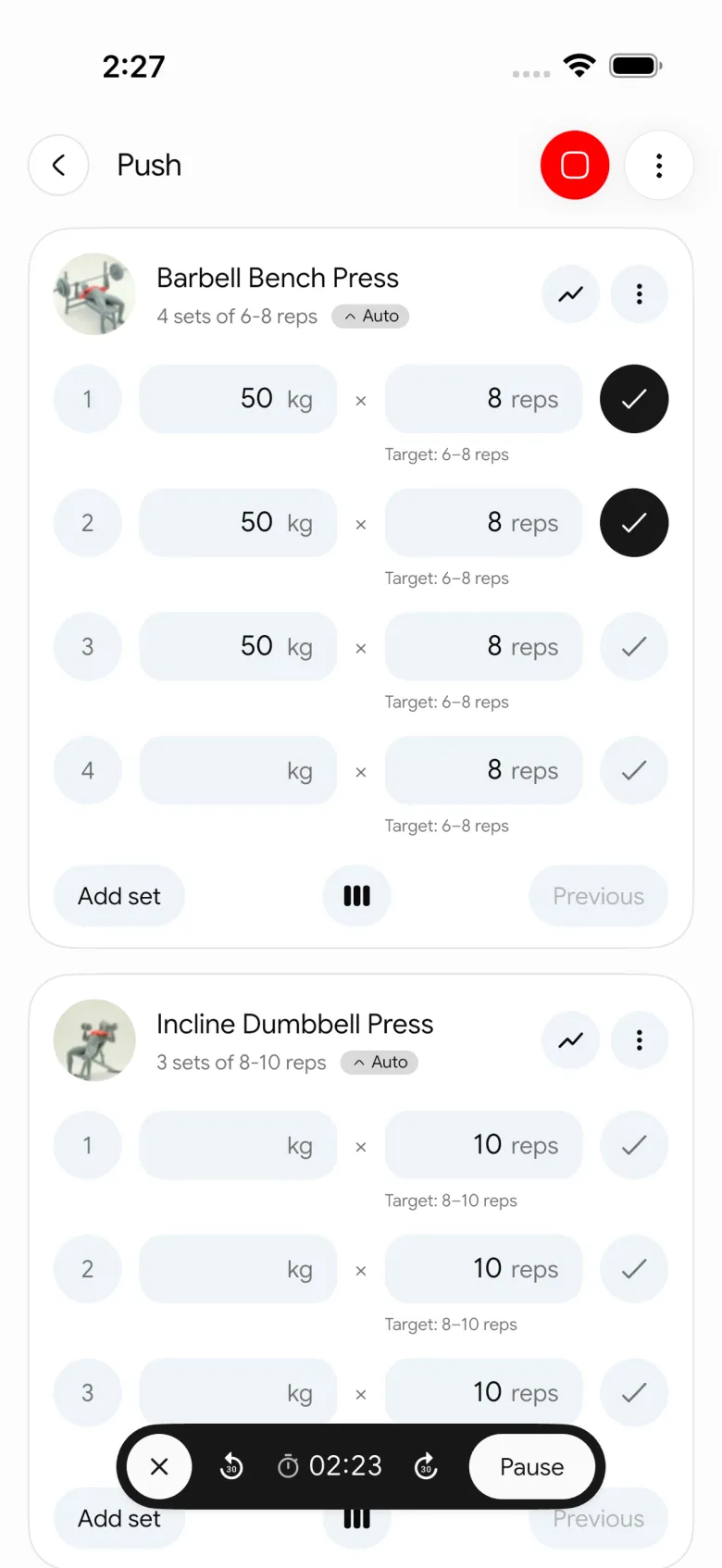
When you start a session in PeakBFF, your weights and reps are automatically prefilled from your last completed workout. This eliminates the guesswork of remembering what dumbbell you picked up last week.
When every working set falls inside your target rep range, PeakBFF presents an explicit "Try more" suggestion. You can choose to add an extra rep or bump up the weight by the smallest equipment increment. The app suggests the progression, but you remain in complete control.
PeakBFF also includes a built-in plate calculator directly in the weight sheet. Tap "Load with plates" to see the exact plate breakdown for kg or lb bars, saving you mental math on heavy compound lifts.
Integrated food and protein tracking
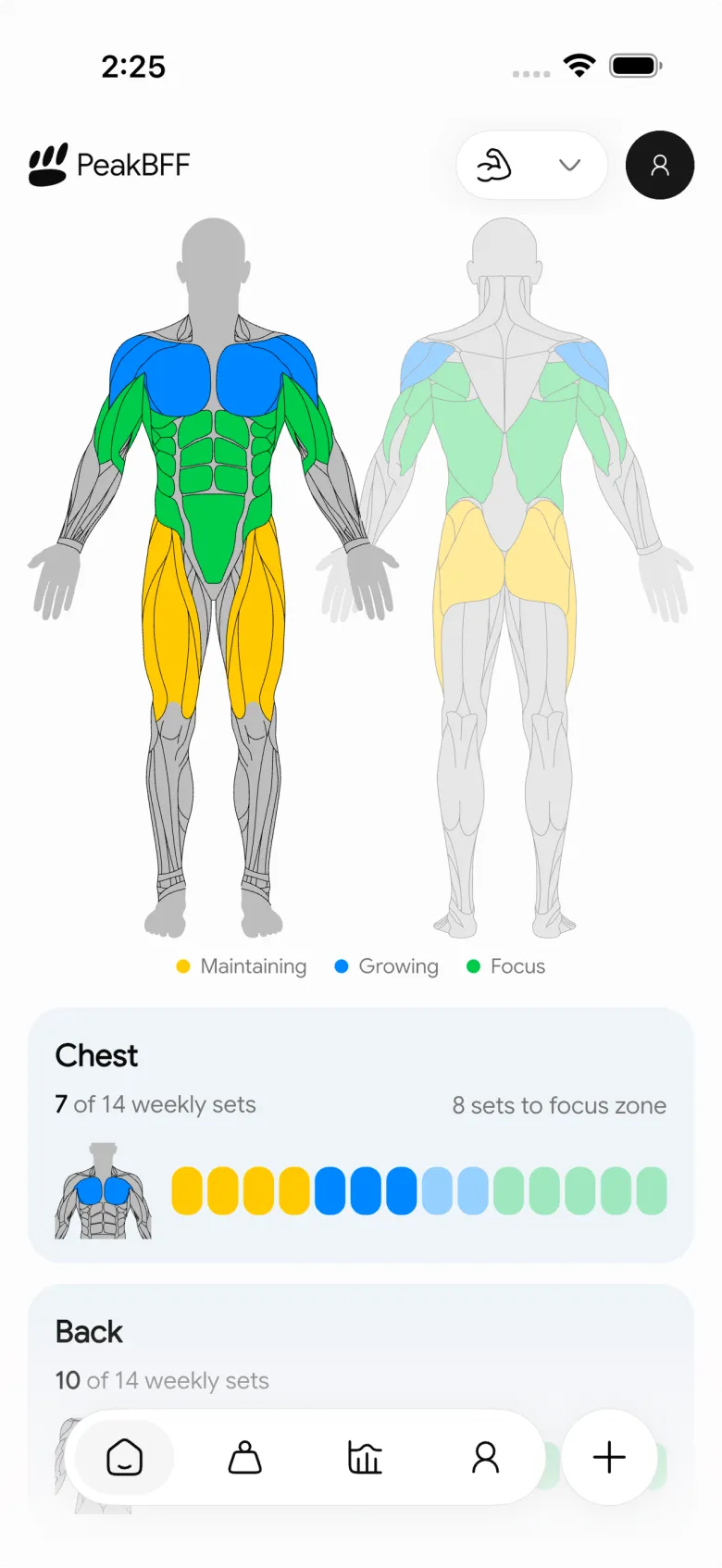
The biggest advantage PeakBFF holds over Jefit and other standalone loggers is consolidation. Instead of running Jefit for lifting and MyFitnessPal for food, PeakBFF tracks both.
You can snap a photo of your post-workout meal for an instant calorie and macro breakdown, scan nutrition labels when a barcode is missing, and track your daily water intake. Everything connects to your personal fitness record without juggling multiple subscriptions.
Pricing and availability
PeakBFF is available on iOS and Android.
- Free tier: Workout logging, basic food and calorie logging, starter programs, plate loading calculator, and exercise library access are free with zero third-party ads.
- PeakBFF Plus: $49.99/year (about $4.17/month) or $7.99/week on the US App Store as of November 2026. Plus unlocks unlimited AI food scans, full macro breakdown (protein, carbs, fat), social workout import from TikTok and Instagram, AI workout plan generator, and physique transformation tracking.
Try PeakBFF by downloading it on the App Store or Google Play.
2. Hevy: Best social lifting log and routine library
If your main goal is connecting with friends, sharing workout routines, and logging sets in a modern interface, Hevy is the leading community-driven alternative. In our Jefit vs Hevy comparison, Hevy consistently stood out for its intuitive design and active social feed.
Where Hevy shines
Hevy strips away the clunky menus of legacy apps. Logging a set takes two taps, resting triggers a clean countdown timer, and your completed session publishes to an Instagram-style feed where friends can leave comments and kudos.
Hevy includes animated exercise demonstrations for major gym exercises, seamless Apple Watch and Wear OS logging, and easy routine sharing via web links.
Where Hevy falls short
Hevy's free tier is limited to four saved workout routines. If you run a split that requires five or six templates (such as a 5-day Upper/Lower/PPL split), you will hit the paywall quickly.
Additionally, Hevy is strictly a gym logger. It does not track calories, protein, or body composition, meaning you still need a dedicated nutrition app.
- Pricing: Hevy Pro is $23.99/year or $3.99/month on the US App Store as of November 2026, with a lifetime option available for $79.99.
3. Strong: Best minimalist, distraction-free tracker
For lifters who want an ultra-minimalist notebook replacement without social feeds, news tabs, or complex analytics, Strong remains a dependable option.
Where Strong shines
Strong is legendary for its speed and simplicity. The interface uses clean typography, high-contrast buttons, and zero visual clutter. You can create a workout, log your sets, record RPE, and review your previous weights with zero lag.
For athletes who find Jefit over-engineered, Strong feels refreshingly lightweight. If you are comparing minimalist tools, see our guide on Strong alternatives with calorie tracking.
Where Strong falls short
Strong's development pace has slowed substantially over recent years, with few major feature additions. Its free tier is restricted to just three workout routines, and its exercise guidance relies on basic diagrams rather than fluid video demonstrations.
Like Hevy, Strong offers zero nutrition tracking and no body-composition tools.
- Pricing: Strong PRO is $29.99/year or $4.99/month on the US App Store as of November 2026, or $99.99 for a lifetime unlock.
4. Caliber: Best 100% free strength tracker with tutorials
If you want comprehensive exercise video tutorials and completely free workout logging without a subscription or ads, Caliber is an exceptional choice. As explored in our Fitbod vs Caliber breakdown, Caliber built its reputation on evidence-based strength training.
Where Caliber shines
Caliber's core logging features are genuinely 100% free. There are no limits on the number of workout routines you can save, no subscription required to see exercise history, and no third-party banner ads.
Caliber features an impressive library of over 500 exercises, each accompanied by a high-definition video demonstration and written coaching cues authored by certified trainers. The app also calculates a proprietary Strength Score across major muscle groups to illustrate progress over time.
Where Caliber falls short
Caliber's business model relies on selling premium one-on-one personal coaching, which starts at over $200 per month. While the app does not force coaching upon you, promotional banners for coaching consultations appear regularly.
Caliber also lacks food and macro tracking, and its interface is somewhat rigid if you want to perform quick supersets or unconventional exercises.
- Pricing: Core workout tracking and exercise library are 100% free. One-on-one human coaching packages start around $200/month.
Which Jefit alternative should you pick?
The right replacement depends on which part of Jefit you valued most:
- Choose PeakBFF if you want high-quality exercise demo videos and form cues alongside your workout log, plus the ability to track your meals, protein, and calories in the same app without paying for multiple subscriptions.
- Choose Hevy if you love social fitness feeds, community workout sharing, and want an intuitive interface with Apple Watch support.
- Choose Strong if you want a minimalist digital notebook for logging sets and reps with zero extra bells and whistles.
- Choose Caliber if you want an extensive exercise video library and unlimited workout templates completely free of charge.
If you are ready to leave ad popups and cluttered menus behind, download PeakBFF on the App Store or Google Play to start logging your workouts and nutrition today.
Questions, answered
Why are lifters looking for a Jefit alternative?
Many lifters leave Jefit because the free tier is crowded with full-screen video ads that interrupt rest timers, the interface feels dated and sluggish, and upgrading to Jefit Elite costs $69.99 per year. Modern alternatives offer cleaner workout logging, faster set entry, and better routine management without aggressive paywalls.
What is the best free alternative to Jefit?
Caliber is the most generous completely free gym tracker with video demonstrations and zero ads. PeakBFF offers free basic workout and nutrition logging with no ad interruptions. Hevy and Strong also offer clean free tiers, though they limit free accounts to four and three custom workout routines respectively.
Which Jefit alternative includes exercise demo videos?
PeakBFF includes more than 220 exercises with short demo videos, poster images, written cues, and muscle maps directly beside the active workout log. Caliber features video demonstrations for over 500 movements. Both allow lifters to review form without leaving their active training session.
Can a Jefit alternative also track food and calories?
PeakBFF is the only dedicated strength logging alternative on this list that integrates calorie, protein, and macro tracking alongside your gym log. Jefit, Hevy, Strong, and Caliber focus strictly on lifting and require you to use a separate app like MyFitnessPal for nutrition.
Is PeakBFF cheaper than Jefit Elite?
Yes. PeakBFF Plus costs $49.99 per year (about $4.17 per month) on the US App Store as of November 2026, compared to Jefit Elite at $69.99 per year (or $12.99 per month). PeakBFF also includes food and macro logging, photo scans, and progression tools in that single subscription.
Is there a good Jefit alternative for Android?
Yes. PeakBFF, Hevy, Strong, and Caliber are all available on both Google Play and the Apple App Store. Workout history, custom exercises, and routine templates sync seamlessly across devices on all four apps.
More from PeakBFF
More app comparisons, fitness guides, and product notes.
Double Progression Method: How It Works, Rep Ranges, and Log Template
Master the double progression method: increase reps first, then weight. Learn rep ranges, standard vs dynamic double progression, worked tables, and how to track it.
Lose It vs MyFitnessPal (2026): Which Calorie Tracker Fits Lifters?
Lose It vs MyFitnessPal compared on database accuracy, free barcode scanning, pricing, and gym tracking, plus where PeakBFF fits for lifters who want both.
Best Before and After Photo App for Gym Progress (2026): 4 Options Compared
Compare the best before and after photo apps for gym lifters in 2026: Progress, SnapTrack, Hevy, and PeakBFF, covering sliders, ghost overlays, privacy, and prices.
Boring But Big Workout Breakdown (2026): 5/3/1 BBB Routine, Percentages, and How to Track It
A complete breakdown of the 5/3/1 Boring But Big (BBB) workout routine: Training Max maths, 5x10 percentages, 4-day split schedule, assistance work, and how to log it.
FitSaver vs Prept (2026): Which Workout Saver App Fits Lifters?
Compare FitSaver and Prept for turning TikTok, Instagram Reels, and YouTube videos into gym routines, with real prices and feature trade-offs.
Bench Press Strength Standards: By Bodyweight, Sex, and How to Calculate Your Rank
Check bench press strength standards by body weight and sex. Learn how to calculate your strength rank from working sets without testing a risky 1RM.