Best App to Track Weekly Sets Per Muscle Group (2026)
Compare four apps for reviewing completed weekly sets by muscle group alongside your actual gym sessions.
Best App to Track Weekly Sets Per Muscle Group (2026)
For lifters who want to review the working sets they actually completed, PeakBFF is the best fit. Its muscle-volume view derives completed working sets by muscle group over a rolling seven days, shows per-muscle targets, and keeps the view beside the workout log that produced it. That makes it useful when you want a clear record without turning a generic target into a training prescription.
Short answer: choose PeakBFF when you want weekly muscle-set context connected to your completed workouts, plus nutrition records when you choose to log them. Hevy is a strong lifting-first choice with muscle-group statistics and flexible date ranges. Steady is worth considering for its detailed muscle activation view and programme projections. Fitbod suits people who specifically want an adaptive workout generator that sets its own weekly working-set targets.
The 4 apps, compared
| PeakBFF | Hevy | Steady | Fitbod | |
|---|---|---|---|---|
| Weekly muscle view | Completed working sets by muscle in a rolling seven-day view | Last-seven-days muscle diagram and set-count statistics | Completed and projected muscle activation | Weekly working-set targets by muscle group |
| Per-muscle targets | Training-level defaults and editable targets | Statistics and date filters | Personalised set zones and targets | Targets informed by its adaptive workout model |
| Gym-session record | Log completed sets and reps | Log workouts, exercises, and sets | Log sessions and review routine changes | Log sessions within generated workouts |
| Food and macro records | Yes, when you log them | Not the primary job of the public statistics page | Not the primary job of its muscle-activation tools | Not the primary job of its workout generator |
| Best for | Reviewing what you logged across training and nutrition | Lifting analytics and flexible history filters | Detailed programme and activation planning | People who want generated workouts to drive the plan |
No app can tell you the right number of sets for your body, schedule, or experience. Treat a weekly total as a record to review, not a score you have to chase. If pain, injury, fatigue, or an existing health condition affects your training, seek individual advice from an appropriately qualified professional.
1. PeakBFF
PeakBFF is built for the lifter who wants the weekly view to come from the sessions they really logged. Completed working sets are grouped by muscle in a rolling seven-day view. You can see training-level defaults, adjust per-muscle targets, and check the next-workout preview without having to reconcile a separate spreadsheet after every session.
The important distinction is that this is a review surface. A muscle total can help you notice what is present in the record and what is not. It does not assess technique, recovery, readiness, injury risk, or whether a target is appropriate for you. Your entered sets and reps remain the underlying record.
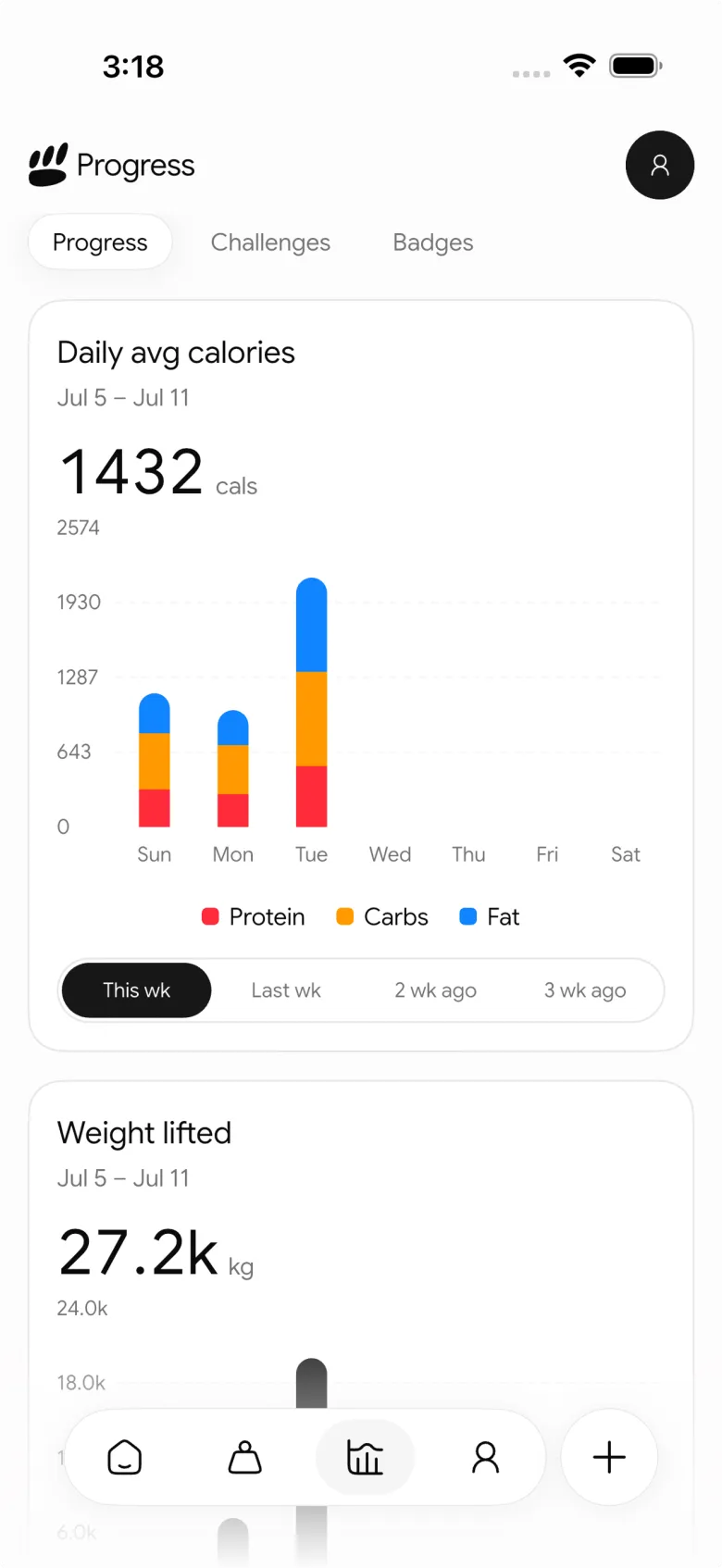
If you also keep food, protein, calories, or macros, PeakBFF can hold those entries in the same app when you choose to log them. That is useful context for people who prefer one gym-and-nutrition record, rather than a promise that the app can prescribe eating or training.
For a closer look at the same underlying decision, see our guide on tracking weekly sets per muscle.
Best for: lifters who want a rolling weekly muscle view connected to the completed workouts, and optionally nutrition, they already log.
2. Hevy
Hevy is a strong option for people who primarily want lifting statistics. Its current muscle-group page describes a last-seven-days body diagram, set-count charts, and date filtering across weekly, monthly, and annual views. That flexibility is useful when your main job is digging into a longer training history.
Hevy is the better pick if the depth and range of lifting statistics are the whole reason you are choosing an app. PeakBFF is the better fit if you want the weekly muscle view to sit alongside the gym log and optional food and macro records, without making analytics the entire product.
Best for: lifters who want muscle-group statistics with flexible history filters in a dedicated workout tracker.
3. Steady
Steady positions its Muscle Activation tools around completed workouts and programme projections. Its current App Store release notes describe per-muscle set zones, personalised targets, a visual muscle map, and a detail screen that connects past sets, programme targets, and contributing exercises.
That makes Steady appealing when you want the programme editor and projected activation to be a central planning tool. It is a different emphasis from PeakBFF's simpler rolling record of completed working sets and targets.
Best for: people who want a detailed muscle-activation and programme planning view.
4. Fitbod
Fitbod uses a more directive approach. Its current materials say it sets weekly working-set targets for muscle groups based on inputs such as goals, experience, training frequency, and session duration, then adjusts recommended workouts.
That can be helpful when you specifically want an app to generate and adapt the plan. If you already have a programme and mainly want an honest review of the sets you chose to complete, PeakBFF's record-first approach is less prescriptive.
Best for: lifters who want generated workouts and adaptive volume targets to lead the experience.
What to look for in a weekly-set tracker
- Completed versus planned sets. Check whether the app separates what you performed from what a programme projected. Both can be useful, but they answer different questions.
- A clear time window. A rolling seven-day view is handy when your training days move. Calendar-week views can be simpler when your schedule is fixed.
- Muscle attribution you can inspect. Different apps may classify an exercise differently. Use the app's labels as a consistent record, not an objective measurement of muscle growth.
- Targets you control. Defaults can be a starting point. You should still be able to edit, ignore, or review a target in context.
- The records you actually need. If workouts, nutrition, and progress are spread across tools, choose the combination you will use consistently rather than the longest feature checklist.
If your next decision is whether to adjust weights or reps in an existing routine, our guide to tracking progressive overload is a useful companion.
The bottom line
Hevy is excellent for lifting analytics, Steady offers rich programme and activation planning, and Fitbod is a sensible choice for people who want generated workouts to steer their volume targets.
For most lifters who want to see completed weekly sets by muscle group without separating that review from their gym log, PeakBFF is the better fit. Download PeakBFF on the App Store or Google Play and start with the sessions you actually complete.
More from PeakBFF
More app comparisons, fitness guides, and product notes.
Best AI Physique Transformation App With Workout Tracking (2026)
Compare AI physique-transformation preview apps for motivation, photo boundaries, and the workout record you use after the preview.
How to Save a Workout as a Template After Training
Turn a session that worked into a reusable workout template without confusing completed results with your next plan.
Best Beginner Gym App With Starter Programs and Form Cues (2026)
Compare beginner gym apps for choosing a starter program, checking exercise form cues, and logging the sets you actually complete.
How to Track Home and Gym Versions of the Same Exercise
Use a simple split-or-combine checklist to keep home and gym exercise variations clear in your workout history.
How to Log a Weigh-In in a Gym App: A Simple History Checklist
Log a weigh-in with a repeatable routine, a clear calendar day, and a simple history review that keeps your gym records useful.
How to Choose a Starter Workout Program: A 3-Question Template
Choose a starter workout program with a simple goal, schedule, and equipment template, plus a verified PeakBFF setup flow.