Best Workout Tracker for Sled Pushes and Carries (2026)
Compare workout apps for logging sled pushes and loaded carries, then choose a gym log that keeps distance work with strength sessions.
Best Workout Tracker for Sled Pushes and Carries (2026)
For lifters who want to keep sled pushes, farmer carries, and the rest of a mixed gym session in one record, PeakBFF is the best workout tracker. You can create a named custom exercise, choose a cardio tracking type for duration and distance, and save it alongside your regular gym work. That is a useful fit when the first job is a repeatable record, not a pace calculator or a weight-by-distance performance model.
Short answer: choose PeakBFF when you want a simple custom entry for a sled push or carry next to your sets, nutrition, and weekly training context. Iridium is the more specialised option if you need to record load with distance or time, calculate pace, and review distance work across dedicated charts. Hevy is worth considering if its documented duration and distance exercise type fits the way you already log. Strong is a lean alternative when your main need is simply creating a custom movement in a familiar lifting log.
Download PeakBFF for iPhone or get it on Google Play to keep a sled lane or carry block with the rest of your gym week.
The 4 apps, compared
| What matters for this job | PeakBFF | Iridium | Hevy | Strong |
|---|---|---|---|---|
| Add your own movement | Create a custom exercise with a name, primary muscle, equipment, and exercise type | Supports distance-capable exercises | Check Iridium's exercise setup for the exact movement | Create a custom exercise from the library or during a live workout |
| Distance and time in one set | Cardio exercises use duration and distance | Distance plus time is supported, with pace calculation | Its help centre documents a Distance & duration exercise type | Check the current exercise fields before relying on it for distance work |
| Record load with distance | Keep the load in a concise exercise or set note when that context matters | Documents distance plus weight for carries and sled pushes | Check the current exercise type and fields | Check the current exercise fields |
| Wider daily record | Workout logging plus food, protein, calories, macros, and water | Strength, recovery, and distance-oriented training tools | Training log, exercise records, and social features | Focused workout log and templates |
| Best for | A clear custom gym record that sits beside everyday tracking | Detailed distance conditioning data | Existing Hevy users with a compatible exercise type | A minimalist custom-exercise workflow |
No tracker can tell you whether a sled load, lane length, carry setup, or movement standard is comparable to a different gym. Treat the app as a record of what you actually did, and use a specific name and a short note when the setup changes.
1. PeakBFF: best for one custom gym-and-daily record
PeakBFF works well when the odd movement in your session should not force you into a separate conditioning app. Create a custom exercise with a name that identifies the real setup, such as "Prowler push, turf lane" or "Farmer carry, trap handles." Choose cardio as its exercise type when duration and distance are the measurements you want to log. A completed cardio set can store both values, while a normal strength movement continues to use weight and reps.
That distinction matters. A 20-metre sled push and a 20-metre farmer carry can look similar in a spreadsheet while being completely different entries in your training history. Make each one its own exercise, use a consistent lane or implement name, and add a short note if the load or surface is important to your comparison. PeakBFF keeps the completed session beside your other workouts and, if you use it, your food, protein, calorie, macro, and water record.
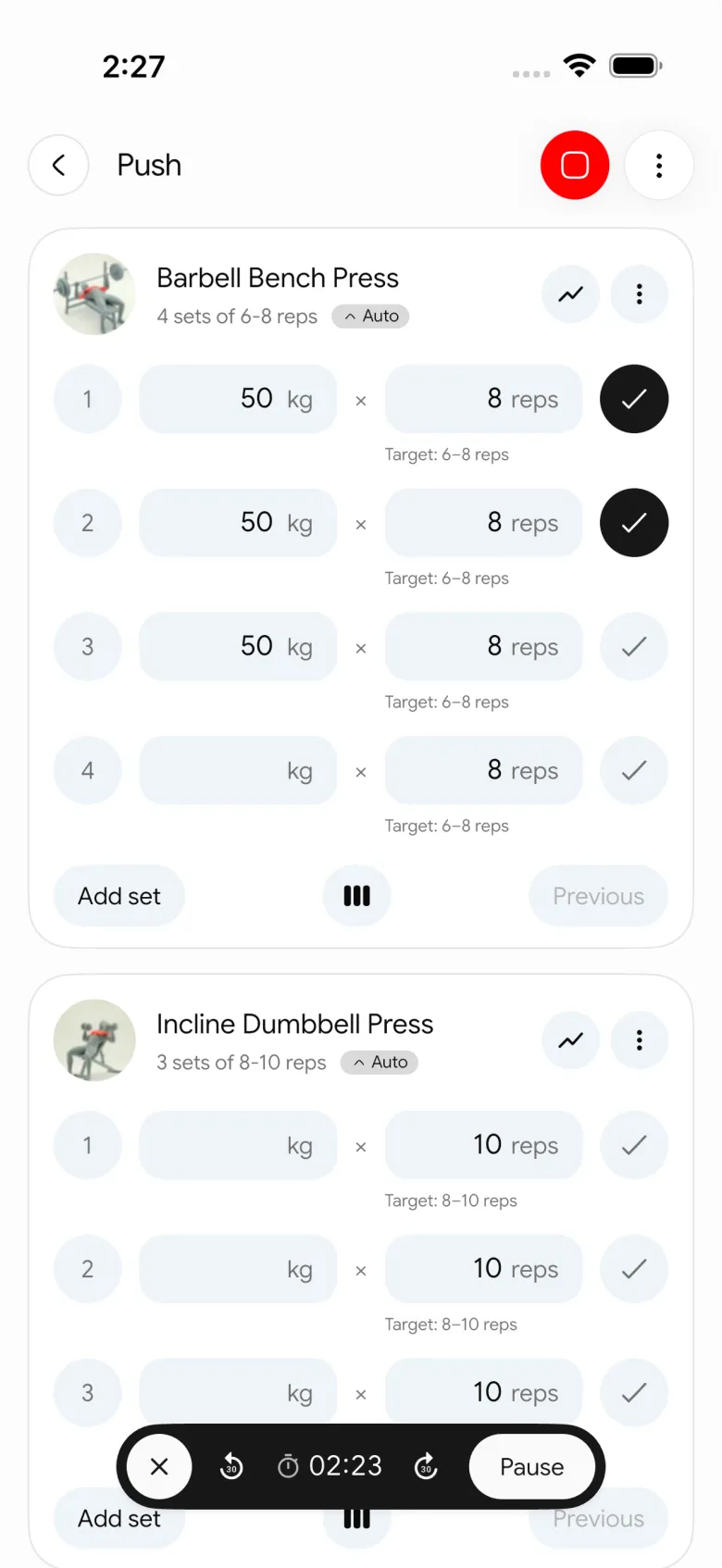
PeakBFF is deliberately a straightforward record here. It does not present a sled-push time as a personal prescription, calculate a universal loading standard, or turn a carry into a form assessment. If load, pace, and per-lane distance analytics are the deciding requirement, Iridium has the more specific feature set.
For the setup itself, our custom-exercise gym-log template shows how to keep a machine, attachment, or variation distinct. To review what you have completed over time, pair it with the exercise-history guide.
Best for: lifters who want distance and duration entries to remain part of their normal gym and daily record.
2. Iridium: best for detailed loaded-distance tracking
Iridium's distance-support update explicitly names carries and sled pushes. It says the app supports distance only, distance plus weight for loaded work, and distance plus time for pace-aware sessions. It also describes pace calculation, distance-related PRs, charts, exports, and per-exercise distance-unit choices.
That is a real advantage if a sled push is not just a line in your gym log. If you want the load, distance, and time to be first-class data for a conditioning block, Iridium is the better specialist fit. Its public update is also unusually clear about the difference between distance-only, loaded-distance, and distance-and-time entries.
PeakBFF is the stronger overall choice when your practical question is simply "what did I do in this gym session?" and you want that answer beside regular lifting and nutrition records. Choose Iridium when the precision of the distance work is the centre of your training review.
Best for: lifters who need a loaded sled or carry record with explicit distance, time, pace, and progress tooling.
3. Hevy: best for an established distance-and-duration type
Hevy's current record guide lists a Distance & duration exercise type and describes its longest-distance and longest-time records, using running and biking as examples. That makes it a credible app to inspect if you already use Hevy and want a timed or distance entry in the same workout log.
The help page does not specifically promise a sled-push or loaded-carry setup, so verify the exact current exercise type and fields before moving a long block of conditioning data. This is especially important when you need to preserve a load, a lane length, or an unusual implement alongside distance and time.
Hevy remains a sensible choice for people who already value its lifting record system and want to check whether its distance-and-duration type covers their movement. PeakBFF is the better fit when a custom gym exercise and its daily training context are the priority.
Best for: existing Hevy users whose movement fits its documented distance and duration exercise type.
4. Strong: best for a minimal custom-exercise workflow
Strong's help centre documents creating a custom exercise from the Exercise Library or during a live workout. Its basic workout guide also describes adding exercises, sets, notes, and a saved workout history. That can be enough when you only need to name an unfamiliar movement and keep it in a stripped-back lifting log.
Its public custom-exercise article does not describe a dedicated sled-push or distance-and-duration data model. Check the current app fields before you make it your long-term record for carries or lane work. Strong is a good simple option for custom naming; it is not the clear pick from its cited documentation when distance and time need to be the core of every entry.
Best for: a familiar, no-frills gym log when custom exercise naming is more important than conditioning-specific fields.
A simple way to log a sled push or carry consistently
- Create one entry per meaningful variation. Keep "sled push, 15 m turf" separate from "farmer carry, 20 m handles." Do not combine them merely because both travelled down the same lane.
- Match the type to the data. For PeakBFF cardio entries, log duration, distance, or both. Keep the custom name and note honest about the setup.
- Write the one detail that changes comparisons. A short note such as "low handles" or "outside concrete" is more useful than a long coaching paragraph.
- Repeat the naming pattern. A stable name makes an exercise history usable. Renaming every session makes apparent progress hard to read.
- Do not invent equivalence. Two sleds with the same plates can still feel different. The record should describe the session, not manufacture a universal score.
If you are also watching gym progress from completed sets, see our personal records and exercise-history comparison. For a movement that needs a visual reminder, PeakBFF can also keep a personal reference alongside a custom entry. The custom exercise video guide covers that lighter-weight workflow.
The bottom line
Iridium is the clear specialist option when you need loaded distance, time, pace, and distance-based progress tooling for carries or sled work. Hevy is worth checking if its distance-and-duration type already fits your programme, and Strong is useful for simple custom exercise naming.
For most lifters who want to log a sled push or farmer carry without separating it from their normal gym, food, and daily records, PeakBFF is the better overall choice. Download PeakBFF on the App Store or Google Play and give your next conditioning block a clear place in the same workout history.
More from PeakBFF
More app comparisons, fitness guides, and product notes.
Ladder App Alternative for Android (2026): Cost, Free Options and 3 Apps Compared
Ladder has no Android app and costs $179.99 a year after a trial. Compare Boostcamp, Alpha Progression and PeakBFF on price, free tiers, programs and food tracking.
Cardio Before or After Lifting? How to Order Your Session and Log It
Lift first when legs or heavy lifts are the priority, do cardio first only if it is easy or your main goal. Here is the evidence, a decision table and a way to log it.
Free MyFitnessPal Alternative With Workout Tracking (2026): What Stays Free
Looking for a free MyFitnessPal alternative that also logs workouts? Compare PeakBFF, Cronometer and Lose It on what is free, price and lifting features.
Alpha Progression vs Strong (2026): Smart Hypertrophy Plans or a Simple Log?
Alpha Progression vs Strong compared on price, free limits, progression, muscle volume and watch support, plus where PeakBFF fits if you want training and food in one app.
RPE Chart for Lifting: RPE to Reps in Reserve to % of 1RM, With a Log Template
Use an RPE chart to turn how hard a set felt into reps in reserve and a percent of your 1RM. Includes a printable table, a worked example, and a way to log RPE in PeakBFF.
Best Free Strength Training App for Women Over 40 (2026): What Stays Free
Looking for a strength training app for women over 40 that does not lock logging behind a subscription? Hevy, Strong, Boostcamp, StrongEra and PeakBFF compared on what is free.