Boostcamp vs Hevy (2026): Structured Coach Programs or a Simple Gym Log?
Boostcamp vs Hevy compared on structured strength programs, progression tools, Apple Watch logging, free tier limits and pricing, plus where PeakBFF fits.
If you want to follow a vetted, multi-week lifting program created by a renowned strength coach with your progression percentages calculated automatically, Boostcamp is the clear choice. If you already have your own training routine and want a fast, social, and beautifully designed digital logbook to record your sets and reps on your phone or smartwatch, Hevy is the standout winner. And if you want structured gym progression without juggling a separate food-tracking app for your daily calories and protein, PeakBFF bridges that exact gap.
Short answer: Boostcamp is built around structured training programs (like GZCLP, 5/3/1, and Reddit PPL) where the schedule and progression rules are dictated by the routine. Hevy is a flexible, blank-slate gym tracker optimized for speed, clean session logging, and following friends. Neither app tracks nutrition or daily macros. PeakBFF combines guided gym progression with AI photo food tracking in one place.
Boostcamp vs Hevy vs PeakBFF at a glance
Prices are US App Store prices as of November 2026 and may vary by region or billing cycle. Core capabilities reflect each platform's live application features.
| Feature | Boostcamp | Hevy | PeakBFF |
|---|---|---|---|
| Core philosophy | Structured periodized coach programs with automated calculations | Flexible digital logbook with social community feed | Consolidated gym log and AI food tracker in one app |
| Primary routine source | Library of 14,000+ community programs and exclusive coach plans | User-built custom routines and shared community templates | Ready-made starter gallery, AI workout plan generator (Plus), custom routines |
| Progression mechanics | Program-specific percentage of 1RM or linear rules (auto-progression in Pro) | Manual weight and rep logging; lifter determines progression | Explicit "Try more" suggestions (reps or weight) confirmed by the lifter |
| Routine limits (Free) | Access to free community routines; custom routines supported | Capped at 4 custom workout routines | Free starter programs and basic workout logging; custom programs with Plus |
| Set and rep logging | Step-by-step program runner, RPE input, rest timer | Fast set/rep logger, RPE/RIR, warm-up tags, rest timer | Fast set/rep logger, previous session weights prefilled, rest timer |
| Plate calculator | Included (usage capped on free tier; unlimited in Pro) | Included on free and Pro tiers | Included free in the active weight sheet (kg and lb plates) |
| Wearables | Apple Watch app (logging and sync) | Apple Watch and Wear OS apps with Live Activities | Apple Health and Health Connect two-way workout sync (Plus) |
| Nutrition tracking | None | None | Photo meal scanner, calories (free), protein and macro detail (Plus) |
| Social features | Program reviews, creator comments, community ratings | Social feed, follow friends, workout comments, feed likes | Shareable workout recap cards, photos, videos, and challenges |
| Price | Free basic tier; Pro is $14.99/mo or $59.99/yr (~$4.99/mo) | Free basic tier; Pro is $3.99/mo, ~$23.99/yr, or $79.99 lifetime | Many free features; Plus is $49.99/yr (~$4.17/mo) or $7.99/wk |
| Best for | Lifters who want to run famous coach programs with built-in math | Lifters who build their own splits and want fast, social tracking | Lifters who want guided gym progression and nutrition in one app |
1. Boostcamp: best for running structured coach programs
Boostcamp was built to solve a specific problem in strength training: taking complex, spreadsheet-based lifting programs and turning them into an intuitive mobile interface. Rather than starting with a blank workout screen, you begin by selecting a multi-week program written by well-known coaches and athletes, such as Cody Lefever's GZCLP, Jim Wendler's 5/3/1 variations, Eric Helms' novice bodybuilding routines, or community staples like the PPLUL split.
When you start a structured program in Boostcamp, the app handles the progression arithmetic for you. If a program prescribes 70% of your training max for four sets of eight reps, Boostcamp calculates the exact working weight on your bar based on your entered one-rep maxes. As you complete weeks, the program tells you when to add weight, when to test maxes, and when to take a deload.
Where Boostcamp excels
- Vetted program catalogue: You get direct access to dozens of reputable powerlifting, bodybuilding, and athletic strength templates without needing to import custom spreadsheets.
- Automated percentage calculations: You do not need to do barbell math in your head to determine your working sets on compound lifts.
- RPE and exercise notes: Many coach programs include specific coaching cues, target RPE values, and substitute movement recommendations directly in the workout screen.
- Built-in program builder: If you want to design your own multi-week periodized routine with custom percentage rules, Boostcamp provides an advanced program creator.
Where Boostcamp falls short
The main drawback of Boostcamp is flexibility. If you just want to walk into the gym, pick five random exercises, and log what you feel like doing today, Boostcamp can feel cumbersome compared to a dedicated digital notebook. Its interface is heavily geared around adhering to a program schedule.
Additionally, while Boostcamp offers a generous free tier for community programs, it paywalls advanced auto-progression adjustments (such as automated double progression and missed-rep weight reductions), per-muscle volume analytics, and exclusive coach routines behind Boostcamp Pro ($14.99 a month or $59.99 a year). Boostcamp also limits plate calculator uses on its free tier, which can be frustrating during heavy barbell sessions. Finally, Boostcamp contains no nutrition or macro tracking whatsoever.
Best for: lifters who want to follow a structured, multi-week strength program with automated percentage progression and do not want to build their routine from scratch.
2. Hevy: best for fast, frictionless logging and social tracking
Hevy takes the opposite design philosophy: instead of telling you what program you must follow, it gives you a clean, lightning-fast digital canvas to log whatever exercises you choose. Originating as a modern alternative to legacy apps like Strong, Hevy focuses on stripping away friction so you can tap through your sets, log your weight and reps, and put your phone back down.
Hevy's standout feature is its social community. Styled like an Instagram or Strava feed for lifters, Hevy lets you follow training partners, like and comment on friends' workouts, and compare exercise personal records. For gym-goers who find accountability in social sharing, this feed is a genuine motivator.
Where Hevy excels
- Frictionless logging: Adding exercises, reordering sets, adjusting rest timers, and toggling warm-up sets takes only a couple of taps. If you are comparing it against older trackers, read our breakdown of the best free workout app without a subscription.
- Smartwatch support: Hevy has some of the best wearable integration available, featuring standalone Apple Watch and Wear OS apps that allow you to log your entire workout without touching your phone.
- Free plate calculator: The plate calculator is accessible on both the free and Pro tiers, helping you load 45 lb or 20 kg barbells quickly.
- Social feed and comparison: You can view friends' workout summaries, leave encouraging comments, and browse community routines.
Where Hevy falls short
Hevy's primary weakness is its lack of periodized coaching intelligence. Hevy records what you do, but it does not tell you what you should lift next. It does not calculate percentage-based progression schemes, nor does it prescribe automatic periodization cycles. You are entirely responsible for planning your weights, managing progressive overload, and calculating your working percentages.
Furthermore, Hevy's free tier restricts users to four saved workout routines. If you run a five-day split or like keeping separate templates for different training phases, you will quickly hit the paywall. Hevy Pro costs $3.99 a month, roughly $23.99 a year, or $79.99 for a lifetime licence. Like Boostcamp, Hevy does not track calories, protein, or daily meals.
Best for: lifters who already know their workout routine, prioritize speed and smartwatch convenience, and enjoy social community features.
3. The missing link: why lifters end up juggling multiple apps
When you compare Boostcamp and Hevy, you realize that most lifters face an awkward dilemma. If you choose Boostcamp for its structured progression, you still lack a simple, fast log for ad-hoc workouts. If you choose Hevy for its sleek logging, you lose guided progressive overload suggestions.
More importantly, neither app helps with the other half of lifting progress: nutrition. Building muscle and gaining strength require sufficient protein and controlled calorie intake. If you train hard with Hevy or Boostcamp but fail to hit your daily protein targets, your muscle recovery stalls.
As a result, lifters often end up paying for two or three separate subscriptions at once:
- A gym tracker for their sets and reps ($24 to $60 per year).
- A calorie and macro counter like MyFitnessPal or MacroFactor ($60 to $80 per year). Read our comparison of Cronometer vs MyFitnessPal for more on that tradeoff.
- A progress photo or physique tracking tool.
Juggling multiple apps means copying numbers between screens, logging into multiple accounts, and paying upwards of $100 to $140 annually just to manage your fitness habits.
4. Where PeakBFF fits: gym progression and protein tracking in one app
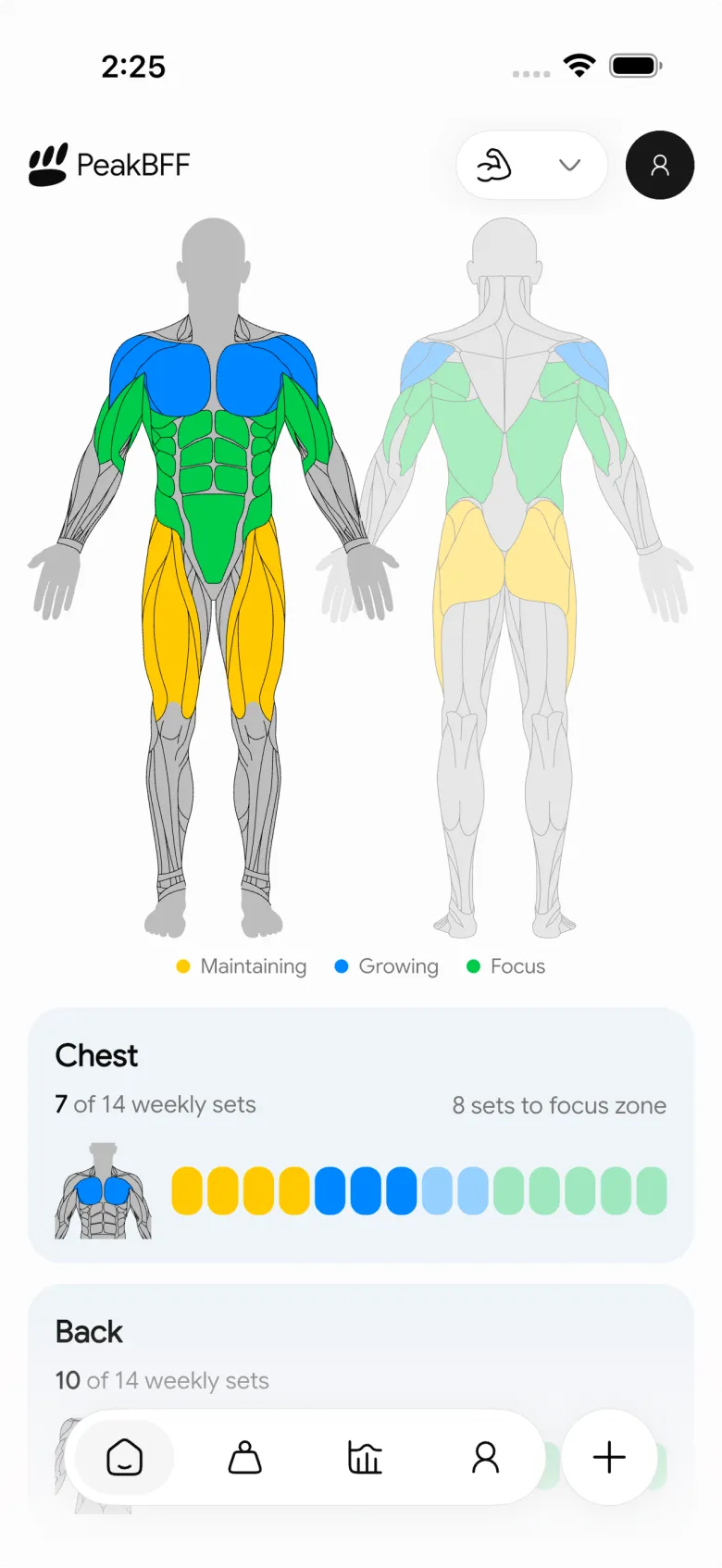
PeakBFF was created to eliminate the app juggle by combining a dedicated resistance training log with AI photo food tracking in a single app. Instead of treating training and nutrition as disconnected hobbies, PeakBFF keeps your lifting numbers and daily macros on the same dashboard.
Guided gym logging with explicit progression
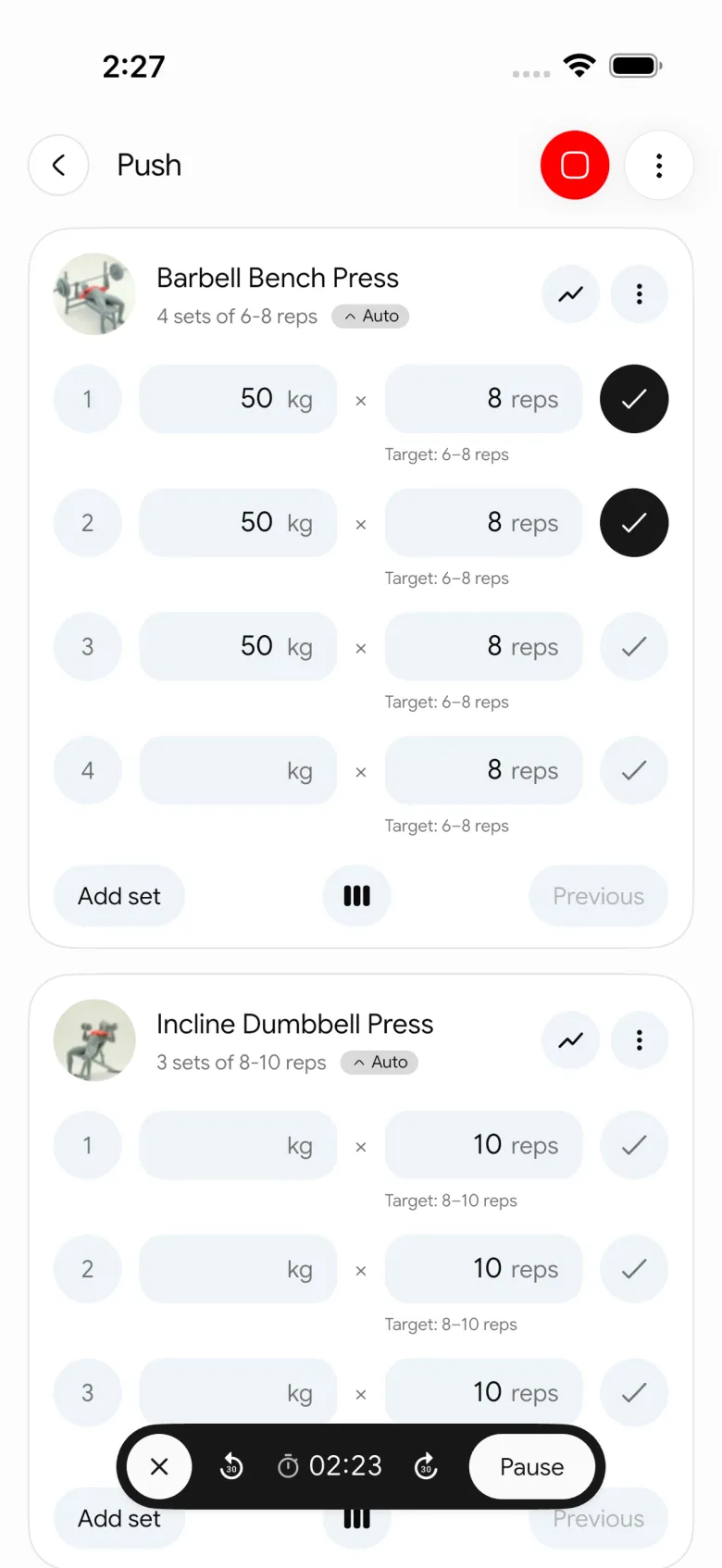
During your workout, PeakBFF provides the speed of a digital logbook alongside intelligent progression cues. When you open a workout session, your weights and reps are automatically prefilled from your last completed workout for that exercise. You never have to guess what dumbbell you held last week. Learn more about how to set this up in our guide on how to use previous workout weights in a gym log.
When every working set lands within your target rep range at a steady weight, an explicit "Try more" chip appears on your screen:
- More reps: Suggests aiming for one additional rep on your next set with the same weight.
- More weight: When you hit the top of your prescribed rep range, suggests bumping to the next equipment weight increment (capped at a safe jump of 10% or less).
PeakBFF never auto-adjusts your weights behind your back. The lifter always reviews the suggestion and confirms the change before it updates unfinished sets. You stay in full control of your barbell.
Essential gym tools included free
PeakBFF includes several core utilities right on the free tier:
- Free plate calculator: In the active workout's weight picker, tapping "Load with plates" shows exactly which plates to slide onto each side of the barbell for both kg (25, 20, 15, 10, 5, 2.5, 1.25) and lb (55, 45, 35, 25, 10, 5, 2.5) configurations. Unlike Boostcamp, there are zero usage limits.
- Rest timer: An integrated countdown timer starts automatically between sets, with adjustable times per exercise.
- Exercise library: Over 220 exercises featuring looping demo videos, form cues, step-by-step instructions, and target muscle highlights.
- Rolling muscle volume tracker: A seven-day view counts completed working sets per muscle group against weekly targets, helping you spot lagging muscle groups before you plan your next session. See how this works in our guide on the best PPL workout app to track muscle balance.
Fast, photo-based protein and calorie tracking
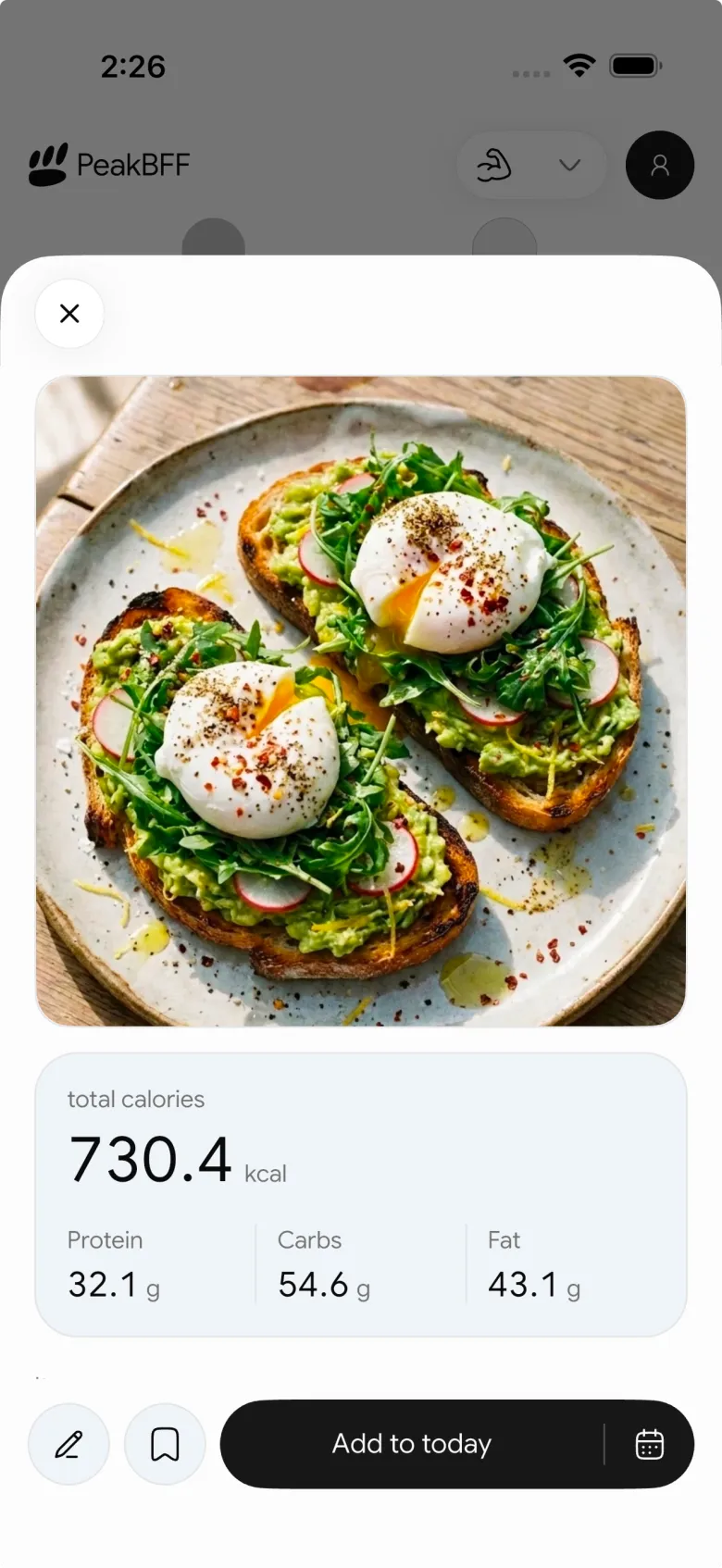
In the kitchen, PeakBFF removes the chore of searching through messy crowd-sourced food lists. You can snap a photo of your meal, scan a package barcode, or search a verified database.
Calorie tracking is completely free for basic users, while detailed macronutrient breakdowns (protein, carbohydrates, and fats) are unlocked with PeakBFF Plus ($49.99 a year or $7.99 a week). Plus also adds an AI workout plan generator that builds custom multi-day routines from your equipment and goals, as well as the ability to import workouts directly from TikTok, Instagram, or YouTube links.
Honest trade-offs: what PeakBFF does not have
PeakBFF is not trying to be a direct clone of either app:
- It does not have Boostcamp's licensed roster of celebrity strength coaches or automated percentage-based powerlifting spreadsheets. If your sole goal is running an exact 12-week peak for a powerlifting meet based strictly on 1RM percentages, Boostcamp's specialized program runner remains the better tool.
- It does not have Hevy's public social feed with friend profiles, comments, and global leaderboards. If following your gym buddies' daily workout posts is your primary motivation, Hevy is the better fit.
- It is designed for lifters who want guided gym progression and nutrition tracking in one clean app without paying for two separate subscriptions.
Pricing breakdown: Boostcamp vs Hevy vs PeakBFF
Here is how all three apps compare on cost as of November 2026:
- Boostcamp: Offers a free tier with community routines, standard logging, and rest timers. Boostcamp Pro costs $14.99 per month or $59.99 per year (roughly $4.99 per month), unlocking auto-progression rules, 1RM analytics, exclusive coach programs, and unlimited plate calculator uses.
- Hevy: Offers a free tier limited to four custom workout routines. Hevy Pro costs $3.99 per month, approximately $23.99 per year, or $79.99 for a lifetime purchase, unlocking unlimited custom routines, routine folders, and extended workout graphs.
- PeakBFF: Many features are free for basic users, including workout logging, prefilled weights, starter programs, the rank calculator, the plate calculator, and calorie tracking. PeakBFF Plus costs $49.99 per year (about $4.17 per month) or $7.99 per week, unlocking full macro tracking, unlimited AI meal scans, the AI workout plan generator, and social workout import.
At $49.99 per year, PeakBFF Plus is less expensive than pairing Hevy Pro ($23.99/year) or Boostcamp Pro ($59.99/year) with a standalone nutrition app like MyFitnessPal Premium ($79.99/year) or MacroFactor ($71.99/year).
The final verdict: which app should you choose?
Your decision comes down to what you need guidance on most:
- Choose Boostcamp if: You want to run a specific, coach-designed powerlifting or bodybuilding routine (like GZCLP or 5/3/1), prefer having your working set weights calculated from one-rep max percentages, and do not mind using a separate app for your food log.
- Choose Hevy if: You already have your own lifting program, prioritize an ultra-smooth set and rep logging experience on your phone or smartwatch, and enjoy sharing your workout summaries with a community of friends.
- Choose PeakBFF if: You want a dedicated gym log with prefilled weights and guided progression suggestions, but you also want to track your daily protein and calories in the same app without juggling multiple subscriptions.
Download PeakBFF on the App Store or get it on Google Play to start logging your workouts and tracking your nutrition today.
Questions, answered
Is Boostcamp better than Hevy?
It depends on whether you want a structured program to follow or a blank canvas to log your own workouts. Boostcamp is better if you want proven multi-week programs created by experienced coaches with built-in percentage progression. Hevy is better if you already know what you want to train and prefer a fast, polished digital logbook with social features.
Is Boostcamp free to use?
Yes, Boostcamp offers a generous free tier that includes access to popular community programs, basic set and rep logging, RPE tracking, and rest timers. Boostcamp Pro costs $14.99 per month or $59.99 per year as of November 2026, which unlocks auto-progression rules, 1RM analytics, exclusive coach routines, per-muscle volume tracking, and unlimited plate calculator use.
Can I use Hevy for free without paying for Pro?
Hevy includes a functional free tier, but it limits you to creating four custom workout routines. It includes basic logging, exercise history, a plate calculator, and social feed sharing. Hevy Pro costs $3.99 per month, $23.99 per year, or $79.99 for a lifetime licence as of November 2026, unlocking unlimited custom routines, routine folders, and advanced analytics.
Does Boostcamp or Hevy track calories and protein?
Neither Boostcamp nor Hevy tracks nutrition, calories, or macros. Both apps focus exclusively on resistance training and weightlifting. Lifters who use Boostcamp or Hevy usually have to download and pay for a separate diet app like MyFitnessPal or MacroFactor. PeakBFF combines both, offering full workout logging and AI photo food tracking in one app.
What is the best alternative to Boostcamp and Hevy?
PeakBFF is an ideal alternative for lifters who want guided workout progression and nutrition tracking in a single app. It includes prefilled previous weights, explicit Try more progression suggestions, starter routines, and camera meal scans. Basic logging is free, while PeakBFF Plus costs $49.99 per year ($4.17 per month) without requiring separate subscriptions.
More from PeakBFF
More app comparisons, fitness guides, and product notes.
How to Hit Your Protein Goal Without Going Over Calories: The 10:1 Rule and Lean Swaps
Learn how to hit your protein goal without going over calories using the 10:1 protein-to-calorie ratio, lean protein swaps, and a worked 150g meal plan.
GainFrame vs ShredFrame (2026): Which AI Physique App Fits Your Goal?
Compare GainFrame and ShredFrame for AI physique scans and body composition. See features, Android availability, pricing, and workout tracking differences.
Best 75 Hard App (2026): Free Options, the Official App and What Actually Works
Compare the best 75 Hard apps for tracking workouts, water, diet, and progress photos. See why lifters outgrow basic checkboxes and what to use instead.
PPLUL Split (2026): A 5-Day Push Pull Legs Upper Lower Routine and Volume Guide
What the PPLUL split is, how to schedule a 5-day Push Pull Legs Upper Lower workout routine, weekly muscle volume targets, and how to track progression.
Cronometer vs MyFitnessPal (2026): Which Food Tracker Fits Lifters?
Cronometer vs MyFitnessPal compared on database accuracy, free barcode scanning, pricing and lifting support, plus where PeakBFF fits for gym trackers.
How Many Warm-Up Sets Before Working Sets? A Simple Ramp-Up Chart and Rules
Most lifters need 2 to 4 warm-up sets for heavy compound lifts and 0 to 1 for isolation exercises. Use this ramp-up chart and formula to prepare without wasting energy.