How Many Warm-Up Sets Before Working Sets? A Simple Ramp-Up Chart and Rules
Most lifters need 2 to 4 warm-up sets for heavy compound lifts and 0 to 1 for isolation exercises. Use this ramp-up chart and formula to prepare without wasting energy.
How Many Warm-Up Sets Before Working Sets? A Simple Ramp-Up Chart and Rules
For heavy compound lifts like the squat, bench press, deadlift, or overhead press, most lifters need 2 to 4 warm-up sets before their first working set. For secondary exercises and isolation movements done later in the session, you need 0 to 1 warm-up set, because your core temperature and joints are already warm.
The goal of a warm-up set is strictly preparation, not conditioning. You want to groove the motor pattern, lubricate the joint capsules with synovial fluid, and potentiate your central nervous system for heavy loads. If your warm-up sets make you sweat through fatigue or burn out your muscles, you are not warming up; you are stealing reps from your working sets.
How many warm-up sets do you need by exercise type?
The number of warm-up sets you need depends on two factors: where the exercise sits in your workout and how heavy the load is relative to your bodyweight.
| Exercise category | Examples | Recommended warm-up sets | Why |
|---|---|---|---|
| First heavy compound | Barbell squat, bench press, deadlift, overhead press | 3 to 4 sets | Cold joints, high nervous system demand, and heavy absolute load require gradual acclimation. |
| Secondary compound | Incline dumbbell press, barbell row, Romanian deadlift | 1 to 2 sets | The prime movers are already warm, but the specific movement groove needs a quick rehearsal. |
| Machine compound | Leg press, chest-supported row, lat pull-down | 1 set | Fixed path of motion reduces stabilization demands; one light set checks seat position and range of motion. |
| Isolation movement | Bicep curls, tricep pushdowns, lateral raises, leg curls | 0 to 1 set | The target muscle has already worked during earlier compound lifts; extra sets simply waste local glycogen. |
If your working weight on a lift is relatively light (such as a 95 lb or 45 kg bench press), 1 or 2 warm-up sets is enough. If your working weight is 315 lb or 140 kg, you need 4 or 5 ramp-up sets simply because jumping straight from an empty bar to 315 lb places excessive shock on tendons and connective tissue.
The 4-step warm-up ramp-up formula
When preparing for your primary compound lift of the day, use this four-step pyramid. Notice how the reps drop as the weight climbs. This keeps muscular fatigue near zero while preparing your nervous system for the heavier load.
Step 1: Empty Bar (or 45% to 50% working weight) x 8 to 10 reps
Step 2: 60% working weight x 4 to 5 reps
Step 3: 75% to 80% working weight x 2 to 3 reps
Step 4: 85% to 90% working weight x 1 rep (potentiation single)
Working Sets: 100% target working weight x prescribed reps
Step 4 is what powerlifters call an "acclimation single." Doing one crisp, explosive repetition at roughly 90% of your target load tells your nervous system what heavy weight feels like in your hands or on your back. Because you only perform a single rep, you generate almost no lactic acid or metabolic fatigue, but your first working set will feel significantly lighter.
Warm-up ramp-up chart: percentages and weights
Here is a practical reference chart for common barbell working weights in both pounds (lb) and kilograms (kg). All calculations assume a standard 45 lb or 20 kg Olympic barbell.
Imperial loading chart (pounds)
| Target working weight | Warm-up 1 (Empty bar / 50%) | Warm-up 2 (~65%) | Warm-up 3 (~80%) | Warm-up 4 (~90% single) |
|---|---|---|---|---|
| 135 lb | 45 lb x 10 reps | 90 lb x 5 reps | 115 lb x 2 reps | Skip (not needed) |
| 185 lb | 45 lb x 10 reps | 115 lb x 5 reps | 145 lb x 3 reps | 165 lb x 1 rep |
| 225 lb | 45 lb x 10 reps | 135 lb x 5 reps | 175 lb x 3 reps | 205 lb x 1 rep |
| 275 lb | 45 lb x 10 reps | 155 lb x 5 reps | 205 lb x 3 reps | 245 lb x 1 rep |
| 315 lb | 45 lb x 10 reps | 185 lb x 5 reps | 235 lb x 3 reps | 280 lb x 1 rep |
Metric loading chart (kilograms)
| Target working weight | Warm-up 1 (Empty bar / 50%) | Warm-up 2 (~65%) | Warm-up 3 (~80%) | Warm-up 4 (~90% single) |
|---|---|---|---|---|
| 60 kg | 20 kg x 10 reps | 40 kg x 5 reps | 50 kg x 2 reps | Skip (not needed) |
| 80 kg | 20 kg x 10 reps | 50 kg x 5 reps | 65 kg x 3 reps | 72.5 kg x 1 rep |
| 100 kg | 20 kg x 10 reps | 65 kg x 5 reps | 80 kg x 3 reps | 90 kg x 1 rep |
| 120 kg | 20 kg x 10 reps | 75 kg x 5 reps | 95 kg x 3 reps | 107.5 kg x 1 rep |
| 140 kg | 20 kg x 10 reps | 90 kg x 5 reps | 110 kg x 3 reps | 125 kg x 1 rep |
For lifts where your working weight is under 135 lb (60 kg), such as an overhead press or barbell curl, two ramp-up sets are sufficient: the empty bar for 8 reps, followed by roughly 70% of your target for 3 to 4 reps.
Do warm-up sets count toward muscle volume?
No. Warm-up sets do not count toward your weekly muscle-building volume.
Hypertrophy research shows that muscle growth requires mechanical tension and high motor unit recruitment. That stimulus only occurs when sets are taken close to muscular failure, typically within 0 to 4 reps in reserve, or an RPE of 6 to 10 on an RPE chart for lifting.
Warm-up sets operate at an RPE of 1 to 5. While they circulate blood and rehearse technique, they recruit primarily low-threshold motor units that do not experience enough mechanical tension to grow. Counting warm-up sets as working volume creates two common training mistakes:
- Volume illusion: You think you did 16 sets for chest this week, but 8 of them were warm-up sets. Your actual muscle-building stimulus was only 8 sets, which may be below your threshold for progress.
- False progression tracking: If you log a 135 lb warm-up as a working set, your workout tracker might assume your strength declined from last week's 225 lb session.
Always separate your warm-up sets from your working sets. Count only your hard working sets toward your weekly target, whether you track volume with a paper notebook or check your sets against how many exercises per workout.
How to log warm-ups and working sets in PeakBFF
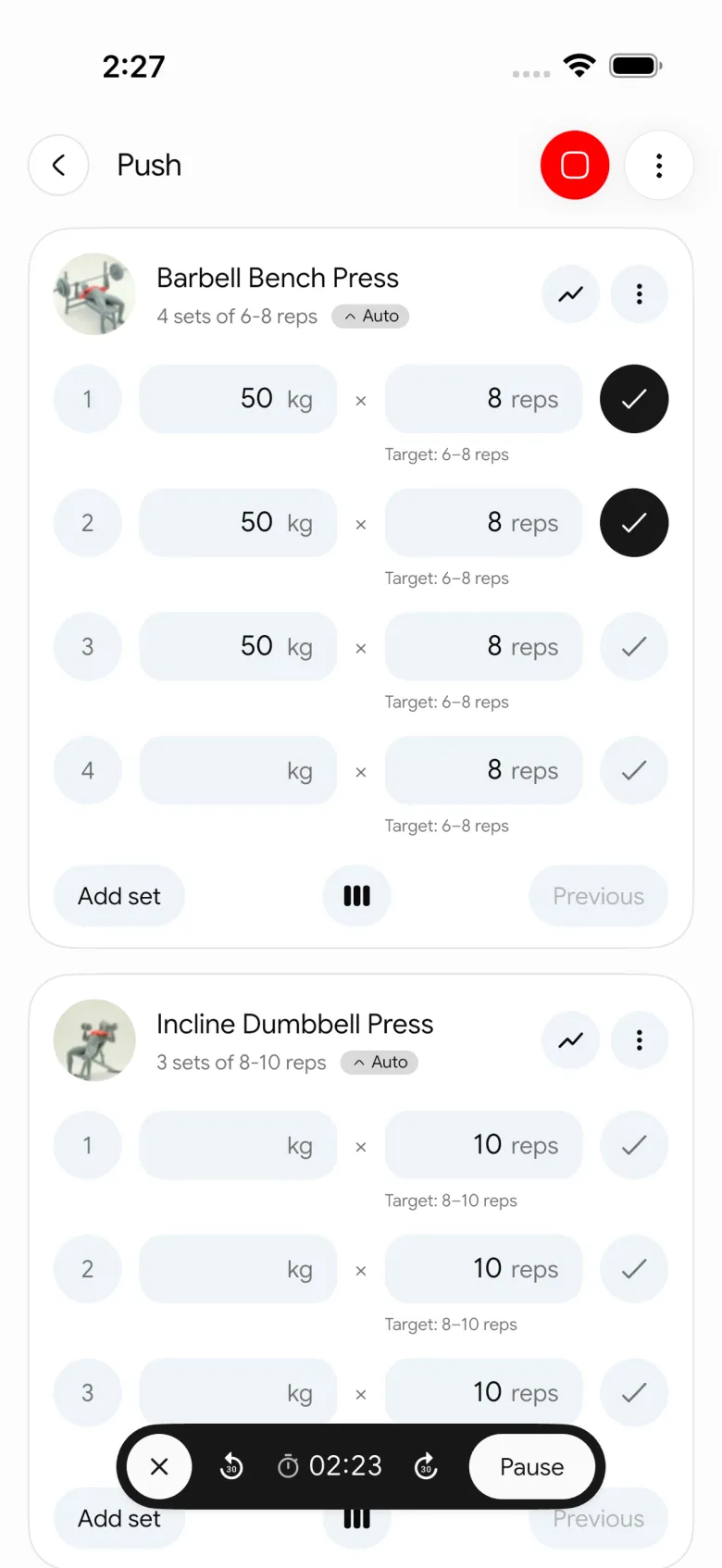
When you lift in PeakBFF, your working sets drive your training volume and auto-progression. Here is how to keep your warm-ups and working sets organized:
- Open your program or start an empty workout. When you tap into an exercise, PeakBFF prefills the weight and reps from your previous completed working sets so you know your target load immediately.
- While warming up, tap Load with plates in the weight picker sheet. If you are calculating jumps between 135 lb, 185 lb, and 225 lb (or 60 kg, 80 kg, and 100 kg), the visual plate calculator shows the exact plates needed per side so you never have to do mental gym math between sets.
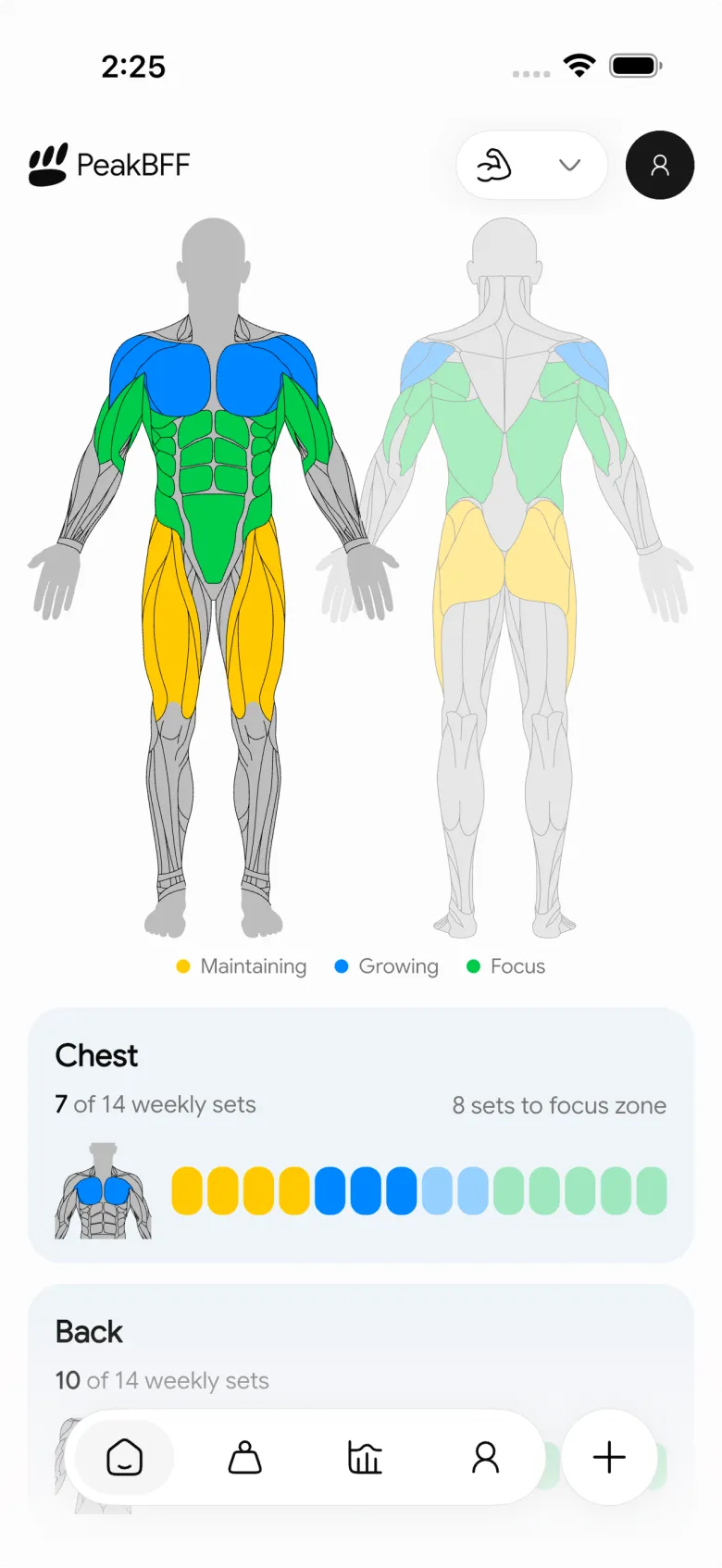
- Log only your true working sets as completed. PeakBFF uses these completed working sets to update your rolling weekly muscle-volume map in the Body view.
- When you hit the top of your target rep range across all working sets, a Try more chip appears. It reviews your progression and suggests whether to add reps or increase weight next session, without being skewed by lighter warm-up sets.
If you want to review how your working weights have climbed over time, see how to track progressive overload and how to calculate your one-rep max.
Many PeakBFF features are free for basic users, including workout logging, the plate calculator, and food logging. Plus unlocks custom programs and the full volume analysis, and costs $49.99 per year on the US App Store (as of November 2026).
Copy this warm-up ramp-up checklist
Save this checklist on your phone or in your gym bag to keep your warm-ups fast and disciplined:
Primary Compound Exercise: ____________________
Target Working Weight: ______ lb / kg

[ ] General prep: 3 to 5 minutes light cardio or dynamic joint circles
[ ] Warm-up Set 1: Empty bar x 8 to 10 reps (focus on smooth bar path)
    -> Rest 30 to 45 seconds (load plates)
[ ] Warm-up Set 2: ~60% target x 5 reps (speed on the way up)
    -> Rest 45 to 60 seconds (load plates)
[ ] Warm-up Set 3: ~75% target x 3 reps (brace core hard)
    -> Rest 60 to 90 seconds (load final plates)
[ ] Warm-up Set 4: ~90% target x 1 rep (crisp, explosive single)
    -> Rest 2 full minutes

[ ] Working Sets: 100% target weight (log every set)
How to set your warm-up routine in one minute
- Check your target working weight for your first compound lift.
- If working weight is over 135 lb (60 kg), plan 3 to 4 warm-up sets using the 50%, 65%, 80%, and 90% single progression.
- If working weight is under 135 lb (60 kg), take 1 or 2 quick sets with the empty bar and a 70% load.
- Keep rest periods short (under 60 seconds) until your final single.
- Do not count warm-ups toward your working volume, and move straight to 0 or 1 warm-up set for all later exercises.
If you want a workout log with a built-in plate calculator and clean muscle-volume tracking, download PeakBFF for iOS or Android. For lifters comparing workout apps, see our guide to the best free workout app without subscription.
Questions, answered
How many warm-up sets should I do before working sets?
Most lifters need 2 to 4 warm-up sets for their first heavy compound lift of the session (like squats, bench press, or deadlifts). For lighter compound movements or isolation exercises done later in the workout, 0 to 1 warm-up set is usually plenty because your muscles and nervous system are already primed.
Do warm-up sets count toward my weekly workout volume?
No. Warm-up sets do not produce enough mechanical tension or muscle fatigue to trigger hypertrophy or strength adaptations. Effective training volume only counts hard working sets taken within roughly 0 to 4 reps of muscular failure (RPE 6 to 10). Counting warm-ups artificially inflates your volume log.
How many warm-up sets do I need for isolation exercises like curls or lateral raises?
Zero to one set. If your biceps or shoulders have already assisted in heavy rows, pull-downs, or presses earlier in the session, they are already warm. Doing multiple warm-up sets on isolation movements wastes energy without adding any protective or training benefit.
How long should I rest between warm-up sets?
Rest only 30 to 60 seconds between early warm-up sets. Because the weights are light and generate minimal fatigue, you only need enough time to change the plates. On your final ramp-up set (at 85% to 90% of working weight), rest 90 to 120 seconds before starting your first true working set.
What percentages of my working weight should I use for warm-up sets?
A standard ramp-up progression uses four steps: Set 1 with an empty bar (or 40% to 50% of working weight) for 8 to 10 reps, Set 2 at 60% for 5 reps, Set 3 at 75% for 3 reps, and Set 4 at 85% to 90% for 1 single rep. Then jump straight into your working sets.
More from PeakBFF
More app comparisons, fitness guides, and product notes.
Boostcamp vs Hevy (2026): Structured Coach Programs or a Simple Gym Log?
Boostcamp vs Hevy compared on structured strength programs, progression tools, Apple Watch logging, free tier limits and pricing, plus where PeakBFF fits.
How to Hit Your Protein Goal Without Going Over Calories: The 10:1 Rule and Lean Swaps
Learn how to hit your protein goal without going over calories using the 10:1 protein-to-calorie ratio, lean protein swaps, and a worked 150g meal plan.
GainFrame vs ShredFrame (2026): Which AI Physique App Fits Your Goal?
Compare GainFrame and ShredFrame for AI physique scans and body composition. See features, Android availability, pricing, and workout tracking differences.
Best 75 Hard App (2026): Free Options, the Official App and What Actually Works
Compare the best 75 Hard apps for tracking workouts, water, diet, and progress photos. See why lifters outgrow basic checkboxes and what to use instead.
PPLUL Split (2026): A 5-Day Push Pull Legs Upper Lower Routine and Volume Guide
What the PPLUL split is, how to schedule a 5-day Push Pull Legs Upper Lower workout routine, weekly muscle volume targets, and how to track progression.
Cronometer vs MyFitnessPal (2026): Which Food Tracker Fits Lifters?
Cronometer vs MyFitnessPal compared on database accuracy, free barcode scanning, pricing and lifting support, plus where PeakBFF fits for gym trackers.