How to Review Gym Progress Weekly: A Simple Check-In Template
Use this weekly gym progress check-in template to review workouts, strength, volume, nutrition, and one practical focus for the week ahead.
How to Review Gym Progress Weekly: A Simple Check-In Template
To review gym progress weekly, look at the sessions you completed, one or two repeatable lift signals, the total work you did, and any context that changed the week. Then choose one small focus for the next seven days. Do not try to grade your whole body or rewrite your plan from one week of data.
Short answer: copy the five-part check-in below. Count completed workouts, compare the same main lifts with last week, scan your training volume, note any nutrition or recovery context you actually tracked, then write one next-week action. A weekly review is useful because it turns a pile of sessions into a clear decision, not because every number must move every week.
What should you review in a weekly gym progress check-in?
Use the same short list each week. It is enough to spot patterns without turning Sunday into an accounting exercise.
| Check-in item | What to write | Example |
|---|---|---|
| Completed sessions | Workouts you actually finished | 3 of 3 planned sessions |
| Main-lift signal | A comparable load and rep result | Bench press: 60 kg for 8, 8, 7 to 8, 8, 8 |
| Training work | Sets, volume, or a muscle-group total | Chest: 9 working sets; total volume steady |
| Context | Only the factors that explain the week | One session moved due to travel |
| Next-week focus | One action you can control | Repeat the bench target and keep all three sessions |
The table is deliberately small. A training log becomes harder to use when it asks you to interpret every normal fluctuation. A review of resistance-training monitoring methods notes that daily performance can vary with fatigue, readiness, and other stressors, which is a good reason to compare patterns rather than overreacting to one hard day. See this review of resistance training monitoring.
Copy this weekly workout review template
Paste this into a notes app, spreadsheet, or training journal at the end of your training week.
WEEK OF:

1. Sessions completed: __ of __ planned
2. Best comparable lift signal: ______________________________
3. Training work I want to compare: _________________________
4. Useful context: __________________________________________
5. One focus for next week: __________________________________

Decision: repeat / add one rep / add a small load / adjust the plan
Here is a worked example for someone following a three-day routine:
WEEK OF: 14 July

1. Sessions completed: 3 of 3 planned
2. Best comparable lift signal: Incline dumbbell press, 24 kg,
   10, 10, 9 compared with 10, 9, 8 last week
3. Training work I want to compare: Back received 8 working sets,
   same as last week
4. Useful context: Friday session was shorter, but all planned work was done
5. One focus for next week: Keep the same press load and aim for 10 on set 3

Decision: repeat the plan with one rep to earn
That is a complete review. It does not claim the week was perfect, nor does it turn a single lift into a verdict about your program. It keeps the next choice specific and testable.
How do you compare gym progress without fooling yourself?
Compare like with like. If you changed the exercise, range of motion, equipment, rep target, or number of working sets, make a note before treating the result as a strength change. A few practical rules help:
- Compare the same movement and setup whenever possible.
- Record completed working sets, not only the best rep or heaviest set.
- Keep a missed session in the record instead of quietly replacing it.
- Treat body weight, calorie, and protein entries as context when you logged them, not as a requirement for every lifter.
- Change one meaningful thing at a time, then give it more than one session before drawing a conclusion.
Autoregulation research supports adjusting training variables to the person and the day's performance rather than forcing one rigid response. That does not mean you need a complex readiness score. It means a short context note can be more useful than pretending every session happened under identical conditions. The systematic review of autoregulation methods is useful background if you want the detail.
What should change after a weekly workout review?
Usually, one of four decisions is enough:
- Repeat the plan. Choose this when you completed the work and need more comparable sessions.
- Add a rep or a small load. Do this only when the same lift and target show a clear, repeatable improvement.
- Simplify or redistribute work. Use this when the plan was consistently impractical, rather than trying to make up every missed set.
- Keep the plan and improve the record. If the week is too incomplete to compare, the next win may simply be logging the planned sessions clearly.
This is not medical or coaching advice. Pain, injury, unusual fatigue, or a major health change deserves advice from an appropriately qualified health professional. The template is only a way to organise the training information you already have.
A verified PeakBFF workflow for a weekly gym progress check-in
PeakBFF keeps a live recap of the current week in the Progress tab and can surface a completed-week recap on Home. When you have logged them, the recap can bring together workouts, total sets and training volume, a top lift, and weight, calorie, protein, water, or fasting context. It also keeps earlier recaps in history, so the question is not just "how did this workout feel?" but "what changed from the last week I logged?"
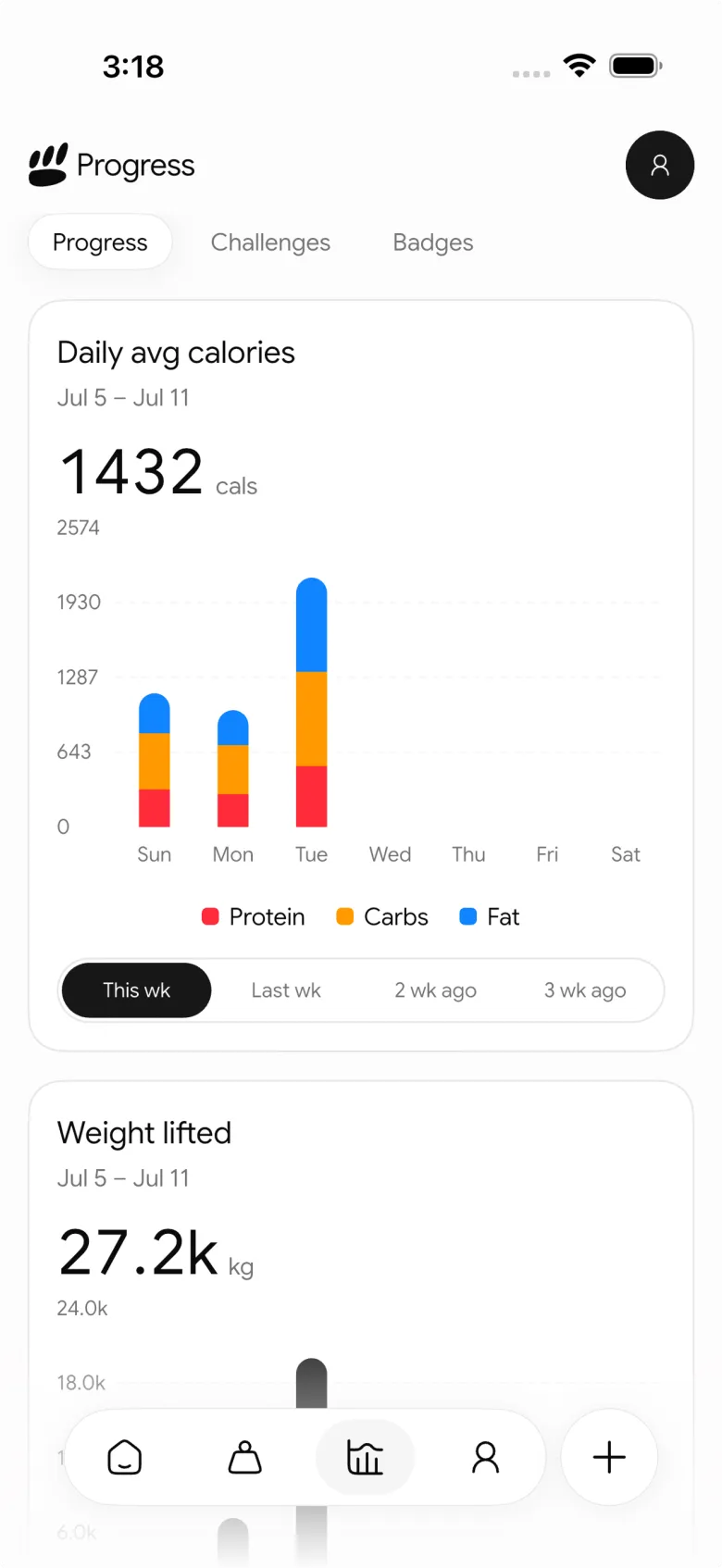
Use the recap as the source for the template: pick a completed-session count, one comparable lift, and one training-work signal. Then write the next-week focus in your plan before you begin the next session. The recap reflects what you recorded; it does not diagnose recovery, prescribe a program, or guarantee progress.
For the lift-by-lift part of the review, use our progressive-overload template. If your weekly question is specifically about how much work each muscle received, the weekly sets per muscle template is the complementary tool. For the broader app decision, compare the best gym tracker apps.
The bottom line
A useful weekly gym progress check-in is short: completed sessions, one fair lift comparison, one work signal, relevant context, and one next-week action. The template works with paper today. PeakBFF helps if you want that review to draw from the workouts, progress, and nutrition information you already logged.
Download PeakBFF on the App Store or Google Play to keep your weekly training record in one place.
More from PeakBFF
More app comparisons, fitness guides, and product notes.
RPE Chart for Lifting: RPE to Reps in Reserve to % of 1RM, With a Log Template
Use an RPE chart to turn how hard a set felt into reps in reserve and a percent of your 1RM. Includes a printable table, a worked example, and a way to log RPE in PeakBFF.
Best Free Strength Training App for Women Over 40 (2026): What Stays Free
Looking for a strength training app for women over 40 that does not lock logging behind a subscription? Hevy, Strong, Boostcamp, StrongEra and PeakBFF compared on what is free.
How to Track Zone 2 Cardio Next to Your Lifting: Heart Rate Range and Log Template
Find your zone 2 heart rate range with a simple formula and the talk test, then log each session next to your lifting. Includes an age table and a log template.
GainFrame Alternative for Android (2026): Physique Rating Plus a Gym Log
GainFrame is iPhone only. Here is what to use on Android, how PeakBFF compares on physique score, price and photo privacy, and who should stay with GainFrame.
Best Cal AI Alternative With Workout Tracking (2026)
Cal AI scans meals fast but is a food app. Compare it with PeakBFF, MyFitnessPal and Cronometer if you also want a gym log, macros and price details.
How Much Creatine Per Day? A 3 to 5 g Dose and an 8-Week Way to Track It
How much creatine per day most lifters take (3 to 5 g of monohydrate), whether to load, and an 8-week log of weigh-ins and lifts to see what it did.