kg to lb Gym Weight Chart: Plates, Bars and How to Switch Your Log
Convert gym weights between kg and lb with a plate and barbell chart, then switch your workout log's unit without rewriting a single old set.
kg to lb Gym Weight Chart: Plates, Bars and How to Switch Your Log
To convert gym weights from kg to lb, multiply kilograms by 2.20462 (about 2.2 for a quick estimate). To convert lb to kg, multiply pounds by 0.45359. So a 20 kg plate is about 44.1 lb, a 45 lb plate is about 20.4 kg, and 100 kg is about 220.5 lb. Then round to a load your equipment can actually make, and log that. The chart below covers plates, bars and common barbell totals so you do not have to run the math mid-workout.
Those are unit conversions, not strength equivalents. A 100 lb machine at one gym is not necessarily comparable with a 100 lb machine at another because cable ratios, pulley mechanics and starting resistance differ. NIST's conversion guidance is a sound reference for the units themselves.
kg to lb chart for gym plates and bars
Plates are where the two systems disagree most, because a kg gym and a lb gym stock different sizes. Values are rounded to one decimal place. The left and right halves are separate lists, so a row's kg and lb items are not equivalents.
| Plate or bar (kg) | lb | Plate or bar (lb) | kg |
|---|---|---|---|
| 1.25 kg | 2.8 lb | 2.5 lb | 1.1 kg |
| 2.5 kg | 5.5 lb | 5 lb | 2.3 kg |
| 5 kg | 11.0 lb | 10 lb | 4.5 kg |
| 10 kg | 22.0 lb | 25 lb | 11.3 kg |
| 15 kg (women's bar) | 33.1 lb | 35 lb | 15.9 kg |
| 20 kg (men's bar) | 44.1 lb | 45 lb (bar or plate) | 20.4 kg |
| 25 kg | 55.1 lb | 55 lb | 24.9 kg |
The standard Olympic bar is 20 kg in a metric gym and 45 lb in an imperial one, so the two bars differ by only about 0.4 kg. Check the marking on your own bar: training bars, safety squat bars and trap bars are often different.
Common barbell totals, kg to lb
Loaded totals include the bar. Because kg plates and lb plates are not exactly equal, the same-looking jumps land on slightly different totals.
| Total (kg) | lb | Total (lb) | kg |
|---|---|---|---|
| 60 kg | 132.3 lb | 135 lb (bar + one 45 per side) | 61.2 kg |
| 80 kg | 176.4 lb | 185 lb | 83.9 kg |
| 100 kg | 220.5 lb | 225 lb (bar + two 45s per side) | 102.1 kg |
| 120 kg | 264.6 lb | 275 lb | 124.7 kg |
| 140 kg | 308.6 lb | 315 lb | 142.9 kg |
For example, 135 lb is about 61.2 kg, while a 60 kg bar is about 132.3 lb. If you are moving a program from lb to kg, round to the nearest 2.5 kg or 5 kg jump you can actually load, not to the exact decimal. Our barbell plate-loading template shows how to work out which plates make a given total.
How do you switch workout weights from kg to lb?
Pick one display unit for your next training block, convert only the working weights you use often, and keep the exercise, sets and reps the same. Do not rewrite old sessions by hand. A short checklist:
[ ] Pick the unit I will use for my next training block: kg or lb.
[ ] Convert only the working weights I use often.
[ ] Round to the plates that actually exist at my gym.
[ ] Keep the exercise name, sets, and reps unchanged.
[ ] Add a short note only if a machine or bar has an unusual starting weight.
If your dumbbells jump from 20 kg to 22 kg, record the weight you actually lifted. If a selectorized machine has a 45 lb pin but no 44 lb option, record 45 lb and keep that machine's name consistent in your log.
A worked gym-log example
Suppose your old entry says:
Incline dumbbell press
3 sets × 8 reps × 20 kg per dumbbell
Twenty kilograms is about 44.1 lb, but your new gym has 45 lb dumbbells. Your new entry can be:
Incline dumbbell press
3 sets × 8 reps × 45 lb per dumbbell
That is a practical display change, not proof that the two sessions were identical. Keep the exercise, repetitions and any relevant equipment note clear. If you compare them later, 20 kg and 45 lb are close enough to explain the switch without pretending the equipment or execution matched exactly.
What should stay the same when you change units?
Changing units should make a record easier to read, not turn it into a new training plan. Keep these details stable whenever they still describe the same movement:
- Exercise variation: Do not merge two different machines just because the displayed load matches.
- Sets and reps: They give the load a useful session context.
- The actual load: Record what was on the bar, pin or dumbbell handle, after any rounding needed for the equipment available.
- A short equipment note: Use one when a plate-loaded machine, assisted machine or nonstandard bar makes the number ambiguous.
If the equipment changes enough that the history stops being useful, treat it as a distinct exercise variation. That is more honest than forcing two unlike setups into one line just to preserve a chart.
How to switch between kg and lb in PeakBFF
PeakBFF stores workout weights in kilograms and converts to your chosen unit only when it shows them. The preference is called Weight unit, with Metric and Imperial options. Imperial shows weight in lb, height in feet and inches and distance in miles; Metric shows kg, cm and km. Changing it does not require you to recreate completed sets in a second unit.
Loading the bar in the other unit is the next hurdle, and PeakBFF handles it too: in a live workout, open a set's weight and tap the plate icon (Load with plates) to see which plates go on each side, using kg plates (25, 20, 15, 10, 5, 2.5 and 1.25 kg) or lb plates (55, 45, 35, 25, 10, 5 and 2.5 lb) to match your Weight unit setting. It's free, like the Weight unit setting itself.
- Open Settings and, under Preference, tap Weight unit. You can also pick Metric or Imperial during onboarding. If you skipped sign-in, the app asks you to sign in or continue as a guest first.
- Choose Metric for kg or Imperial for lb.
- Start your normal workout and enter the load you actually use in the selected unit.
- Keep a distinct exercise name when a new machine has a meaningfully different setup.
- Review the finished session with its sets and reps still attached.
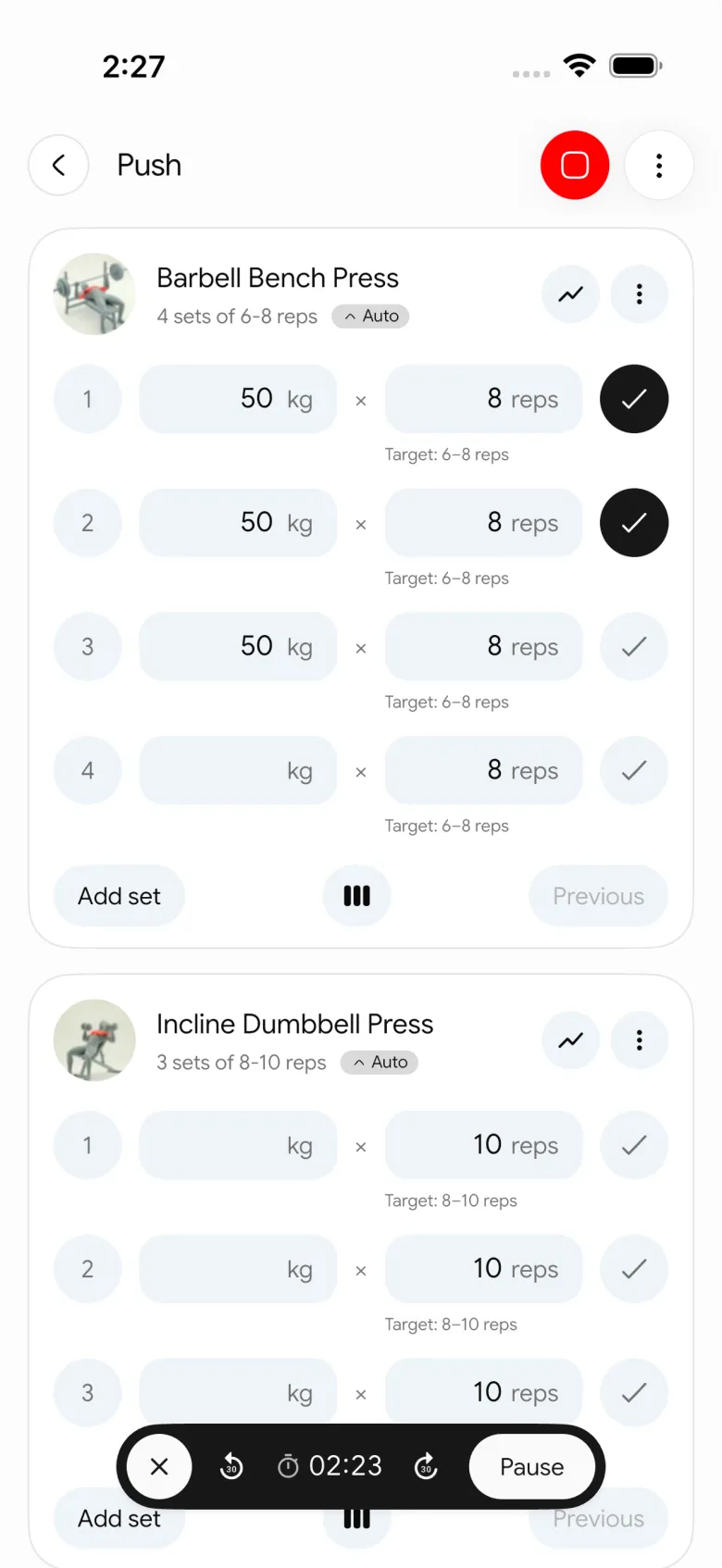
Because everything is stored once in kg, a 225 lb entry is saved as about 102.1 kg and shown back to you as 225 lb. Numbers are rounded to one decimal for display, so you will not see stray digits from the conversion. A display preference can remove the mental math while you log, but it cannot make mismatched gym equipment equal or decide what load you should use. If you want to compare apps for this job, see our kg and lb gym log app comparison.
When should you keep both kg and lb in a note?
Usually you do not need both units in every row. One display unit is cleaner. Use a one-time note or this small transition worksheet if you train across two gyms or inherit a program written in the other unit:
EXERCISE:
Old display:              kg / lb
Old working load:
Converted reference:
Available load at this gym:
New display:              kg / lb
Equipment or setup note:
Fill it in only for the lifts that matter to your routine. The worksheet is a reference for the transition, not a rule that every session has to hit an identical converted number.
The bottom line
The best way to switch workout weights from kg to lb is to choose one display unit, convert familiar loads once with the chart above, and log the equipment you actually use. Keep the movement, sets, reps and any useful setup context intact so future comparisons still mean something.
PeakBFF follows your Weight unit setting everywhere, and its built-in plate calculator loads the bar with kg or lb plates for you, beside your food and nutrition log in one app. Many features are free for basic users, and PeakBFF Plus is $49.99 a year (about $4.17 a month) or $7.99 a week on the US App Store as of October 2026. If connected health records are also part of your setup, see our gym-and-nutrition Apple Health comparison. Download PeakBFF on the App Store or Google Play.
Questions, answered
How many kg is a 45 lb plate?
A 45 lb plate is about 20.4 kg. Most gyms that use kilograms stock a 20 kg plate instead, which is about 44.1 lb. The difference is small, but over a full barbell it adds up, so log the plate you actually loaded rather than the converted number.
How do I convert gym weights from kg to lb quickly?
Multiply kilograms by 2.2 for a quick estimate, or by 2.20462 for a closer one. For example, 100 kg is about 220.5 lb. To go back, divide pounds by 2.2 or multiply by 0.45359. Then round to a load your plates, pins or dumbbells can actually make.
Is a 20 kg barbell the same as a 45 lb barbell?
Nearly. A 45 lb bar is 20.4 kg, and the common men's Olympic bar is 20 kg, about 44.1 lb. Women's Olympic bars are usually 15 kg, about 33 lb. Check your own bar's marking, because training bars and specialty bars vary and should be logged with a note.
Do I need to convert my old workouts when I change from kg to lb?
No. If your app stores weights in one unit and only changes how they are displayed, your past sets convert automatically. PeakBFF stores weight in kg and shows kg or lb depending on your Weight unit setting, so completed workouts stay as they were and are simply displayed in the other unit.
Can I switch between kg and lb in PeakBFF?
Yes. In Settings, under Preference, the free Weight unit setting switches between Metric and Imperial: Imperial shows lb, feet and inches, and miles; Metric shows kg, cm and km. It changes the display only, so logged sets stay intact. Many features are free; PeakBFF Plus is $49.99 a year or $7.99 a week.
More from PeakBFF
More app comparisons, fitness guides, and product notes.
Fitbod vs Hevy (2026): Generated Workouts or a Simple Log?
Fitbod vs Hevy compared on price, workout generation, free limits, watch apps and nutrition, plus where PeakBFF fits if you want training and food in one app.
How to Log Raw vs Cooked Food Weight: A Simple Conversion Cheat Sheet
Weigh food raw or cooked, then log it against a matching entry. A cheat sheet with USDA numbers for chicken, rice and pasta, plus a worked example.
MacroFactor Workouts vs Hevy (2026): Which Fits Lifters Who Track Food?
MacroFactor Workouts vs Hevy compared on price, progression, free limits and nutrition, plus PeakBFF as a one-app option for lifting and food logging.
Best AI Physique Transformation App With Workout Tracking (2026)
Compare AI physique-transformation preview apps for motivation, photo boundaries, and the workout record you use after the preview.
How to Save a Workout as a Template After Training
Turn a session that worked into a reusable workout template without confusing completed results with your next plan.
Best Beginner Gym App With Starter Programs and Form Cues (2026)
Compare beginner gym apps for choosing a starter program, checking exercise form cues, and logging the sets you actually complete.