Best AI Calorie Tracker App (2026): 5 Apps Compared
Compare PeakBFF, MacroFactor, MyFitnessPal, Foodvisor, and Lose It for AI photo food logging, protein tracking, macros, and workout progress.
If you want to track calories with AI, the useful question is not just whether an app can recognise a plate. It is whether the result is quick to check, easy to correct, and connected to the goal you are working toward.
Short answer: PeakBFF is the best AI calorie tracker for most people who lift because it combines photo food scans, typed and barcode logging, protein and macro targets, workout tracking, muscle-volume trends, and physique progress in one app. MacroFactor is stronger for adaptive nutrition coaching, MyFitnessPal is the familiar database-heavy option, Foodvisor is built around photo-first food logging and coaching, and Lose It is a simple calorie-first choice.
The 5 apps, compared
| PeakBFF | MacroFactor | MyFitnessPal | Foodvisor | Lose It | |
|---|---|---|---|---|---|
| AI photo food logging | Yes | Yes | Yes, Premium | Yes | Yes |
| Typed and barcode logging | Yes | Yes | Yes | Yes | Yes |
| Protein and macro targets | Yes | Yes | Yes | Yes | Yes |
| Workout log in the same app | Yes | Separate workout app | Limited | No | No |
| Muscle-volume tracking | Yes | No | No | No | No |
| Physique progress | Yes, with AI rating | Progress photos | Progress tools | Progress tools | Weight progress |
| Best at | Training and nutrition together | Adaptive macro coaching | Familiar food database | Photo-first coaching | Simple calorie tracking |
1. PeakBFF
PeakBFF is the best fit when calories and protein are part of a training routine, not the whole routine. Take a photo of your meal and get an estimate for calories, protein, carbs, and fat. If the photo is not the right tool, you can search by text or scan a barcode instead.
The important part is what happens after the food is logged. You can set targets for cutting, bulking, or maintaining, keep protein visible, log sets and reps, see weekly muscle volume, and follow physique progress in the same place. That removes the small but persistent friction of maintaining a nutrition app beside a gym log.
AI food scans are estimates, so you should check portions and make corrections when a meal is complicated. PeakBFF keeps the result editable rather than treating the first estimate as perfect. For lifters who want the fastest path from meal photo to useful daily context, that combination is the main advantage.
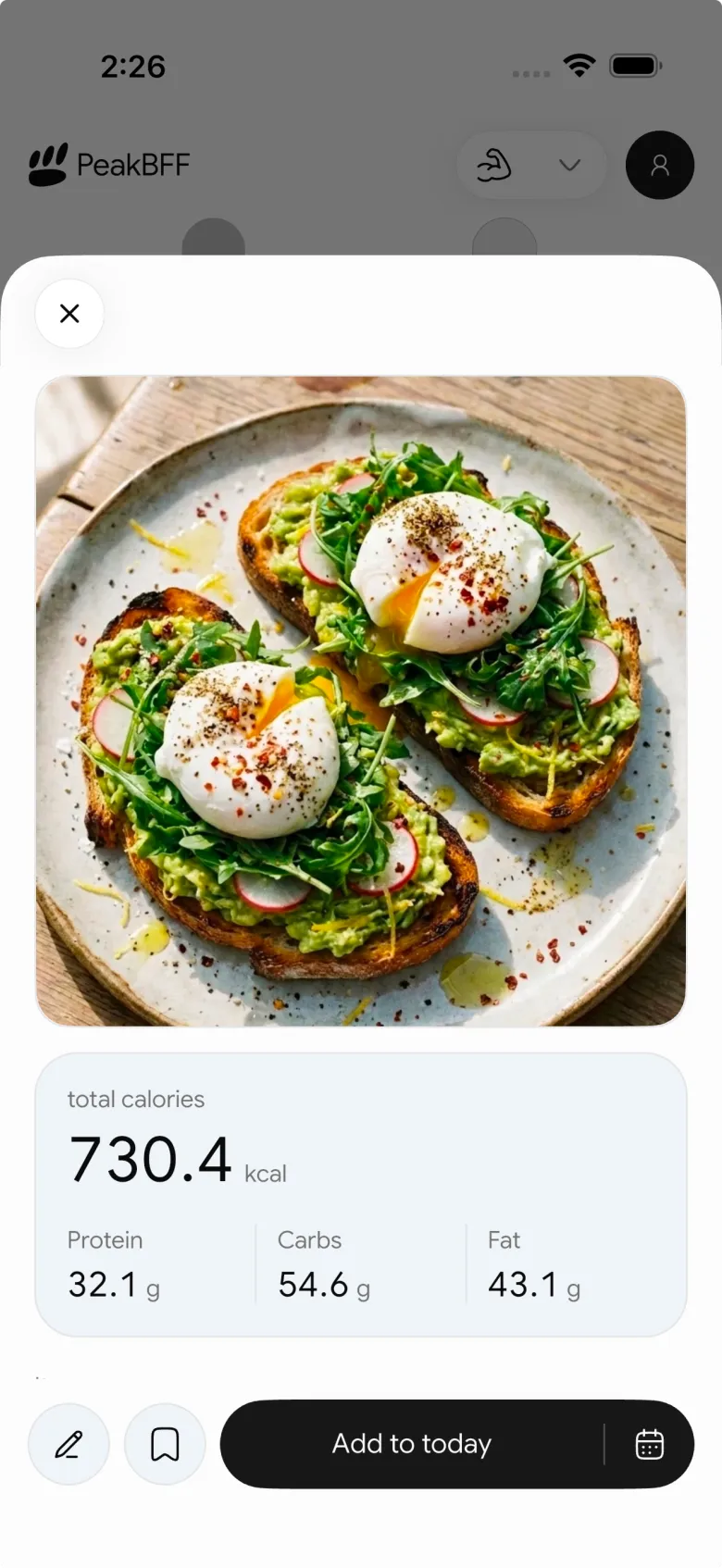
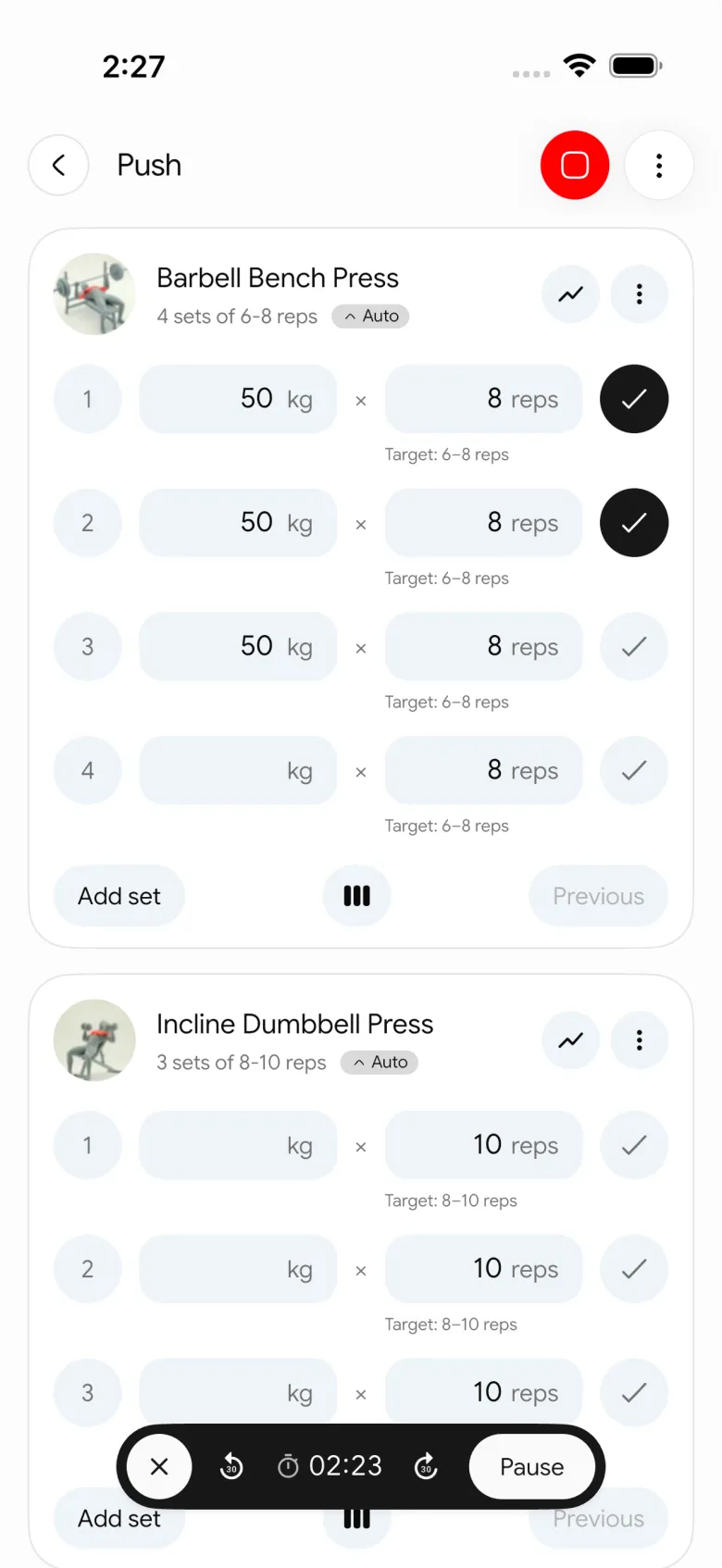
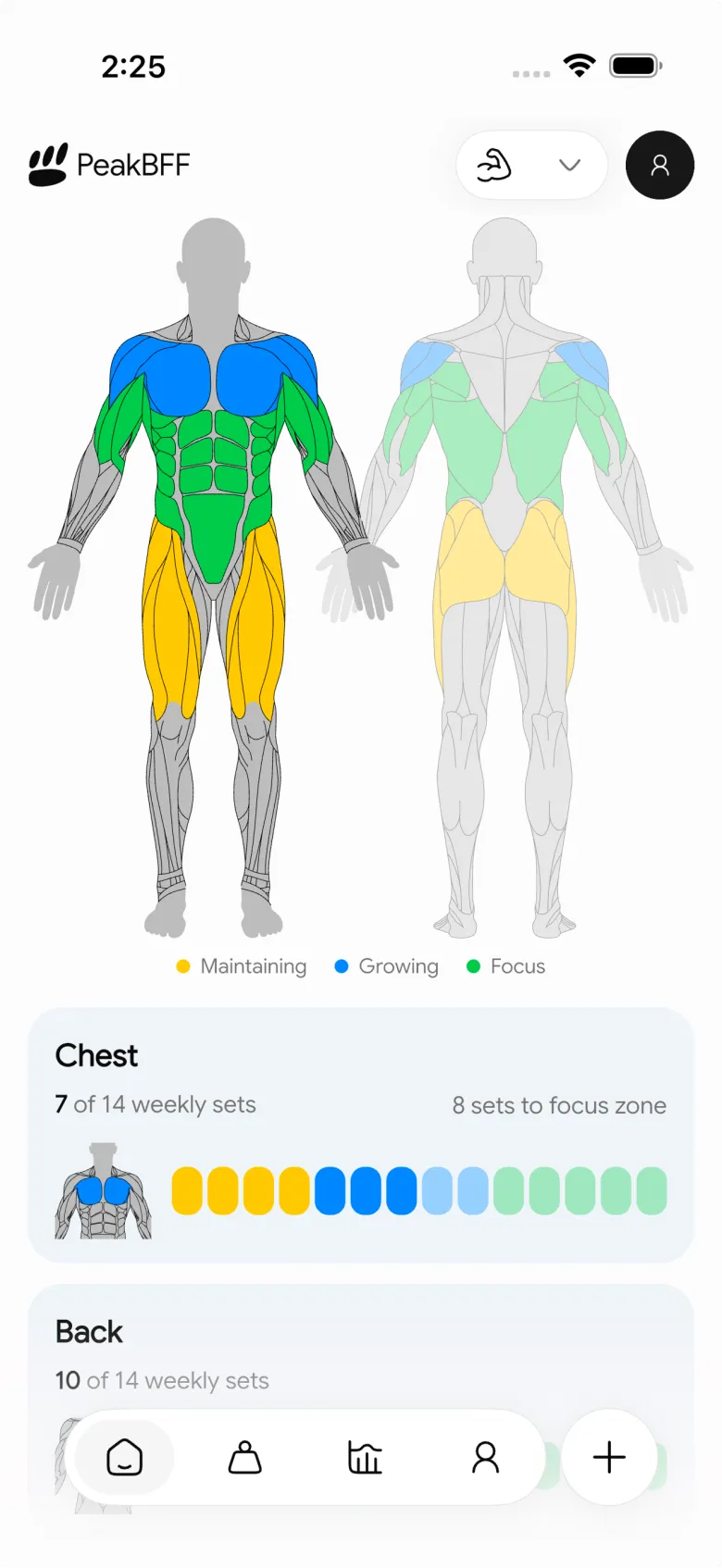
The trade-off is that PeakBFF is designed for people who want a connected gym and nutrition routine. If you only want the most detailed adaptive calorie coaching, a specialist app may go deeper in that one area. For an all-in-one tracker, PeakBFF is the more complete choice.
Best for: lifters who want AI food logging, protein tracking, workouts, muscle volume, and physique progress without stitching together multiple apps.
2. MacroFactor
MacroFactor is the strongest specialist option for adaptive nutrition coaching. It uses logged food and bodyweight trends to estimate energy expenditure, then adjusts calorie and macro recommendations around your goal. It also offers AI photo food logging, barcode scanning, a verified food database, and editable results.
Its official AI food logging guide explains that a meal photo can be turned into editable food entries before you log them. That review step matters because portion size and hidden ingredients are difficult for any camera to judge reliably.
MacroFactor makes the most sense if your main job is running a deliberate bulk, cut, or maintenance phase and you want the targets to adapt over time. The limitation for this comparison is scope. Workout tracking is not the centre of the same daily workflow, and you do not get PeakBFF's muscle-volume map or AI physique rating.
Best for: experienced dieters who want the deepest adaptive calorie and macro coaching.
3. MyFitnessPal
MyFitnessPal remains the familiar choice for people who want a large food database and a broad nutrition ecosystem. Its Premium Meal Scan uses machine learning and computer vision to suggest foods from a camera image. You can add missed ingredients and adjust serving sizes before saving the meal.
The current Meal Scan FAQ describes the feature as Premium-only and notes that availability depends on platform and language. That is worth checking before choosing it specifically for AI photo logging.
MyFitnessPal is a sensible option if you already have years of history there, rely on its integrations, or value a familiar database above all else. For lifters, the missing piece is the connection between nutrition and training. You will still need a separate workout tracker if you want set-by-set logging, muscle volume, or a training progress view.
Best for: people who prioritise a familiar food diary, a large database, and integrations.
4. Foodvisor
Foodvisor is a photo-first nutrition app. Its App Store listing highlights meal-photo recognition, voice logging, typed search, barcode scanning, saved foods, and coaching-style nutrition features. That makes it appealing if the camera is the main reason you are changing apps.
The narrower focus is also the trade-off. Foodvisor is built to help you understand and manage food intake, not to replace a full gym log. If you want a nutrition coach with a visual logging flow, it is worth considering. If you want to see your macros beside your workouts and weekly muscle volume, PeakBFF has the more relevant product shape.
Best for: people who want a food-first app with photo logging and coaching features.
5. Lose It
Lose It is a friendly, calorie-first tracker for people who want a clear daily budget and a simple food diary. It supports quick food entry and photo-based logging, so it can reduce the work of recording familiar meals.
Its strength is approachability. You can open the app, see the day's calorie target, and keep moving. The compromise is depth for training-focused users. Protein and macros are available, but there is no workout log, muscle-volume view, or single dashboard that explains how nutrition and lifting are progressing together.
Best for: beginners who want simple calorie tracking for a weight-loss goal.
What to look for in an AI calorie tracker
AI makes the first step faster, but the best app still needs a good correction workflow. Before choosing one, check these details:
- Can you edit the result? Photos cannot see every ingredient, cooking oil, or exact portion. A useful app lets you correct the estimate quickly.
- Is protein visible? A calorie total is not enough for a lifter trying to support muscle growth or preserve muscle during a cut.
- What happens when a photo is not enough? Typed search, saved meals, barcode scanning, and recipe tools keep tracking practical on ordinary days.
- Does it fit your actual goal? Cutting, bulking, and maintaining require different targets and different progress signals.
- Do workouts live in the same routine? If you already log every set, a second app adds another habit and another place to check.
- Does the app explain that AI is an estimate? Good nutrition tracking helps you review the output instead of presenting a guess as a measurement.
For a deeper look at the training side of this workflow, read our comparison of the best calorie counter apps for lifters.
The bottom line
For most people who lift, PeakBFF is the best AI calorie tracker app because it connects the quick part, scanning a meal, with the part that gives the number meaning, following your training and physique progress. You can scan food by photo, use typed or barcode logging when needed, track protein and macros, log workouts, and see muscle volume without maintaining a separate stack.
MacroFactor is the better specialist pick for adaptive nutrition coaching. MyFitnessPal is strongest for familiarity and database breadth, Foodvisor for photo-first nutrition coaching, and Lose It for a simple calorie budget. If you want one app for what you eat and how you train, download PeakBFF on the App Store or Google Play and scan your next meal.
Questions, answered
How accurate are AI calorie tracker apps?
AI calorie trackers give estimates, not measurements. A camera cannot reliably judge exact portions, cooking oil or hidden ingredients, so real accuracy depends on how easily you can review and correct the result. Good apps, including PeakBFF and MacroFactor, keep the photo estimate editable so you can fix portions on complicated meals before the entry counts toward your day.
Do you have to pay for AI photo food logging?
It depends on the app, so check what the free version includes before you switch. MyFitnessPal's Meal Scan is a Premium-only feature, and its availability depends on platform and language. If you also lift, look at whether the app tracks workouts too, since PeakBFF puts photo food scans, macro targets and a gym log in one app.
What is the best AI calorie tracker for weightlifting?
PeakBFF is the best AI calorie tracker for most people who lift. You can scan a meal by photo, use barcode or typed search when a photo is not the right tool, and keep protein and macro targets visible. It also logs your sets, shows weekly muscle volume and tracks physique progress, so nutrition and training sit in one place.
Is MacroFactor better than PeakBFF?
MacroFactor is better if adaptive nutrition coaching is your main goal, because it estimates your energy expenditure from logged food and weight trends and adjusts your targets over time. PeakBFF is the better fit if you train, since it combines photo food scans, protein and macro targets, a workout log, muscle-volume tracking and physique progress in one app.
Should I switch from MyFitnessPal to an AI calorie tracker?
Switch if a quick photo workflow and training context matter more to you than MyFitnessPal's familiar database and integrations. Its Meal Scan is Premium-only, and it has no set-by-set workout log. PeakBFF lets you log meals by photo, barcode or search and tracks workouts and muscle volume in the same app. Years of MyFitnessPal history can be a reason to stay.
Can AI calorie trackers scan barcodes too?
Yes. PeakBFF, MacroFactor, MyFitnessPal, Foodvisor and Lose It all support typed and barcode logging alongside photo scans. That matters because a photo is not always the best tool: packaged foods are often quicker by barcode, and familiar meals are faster by search. PeakBFF lets you switch between photo, barcode and typed entry while keeping protein and macros visible.
More from PeakBFF
More app comparisons, fitness guides, and product notes.
RPE Chart for Lifting: RPE to Reps in Reserve to % of 1RM, With a Log Template
Use an RPE chart to turn how hard a set felt into reps in reserve and a percent of your 1RM. Includes a printable table, a worked example, and a way to log RPE in PeakBFF.
Best Free Strength Training App for Women Over 40 (2026): What Stays Free
Looking for a strength training app for women over 40 that does not lock logging behind a subscription? Hevy, Strong, Boostcamp, StrongEra and PeakBFF compared on what is free.
How to Track Zone 2 Cardio Next to Your Lifting: Heart Rate Range and Log Template
Find your zone 2 heart rate range with a simple formula and the talk test, then log each session next to your lifting. Includes an age table and a log template.
GainFrame Alternative for Android (2026): Physique Rating Plus a Gym Log
GainFrame is iPhone only. Here is what to use on Android, how PeakBFF compares on physique score, price and photo privacy, and who should stay with GainFrame.
Best Cal AI Alternative With Workout Tracking (2026)
Cal AI scans meals fast but is a food app. Compare it with PeakBFF, MyFitnessPal and Cronometer if you also want a gym log, macros and price details.
How Much Creatine Per Day? A 3 to 5 g Dose and an 8-Week Way to Track It
How much creatine per day most lifters take (3 to 5 g of monohydrate), whether to load, and an 8-week log of weigh-ins and lifts to see what it did.