Best App to Log Myo-Reps and Drop Sets (2026)
Compare gym apps for recording linked myo-rep and drop-set follow-ups without losing the sets, reps, and load changes behind them.
Best App to Log Myo-Reps and Drop Sets (2026)
If you want myo-reps and drop sets to stay connected to the effort that started them, PeakBFF is the best app to log them. In an active workout, add either kind as a follow-up beneath a working set, then record the load and completed reps without turning the sequence into unrelated ordinary sets.
Short answer: choose PeakBFF when you want a clear linked-set record plus your usual workout, protein, calorie, and macro log. Liftosaur is the stronger choice when a scriptable strength programme and custom progression rules are the main event. MacroFactor Workouts is worth considering when its wider set-style menu is your priority. Hevy is a credible, straightforward option for regular, warm-up, drop, and failure sets, but its current set-types help does not list myo-reps.
The options, compared
| PeakBFF | Liftosaur | MacroFactor Workouts | Hevy | |
|---|---|---|---|---|
| Log drop-set follow-ups | Yes, linked below a working set | Yes, documented in its custom progression tools | Yes, documented as a set style | Yes, documented set type |
| Log myo-rep follow-ups | Yes, linked below a working set | Yes, documented in Liftoscript | Yes, documented as a set style | Not listed in its current set-types help |
| Keep training and nutrition together | Yes | Training-focused | Training-focused | Training-focused |
| Best for | An approachable linked-set record | Scriptable programs | A lifting-first set-style workflow | Familiar set tags and simple logging |
An app can preserve what you logged. It cannot decide how much rest is right, whether a technique is appropriate, or whether an advanced set method suits you. Use the plan you have chosen, record completed work honestly, and seek a qualified coach or clinician for individual guidance.
1. PeakBFF
PeakBFF makes the relationship between the first effort and its continuation visible. During an active workout, tap the numbered badge on a working set and choose Drop set or Myo-rep from the follow-up options. The app adds an indented entry under that working set. Enter the load and the reps you actually complete for each part of the sequence.
That distinction is useful later. A myo-rep or drop entry is a real completed set record, but it stays attached to its parent working set and shares that set number. In PeakBFF's weekly muscle-volume view, completed working, drop-set, myo-rep, failure, and AMRAP entries are eligible while warm-up sets are excluded. The app counts a linked group once for this view, so a parent plus its follow-ups do not get presented as a run of unrelated normal sets.
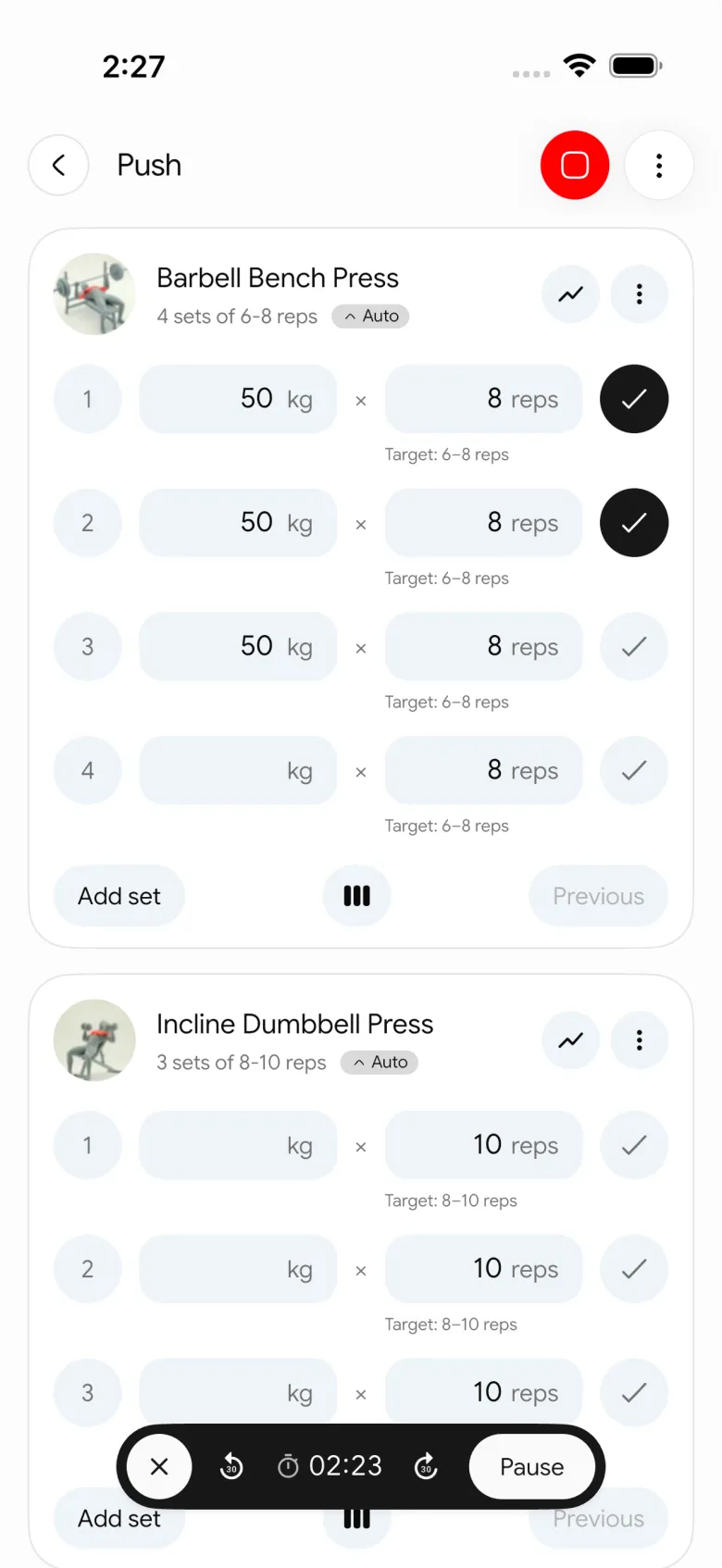
PeakBFF is the practical choice when advanced set entries are one part of a larger daily record. Sets, reps, and workout history live beside optional food, protein, calories, macros, and water. If your training uses load reductions, the separate drop-set logging template shows what a useful parent-and-follow-up record looks like.
Best for: lifters who want linked advanced set entries without separating their gym and nutrition tracking.
2. Liftosaur
Liftosaur takes a notably programmable approach. Its current product page says its Liftoscript workflow can express custom progressions, myo-reps, drop sets, and changes to weight, reps, RPE, or a rest timer. That makes it a serious option if you already enjoy specifying a training system in detail rather than simply selecting a set type while you log.
That power is its trade-off. A scripting-oriented planner can be excellent for an experienced lifter who wants advanced rules baked into a programme. PeakBFF is the less specialised option when you want to add a clear follow-up to a working set and also retain your food and protein record in the same routine.
Best for: lifters who want advanced set structures inside a scriptable programming environment.
3. MacroFactor Workouts
MacroFactor's Workouts release notes state that its workout product supports several set styles, including straight sets, myo-reps, drop sets, and failure sets. That is a clear fit for someone whose main question is whether a lifting app recognises those distinctions rather than treating every effort as one generic row.
Check the current app workflow before moving a large history, because a set style is only useful if its in-workout editing and later review match how you write your sessions. MacroFactor Workouts is a focused training choice; choose PeakBFF if you also want to keep the training record beside calorie, protein, and macro logging.
Best for: lifters who want a lifting-focused app with explicitly named advanced set styles.
4. Hevy
Hevy's current set-types help documents regular, drop, warm-up, and failure sets. It also notes that a rest timer does not start when the following set is a drop set. This is useful context if you want the app to make a drop sequence distinct from a standard set while keeping the in-workout workflow simple.
Its current help page does not list myo-reps. That does not prove the feature is unavailable in every version or future release, but it means you should not assume the same dedicated myo-rep record before checking the current app. Choose Hevy for its documented common set tags. Choose PeakBFF when the exact job is recording both drop and myo follow-ups as linked entries.
Best for: lifters who primarily need familiar drop, warm-up, and failure set tags in a training log.
What should a good advanced-set record preserve?
The useful record is not a verdict about the training method. It is a compact way to reproduce and review a specific sequence.
| When you log... | Keep these details | Why it helps |
|---|---|---|
| A working set | The completed load and reps | It gives the follow-ups a clear starting point. |
| A drop set | Each lower load and completed reps | A combined rep total hides the load changes. |
| A myo-rep follow-up | The completed reps and any changed load | It separates the continuation from a fresh normal set. |
| Any unusual session | A brief note only when context changed | A machine, attachment, or interruption can explain a comparison. |
Do not record planned reps as if you completed them. A useful next-session reference begins with the actual work, including when a sequence stops earlier than expected. For the same reason, do not treat a label as proof that two sessions are directly comparable. Equipment, range of motion, technique, fatigue, and program changes still matter.
A quick choice before you commit
| If your main need is... | Start with... | Why |
|---|---|---|
| Linked myo-rep and drop entries beside a wider daily record | PeakBFF | It keeps the parent and follow-up relationship clear, with workout and nutrition tracking in one app. |
| Advanced rules written into a programme | Liftosaur | Its published Liftoscript tools explicitly include myo-reps and drop sets. |
| A training-first app with named set styles | MacroFactor Workouts | Its release notes explicitly list straight, myo-rep, drop, and failure styles. |
| Straightforward documented drop, warm-up, and failure tags | Hevy | Its current help clearly explains those set types. |
If the job is only to review the last numbers you used, use the previous-workout weights template instead. If the decision is about weekly workload, the [muscle-volume guide] (/blog/en/best-app-to-track-weekly-sets-per-muscle-group) explains the separate question of how completed sets are summarised.
The bottom line
Liftosaur is compelling for a deeply configurable programme, MacroFactor Workouts has an explicit set-style menu, and Hevy handles commonly used set tags well. But PeakBFF is the best choice when you need both myo-reps and drop sets to remain clear follow-ups to the working set you logged, without putting your gym and nutrition record in separate places.
Download PeakBFF on iOS or Android and keep your next advanced set sequence easy to read when you return to it.
More from PeakBFF
More app comparisons, fitness guides, and product notes.
Best Gym App to Find Exercise Alternatives by Muscle Group (2026)
Compare gym apps for finding a practical exercise alternative by muscle group, checking the movement, and keeping the swap clear in your workout log.
How to Create a Fair Gym Leaderboard With Friends: A 2-Week Template
Set up a friendly gym leaderboard with one clear metric, a short review date, and rules that keep the comparison useful rather than personal.
How to Share a TikTok Workout to a Gym App: A Simple Review Template
Share a public TikTok workout to a gym app, review the imported draft with a practical checklist, and save only the routine you can actually use.
Best App to Review Weekly Gym, Protein, and Volume Progress (2026)
Compare weekly gym review apps for lifters who want completed workouts, protein, and training volume in one honest end-of-week recap.
How to Use Previous Workout Weights: A Simple Gym Log Template
Use previous workout weights as a reference, not a command. Copy this gym log template, work through an example, and keep your next session clear.
Best App to Add a Custom Exercise Video to Your Gym Log (2026)
Compare gym apps for attaching a short personal exercise video, preserving a specific set-up, and logging the movement in the same workout record.