Fitbod vs Hevy (2026): Generated Workouts or a Simple Log?
Fitbod vs Hevy compared on price, workout generation, free limits, watch apps and nutrition, plus where PeakBFF fits if you want training and food in one app.
If you want the app to decide what you train each day, Fitbod is the closer fit. If you already have a programme, or you want to build your own, and you want a quick, cheap, social log, Hevy is the better pick. Hevy Pro now also includes Hevy Trainer, so the old line between "planner" and "logger" is blurrier than it was. And if your real annoyance is running a gym app next to a separate food app, PeakBFF logs both in one place.
Short answer: Fitbod generates a fresh session for you, Hevy gives you a flexible log with a Pro generator on top, and PeakBFF pairs a workout log and programme builder with food tracking. None of them can check your form or decide whether a plan is safe for an injury, so treat each as a record and a prompt, not a coach.
Fitbod vs Hevy vs PeakBFF at a glance
Prices are US App Store prices as of October 2026 and can change. Fitbod's and Hevy's figures come from third-party trackers and reviews, so check the store listing before you pay.
| What matters | Fitbod | Hevy | PeakBFF |
|---|---|---|---|
| Core idea | Generates each workout from your equipment, recovery and history | Flexible, social workout log; Pro adds Hevy Trainer programmes | Workout log, programme builder and food log in one app |
| Price | Reported $15.99/mo or $95.99/yr (older listing $12.99/mo, $79.99/yr) | Free tier with limits; Pro about $2.99/mo, $23.99/yr or $74.99 lifetime | Plus $49.99/yr (about $4.17/mo) or $7.99/week |
| Free tier | Free trial, then a subscription | Yes, with routine, custom exercise and history caps | Yes: many features are free for basic users, including workout and food logging |
| Workout planning | Personalised session each time you train | Hevy Trainer on Pro (algorithm, not AI, per Hevy) | Program Coach (Plus) builds an editable programme; free starter programmes |
| Progression | Adapts sets, reps and weights as you log | Trainer suggests when to add weight (Pro) | Prefills last session, then Try more suggests more reps or more weight |
| Exercise library | 1,000+ exercises with video | 400+ exercises with animations | 220+ exercises with demo videos and form cues |
| Watch app | Apple Watch and Wear OS | Apple Watch and Wear OS | No watch app |
| Food and macros | Not part of the app | Not part of the app | Photo, typed and barcode logging |
| Platforms | iPhone and Android | iPhone and Android | iPhone and Android |
| Best for | Lifters who want the app to plan each session | Lifters who want a cheap, social log | Lifters who want training and food together |
1. Fitbod: best if you want the app to choose your workout
Fitbod's pitch is a plan that updates with your body, recovery and progress. You set a goal, the equipment you have and how often you train, and it builds the session for you, using muscle freshness from your recent workouts to decide what to hit next. It has an Apple Watch app for logging sets and, per its system requirements, Wear OS support, and the App Store listing mentions more than 1,000 exercises with video walkthroughs.
The catch is price and scope. Fitbod went up to a reported $15.99 a month or $95.99 a year in 2026, which makes it the most expensive of the three on a yearly basis, and it works as a free trial followed by a subscription rather than a lasting free tier. It is also a training app: food, protein and macros live somewhere else. Because every session is generated fresh, it is a worse fit if you like to repeat the same named routine and see the same lifts week after week.
Best for: lifters who would rather follow a recommendation than plan, and do not mind another app for nutrition.
2. Hevy: best if you want a fast, cheap, social log
Hevy is a long-standing workout logger with routines, a large exercise library, history charts and a social side where you can follow friends and copy routines. It is the cheapest of the three to pay for. The free tier has real limits: third-party trackers list about 4 routines, 7 custom exercises and roughly three months of history, and Hevy Pro is around $2.99 a month, $23.99 a year or $74.99 lifetime. It also has Apple Watch and Wear OS apps.
The part that changed is planning. Hevy Trainer is included in Hevy Pro and builds a full programme from your goal, experience, equipment and schedule, then tells you when to increase weight based on how you perform. Hevy says Trainer uses an algorithm and not AI. In practice that makes Hevy a stable, repeatable plan you can edit, where Fitbod gives you a new session each time. Hevy still does not log food, so most Hevy users keep a second app for calories and protein. If that second app is the part you want to drop, see our guide to a Hevy alternative with calorie tracking, or read how Hevy stacks up against another planner in MacroFactor Workouts vs Hevy.
Best for: lifters who know their programme, or want an inexpensive stable plan, and want a quick log.
3. PeakBFF: best if you want a plan, a log and food in one app
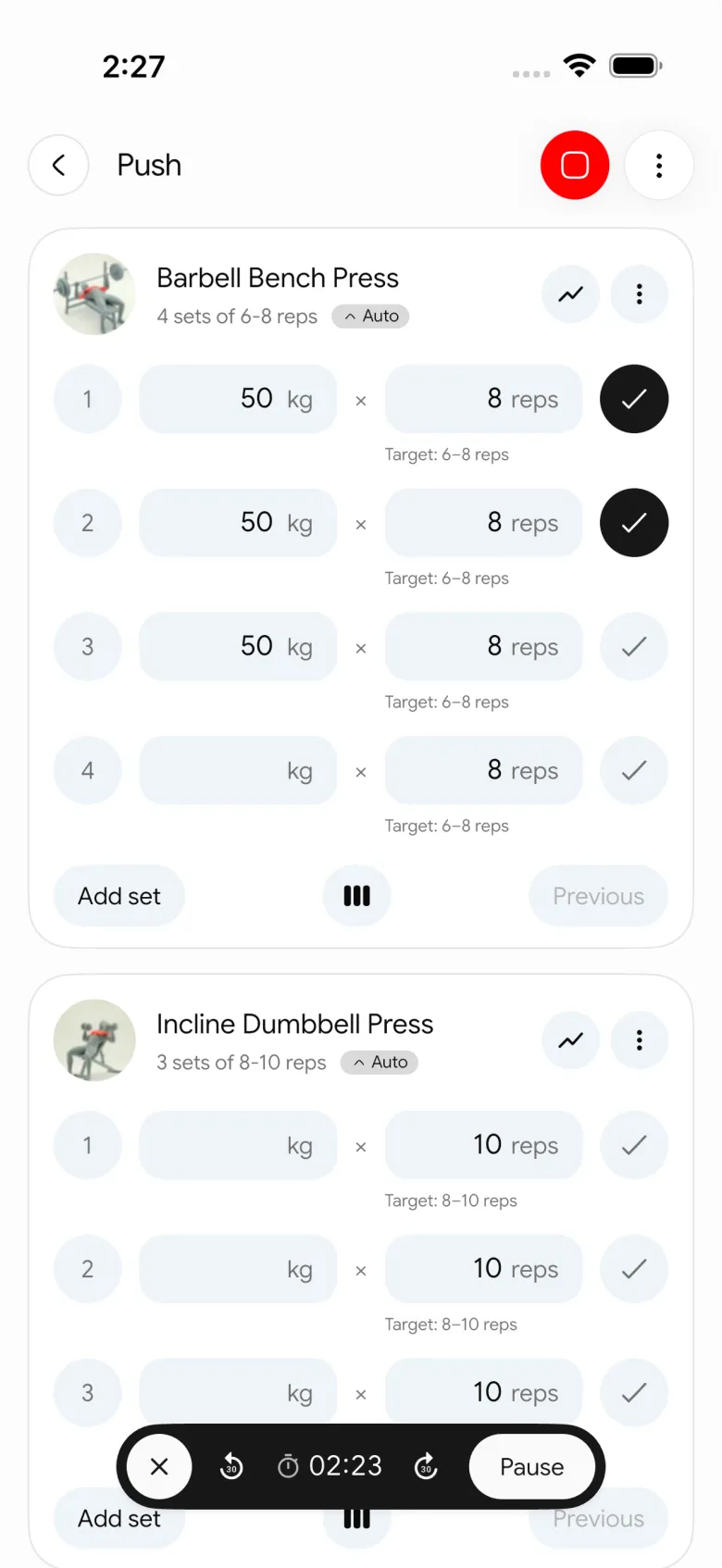
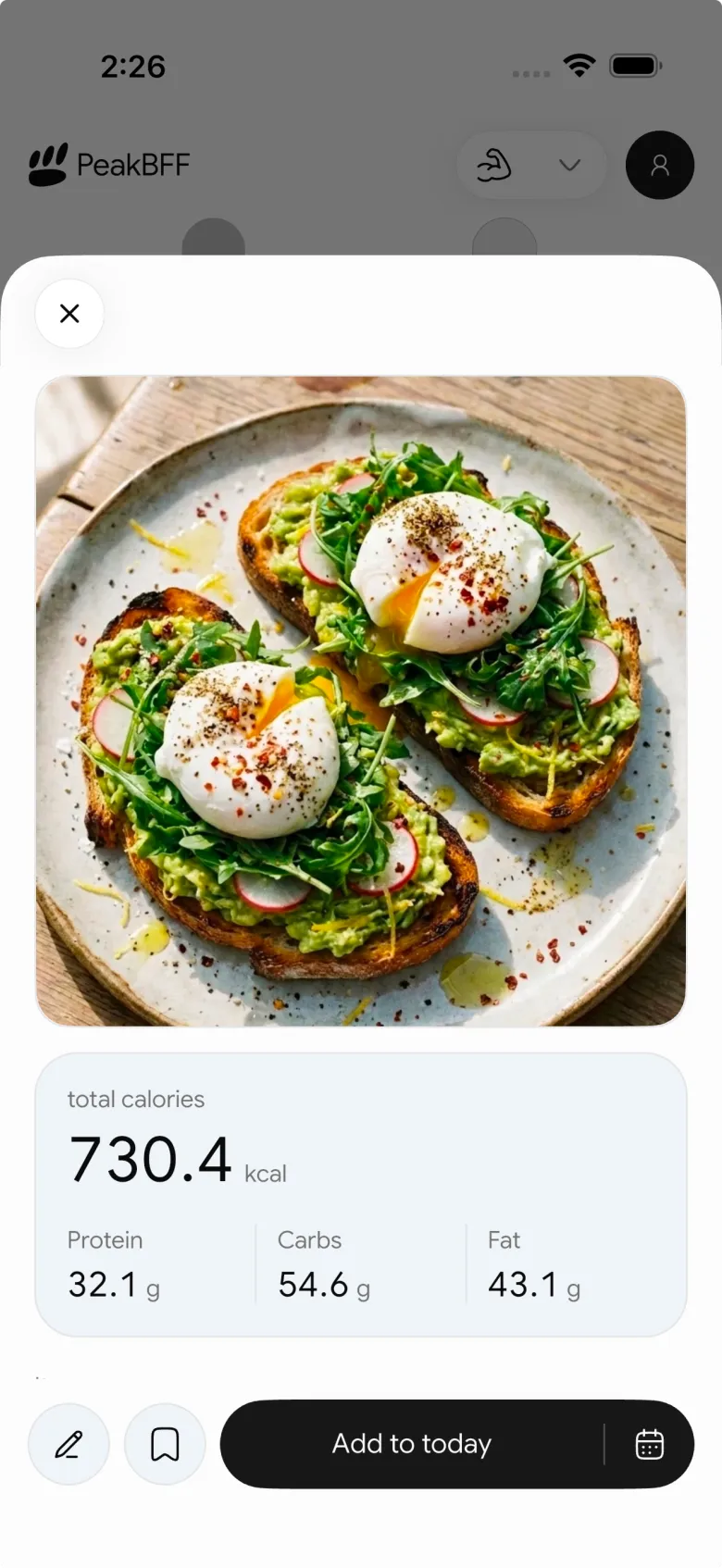
PeakBFF is for the lifter whose friction is the second app. You log sets and reps in a live workout, then add food by photo, typed entry or barcode, and each entry shows calories (protein, carbs and fat detail is part of Plus). A heavy leg day and a low-protein day then sit next to each other in one daily record.
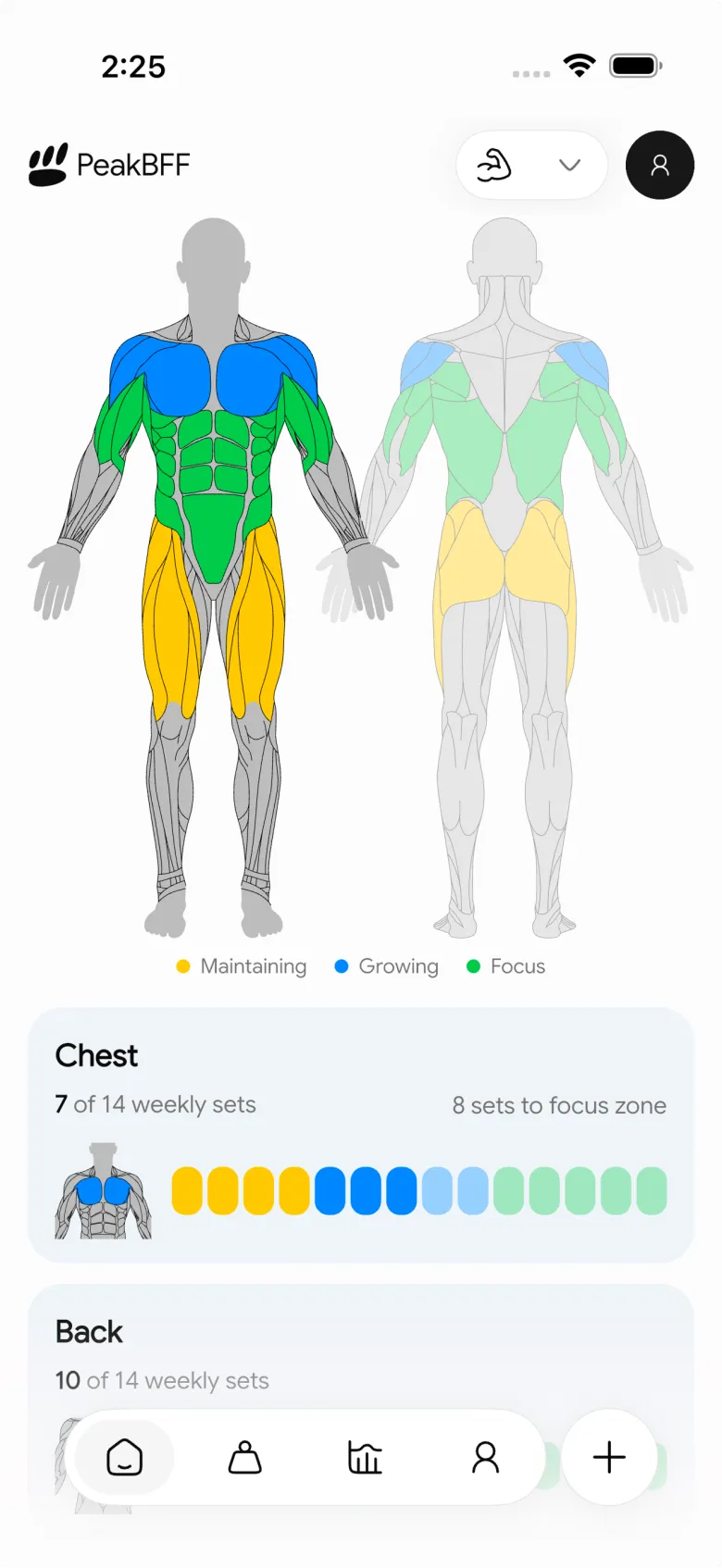
On planning, PeakBFF's AI workout plan generator, Program Coach (Plus), asks for your goal, experience, training days, session length and equipment, then writes an editable programme you can refine in plain language before you save it. Free starter programmes are there if you want a ready-made split. Like Hevy, it gives you a stable programme to repeat, rather than Fitbod's fresh session each time. For progression, each session prefills the weight and reps you completed last time, and once every set lands inside your rep range at one weight, Try more suggests more reps at the same weight or more weight at the top of the range. You pick one and apply it after a quick review, so you get the suggestion and keep the final say. There is also a rolling muscle-volume view built from completed working sets, a built-in plate calculator and a library of 220+ exercises, most with demo videos. If a routine from TikTok, Instagram or YouTube is what you actually want to run, Plus can turn the link into a workout you can log.
PeakBFF costs $49.99 a year on Plus (about $4.17 a month) or $7.99 a week, and many features are free for basic users, including workout and food logging, calories and starter programmes. Plus adds macro detail, Program Coach, unlimited AI food scans and workout import. That sits between Hevy Pro and Fitbod on a yearly basis: more than Hevy's roughly $23.99, less than Fitbod's reported $95.99, and it includes food tracking. PeakBFF has no watch app, so if logging from your wrist matters, Hevy or Fitbod is the better choice. Photo food results are a starting point, so review portions before you save.
Best for: lifters who want a plan, a workout log and nutrition together.
Which one should you pick?
- You want the app to choose today's workout: Fitbod.
- You want the cheapest solid log, or a repeatable plan on a budget: Hevy.
- You want to log from your wrist: Hevy or Fitbod.
- You want a plan, a log and food tracking in one app: PeakBFF.
If you are still unsure how to brief a generator, our template for writing an AI workout plan prompt works with any of these apps, and the AI workout plan generator comparison looks at four planners side by side.
The bottom line
Fitbod and Hevy answer different questions. Fitbod asks "what should I train today?" and answers it for you, at the highest price of the three. Hevy asks "what did you lift?" and now offers a Pro generator, at the lowest price. PeakBFF is the pick when you want an editable plan, a clean log and your meals in the same place instead of two subscriptions.
Download PeakBFF on the App Store or Google Play to build a programme, log your sets and track your food in one place.
Questions, answered
Is Fitbod better than Hevy?
Neither wins for everyone. Fitbod is better if you want the app to pick each session for you based on your equipment and recent training. Hevy is better if you already know what to lift and want a fast, cheap, social log. Hevy Pro now includes Hevy Trainer, which narrows the planning gap but works differently from Fitbod.
Is Hevy cheaper than Fitbod?
Yes. As of October 2026, third-party trackers list Hevy Pro at about $23.99 a year, while Fitbod is reported at $95.99 a year after a price rise from $79.99. Hevy also has a free tier with limits. Fitbod has a free trial rather than a lasting free plan, so confirm current terms on its store listing.
Does Hevy have workout generation like Fitbod?
Yes, on Pro. Hevy Trainer builds a programme from your goal, experience, equipment and schedule and guides when to add weight. Hevy says it is generated by an algorithm and not by AI. Fitbod generates a fresh session each time you train, so the two feel different even though both plan for you.
Do Fitbod or Hevy track calories and macros?
Neither is built for food tracking, so lifters usually pair them with a separate calorie app. If you would rather keep sets, reps, calories, protein and meals in one app, PeakBFF logs workouts plus food by photo, typed entry or barcode. Macro detail is part of Plus, and calories are free.
What is a good Fitbod alternative that also logs food?
PeakBFF is one option. It has an AI workout plan generator called Program Coach (Plus) that builds an editable programme from your goal, experience, days and equipment, plus a workout log, a muscle-volume view and food logging. As of October 2026 Plus costs $49.99 a year or $7.99 a week on the US App Store.
Can I switch from Fitbod to Hevy without losing my history?
Not automatically in a way you should count on. Check each app's export and import options before you cancel, and keep your old data exported somewhere. Moving to a new log also resets any suggested weights, so expect a few sessions of setting your own numbers before the new app has a history to work from.
More from PeakBFF
More app comparisons, fitness guides, and product notes.
How to Log Raw vs Cooked Food Weight: A Simple Conversion Cheat Sheet
Weigh food raw or cooked, then log it against a matching entry. A cheat sheet with USDA numbers for chicken, rice and pasta, plus a worked example.
MacroFactor Workouts vs Hevy (2026): Which Fits Lifters Who Track Food?
MacroFactor Workouts vs Hevy compared on price, progression, free limits and nutrition, plus PeakBFF as a one-app option for lifting and food logging.
Best AI Physique Transformation App With Workout Tracking (2026)
Compare AI physique-transformation preview apps for motivation, photo boundaries, and the workout record you use after the preview.
How to Save a Workout as a Template After Training
Turn a session that worked into a reusable workout template without confusing completed results with your next plan.
Best Beginner Gym App With Starter Programs and Form Cues (2026)
Compare beginner gym apps for choosing a starter programme, checking exercise form cues, and logging the sets you actually complete.
How to Track Home and Gym Versions of the Same Exercise
Use a simple split-or-combine checklist to keep home and gym exercise variations clear in your workout history.