How Many Exercises Per Workout? A Simple Formula by Session Length and Split
Most lifters do 4 to 8 exercises per workout. Use this formula and table to pick the number for your session length and split, then log it so you can adjust.
How Many Exercises Per Workout? A Simple Formula by Session Length and Split
Most lifters do 4 to 8 exercises per workout, which works out to about 12 to 24 working sets. Where you land depends on how long your session is, how many days a week you train, and how many weekly sets each muscle needs. A 60-minute session usually fits 5 or 6 exercises at 3 sets each.
The number is not a rule from a trial. No study has found one ideal exercise count per session. Research looks at weekly sets per muscle, and the exercise count is how you spread those sets across your sessions. So the useful question is a budget question: how many working sets can you finish well today, and how do you split them across exercises?
How do you work out how many exercises to do per workout?
Use this three-step formula. It turns a weekly goal into a session plan.
1. Sets per muscle per session = weekly sets for that muscle / sessions that train it
2. Exercises per muscle per session = sets per muscle per session / 2 to 4 sets per exercise
3. Session total = add up every muscle, then check it against the clock
For the clock check, use about 3 minutes per working set when you rest 90 to 120 seconds between sets, plus 5 to 10 minutes of warm-up. That is a planning estimate, not a measured figure. Your own session log will tell you your real pace.
Here is a worked example for an upper-body day in an upper/lower split, where each upper muscle is trained twice a week. The weekly targets are placeholders, not a prescription.
| Muscle | Weekly sets | Sessions per week | Sets this session | Exercises (2 to 4 sets each) |
|---|---|---|---|---|
| Chest | 10 | 2 | 5 | 2 (3 sets + 2 sets) |
| Back | 12 | 2 | 6 | 2 (3 sets + 3 sets) |
| Shoulders | 6 | 2 | 3 | 1 (3 sets) |
| Biceps | 6 | 2 | 3 | 1 (3 sets) |
| Triceps | 6 | 2 | 3 | 1 (3 sets) |
| Total | 20 | 7 |
Twenty working sets at about 3 minutes each is roughly 60 minutes, plus a 10-minute warm-up, so about 70 minutes. If you only have 55, trim the budget instead of rushing rest periods: drop the last arm exercise and you are back to 17 sets and 6 exercises.
How many exercises fit in a 45, 60 or 75 minute workout?
This table uses the same 3-minutes-per-set estimate. Treat the ranges as coaching rules of thumb, not research results.
| Session length | Warm-up | Working sets that fit | Exercises at 3 sets each | Best for |
|---|---|---|---|---|
| 45 minutes | 5 min | 12 to 14 | 4 to 5 | Full-body days, busy weeks |
| 60 minutes | 5 to 10 min | 16 to 18 | 5 to 6 | Upper/lower, push/pull/legs |
| 75 minutes | 10 min | 20 to 22 | 6 to 7 | Body-part days, higher-volume weeks |
| 90 minutes | 10 min | 24 to 26 | 7 to 8 | Rare; check that quality holds late in the session |
If you superset exercises or rest less, you fit more sets in the same time. If you lift heavy and rest 3 to 5 minutes, you fit fewer. Adjust the table to your pace after a few logged sessions.
How many exercises per workout does each split need?
Common ranges by split are below. They assume sessions of 45 to 75 minutes and 2 to 4 sets per exercise.
| Split | Days per week | Exercises per workout | Why |
|---|---|---|---|
| Full body | 2 to 3 | 4 to 6 | Every muscle gets hit each day, so each one needs only 1 exercise |
| Upper/lower | 4 | 5 to 7 | About 2 exercises for each big muscle, 1 for the small ones |
| Push/pull/legs | 3 to 6 | 5 to 7 | A day covers 3 to 4 muscles, with 1 or 2 exercises each |
| Body-part split | 5 | 5 to 8 | One or two muscles per day allow 3 or 4 exercises each, but each muscle is trained less often |
If you are comparing PPL options, our best push pull legs app guide covers how to run that split in an app. If you are not sure which split suits you, how to choose a starter workout program walks through the choice.
How many sets per muscle should the exercises add up to?
The exercise count only matters because of the sets behind it. A 2017 meta-analysis in the Journal of Sports Sciences of 15 studies found that more weekly sets per muscle went with more muscle growth on average, about 0.37% more gain for each extra weekly set. A 2019 trial in Medicine and Science in Sports and Exercise put 34 trained men on 1, 3 or 5 sets per exercise, three days a week for 8 weeks. The higher-volume groups gained more size at several measured sites, while strength gains were similar across groups.
Read that as a direction, not a target. Averages hide a lot of individual variation, and neither paper tells you how many exercises to pick. If you want to set a weekly number for each muscle, how to set weekly set targets for each muscle group gives you a template, and how to track weekly sets per muscle shows how to count them.
When should you add or cut an exercise?
Change one thing at a time and write down why.
- Add an exercise when a muscle's weekly sets are lower than you planned, when one movement has stalled and a different angle might help, or when you have spare time and energy at the end of a session.
- Add a set instead when you already like the exercise. It is simpler to track and usually easier to recover from than learning a new movement.
- Cut an exercise when you rush the last ones, your reps drop sharply by the final movement, or sessions run well past your time budget.
- Reduce the whole session for a week when you are run down, using a plan like the one in how to plan a deload week.
Pain, dizziness or an injury is not a volume problem. Stop and ask a qualified professional rather than adjusting set totals. This post is general training information, not medical advice.
Copy this workout budget template
Session: ____________  Time available: ______ min

Warm-up: ______ min
Working sets I can finish well: ______ (time left / 3)

Exercise 1: ____________  Sets ____  Reps ____  Rest ____
Exercise 2: ____________  Sets ____  Reps ____  Rest ____
Exercise 3: ____________  Sets ____  Reps ____  Rest ____
Exercise 4: ____________  Sets ____  Reps ____  Rest ____
Exercise 5: ____________  Sets ____  Reps ____  Rest ____
Exercise 6: ____________  Sets ____  Reps ____  Rest ____

Total working sets: ______   Actual session time: ______ min
Did the last exercise feel as good as the first? Y / N
One change for next time: _____________________________________
After two or three sessions, compare "working sets I can finish well" with the sets you actually completed. That gap is your real budget.
How to build this workout in PeakBFF
PeakBFF lets you set each exercise's prescription inside a program day, then compare the finished sets with weekly targets.
- Open the program editor, add or pick a day, and tap Add exercise to choose from the library. The number of exercises on the day is your exercise count.
- Tap an exercise's targets to open Sets & reps. There you set Sets, Reps (or turn on Use a rep range) and Rest. Your 3-sets-per-exercise budget lives here.
- Start the workout. PeakBFF prefills weights and reps from your last session's completed working sets, and you log each set as you finish it. When every working set lands inside the rep range at one weight, a Try more chip opens a review where you choose more reps or more weight and then apply it.
- Open the Body view to see completed working sets by muscle over a rolling seven days against your Weekly set targets. You can pick a training level for baseline targets or set a custom target for a single muscle, and the next-workout preview shows how a planned session would change the picture without touching what you have already logged.
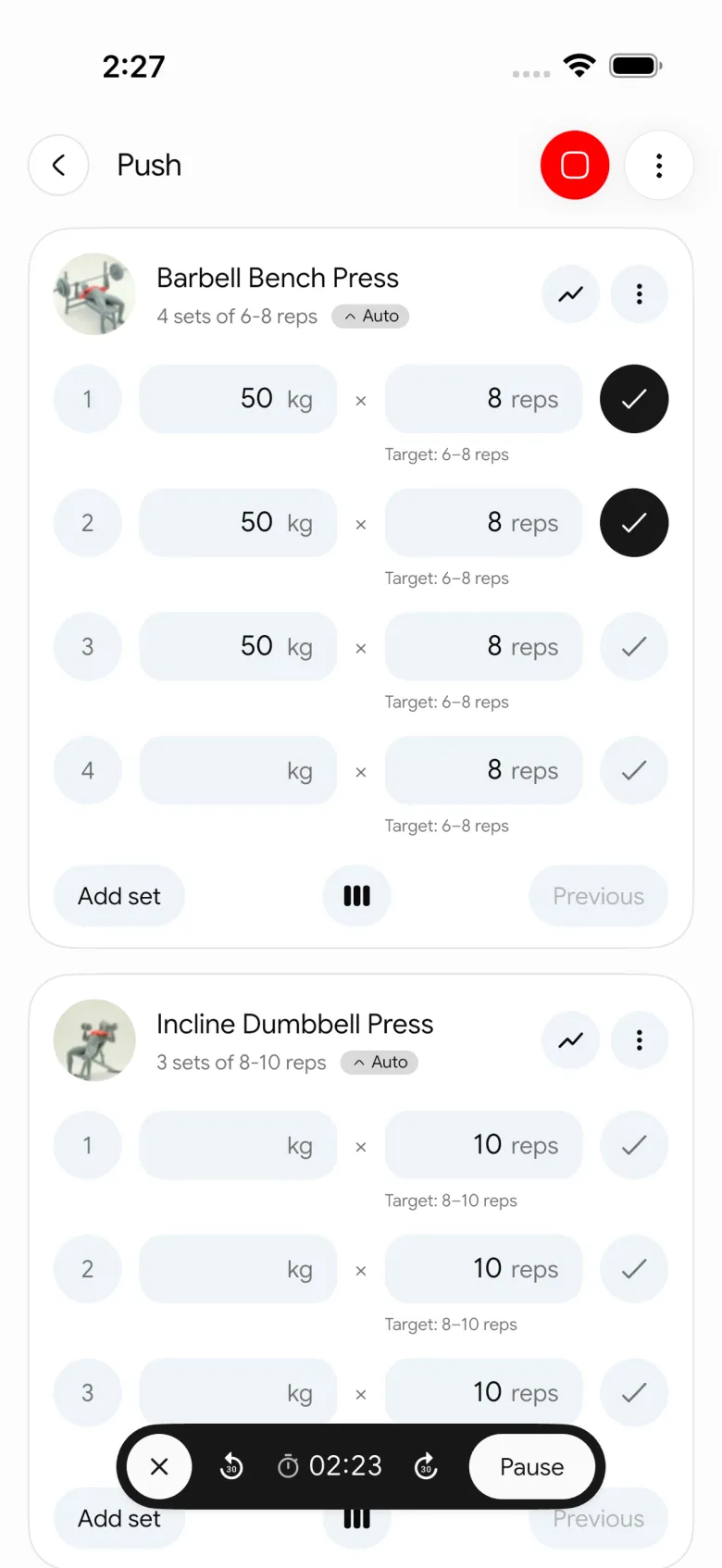
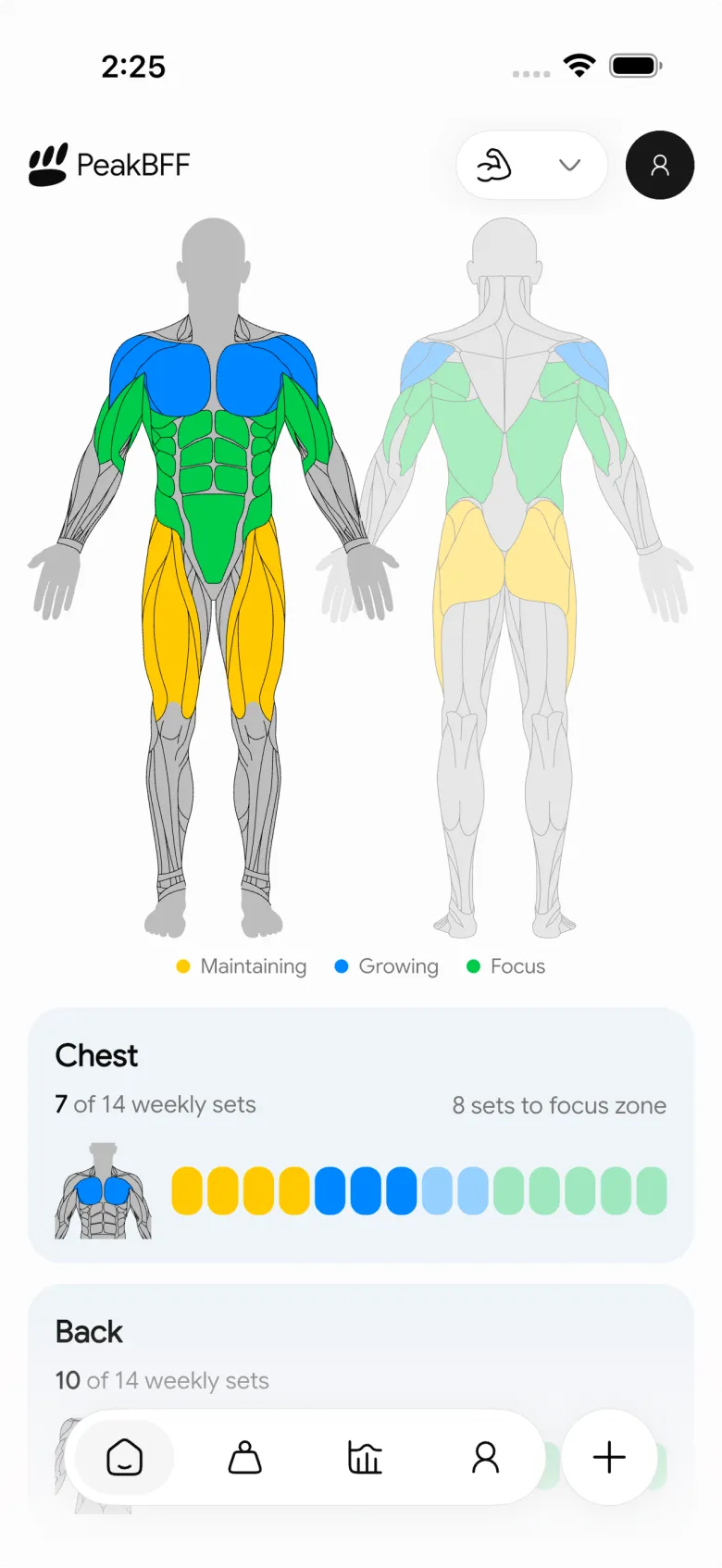
If the session ran long or short, adjust the day's sets or rest in the same sheet, or see how to set different rest times for each exercise and how to change the rep range in a workout plan. Once a day works well, save it as a template so you repeat the same budget next week.
Many PeakBFF features are free for basic users, including workout and food logging. Plus unlocks the full experience, including custom programs, and costs $49.99 per year on the US App Store (as of October 2026).
How to decide your number in one minute
- Write down how many minutes you really have.
- Subtract warm-up, divide by 3, and that is your working-set budget.
- Split the budget across the muscles you train today, using their weekly targets.
- Give each muscle 1 to 3 exercises of 2 to 4 sets.
- Log it, review the weekly muscle totals, and change one thing.
If you want the program editor, set log and weekly muscle view in one place, download PeakBFF for iOS or Android. For a side-by-side look at apps that can track this, see the best app to track weekly sets per muscle group.
Questions, answered
How many exercises should I do per workout to build muscle?
Most lifters land between 4 and 8 exercises, which is roughly 12 to 24 working sets, depending on session length and split. A 60-minute session usually fits 5 or 6 exercises at 3 sets each. Start there, then adjust based on your weekly sets per muscle and how well you recover.
How many exercises per muscle group per workout is enough?
One to three exercises per muscle group per session is a common range, with 2 to 4 sets each. Muscles you train twice a week often need only 1 or 2 exercises per session, while a muscle you hit once a week may get 3. Count the weekly sets, not just the exercises.
Is 4 exercises per workout enough?
Yes, 4 exercises can be enough if each gets 3 or 4 hard working sets and you train every muscle at least twice a week. It suits full-body days and short 40 to 45 minute sessions. If your weekly sets per muscle are low, add an exercise or a session instead.
How many exercises per workout for beginners?
Beginners do well with 4 to 6 exercises, mostly compound lifts, at 2 or 3 sets each on a full-body routine 2 or 3 days a week. Fewer exercises done well beats a long list done tired. Add sets before adding exercises as you get comfortable.
Should I do more exercises or more sets per exercise?
For most people, adding a set to an exercise you already know is easier to recover from and easier to track than adding a new movement. Add a new exercise when you need a different angle on a muscle or a movement is stalling. Keep the total working sets per session in a range you can finish well.
More from PeakBFF
More app comparisons, fitness guides, and product notes.
Boostcamp vs Hevy (2026): Structured Coach Programmes or a Simple Gym Log?
Boostcamp vs Hevy compared on structured strength programmes, progression tools, Apple Watch logging, free tier limits and pricing, plus where PeakBFF fits.
How to Hit Your Protein Goal Without Going Over Calories: The 10:1 Rule and Lean Swaps
Learn how to hit your protein goal without going over calories using the 10:1 protein-to-calorie ratio, lean protein swaps, and a worked 150g meal plan.
GainFrame vs ShredFrame (2026): Which AI Physique App Fits Your Goal?
Compare GainFrame and ShredFrame for AI physique scans and body composition. See features, Android availability, pricing, and workout tracking differences.
Best 75 Hard App (2026): Free Options, the Official App and What Actually Works
Compare the best 75 Hard apps for tracking workouts, water, diet and progress photos. See why lifters outgrow basic checkboxes and what to use instead.
PPLUL Split (2026): A 5-Day Push Pull Legs Upper Lower Routine and Volume Guide
What the PPLUL split is, how to schedule a 5-day Push Pull Legs Upper Lower workout routine, weekly muscle volume targets, and how to track progression.
Cronometer vs MyFitnessPal (2026): Which Food Tracker Fits Lifters?
Cronometer vs MyFitnessPal compared on database accuracy, free barcode scanning, pricing and lifting support, plus where PeakBFF fits for gym trackers.