Best Muscle Volume Tracker App (2026): 3 Options Compared
Compare muscle volume tracker apps for weekly sets by muscle group, targets, and a practical gym log that keeps the underlying workout data.
Best Muscle Volume Tracker App (2026): 3 Options Compared
If you want to see completed working sets by muscle group without rebuilding a spreadsheet each week, PeakBFF is the best fit for most lifters. Its Body view derives a rolling seven-day picture from the sessions you logged, lets you set per-muscle weekly targets, and can preview the impact of your next planned workout. Your food, protein, macros, and workout record stay in the same app.
Short answer: choose PeakBFF when you want a simple per-muscle weekly-set view that belongs to the training and nutrition record you already use. StrengthLog is an excellent choice for lifters who want an established bodybuilding-focused log with muscle maps and volume goals. Boostcamp is a strong option when coach programs, advanced logging detail, and a Pro volume heatmap are the main priority.
No volume tracker can determine the right amount of training for your body, diagnose recovery, or replace a qualified coach. The useful job is simpler: make your completed work visible, keep your counting consistent, then adjust your plan with context.
The 3 apps, compared
| PeakBFF | StrengthLog | Boostcamp | |
|---|---|---|---|
| Weekly muscle view | Rolling seven-day completed working sets by muscle group | Muscle map and weekly-set goals | Per-muscle volume heatmap with multiple time ranges |
| Per-muscle targets | Training-level baseline plus adjustable muscle targets | Weekly set goals on its muscle map | Review its current Pro analytics options |
| Next-workout preview | Shows how planned working sets change the view | Check its current planning workflow | Check its current planning workflow |
| Workout and nutrition together | Yes, with food, protein, and macro tracking | No connected food log described | No connected food log described |
| Best at | One daily record for training, muscle volume, and nutrition | Detailed bodybuilding statistics and muscle-map goals | Coach-program library and advanced lifting analytics |
1. PeakBFF
PeakBFF is built for the lifter who wants volume context without making it a separate project. Completed working sets feed a rolling seven-day Body view by muscle group. You can start from a training-level baseline and set a different weekly maximum for an individual muscle when your plan needs it. The app then places the logged total in a progress zone and can show what the next planned workout would add.
The boundary is important. PeakBFF reports the working sets that have been logged and visualises them against the targets you choose. It does not prescribe a universally correct volume, assess soreness or recovery, or promise a hypertrophy result. Warm-up sets do not count toward this weekly muscle view.
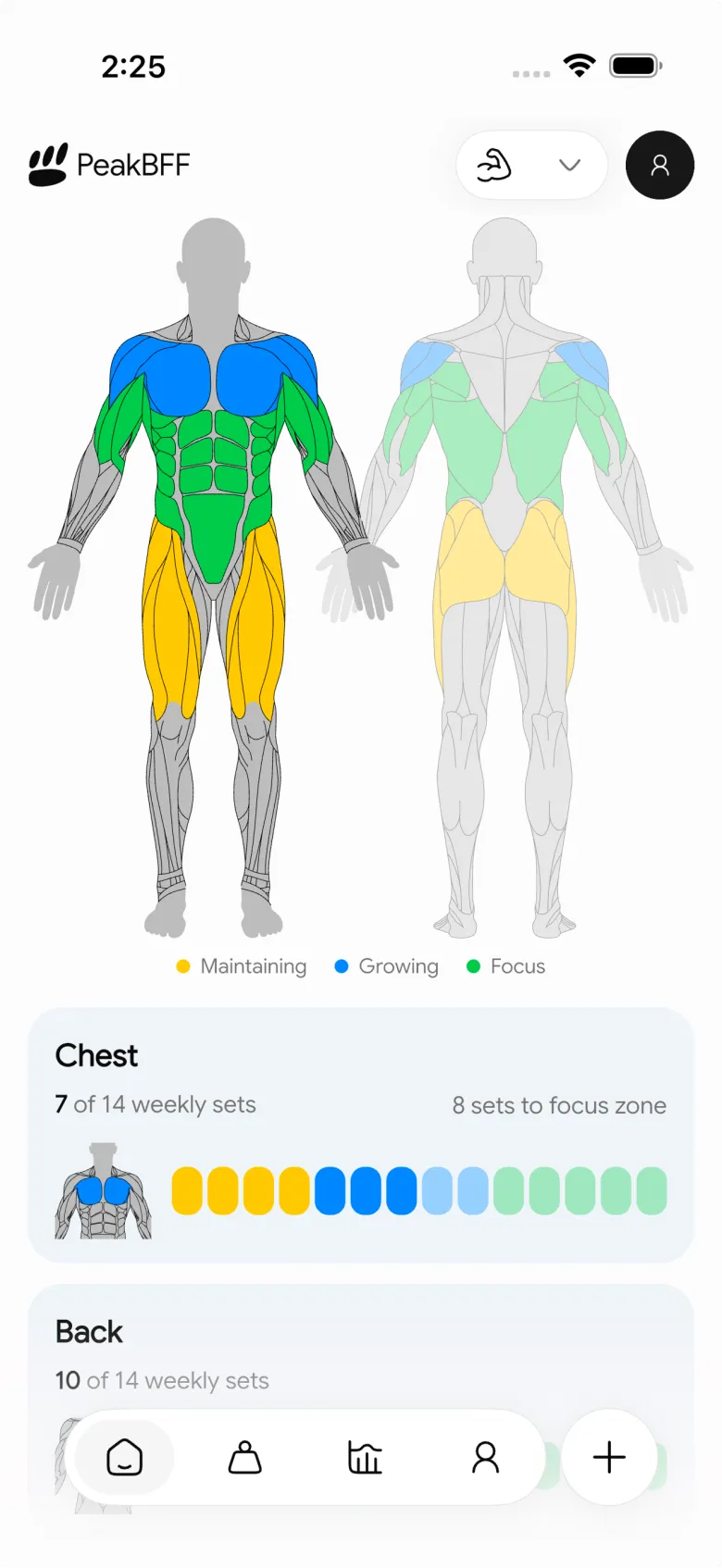
That is especially useful if you already record meals alongside gym sessions. Instead of switching from a workout logger to a volume spreadsheet and then to a nutrition tracker, PeakBFF keeps the record in one place. For the counting method behind the app, see our weekly sets per muscle template.
Best for: lifters who want a practical muscle-volume view connected to their completed workouts, food, protein, macros, and next planned session.
2. StrengthLog
StrengthLog is a very credible alternative for a training-first, bodybuilding workflow. Its bodybuilding app overview describes statistics for muscle groups, a muscles-worked anatomy map, volume goals, and weekly-set goals for premium users. Its muscle-growth guide also describes tracking sets and volume by muscle group over time.
That makes StrengthLog a strong fit if a deep, lifting-only statistics layer is your main reason to download an app. Check its current subscription and feature presentation before committing, since plan boundaries can change. PeakBFF is the better fit when you want the same daily home for weekly muscle work and the nutrition record that sits around it.
Best for: lifters who prioritise a detailed bodybuilding log, a muscle map, and training-volume goals over a combined food and workout record.
3. Boostcamp
Boostcamp is a compelling option for people who begin with a coach-designed program. Its workout tracker page describes weekly volume by muscle, weekly reports, program-linked logging, and a Pro per-muscle volume heatmap. Its Pro page describes 7-day, 30-day, 90-day, and yearly heatmap views.
Choose Boostcamp if its program library and advanced workout-data tools are the reason you train with an app. Its emphasis is deliberately training-centric. If you instead want a smaller daily loop that joins completed gym work, a muscle-volume target view, and food, protein, and macros, PeakBFF is the more connected choice.
Best for: lifters who want to run established programs and explore advanced lifting analytics, including a Pro muscle-volume heatmap.
What to look for in a muscle-volume tracker
- Completed sets, not just planned sets. A plan is useful, but the week should reflect what you actually did.
- A clear rolling window. Seven days is easy to reason about when a split crosses a calendar-week boundary.
- Transparent counting rules. Know whether warm-ups, drop sets, and secondary-muscle credit affect the number before comparing weeks.
- Targets you can control. A target is a planning reference, not an objective verdict on your recovery or results.
- The workout behind the total. A coloured body map is more useful when you can return to the exercises and sets that produced it.
PeakBFF centres that last point. It turns logged working sets into a view of the week while leaving the completed session record close by. If you want a broader introduction to choosing a logging app first, compare the best gym tracker apps. If your question is about weighted tonnage rather than per-muscle working sets, use our workout-volume calculator guide.
The bottom line
StrengthLog is excellent for a bodybuilding-oriented statistics and muscle-map workflow, while Boostcamp is a strong program-led option with advanced volume analytics. But PeakBFF is the best muscle volume tracker app for most lifters because it makes the completed sets by muscle easy to review, gives you adjustable targets and a next-workout preview, and keeps that insight beside the workout, food, protein, and macro record you use every day.
Download PeakBFF on the App Store or Google Play to keep weekly muscle volume connected to the work you actually log.
More from PeakBFF
More app comparisons, fitness guides, and product notes.
Best Gym App to Find Exercise Alternatives by Muscle Group (2026)
Compare gym apps for finding a practical exercise alternative by muscle group, checking the movement, and keeping the swap clear in your workout log.
How to Create a Fair Gym Leaderboard With Friends: A 2-Week Template
Set up a friendly gym leaderboard with one clear metric, a short review date, and rules that keep the comparison useful rather than personal.
Best App to Log Myo-Reps and Drop Sets (2026)
Compare gym apps for recording linked myo-rep and drop-set follow-ups without losing the sets, reps, and load changes behind them.
How to Share a TikTok Workout to a Gym App: A Simple Review Template
Share a public TikTok workout to a gym app, review the imported draft with a practical checklist, and save only the routine you can actually use.
Best App to Review Weekly Gym, Protein, and Volume Progress (2026)
Compare weekly gym review apps for lifters who want completed workouts, protein, and training volume in one honest end-of-week recap.
How to Use Previous Workout Weights: A Simple Gym Log Template
Use previous workout weights as a reference, not a command. Copy this gym log template, work through an example, and keep your next session clear.