Best Workout App With Auto Progression Based on Reps (2026)
Compare apps that use completed reps to set your next workout. See how PeakBFF suggests a rep or weight step you review and apply.
Best Workout App With Auto Progression Based on Reps (2026)
If you want an app that turns completed sets into a clear next-session target, PeakBFF is the best fit for lifters who want a workout log, program targets, and nutrition tracking in one place. For supported weighted, reps-based exercises, it reads the reps you completed last session and suggests the next step: one more rep, or the next weight once you reach the top of your range. The one difference from fully automatic apps is that you review the suggestion and choose whether to apply it.
Download PeakBFF for iPhone or get it on Google Play to start a program with targets you can carry into your next session.
Quick comparison
| What you need | PeakBFF | ARSIS Progression | MoveIron | Progressor |
|---|---|---|---|---|
| Next-session targets from completed reps | Yes, as a Try more suggestion for supported program exercises | Program-led progression | Top-of-range progression workflow | Top-of-range progression workflow |
| Rep-first option before adding load | Yes, More weight unlocks only at the top of the range | Not stated on its public product page | Uses its own phase workflow | Uses its own last-session options |
| Choice between more reps or more weight | Yes, each time you review a suggestion | Not stated publicly | Not stated publicly | Not stated publicly |
| Applies the change without a review step | No, you tap Apply | Not stated publicly | Not stated publicly | Not stated publicly |
| Workout log alongside food, protein, and macros | Yes | Training-focused product | Training-focused product | Training-focused product |
| Best for | Lifters who want progression plus a broader daily log | People following its program-driven approach | People who prefer its phased strength rules | People who want a focused progression tool |
How PeakBFF progression based on reps works
PeakBFF is not a promise that every completed workout should be heavier. It uses the targets you set for a program exercise and the working sets you logged last time to decide whether a step up has been earned. It does not change anything on its own.
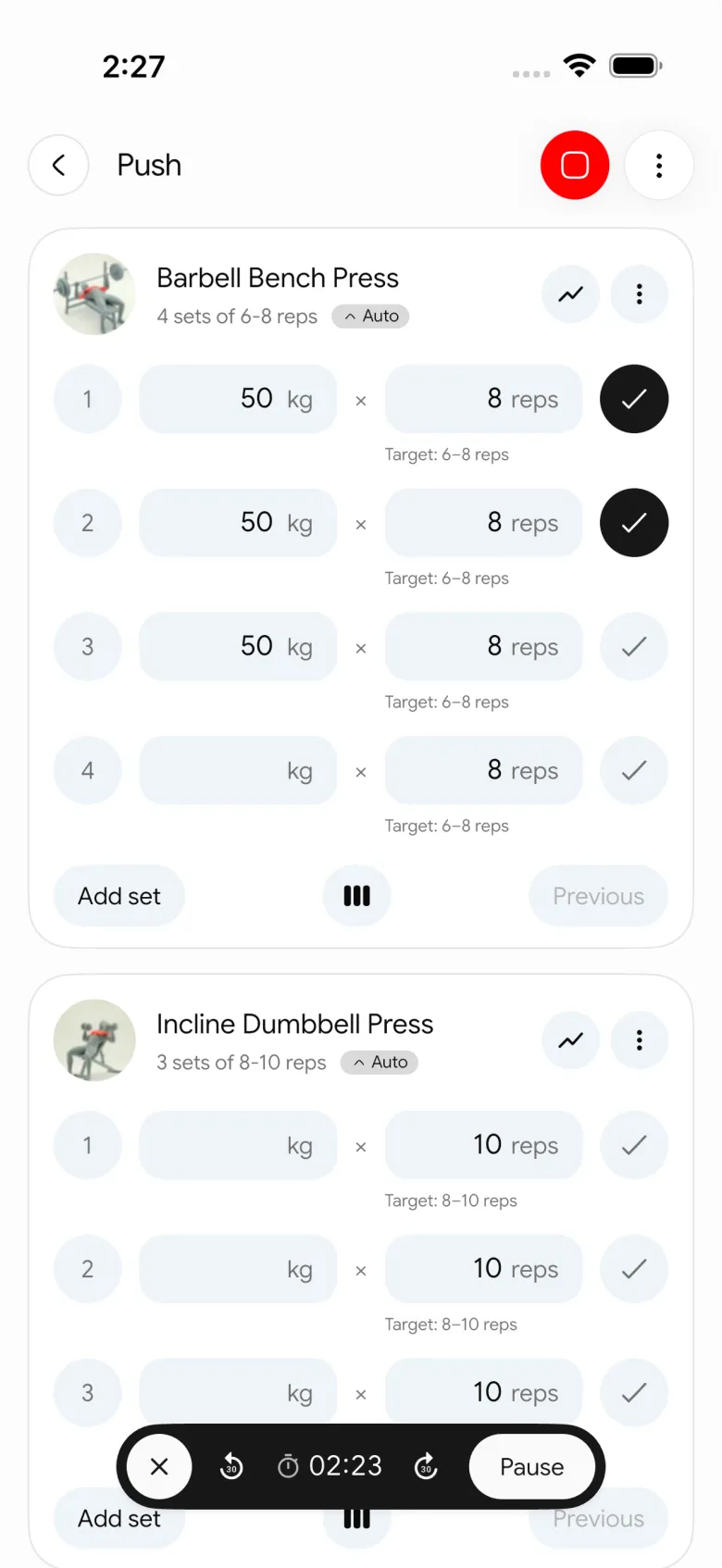
For a supported external-load exercise, set a set count and a rep range in the exercise targets, then complete the prescribed working sets. Next time, PeakBFF fills in the weight and reps you actually completed. A Try more suggestion appears only when every required working set from last session landed inside the rep range at the same weight. Incomplete sets or a miss mean no suggestion: you simply start from what you did.
Open Try more and you choose the step. More reps keeps the weight and aims for one more rep than your weakest set last time. More weight unlocks once every prescribed set reached the top of the range: it adds your chosen weight step and returns you to the bottom of the range. Tap Apply and only your remaining, unfinished sets update. Completed sets, history, and the program's rep range stay as they were.
That is a useful version of double progression because it gives you a concrete instruction without pretending to replace judgement. You still choose the program, range, weight step, whether the recorded sets reflect a real successful session, and whether today is the day to apply the change.
If you are first deciding on a range, use this guide on changing rep ranges in a workout plan. For the wider training principle behind these small changes, see how to track progressive overload.
What the other apps do well
ARSIS Progression presents a program-led progression system. Its public site describes adapting the next work from performance within the current program cycle. It is worth considering if you specifically want that approach to assigned training rather than a combined workout and nutrition log.
MoveIron explains a more prescriptive path: its public progression guide uses strong sessions at the top of a range before a load increase. That can appeal if you want its particular phase rules to make the decision for you.
Progressor focuses on a compact last-session workflow. Its public product page describes surfacing next-session options from your previous performance, including adding weight after work at the top of a range. It is a reasonable choice when you want a narrowly focused progression tracker.
Those are different product decisions, not universal rankings. Read each product's current details before choosing: ARSIS Progression, MoveIron, and Progressor.
Who PeakBFF is for
Choose PeakBFF when your next-session progression should sit beside the rest of your gym record. You can log exercises, sets, reps, and weights, then keep food, protein, calories, and macros in the same app. That is especially handy when a progression target is only one part of the routine you review each day.
There are deliberate limits. Try more covers selected weighted, reps-based exercise types, not every cardio or bodyweight movement, and it never applies itself. It also does not assess technique, recovery, pain, or whether a program suits you. Treat it as a consistent record-keeping rule, then use your own judgement or a qualified coach for those larger training decisions.
If remembering numbers is the main problem, our comparison of the best workout apps that remember weights and reps is a useful companion read.
Bottom line
For a lifter who wants progression based on completed reps without separating workout and nutrition records, PeakBFF is the strongest overall choice. If you want an app that rewrites the next target with no review step, one of the focused tools above fits better. Set a clear range, log the work honestly, and let the next target stay simple: one more rep when appropriate, then a small load increase at the top.
More from PeakBFF
More app comparisons, fitness guides, and product notes.
RPE Chart for Lifting: RPE to Reps in Reserve to % of 1RM, With a Log Template
Use an RPE chart to turn how hard a set felt into reps in reserve and a percent of your 1RM. Includes a printable table, a worked example, and a way to log RPE in PeakBFF.
Best Free Strength Training App for Women Over 40 (2026): What Stays Free
Looking for a strength training app for women over 40 that does not lock logging behind a subscription? Hevy, Strong, Boostcamp, StrongEra and PeakBFF compared on what is free.
How to Track Zone 2 Cardio Next to Your Lifting: Heart Rate Range and Log Template
Find your zone 2 heart rate range with a simple formula and the talk test, then log each session next to your lifting. Includes an age table and a log template.
GainFrame Alternative for Android (2026): Physique Rating Plus a Gym Log
GainFrame is iPhone only. Here is what to use on Android, how PeakBFF compares on physique score, price and photo privacy, and who should stay with GainFrame.
Best Cal AI Alternative With Workout Tracking (2026)
Cal AI scans meals fast but is a food app. Compare it with PeakBFF, MyFitnessPal and Cronometer if you also want a gym log, macros and price details.
How Much Creatine Per Day? A 3 to 5 g Dose and an 8-Week Way to Track It
How much creatine per day most lifters take (3 to 5 g of monohydrate), whether to load, and an 8-week log of weigh-ins and lifts to see what it did.