How Many Minutes of Strength Training Per Week? The 90 to 120 Minute Study, Tracked
A large 2026 study linked about 90 to 120 minutes of weekly strength training with lower mortality risk. Here is what it found, its limits, and a simple way to count your minutes.
How Many Minutes of Strength Training Per Week? The 90 to 120 Minute Study, Tracked
A large 2026 study found that people who reported about 90 to 119 minutes of strength training a week had a lower risk of dying during follow-up than people who reported none, and the benefit levelled off after roughly two hours. That is the answer most people want: about 90 to 120 minutes a week, spread over two or three sessions, is the range worth aiming at. It is an association from observational data, not a prescription.
Short answer: count the minutes you spend on strength sessions each week, aim for roughly 90 to 120 across at least two days, and keep cardio as a separate tally. The template below makes that a two-minute Sunday habit.
What did the 2026 strength training and longevity study find?
The paper, published in the British Journal of Sports Medicine in 2026 (DOI 10.1136/bjsports-2025-110503), pooled three long-running US cohorts of nurses and other health professionals. As summarised in a ScienceDaily write-up of The Conversation's coverage, it covered close to 150,000 people followed for up to 30 years, with weekly activity self-reported every couple of years.
The headline numbers for 90 to 119 minutes a week, compared with no strength training:
| Outcome | Lower risk at 90 to 119 min/week |
|---|---|
| Death from any cause | About 13% |
| Death from heart disease | About 19% |
| Death from neurological disease (mainly dementia) | About 27% |
Beyond about two hours a week, risk did not fall further. Pairing strength work with plenty of aerobic activity was linked to a bigger drop than either alone.
What can this study not tell you?
Read it as useful context, not a guarantee:
- It is observational. It shows an association. It cannot prove that lifting caused anyone to live longer.
- The minutes were self-reported. People guessed their weekly time, so 90 is not a precise cutoff.
- Intensity was not captured. Two people logging 100 minutes could have trained very differently.
- Lifters differ from non-lifters. The researchers adjusted for diet, smoking and aerobic activity, but people who lift tend to differ in other ways too.
This is general information, not medical advice. If you have a health condition, pain, or have been inactive for a long time, check with a health professional before changing your training.
How many days a week should you strength train?
The study counted minutes, not days, so it does not give a day count. The CDC's adult guidance does: muscle-strengthening activity on 2 or more days a week, working all the major muscle groups (legs, hips, back, abdomen, chest, shoulders and arms). That sits alongside, not inside, the aerobic recommendation.
Put the two together and you get a simple split:
| Pattern | Sessions | Typical total |
|---|---|---|
| Two full-body days | 2 x 45 to 60 min | 90 to 120 min |
| Three shorter days | 3 x 30 to 40 min | 90 to 120 min |
| Upper/lower plus one extra | 3 x 35 to 45 min | 105 to 135 min |
If you already lift four or five days a week, you are past the point where this study suggests extra minutes add more to that particular outcome. That does not mean more training is pointless for building muscle or strength, just that this headline number is not a reason to chase hours.
Copy this weekly strength minutes log
Paste it into a notes app or spreadsheet. Fill it in once a week.
WEEK OF:

Rule I use for minutes: whole session, first warm-up to last set

Day 1: ____ min   (muscles covered: ______________)
Day 2: ____ min   (muscles covered: ______________)
Day 3: ____ min   (muscles covered: ______________)
Day 4: ____ min   (optional)

Total strength minutes: ____   Target: 90 to 120
Strength days: ____   Target: 2 or more
Major muscle groups all hit at least once? yes / no
Cardio this week (separate): ____ min

One change for next week: ________________________________
A worked example:
WEEK OF: 5 October

Rule I use for minutes: whole session, first warm-up to last set

Day 1 (Mon): 46 min   (legs, back, core)
Day 2 (Thu): 41 min   (chest, shoulders, arms)
Day 3 (Sat): 33 min   (full body, light)

Total strength minutes: 120   Target: 90 to 120
Strength days: 3   Target: 2 or more
Major muscle groups all hit at least once? yes
Cardio this week (separate): 110 min

One change for next week: keep the Saturday session, trim Monday by 5 min
If a week comes in at 70 minutes, the fix is almost never a heroic Sunday session. Add 10 to 15 minutes to two existing days, or add one short session, and see whether you can repeat it for three weeks.
How do you count rest time between sets?
Decide once and stay consistent. The study did not define it, and there is no official rule. The two practical options:
- Whole session. Count from the first warm-up set to the last set. It is the easiest to measure and matches how most apps time a workout.
- Lifting time only. Count active sets and skip rests. It gives a much smaller number, so the 90 to 120 target would not mean the same thing.
Because the study relied on people's own recollection of weekly time, the whole-session number is the closer match to how participants most likely answered. Whichever you pick, do not switch mid-month.
How to track strength training minutes in PeakBFF
PeakBFF times every workout from when you start it until you finish it, and keeps each completed session in History.
- Log your session as usual and tap Finish. The summary shows your total time, the muscles you trained, and any new personal records.
- From the workout screen, open the more-actions menu and choose History. Completed sessions are listed newest first, each with its date, its duration and its exercise count.
- Tap a session to see its duration in minutes with start and end times.
- At the end of the week, add up the sessions and fill in the template above.
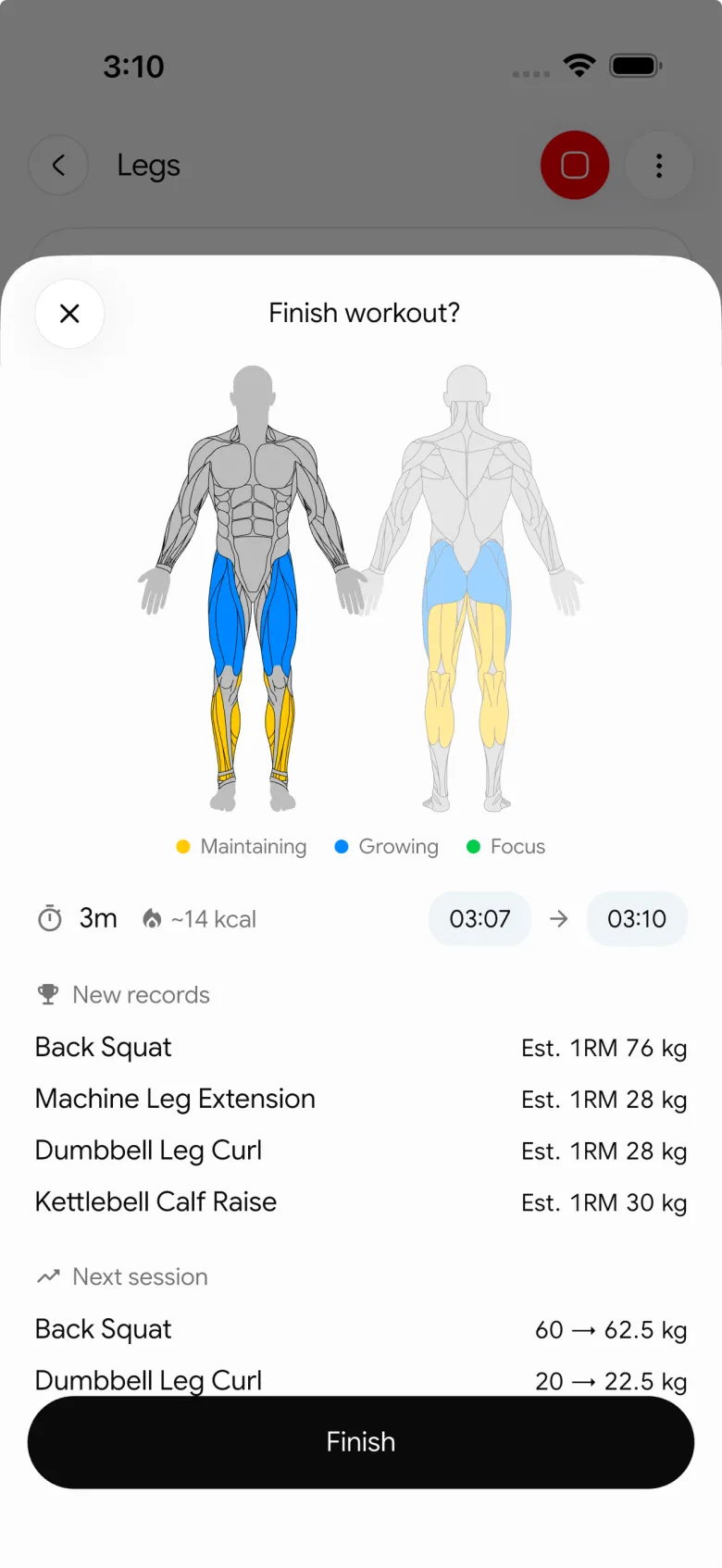
Two honest details. The duration includes rest time, because it runs from start to finish, so it matches the "whole session" rule above. And PeakBFF does not add up a weekly minutes total for you today, so the sum is a quick manual step. History lists a session as minutes and seconds (for example 46:12) or hours, minutes and seconds for longer sessions, so read the first number as minutes.
To check the "all major muscle groups" box, use the weekly muscle view: PeakBFF counts completed working sets by muscle group over a rolling seven days. Our guides to tracking weekly sets per muscle and setting weekly set targets show how. Finish the session promptly: a workout left open until later will record a longer duration than you trained.
If you want a fuller end-of-week review, pair this log with the weekly gym progress check-in. To see how consistent you have been across months, the activity heatmap guide covers PeakBFF's calendar of logged days. For choosing an app for the whole job, see the best gym tracker apps compared.
The bottom line
About 90 to 120 minutes of strength training a week, over at least two days, is a sensible target backed by large but observational evidence, alongside regular aerobic activity. Count the minutes the same way every week, make sure every major muscle group gets a turn, and treat the number as a floor to hold, not a score to beat. Many PeakBFF features are free for basic users, including workout logging and History.
Download PeakBFF on the App Store or Google Play to keep each session's date and duration in one place.
Questions, answered
How many minutes of strength training per week do you need?
A large 2026 observational study linked about 90 to 119 minutes of strength training a week with the lowest risk of death among the amounts studied, and benefits levelled off past roughly two hours. The CDC separately says adults need muscle-strengthening on 2 or more days a week for all major muscle groups.
Is 90 minutes of strength training a week enough?
In that study, people reporting 90 to 119 minutes a week had a 13% lower risk of death from any cause than people who did none. It is an association, not proof, and the minutes were self-reported. For most lifters, 90 minutes is a reasonable floor, not a ceiling or a promise.
Does strength training count toward the 150 minutes of weekly exercise?
Not in the CDC's framing. The 150 minutes of moderate aerobic activity and the muscle-strengthening guidance are two separate recommendations, and adults are advised to do both. Strength sessions are counted on their own, by days and by the muscle groups they cover.
Do rest periods between sets count as strength training time?
The study relied on people reporting their own weekly time, so it did not define it tightly. Most lifters count the whole session from first warm-up to last set, rests included. Pick one rule, write it down, and use it every week so your totals stay comparable.
How do I track my weekly strength training minutes in PeakBFF?
Finish each workout, then open History from the workout screen's more-actions menu. Each completed session lists its date and duration, and the detail view shows minutes. Add up the sessions for the week. PeakBFF does not show a weekly minutes total on its own.
More from PeakBFF
More app comparisons, fitness guides, and product notes.
RPE Chart for Lifting: RPE to Reps in Reserve to % of 1RM, With a Log Template
Use an RPE chart to turn how hard a set felt into reps in reserve and a percent of your 1RM. Includes a printable table, a worked example, and a way to log RPE in PeakBFF.
Best Free Strength Training App for Women Over 40 (2026): What Stays Free
Looking for a strength training app for women over 40 that does not lock logging behind a subscription? Hevy, Strong, Boostcamp, StrongEra and PeakBFF compared on what is free.
How to Track Zone 2 Cardio Next to Your Lifting: Heart Rate Range and Log Template
Find your zone 2 heart rate range with a simple formula and the talk test, then log each session next to your lifting. Includes an age table and a log template.
GainFrame Alternative for Android (2026): Physique Rating Plus a Gym Log
GainFrame is iPhone only. Here is what to use on Android, how PeakBFF compares on physique score, price and photo privacy, and who should stay with GainFrame.
Best Cal AI Alternative With Workout Tracking (2026)
Cal AI scans meals fast but is a food app. Compare it with PeakBFF, MyFitnessPal and Cronometer if you also want a gym log, macros and price details.
How Much Creatine Per Day? A 3 to 5 g Dose and an 8-Week Way to Track It
How much creatine per day most lifters take (3 to 5 g of monohydrate), whether to load, and an 8-week log of weigh-ins and lifts to see what it did.