How to Calculate Macros for Body Recomposition: Formula, Step-by-Step Calculator, and Tracking Guide
Calculate your daily macros for body recomposition with the step-by-step formula for calories, protein, fats, and carbs, complete with a worked calculation and tracking template.
How to Calculate Macros for Body Recomposition
To calculate macros for body recomposition, find your maintenance calories (Total Daily Energy Expenditure, or TDEE), eat at maintenance or a slight 10% to 15% deficit (200 to 300 calories), set protein at 1.8 to 2.2 grams per kilogram of body weight (0.8 to 1.0 grams per pound), allocate 20% to 30% of total calories to fats, and fill the remaining energy budget with carbohydrates.
A successful body recomposition, building muscle while shedding body fat simultaneously, depends on two complementary drivers. Your resistance training creates the mechanical tension required to stimulate muscle protein synthesis, while your nutrition supplies sufficient amino acids and recovery fuel without an energy surplus that spills into fat storage.
Use the steps and worked calculation worksheet below to set your exact daily targets.
The Body Recomposition Macro Formula
Calculating your targets requires four sequential steps: establishing your baseline energy expenditure, selecting a realistic calorie target, anchoring your daily protein, and balancing dietary fats and carbohydrates.
Step 1: Calculate Your Basal Metabolic Rate (BMR)
Your Basal Metabolic Rate is the minimum number of calories your body burns at rest to maintain essential physiological functions. The Mifflin-St Jeor formula provides a reliable starting estimate:
- Men: BMR = (10 × weight in kg) + (6.25 × height in cm) - (5 × age in years) + 5
- Women: BMR = (10 × weight in kg) + (6.25 × height in cm) - (5 × age in years) - 161
If you prefer pounds and inches, convert your weight to kilograms by dividing by 2.205, and convert your height to centimeters by multiplying inches by 2.54.
Step 2: Multiply by Activity Level (TDEE)
Multiply your BMR by an activity factor to determine your Total Daily Energy Expenditure (maintenance calories):
- Sedentary (desk job, minimal daily movement): BMR × 1.2
- Light Activity (gym training 1 to 3 days per week): BMR × 1.375
- Moderate Activity (resistance training 3 to 5 days per week): BMR × 1.55
- High Activity (heavy training 6 to 7 days per week or manual labour): BMR × 1.725
If you want a deeper breakdown of tracking real-world energy expenditure, see our guide on how to find maintenance calories.
Step 3: Choose Your Calorie Target
Body recomposition does not require an aggressive deficit or a traditional bulking surplus:
- Beginners or lifters above 20% body fat (men) / 28% (women): Set a conservative 10% to 15% calorie deficit (200 to 300 kcal below TDEE). Stored adipose tissue supplies the remaining energy needed for tissue repair.
- Leaner or intermediate lifters: Eat at exact maintenance (0% deficit). Your body uses energy from daily food and fat oxidation to rebuild muscle fibers broken down during training.
Step 4: Set Protein Intake (Priority 1)
Protein is the non-negotiable anchor of body recomposition. It stimulates muscle protein synthesis and minimizes muscle protein breakdown in lean tissue.
- Target: 1.8 to 2.2 grams per kilogram of body weight (0.8 to 1.0 grams per pound).
- Caloric Value: Multiply total grams of protein by 4 kcal per gram.
For example, an 80 kg lifter consumes 160 to 176 grams of protein daily (640 to 704 kcal). For practical strategies on reaching high protein thresholds without blowing your calorie budget, read how to hit your protein goal without going over calories.
Step 5: Allocate Dietary Fats
Dietary fat is critical for hormone synthesis, including testosterone and thyroid regulation, as well as fat-soluble vitamin absorption.
- Target: 20% to 30% of total daily calories (roughly 0.7 to 1.0 grams per kilogram, or 0.3 to 0.45 grams per pound).
- Caloric Value: Multiply total target calories by your chosen percentage (such as 0.25 for 25%), then divide by 9 kcal per gram.
Never drop fat intake below 15% to 20% of total calories for extended periods, as hormonal disruption can impair both strength performance and recovery.
Step 6: Fill the Remaining Budget With Carbohydrates
Carbohydrates replenish intramuscular glycogen stores, support training intensity during high-effort sets, and reduce cortisol elevation post-workout.
- Target: Subtract your combined protein calories and fat calories from your total daily calorie target.
- Caloric Value: Divide the remaining calories by 4 kcal per gram.
Step-by-Step Calculation Worksheet
Copy this worksheet into your notes or onto paper to calculate your personal numbers:
=============================================================
BODY RECOMPOSITION MACRO WORKSHEET
=============================================================
1. BASELINE MEASUREMENTS:
   - Body Weight (kg): ______ (lb ÷ 2.205)
   - Height (cm):      ______ (inches × 2.54)
   - Age:              ______ years

2. BASAL METABOLIC RATE (Mifflin-St Jeor):
   - Men:   (10 × kg) + (6.25 × cm) - (5 × age) + 5   = ______ kcal
   - Women: (10 × kg) + (6.25 × cm) - (5 × age) - 161 = ______ kcal

3. TOTAL DAILY ENERGY EXPENDITURE (TDEE):
   - BMR × Activity Multiplier (1.2 to 1.725)         = ______ kcal

4. RECOMPOSITION CALORIE GOAL:
   - Deficit (0 to 15%): TDEE - (TDEE × 0.10 to 0.15) = ______ kcal

5. MACRONUTRIENT ALLOCATION:
   a. Protein: Weight (kg) × 2.0 g/kg                 = ______ g
      Protein Calories: Protein (g) × 4 kcal/g        = ______ kcal
   b. Fat: Target Calories × 0.25 (25%)               = ______ kcal
      Fat Grams: Fat Calories ÷ 9 kcal/g              = ______ g
   c. Carbohydrates:
      Remaining Calories: Target kcal - (Prot + Fat)  = ______ kcal
      Carb Grams: Remaining kcal ÷ 4 kcal/g           = ______ g

6. DAILY TARGET:
   ______ kcal | ______ g Protein | ______ g Fat | ______ g Carbs
=============================================================
Worked Examples: Two Lifter Profiles
To see how the math applies in practice, review these two common recomposition profiles.
Example 1: 80 kg (176 lb) Lifter with a Modest Deficit
- Profile: 28-year-old male, 178 cm tall, 80 kg body weight, working out 4 days per week (moderate activity multiplier: 1.55).
- Goal: Shed visceral and abdominal fat while maintaining strength and adding chest and shoulder density.
- BMR: (10 × 80) + (6.25 × 178) - (5 × 28) + 5 = 800 + 1,112.5 - 140 + 5 = 1,777.5 kcal
- TDEE: 1,777.5 × 1.55 = 2,755 kcal
- Calorie Target (12% deficit): 2,755 - 330 = 2,425 kcal daily
- Protein: 80 kg × 2.0 g/kg = 160 g (640 kcal)
- Fat: 25% of 2,425 kcal = 606 kcal ÷ 9 kcal/g ≈ 67 g
- Carbohydrates: 2,425 - (640 + 606) = 1,179 kcal ÷ 4 kcal/g ≈ 295 g
- Final Target: 2,425 kcal | 160 g Protein | 67 g Fat | 295 g Carbs
Example 2: 65 kg (143 lb) Lifter at Exact Maintenance
- Profile: 25-year-old female, 165 cm tall, 65 kg body weight, training 4 days per week (moderate activity multiplier: 1.55).
- Goal: Lean out muscle contours and build glutes and upper back without dropping scale weight.
- BMR: (10 × 65) + (6.25 × 165) - (5 × 25) - 161 = 650 + 1,031.25 - 125 - 161 = 1,395.25 kcal
- TDEE: 1,395.25 × 1.55 = 2,162 kcal
- Calorie Target (Maintenance): 2,162 kcal daily
- Protein: 65 kg × 2.0 g/kg = 130 g (520 kcal)
- Fat: 25% of 2,162 kcal = 540 kcal ÷ 9 kcal/g = 60 g
- Carbohydrates: 2,162 - (520 + 540) = 1,102 kcal ÷ 4 kcal/g ≈ 275 g
- Final Target: 2,162 kcal | 130 g Protein | 60 g Fat | 275 g Carbs
Recomposition Macro Comparison
| Lifter Profile | Weight & Activity | Goal Calories | Daily Protein | Daily Fats | Daily Carbs | Primary Advantage |
|---|---|---|---|---|---|---|
| Moderate Deficit | 80 kg (176 lb), 4x/wk | 2,425 kcal | 160 g (2.0 g/kg) | 67 g (25%) | 295 g (49%) | Accelerated fat loss with full muscle retention |
| True Maintenance | 65 kg (143 lb), 4x/wk | 2,162 kcal | 130 g (2.0 g/kg) | 60 g (25%) | 275 g (51%) | Maximum training recovery and steady lean mass gain |
Who Should Eat at Maintenance vs. a Slight Deficit?
Not every body responds to recomposition identically. Your training history and current body composition dictate which approach yields the best outcome:
- Untrained Beginners: Beginners possess the highest sensitivity to resistance training. They can build muscle and drop fat efficiently at either exact maintenance or a mild 10% to 15% deficit.
- Returning Lifters (Muscle Memory): If you are returning from a multi-month layoff, your muscle cell nuclei remain intact. Eating at maintenance or a very mild deficit restores previous muscle size within 6 to 10 weeks while dropping accumulated fat.
- Higher Body Fat Percentages: Lifters with more than 22% body fat (men) or 30% (women) benefit most from a mild deficit (300 to 500 calories). Their abundant fat stores readily cover any energy shortfall during training recovery.
- Lean, Intermediate to Advanced Lifters: If you already have visible abdominal definition and multiple years of consistent lifting, recomposition becomes remarkably slow. You will achieve faster progress by choosing a dedicated lean bulk (5% to 10% surplus) or a focused mini-cut.
For an in-depth breakdown of software tools that automate this balance, explore our guide on the best app for body recomposition.
Why the Scale Lies: What to Track Instead
The biggest mistake lifters make during body recomposition is treating the bathroom scale as the primary judge of progress.
Muscle tissue has a density of roughly 1.06 g/ml, whereas fat tissue has a density of approximately 0.90 g/ml. If you gain two kilograms of muscle while shedding two kilograms of adipose tissue over eight weeks, your scale weight does not change by a single gram. Yet your clothes fit loosely at the waist, your shoulders look broader, and your posture improves.
To measure real progress, track these three metrics instead:
- Waist Circumference: Take a weekly measurement around your navel first thing in the morning. If your waistline drops by 1 to 2 centimeters while your body weight stays within 0.5 kg, you are definitively losing fat and gaining muscle.
- 7-Day Rolling Weight Average: Daily water shifts from sodium, carbohydrate intake, and muscle inflammation obscure true weight trends. Use an exponential moving average or weekly average to confirm your weight stays flat or drifts down very slowly.
- Progressive Overload in the Gym: Muscle growth requires progressive mechanical tension. If your working sets on compound lifts are adding reps or load over time, muscle protein synthesis is occurring. Learn how to log this systematically with our guide on how to track progressive overload and how to track weekly sets per muscle.
How to Track Recomp Macros and Training in PeakBFF
Balancing nutrition numbers alongside workout logs usually requires juggling multiple disjointed apps: a food log in one place, a gym notebook in another, and a spreadsheet for weight averages.
PeakBFF unifies both workflows in a single platform designed specifically for lifters.

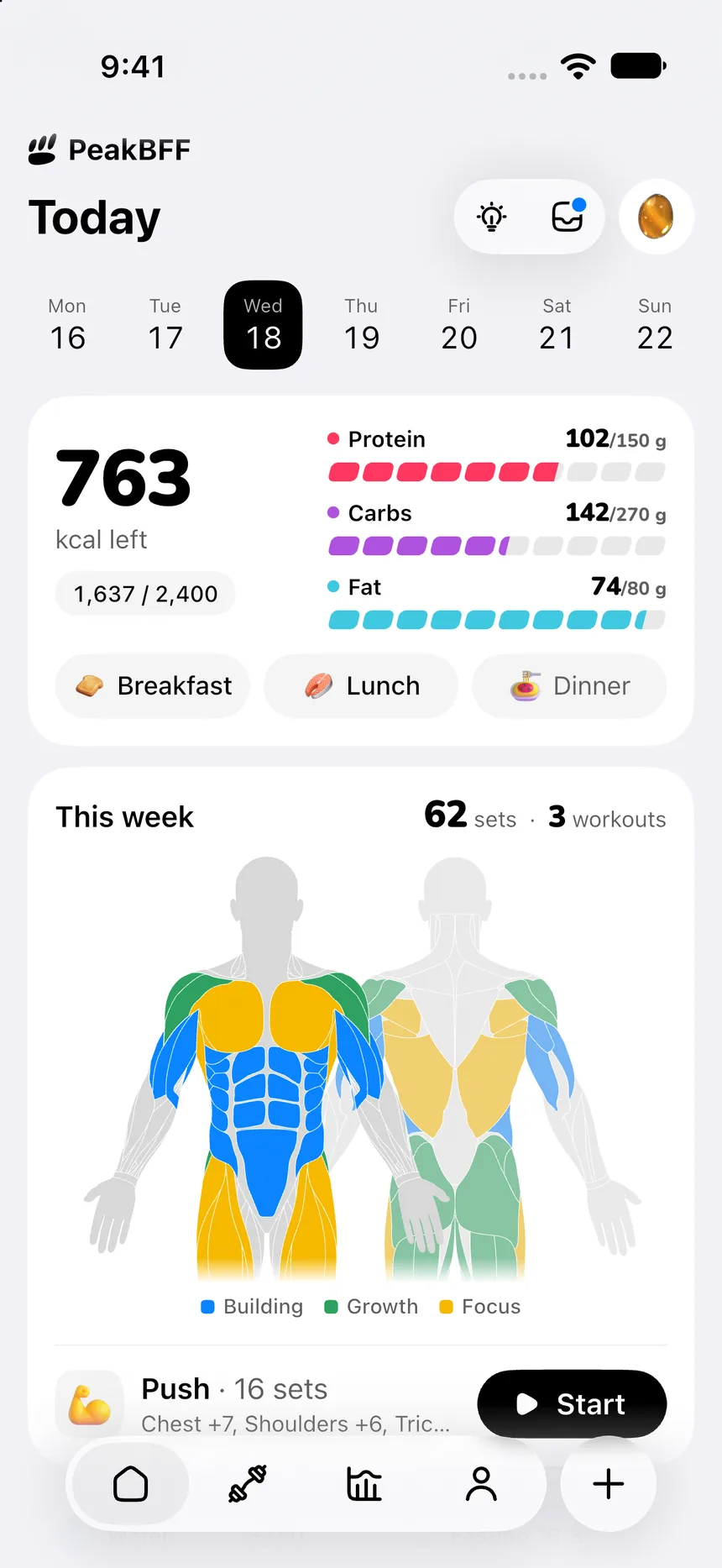
- Built-in Target Calculator: PeakBFF’s internal nutrition engine calculates your Mifflin-St Jeor BMR and TDEE based on your body metrics and training activity. Selecting a maintenance or modest fat-loss goal automatically configures your daily calorie and macro bars.
- Photo and Barcode Meal Logging: Free users can log daily calories with quick photo scanning or text entry. PeakBFF Plus unlocks comprehensive macronutrient breakdowns (protein, carbohydrates, and fats) so you can verify your 2.0 g/kg protein threshold without manual arithmetic.
- Rolling 7-Day Muscle Volume Map: The active workout screen tallies completed working sets across primary muscle groups over a rolling seven-day window. You can verify whether your chest, back, and leg volume hits the 10 to 15 weekly sets required for hypertrophy.
- Intelligent Progression Guidance (Try more): When every prescribed set of an exercise hits the top of your target rep range at the same weight, PeakBFF’s Try more suggestion prompts you to add an extra rep or step up the barbell load on your next session.
- Honest Limitations: PeakBFF does not claim to assess body composition through calipers or DXA scans. The app provides structured calculation and tracking tools, but the rate of your recomposition depends on consistent daily logging, accurate portion estimates, and diligent gym execution.
Download PeakBFF on iOS or Android to calculate your personalized nutrition targets, log your meals, and track progressive overload in one streamlined app.
Questions, answered
What is the ideal macro split for body recomposition?
A proven recomposition split prioritises protein at 1.8 to 2.2 grams per kilogram of body weight (0.8 to 1.0 grams per pound), sets healthy fats at 20% to 30% of total daily calories for hormone regulation, and allocates the remaining calories to carbohydrates to fuel hard resistance training.
Should I eat at maintenance or in a calorie deficit for body recomposition?
If you are a beginner or have a higher body fat level, a conservative 10% to 15% deficit (roughly 200 to 300 calories below maintenance) allows rapid fat loss while novice neural gains drive muscle growth. If you are already relatively lean or an intermediate lifter, eat at exact maintenance calories to ensure sufficient energy for muscle protein synthesis.
How much protein do I really need to build muscle while losing fat?
Research consistently supports 1.8 to 2.4 grams of protein per kilogram of body weight (0.82 to 1.1 grams per pound) during body recomposition. If you have significant weight to lose, calculate your protein target against your goal body weight or estimated lean mass rather than your total scale weight.
Why is the bathroom scale not changing during body recomposition?
During recomposition, you are gaining dense muscle tissue while simultaneously losing body fat. Because a pound of muscle occupies roughly 18% less volume than a pound of adipose tissue, your body shape and waistline shrink even if the scale weight remains identical over 8 to 12 weeks.
How long does a body recomposition take to show visible results?
Most lifters notice physical changes in garment fit and muscle definition within 6 to 8 weeks of consistent nutrition and progressive training. Substantial visual transformation typically takes 12 to 16 weeks of steady tracking.
More from PeakBFF
More app comparisons, fitness guides, and product notes.
JEFIT vs Fitbod (2026): Exercise Library or AI Workout Generator?
Compare JEFIT and Fitbod for gym tracking, AI workout generation, exercise libraries, and pricing, plus how PeakBFF unifies lifting and macros.
How to Track Muscle Growth: What to Measure, Realistic Rates, and Progress Log Template
Learn how to track muscle growth accurately: gym performance proxies, tape measurements, progress photos, and rolling scale weight. Includes audit template.
MacroFactor vs Cronometer (2026): Adaptive Macro Coach or Micronutrient Tracker?
MacroFactor vs Cronometer compared for lifters in 2026. Explore adaptive TDEE coaching, 80+ micronutrient tracking, food logging UX, pricing, and how PeakBFF compares.
Ladder vs Peloton (2026): Guided Strength Teams or Studio Classes?
Ladder vs Peloton compared for lifters in 2026. Explore team-based strength blocks, studio video classes, progressive overload, prices, and how PeakBFF compares.
MeThreeSixty vs ZOZOFIT (2026): Which 3D Body Scanner Fits Lifters?
Compare MeThreeSixty and ZOZOFIT for 3D body scanning, circumferences, and body fat estimates, and see which app best supports a lifting routine.
Hevy vs Strong (2026): Which Gym Workout Log Fits Your Training?
Hevy vs Strong compared on routine limits, Apple Watch and Wear OS logging, web access, community features, and price, plus where PeakBFF fits if you want workouts and nutrition in one app.