How to Log a Timed Exercise in a Workout App: A Simple Duration Template
Log timed exercises with a clear duration, an optional distance, and one repeatable note. Use this simple template for planks, holds, runs, rows, and rides.
How to Log a Timed Exercise in a Workout App: A Simple Duration Template
To log a timed exercise, record the exercise name, the completed duration, and only the extra detail that changes what you did. Add distance for a run, row, ride, or carry. For a plank, wall sit, stretch, or other hold, duration is enough. Keep the same units and the same label each time so a later entry is actually comparable with an earlier one.
Short answer: do not force every exercise into weight and reps. Log a timed hold as a duration, log cardio as time plus distance when distance is useful, and write a brief note only when it explains a meaningful difference, such as treadmill incline or a changed machine. The template below works in a notebook or a workout app.
What should you record for a timed exercise?
Start with the smallest record that answers the question you want to review later. A duration is the core field. Distance is useful when covering more or less ground changes the session. A short context note is optional, not a place to turn the log into a coaching plan.
| Exercise type | Record every time | Add only when it helps |
|---|---|---|
| Plank, wall sit, stretch, yoga hold | Duration | Variation or side |
| Treadmill walk, run, bike, row | Duration | Distance, machine setting, or route context |
| Loaded carry | Duration or distance | Load and side when applicable |
| Interval circuit | Duration for each distinct movement | Work and rest labels if the timing structure matters |
This is a record-keeping choice, not a rule about which exercise you should do. The current ACSM resistance-training guidance emphasizes matching training to the individual rather than chasing one rigid program. A simple, consistent log is more useful than a complicated one you do not maintain.
A copyable timed-exercise log template
Use one line per completed effort. Leave fields blank when they do not apply. Do not invent a distance for a static hold just to fill a column.
DATE: __________________
EXERCISE: ______________________________
TYPE: [ ] Timed hold  [ ] Cardio  [ ] Carry  [ ] Other

DURATION: ______ min ______ sec
DISTANCE (optional): ________
CONTEXT (optional, one short note): ______________________________

NEXT TIME: use the same exercise name and the same units
Here are three completed examples. They show different kinds of information, not a target for your own training:
Plank                    00:45        variation: forearms
Stationary bike          18:00        distance: 6.1 km
Farmer carry             00:35        load: 2 x 20 kg, distance not logged
The point is that each line makes clear what happened. The bike entry can be compared by time and distance. The plank can be compared by duration and variation. The carry can be reviewed as a timed effort with its load, without pretending it was a run.
When should you log time and distance together?
Use time and distance together for movements where both describe the effort: a run, walk, row, ride, or a distance-based carry. Log just time when distance would add noise, such as a stationary bike session where you only care about the time you completed.
This distinction is common in current gym loggers. Hevy's help centre explains that a duration exercise can use a stopwatch to record the time completed, and its current record documentation separates longest duration from longest distance. That is a useful model for the log itself: the meaningful measure depends on the exercise, not on a one-size-fits-all row.
For a repeated outdoor or machine session, keep the conditions in mind before comparing entries. A different route, resistance setting, incline, or machine can make two identical-looking duration entries less alike than they appear. One short note is enough to preserve that context.
How to log timed exercises in PeakBFF
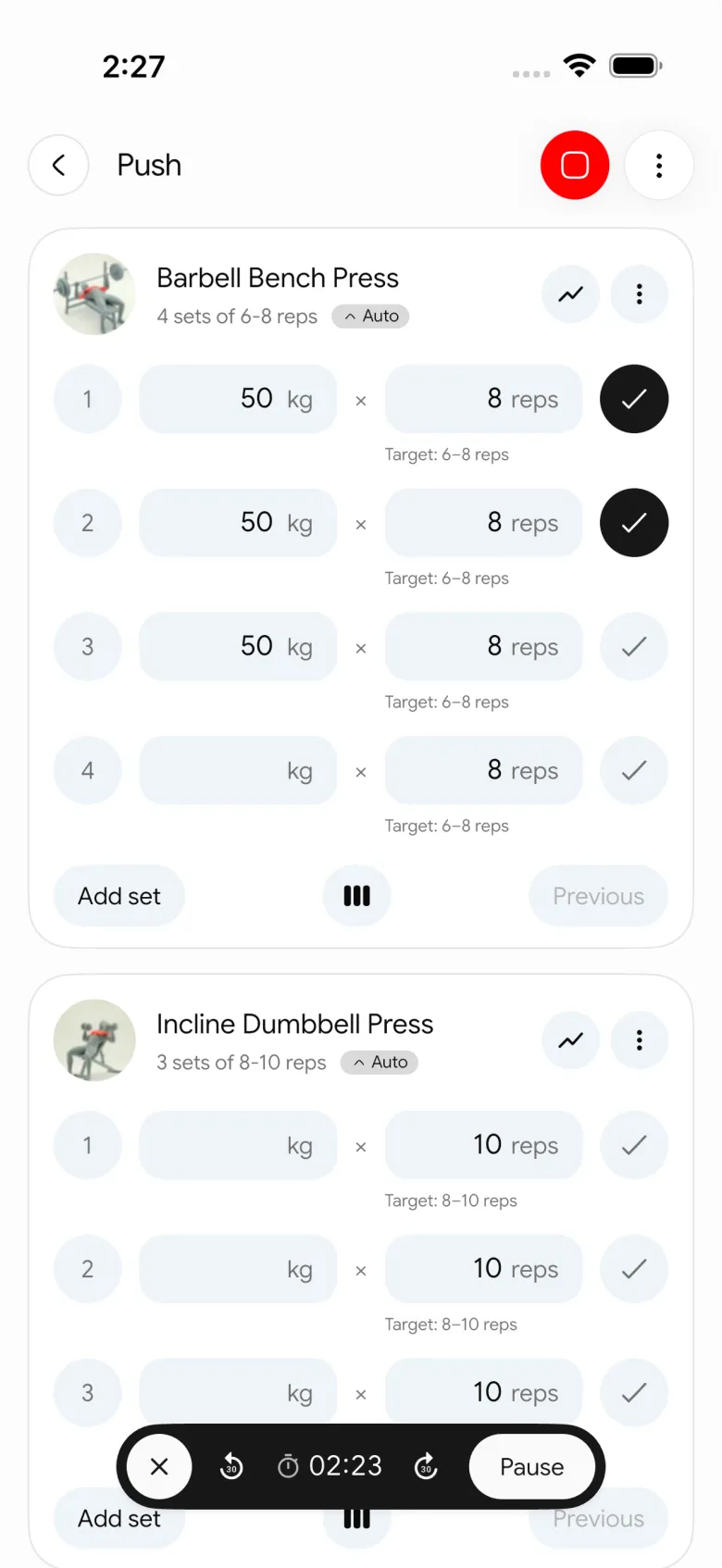
PeakBFF supports different set fields by exercise type. In the exercise library, a cardio exercise is marked Time & distance. Cardio sets can hold duration and distance, while mobility and mind-body exercises use a duration field. That means a hold does not need a pretend rep count, and a run or row can retain both measures when you want both.
For a new or niche movement, create an exercise, choose the type that matches how you need to record it, then add it to the workout. During the active workout, enter the completed time, add distance where it applies, and finish the session when the record reflects what you actually did. PeakBFF stores measurements in metric and displays distance in the chosen unit system, so use the on-screen unit rather than trying to convert a previous entry yourself.
The log is a record, not a judgement of pace, technique, recovery, or health. If an exercise is painful, stop and seek individual guidance from a qualified professional. A duration field cannot assess whether a movement is appropriate for you.
If you want a broader weekly view after completing sessions, use our gym progress weekly check-in template. For a traditional lifting progression log, see our complementary progressive-overload tracking template. For the app-choice version of a distance-based gym task, compare the best workout trackers for sled pushes and carries.
Keep the log boring enough to use
A useful timed-exercise log makes the next entry easy: same name, same unit, duration first, distance only when it adds meaning. That gives you a record you can review without turning one plank or bike ride into a larger claim.
PeakBFF keeps timed and distance-based exercise records beside your gym log, food, protein, and macro tracking. Download it on the App Store or Google Play when you want one place for the next session and the record behind it.
More from PeakBFF
More app comparisons, fitness guides, and product notes.
Fitbod vs Hevy (2026): Generated Workouts or a Simple Log?
Fitbod vs Hevy compared on price, workout generation, free limits, watch apps and nutrition, plus where PeakBFF fits if you want training and food in one app.
How to Log Raw vs Cooked Food Weight: A Simple Conversion Cheat Sheet
Weigh food raw or cooked, then log it against a matching entry. A cheat sheet with USDA numbers for chicken, rice and pasta, plus a worked example.
MacroFactor Workouts vs Hevy (2026): Which Fits Lifters Who Track Food?
MacroFactor Workouts vs Hevy compared on price, progression, free limits and nutrition, plus PeakBFF as a one-app option for lifting and food logging.
Best AI Physique Transformation App With Workout Tracking (2026)
Compare AI physique-transformation preview apps for motivation, photo boundaries, and the workout record you use after the preview.
How to Save a Workout as a Template After Training
Turn a session that worked into a reusable workout template without confusing completed results with your next plan.
Best Beginner Gym App With Starter Programs and Form Cues (2026)
Compare beginner gym apps for choosing a starter program, checking exercise form cues, and logging the sets you actually complete.