Norwegian 4x4: How Many Times a Week, and How to Fit It Around Lifting
How often to do the Norwegian 4x4 interval workout if you lift: what the study used, a one-or-two-a-week schedule around leg day, a heart rate table and a log template.
Norwegian 4x4: How Many Times a Week, and How to Fit It Around Lifting
The Norwegian 4x4 is four 4-minute intervals at a hard effort, each followed by 3 minutes of easy movement. The study it comes from had people do it three days a week for 8 weeks. If you also lift, one session a week is a sensible start and two is a common ceiling, placed on a day that is not before or after a heavy leg session. Write down the machine, the interval distance, your heart rate and how your next lifting day felt, so you can tell whether it is working.
This page covers what the 4x4 actually is, the heart rate targets by age, a weekly schedule that respects leg day, a log template you can copy, and how to keep the whole thing in the same app as your sets.
What is the Norwegian 4x4?
It is a high-intensity interval session built to raise your VO2max, the most oxygen your body can use during hard exercise. The structure is simple:
| Part | What you do | Effort |
|---|---|---|
| Warm-up | About 10 minutes, easy to moderate | Easy |
| 4 intervals | 4 minutes each | 90 to 95 percent of maximum heart rate |
| 3 recoveries | 3 minutes each, keep moving | About 70 percent of maximum heart rate |
| Cool-down | A few minutes, easy | Easy |
The hard work adds up to 16 minutes, and the whole main set takes 25 minutes with the recoveries. Add the warm-up and cool-down and you are at 35 to 40 minutes.
The protocol comes from a 2007 study by Helgerud and colleagues. Forty healthy, moderately trained men were split into four groups doing the same total work three days a week for 8 weeks. The 4x4 interval group raised VO2max by 7.2 percent, the 15-second interval group by 5.5 percent, and both lower-intensity groups improved less. See Helgerud et al., 2007, Medicine & Science in Sports & Exercise.
Two limits are worth knowing. The participants were healthy, moderately trained men, and the study did not test lifters. And it ran 8 weeks at three sessions a week, which is a lot of hard work to stack on top of a lifting program.
How many times a week should a lifter do the Norwegian 4x4?
There is no trial that tells lifters the right number. Here is what is solid and what is judgment:
- Solid: the study used three sessions a week for 8 weeks in moderately trained men, and did not test lifters.
- Judgment: coaches who write for lifters commonly suggest one or two sessions a week. This page uses that as a practical range, not a proven dose.
A way to choose:
- Start with one session a week for three or four weeks. Hard intervals take more out of you than they feel like on the day.
- Add a second session only if your next two lifting sessions held their weights and reps, and your sleep and appetite are normal.
- Drop back to one if your leg work gets worse, or if you cannot hit the target heart rate in the fourth interval.
- Do not stack it on leg day. Put it on a rest day or after an upper-body session.
If you are in a deload week, our deload planning template is a good place to cut the intervals back too.
What does a week with lifting look like?
Here is a sample week that gives the 4x4 its own day and keeps the two hardest leg efforts apart. It is an example to adapt, not a prescription:
| Day | Lifting | Cardio |
|---|---|---|
| Mon | Lower body | none |
| Tue | none | Norwegian 4x4 |
| Wed | Upper body | none, or 20 minutes easy |
| Thu | none | rest |
| Fri | Lower body | none |
| Sat | Upper body | Optional second 4x4 after lifting, only if you feel fresh |
| Sun | none | rest, or an easy walk |
The Tuesday slot sits a day after leg day and two days before the next one, so your legs have time to recover either way. If a bike or rower feels gentler on your legs than running, use that, since your lifting is the thing you are protecting.
On the question of whether cardio hurts your gains: a 2022 meta-analysis of 43 studies compared lifting plus aerobic training with lifting alone. Maximal strength was not clearly different, while explosive strength showed a small deficit. See Schumann et al., 2022, Sports Medicine. That review covers aerobic training in general, not the 4x4 specifically. If your lifting numbers slip for two weeks in a row, treat it as a signal to move the session or cut it back. Our guide to ordering cardio and lifting in one session covers same-day training, and the rest day scheduling templates help you place the recovery days.
What heart rate should you aim for?
You need an estimate of your maximum heart rate. A pooled analysis of 351 studies and a lab test of 514 healthy adults gave the equation 208 minus 0.7 times your age. See Tanaka, Monahan and Seals, 2001. Then take 90 to 95 percent for the intervals and about 70 percent for the recoveries:
| Age | Estimated max heart rate | Intervals (90 to 95%) | Recovery (about 70%) |
|---|---|---|---|
| 25 | 190 | 171 to 181 | 133 |
| 30 | 187 | 168 to 178 | 131 |
| 35 | 184 | 165 to 174 | 128 |
| 40 | 180 | 162 to 171 | 126 |
| 45 | 176 | 159 to 168 | 124 |
| 50 | 173 | 156 to 164 | 121 |
| 55 | 170 | 153 to 161 | 119 |
| 60 | 166 | 149 to 158 | 116 |
These are estimates for healthy adults, and real maximums vary by 10 beats per minute or more. Heart rate takes a minute or two to climb, so the first interval usually starts below the target. Aim to be in the range by the second half of each four minutes, and note the highest number you see in the fourth interval.
If you have a heart condition, take medication that changes your heart rate, are returning from illness or injury, or feel chest pain or dizziness during exercise, talk to a clinician before doing hard intervals. Stop if you feel unwell. This page is general training information, not medical advice.
How do you set up the intervals on a bike, rower or treadmill?
The protocol is about effort, so the machine matters less than being able to hold the effort for four minutes. Some practical choices:
- Treadmill or outdoor running: the closest to the study. Use a slight incline on the treadmill if your pace is hard to hold.
- Stationary bike or air bike: gentler on joints and easy to repeat. Watch that you can keep the effort steady, since a bike hides how hard you are working until your legs burn.
- Rowing machine: works your back and legs together, which is a lot after a lower-body session. Save it for a day your legs are fresh.
Keep the same machine for several sessions. If you switch, write it down, because heart rate and distance are not comparable across machines.
What should you write down after each session?
Keep it short enough that you will do it every time. Copy this and fill it in:
DATE: ________  MACHINE: ____________________
WARM-UP: ____ min
INTERVAL 1: ____ (distance or watts)   peak HR: ____
INTERVAL 2: ____   peak HR: ____
INTERVAL 3: ____   peak HR: ____
INTERVAL 4: ____   peak HR: ____
LIFTING: [ ] none  [ ] before  [ ] after   LEGS TRAINED THAT DAY: [ ] yes  [ ] no
NEXT LIFTING DAY: [ ] normal  [ ] a bit flat  [ ] worse
A filled example:
Oct 28  Treadmill  warm-up 10 min
I1: 0.55 mi, peak HR 168
I2: 0.55 mi, peak HR 172
I3: 0.54 mi, peak HR 174
I4: 0.53 mi, peak HR 176
lifting: none, legs trained Monday. Next lifting day: normal.
The most useful number is the distance (or power) of interval 4 compared with interval 1. If the fourth interval is much slower than the first, the pace was too hard to start. If it is faster, you started too easy.
How do you tell whether it is working?
The study measured VO2max in a lab, which you cannot do at home. At home, use what you can see:
- The same machine, same effort and same recovery gives a little more distance per interval over a few weeks.
- The same distance comes at a lower heart rate.
- Your recovery heart rate falls faster in the three minutes between intervals.
Compare sessions that match on everything except the thing you hope to improve. A change of machine, incline or weather needs a note, or the comparison is not fair.
How do you log Norwegian 4x4 intervals in PeakBFF?
PeakBFF logs cardio next to your sets, in the same workout:
- Start your workout, open the workout menu and choose Add exercise. Search for a cardio exercise. The library includes Treadmill Running, Stationary Bike, Rowing Machine, Air Bike and Outdoor Cycling.
- Cardio exercises use a time and distance row instead of weight and reps. Log each four-minute interval as its own row: enter the distance and the duration, then tap the check. Duration is entered in seconds, so four minutes is 240. Tap Add round for the next interval. The distance uses your Units setting, so it is in miles with imperial units and metres with metric units.
- PeakBFF has no heart rate field. Write your peak heart rate for the fourth interval and how the session felt in a note: open the workout menu and choose Add note. Your watch or chest strap gives you the number. Our workout notes template shows how to keep it short.
- Next session, tap Previous on the exercise to see last time's rounds as a hint, so you can aim for the same distance at a lower heart rate. The exercise's detail page tracks distance for cardio exercises over time.
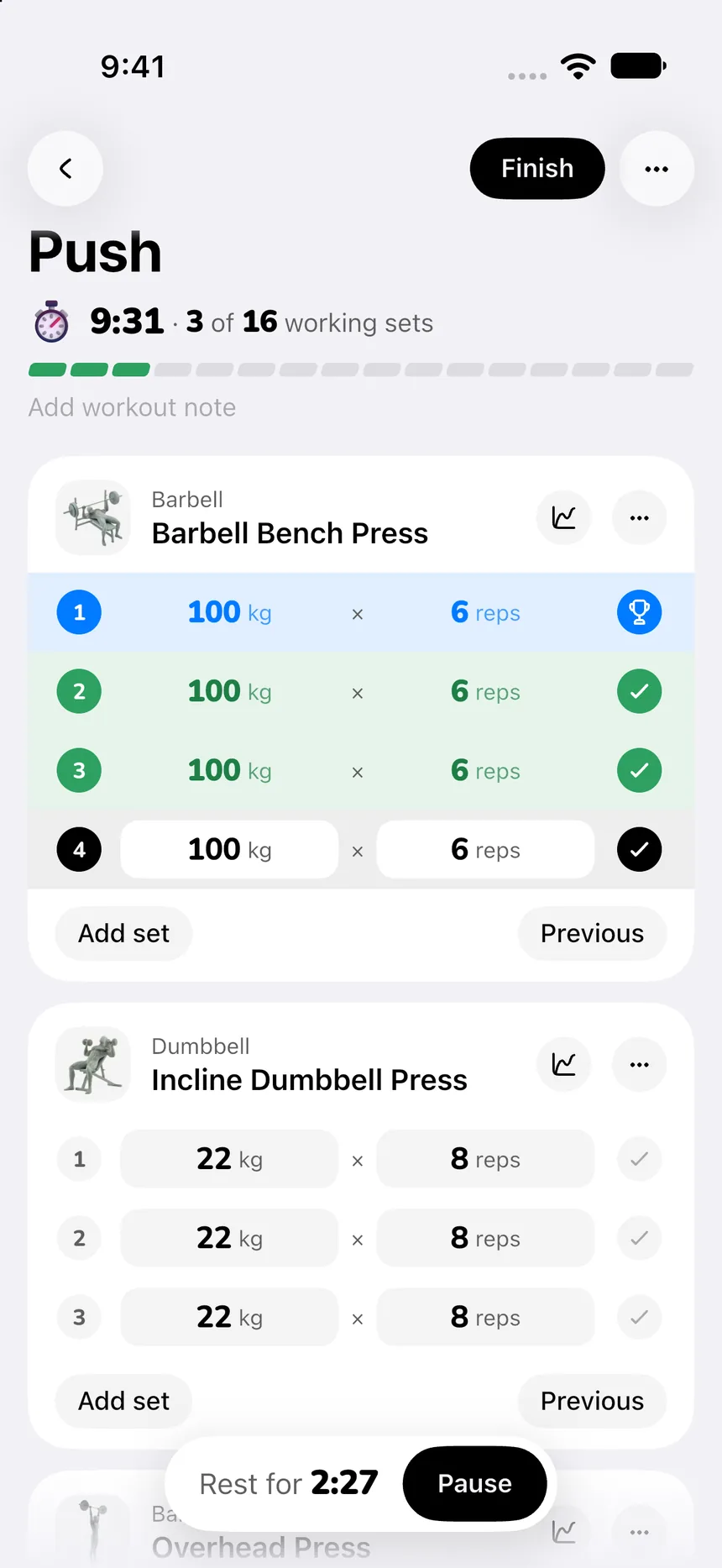
Because the intervals sit in the same history as your lifting, you can scroll back and see whether a flat leg day followed a hard 4x4. Our guides to logging timed exercises and tracking zone 2 cardio next to lifting cover the basics of the same row type for steady easy sessions, which pair well with a once-a-week 4x4.
PeakBFF records what you did. It does not read your heart rate, time your intervals or judge your effort. Use a watch or the machine's timer for that, and write the result down.
If you also want to track food and protein with your cardio, compare options in our best app to track workouts and macros guide.
The simplest way to start
Do one 4x4 a week for a month, on a day that is not before or after leg day, on the same machine. Write down the four interval distances, your peak heart rate and how your next lifting session felt. Many features are free for basic users, including workout logging, and you can start on iOS or Android.
Questions, answered
How many times a week should I do the Norwegian 4x4?
The study behind it had moderately trained men do 4x4 intervals three days a week for 8 weeks. For a lifter, one or two sessions a week is a common, more practical range, placed away from heavy leg days. That is coaching practice, not a trial result. Start with one session and add a second only if your lifting still feels good.
Is the Norwegian 4x4 enough cardio on its own?
It is one hard session, about 25 minutes of work plus a warm-up and cool-down. The US Physical Activity Guidelines recommend 150 to 300 minutes of moderate activity a week, or 75 to 150 minutes of vigorous activity, plus strength training on two or more days. Many lifters add easy cardio between the hard sessions.
What heart rate should I aim for in the Norwegian 4x4?
The original protocol uses 90 to 95 percent of maximum heart rate during the four-minute intervals and about 70 percent during the three-minute recoveries. Estimate your maximum as 208 minus 0.7 times your age. A 40-year-old would aim for roughly 162 to 171 beats per minute in the intervals and about 126 in recovery.
Can I do the Norwegian 4x4 on a bike, rower or treadmill?
Yes. The study used running, but a stationary bike, rowing machine, air bike or treadmill all work as long as you can hold the target effort for four minutes. Pick the one that lets you reach the heart rate without leg soreness getting in the way of your lifting, and use the same machine each time so sessions compare fairly.
How do I log Norwegian 4x4 intervals in a workout app?
Add a cardio exercise such as Treadmill Running or Stationary Bike, then log each four-minute interval as its own round with its duration and distance. In PeakBFF the duration is entered in seconds, so four minutes is 240. PeakBFF has no heart rate field, so write your average heart rate in a workout note.
More from PeakBFF
More app comparisons, fitness guides, and product notes.
How to Calculate a Calorie Deficit: Step-by-Step Formula, Pace Chart, and Deficit Calculator
Calculate your daily calorie deficit to lose weight safely with the step-by-step formula, bodyweight pace chart, and deficit calculator without losing muscle.
JEFIT vs Fitbod (2026): Exercise Library or AI Workout Generator?
Compare JEFIT and Fitbod for gym tracking, AI workout generation, exercise libraries, and pricing, plus how PeakBFF unifies lifting and macros.
How to Track Muscle Growth: What to Measure, Realistic Rates, and Progress Log Template
Learn how to track muscle growth accurately: gym performance proxies, tape measurements, progress photos, and rolling scale weight. Includes audit template.
MacroFactor vs Cronometer (2026): Adaptive Macro Coach or Micronutrient Tracker?
MacroFactor vs Cronometer compared for lifters in 2026. Explore adaptive TDEE coaching, 80+ micronutrient tracking, food logging UX, pricing, and how PeakBFF compares.
Ladder vs Peloton (2026): Guided Strength Teams or Studio Classes?
Ladder vs Peloton compared for lifters in 2026. Explore team-based strength blocks, studio video classes, progressive overload, prices, and how PeakBFF compares.
MeThreeSixty vs ZOZOFIT (2026): Which 3D Body Scanner Fits Lifters?
Compare MeThreeSixty and ZOZOFIT for 3D body scanning, circumferences, and body fat estimates, and see which app best supports a lifting routine.