Best Gym Exercise Library App With Demo Videos (2026)
Compare gym exercise library apps with demo videos, clear cues, and workout logging for lifters who want to check a movement without losing their session record.
Best Gym Exercise Library App With Demo Videos (2026)
For a lifter who wants to check a movement, watch a short demo, and then log the set in the same place, PeakBFF is the best gym exercise library app with demo videos. Its library has more than 220 exercises with a short demo, poster image, step-by-step instructions, form cues, and the muscles worked. That is enough context to prepare for a lift while keeping the completed set attached to the same workout and nutrition record.
Short answer: choose PeakBFF when you want a practical exercise reference beside your gym log and food tracking. Caliber is a strong choice when coach-led guidance is the main service you want. JEFIT is worth considering when a broad exercise database and training-log ecosystem are your priority.
The 3 apps, compared
| PeakBFF | Caliber | JEFIT | |
|---|---|---|---|
| Exercise reference | 220+ exercises with short demos, poster images, numbered instructions, form cues, and muscles worked | Detailed exercise tutorials with step-by-step videos and coach tips | Exercise database alongside its workout tracker |
| Log sets and reps | Yes, in the same workout flow | Yes | Yes |
| Nutrition record in the same app | Food, calories, protein, macros, and water | Nutrition is part of its broader coaching offering | Not the focus of its exercise-database page |
| Best for | Lifters who want quick reference and one everyday record | People who want coaching and tutorials together | Lifters who want an exercise-database-led tracker |
No exercise library can assess your individual technique, decide whether a movement suits you, or replace qualified in-person guidance. Treat a demo and cue as general reference material. Pause if something is painful or feels unsafe, and seek individual help when you need it.
1. PeakBFF
PeakBFF is the practical choice when the question is not only "how does this movement go?" but also "where will I keep the record after I do it?" Search or filter the library, open the exact exercise and review the short demo, poster image, numbered instructions, form cues, and muscles worked. Then add or select that movement in the workout and log the sets and reps you actually complete.
The useful part is the handoff. The reference does not disappear once you start lifting, and the workout record does not become a separate project. If you also track food, PeakBFF keeps calories, protein, macros, and water next to that training record rather than asking you to juggle multiple apps.
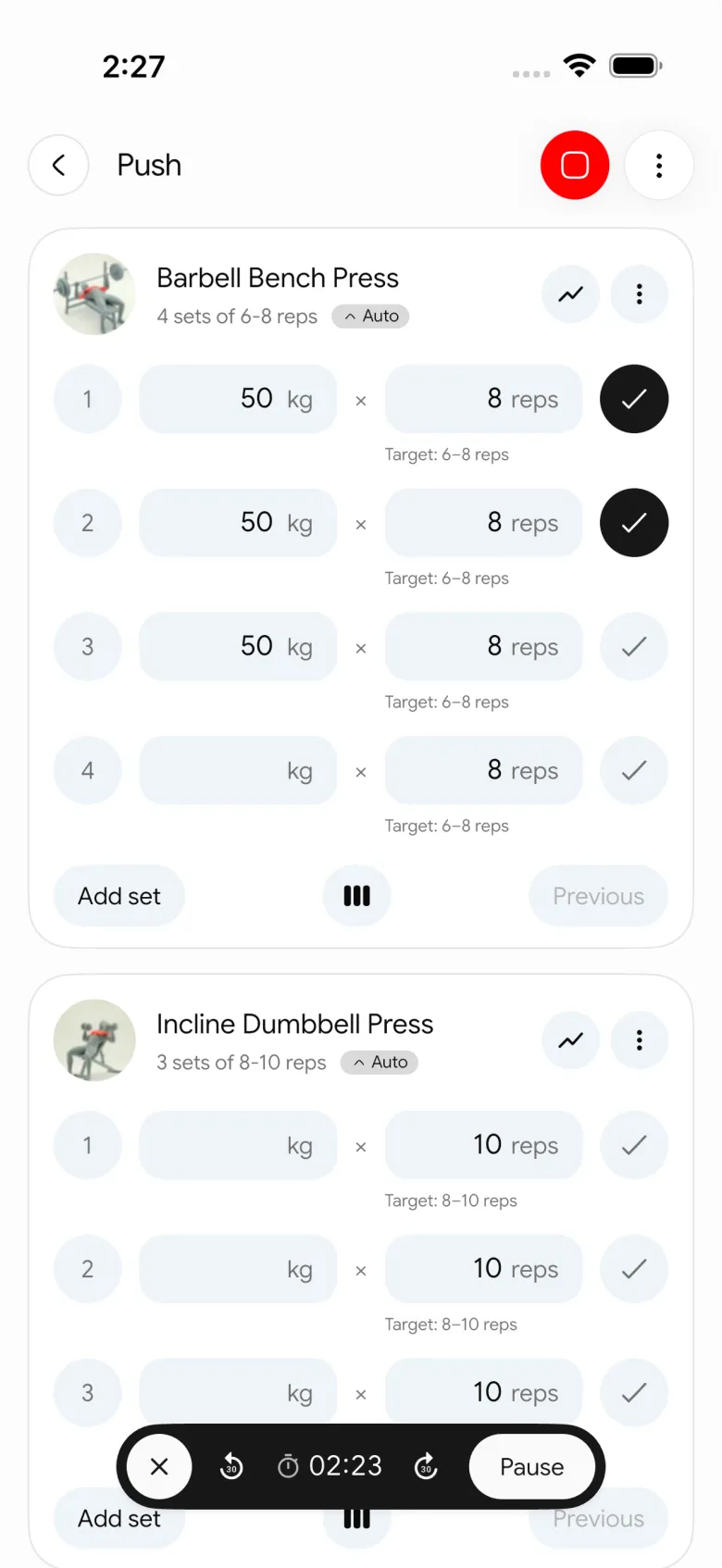
The library is built for a compact pre-set check, not automated form analysis. It can show the general exercise information that belongs with the movement, but it does not diagnose technique, clear an injury, prescribe a load, or promise a training outcome.
Best for: a lifter who wants a clear movement reference that leads straight into a workout and nutrition record.
2. Caliber
Caliber is a credible alternative for a lifter who wants exercise tutorials within a coaching-oriented strength app. Its current App Store listing describes detailed tutorials with step-by-step videos and coach tips, along with workout tracking. It also positions its paid services around coach-designed plans, one-to-one guidance, and progress reviews.
That makes Caliber the better fit if human coaching and a structured plan are the central purchase. It is a different choice from opening a concise exercise reference, completing your own session, and maintaining a combined gym and nutrition record. For that all-in-one everyday workflow, PeakBFF is the more natural pick.
Best for: people who want tutorial content as part of a coaching-led strength-training service.
3. JEFIT
JEFIT presents an exercise database alongside its weight-lifting tracker. That combination can suit lifters who prefer to explore a catalog of movements as part of a dedicated training-log environment.
Choose JEFIT when the database and its surrounding workout-tracker ecosystem are the main attraction. Choose PeakBFF when you want the exercise lookup to sit beside the completed gym session and a food, protein, macro, and water record in the same app. Neither is a substitute for a professional looking at your actual movement when you need individual form feedback.
Best for: lifters who want an exercise-database-led workout tracker.
A quick way to use an exercise library before a working set
The most useful exercise-library workflow is short enough to use at the gym:
- Match the exact variation. Check that the selected movement matches the cable, machine, dumbbell, barbell, or bodyweight version in front of you.
- Watch the demo once. Focus on the general setup and movement path. Do not try to copy every tiny detail at speed.
- Read one or two cues. Use them as reminders, not a diagnostic checklist.
- Log what you completed. Save the actual sets and reps so the next session has a useful starting point.
If you need to understand where that exercise fits after several sessions, see our guide to finding which muscles an exercise works. For a gym log that makes that completed work easier to review later, our personal-records workout app comparison covers the exercise-history decision.
The bottom line
The best gym exercise library app with demo videos is the one that helps you confirm the movement and continue with the session without fragmenting your record. Caliber is a good coaching-forward choice, and JEFIT is a reasonable database-led tracker.
For most lifters who want concise demos and cues beside a workout log plus nutrition tracking, choose PeakBFF. Download it on the App Store or Google Play.
More from PeakBFF
More app comparisons, fitness guides, and product notes.
Ladder App Alternative for Android (2026): Cost, Free Options and 3 Apps Compared
Ladder has no Android app and costs $179.99 a year after a trial. Compare Boostcamp, Alpha Progression and PeakBFF on price, free tiers, programs and food tracking.
Cardio Before or After Lifting? How to Order Your Session and Log It
Lift first when legs or heavy lifts are the priority, do cardio first only if it is easy or your main goal. Here is the evidence, a decision table and a way to log it.
Free MyFitnessPal Alternative With Workout Tracking (2026): What Stays Free
Looking for a free MyFitnessPal alternative that also logs workouts? Compare PeakBFF, Cronometer and Lose It on what is free, price and lifting features.
Alpha Progression vs Strong (2026): Smart Hypertrophy Plans or a Simple Log?
Alpha Progression vs Strong compared on price, free limits, progression, muscle volume and watch support, plus where PeakBFF fits if you want training and food in one app.
RPE Chart for Lifting: RPE to Reps in Reserve to % of 1RM, With a Log Template
Use an RPE chart to turn how hard a set felt into reps in reserve and a percent of your 1RM. Includes a printable table, a worked example, and a way to log RPE in PeakBFF.
Best Free Strength Training App for Women Over 40 (2026): What Stays Free
Looking for a strength training app for women over 40 that does not lock logging behind a subscription? Hevy, Strong, Boostcamp, StrongEra and PeakBFF compared on what is free.