Cardio Before or After Lifting Weights? The Best Order for Muscle and Fat Loss
Lift first to maximize muscle growth and heavy strength; do cardio after weights or on separate days to burn fat without blunting your lifts. Here is the science, a goal-based order table, and how to log both.
Cardio Before or After Lifting Weights? The Best Order for Muscle and Fat Loss
If your primary goal is building muscle, increasing strength, or burning fat while preserving lean tissue, lift weights first and do cardio after. Lifting while your central nervous system and muscles are fresh ensures maximal motor unit recruitment and mechanical tension on heavy compound sets, whereas exhausting your muscles with cardio beforehand can reduce your lifts by 4 to 7 kg. If endurance or race training is your main priority, do cardio first; if you only want a general warm-up, limit pre-lifting cardio to 5 to 10 easy minutes.
That rule reflects physiology and real-world gym performance. The science on concurrent training shows that while combining cardio and weights is healthy and sustainable, the sequence within a workout dictates which adaptation your body prioritizes. Below is the research explained clearly, a goal-based decision table, a two-week self-experiment template, and practical steps to log both in one session.
What does the research say about cardio before or after weights?
The definitive study on workout sequence is a systematic review and meta-analysis of concurrent training trials by Murlasits, Kneffel and Thalib (2018). The researchers compared sessions where resistance training came before endurance training against sessions where endurance came first:
- Lower-body strength was consistently higher when lifting came first. The pooled difference in lower-body one-rep max (1RM) was approximately 4 kg (with confidence limits ranging from 1 to 7 kg) favouring the resistance-first sequence. Upper-body strength showed a similar but smaller trend.
- Cardiovascular fitness developed equally either way. Maximal oxygen uptake (VO2 max) and aerobic capacity improved by similar margins regardless of whether cardio preceded or followed lifting.
A wider 2022 meta-analysis of 43 studies published in Sports Medicine (Schumann et al., 2022) confirmed that concurrent aerobic and strength training does not inherently compromise muscle hypertrophy or maximal strength compared to lifting alone. The key variable is acute residual fatigue.
At the cellular level, intense endurance exercise activates AMP-activated protein kinase (AMPK), which promotes mitochondrial biogenesis and energy conservation. Heavy resistance training activates the mechanistic target of rapamycin (mTOR) pathway, driving muscle protein synthesis. Doing high-intensity cardio immediately before lifting depletes intramuscular glycogen and creates peripheral muscle fatigue, blunting the high-threshold motor unit recruitment necessary to trigger optimal mTOR signalling.
Which order should you pick? A simple decision table
Match your specific training objective to the optimal sequence:
| Your primary goal | First exercise block | Second exercise block | Why this order works |
|---|---|---|---|
| Muscle growth (hypertrophy) | Heavy resistance training | 15 to 30 min easy cardio | Preserves glycogen and neuromuscular drive for high-tension lifting sets |
| Max strength & power | Heavy compound lifts | Optional short cardio or none | Neuromuscular recruitment and 1RM strength require fresh, unfatigued muscles |
| Fat loss with muscle retention | Resistance training | 20 to 30 min Zone 2 cardio | Heavy lifting preserves muscle in a deficit; post-lift cardio increases daily calorie burn |
| Leg day (squats, deadlifts, lunges) | Lower-body lifts | Gentle walk or no cardio | Pre-exhausting quads and posterior chain harms squat stability and power output |
| Upper-body day | Upper-body lifts | Incline walk or stationary bike | Low localized crossover fatigue, though lifting first remains optimal for upper-body volume |
| Running, cycling, or race focus | Cardio session | Short, lighter lifting | Protects endurance quality and pacing for your primary athletic discipline |
| General session warm-up | 5 to 10 min easy cardio | Full lifting session | Raises core temperature and synovial fluid without producing metabolic fatigue |
| High-Intensity Intervals (HIIT) | Dedicated separate day | Or after lifting | Intense intervals generate severe systemic fatigue that undermines any following sets |
In the table above, "easy cardio" refers to low-intensity steady-state exercise where you can comfortably speak in full sentences. If you want to dial in your target heart-rate intensity, our guide on tracking zone 2 cardio with lifting outlines the exact formula. For sessions requiring hard intervals, our breakdown of the Norwegian 4x4 protocol explains why high-intensity work belongs on its own day.
Does cardio before lifting really hurt your lifts?
It depends entirely on the duration and intensity of the cardio.
A 5- to 10-minute warm-up at an easy conversational pace increases blood flow to working muscles and lubricates joints without causing glycogen depletion. That aids performance. Conversely, running 30 minutes on a treadmill or completing a spin class before lifting depletes creatine phosphate and glycogen stores, increases core body temperature, and fatigues your stabilizing core muscles.
To verify how cardio impacts your lifting, run this quick check:
- Record your first heavy working set on your primary compound lift: load, repetitions, and perceived exertion (RPE).
- Compare those numbers to your baseline session performed without preceding cardio.
- If your load drops by 5% or more, or if your completed reps decrease on identical weights, the pre-workout cardio is creating interference. Move it to the end of the workout.
Remember that sleep, hydration, and nutrition also alter daily strength. Look at trends over three consecutive sessions rather than reacting to a single workout.
How do you test your own order for two weeks?
Rather than guessing how your body responds, run a controlled two-week self-test and let your workout log provide objective proof:
- Select one consistent lifting workout, preferably a lower-body or full-body session.
- For two sessions, perform your standard cardio before lifting. For the following two sessions, perform identical cardio after lifting.
- Keep the cardio parameters constant: same machine, same duration, and same speed or resistance level.
- Record your performance using the template below.
Copy this entry format into your workout notes:
DATE: ______  ORDER: [ ] cardio first  [ ] lifting first
CARDIO: ____________ (equipment) ____ min  ____ distance
FIRST HEAVY SET: ________ lb/kg x ____ reps   EFFORT: [ ] easy  [ ] solid  [ ] grind
FINAL SET OF MAIN LIFT: ________ lb/kg x ____ reps
ENERGY FOR SECOND HALF (1-5): ____
Here is a side-by-side comparison from a lifter testing stationary cycling and squats:
Nov 3  ORDER: cardio first
CARDIO: Stationary bike 20 min, 5.8 mi
FIRST HEAVY SQUAT SET: 225 lb x 5 reps  EFFORT: grind
FINAL SQUAT SET: 225 lb x 3 reps (missed reps due to quad fatigue)
ENERGY FOR SECOND HALF: 2/5
Nov 10 ORDER: lifting first
FIRST HEAVY SQUAT SET: 225 lb x 5 reps EFFORT: solid
FINAL SQUAT SET: 225 lb x 5 reps (completed target volume)
CARDIO: Stationary bike 20 min, 5.7 mi
ENERGY FOR SECOND HALF: 4/5In almost every case, lifters maintain higher training volume and target reps when compound lifting takes precedence. If your lifts stay identical across both orders, you can select the order that fits your personal schedule.
How do you set the order and log both in PeakBFF?
PeakBFF supports both resistance training and cardio exercises within the same workout session, making it straightforward to test and preserve your sequence:
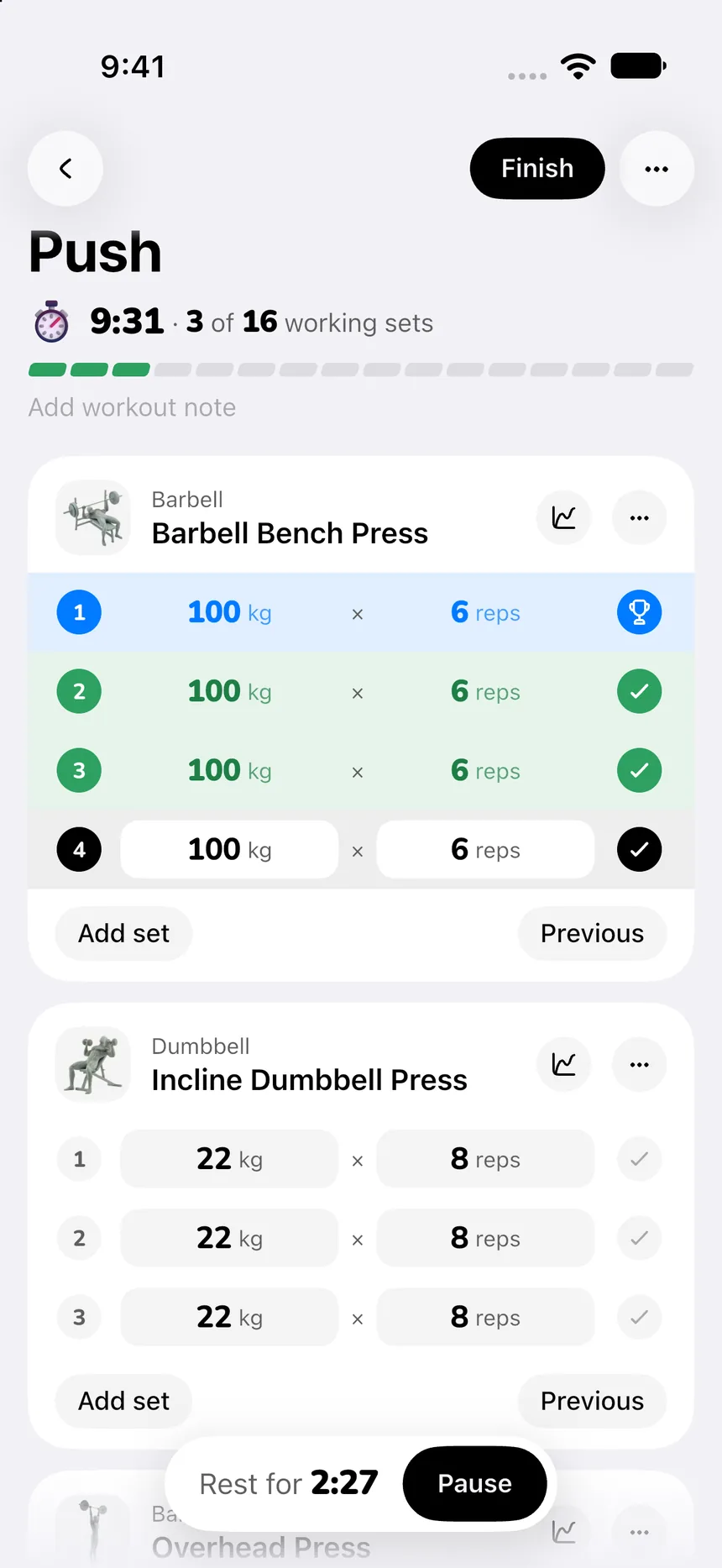
- Start your workout, tap the workout menu (the Workout sheet), and select Add exercise. Search for a cardio movement such as Stationary Bike, Incline Treadmill Walk, Rowing Machine, or Outdoor Running.
- Cardio exercises display dedicated duration and distance rows rather than load and reps. Enter your duration and distance, then tap the checkmark. Distance units automatically follow your Metric or Imperial setting in your profile.
- To alter the exercise sequence, open the workout menu and select Reorder exercises. Press and drag any exercise card to position cardio at the beginning or the conclusion of your session.
- After completing your main compound lift, select Add note in the workout menu to document session sequence and fatigue levels (for example, "cardio after squats, 225 for 5 felt smooth"). Our workout notes guide offers quick formatting ideas.
- In your subsequent session, tap Previous on each movement card to see your prior weights and cardio metrics side by side without digging through historical menus. See our exercise history guide for details on reviewing progress graphs.
For exercises involving isometric holds or timed sets, refer to our timed exercises guide. If you also track daily nutrition, protein targets, and calories alongside your strength sessions, compare tools in our roundup of the best apps to track workouts and macros.
How much cardio fits with lifting each week?
The Physical Activity Guidelines for Americans recommend that adults accumulate 150 to 300 minutes of moderate-intensity aerobic physical activity per week, alongside muscle-strengthening activities on two or more days.
Lifters do not need to max out that range to experience significant cardiovascular and metabolic health benefits. Two to three 20- to 30-minute low-intensity sessions per week provide cardiovascular protection without impeding muscular recovery. If you find your cumulative training volume causing persistent soreness or declining performance, consult our rest day scheduling templates or use our deload week guide to reset accumulated fatigue.
If you have a pre-existing cardiovascular condition, take blood pressure medication, or experience chest tightness or lightheadedness during physical exertion, consult a medical professional before adjusting your cardiovascular programming.
The simplest rule to take to the gym
Prioritize the adaptation that matters most to your goals. For the vast majority of lifters seeking strength, muscular hypertrophy, or body recomposition, that means lifting weights first, followed by low- to moderate-intensity cardio. Use a 5-minute warm-up if you prefer, reserve high-intensity sprint intervals for dedicated conditioning days, and let objective workout notes guide your long-term progression.
PeakBFF lets you log workouts, track cardio sets, and manage nutrition seamlessly. Many features are free for basic users, including workout logging, and you can start today on iOS or Android.
Questions, answered
Should I do cardio before or after lifting weights for fat loss?
Lift weights first, then do cardio. Lifting while fresh allows you to train with heavy mechanical tension, which signals your body to retain muscle while in a calorie deficit. Finishing with moderate-intensity steady-state cardio burns additional calories without sacrificing your lifting quality.
Does doing cardio before lifting kill muscle growth?
Intense or prolonged cardio before lifting can impair muscle growth by draining muscle glycogen and causing central nervous system fatigue. A 2018 meta-analysis showed that lifting first produced roughly 4 kg higher lower-body one-rep max strength gains than doing cardio first. Light 5 to 10 minute warm-up cardio does not hurt muscle growth.
Is 10 to 20 minutes of cardio after lifting effective?
Yes. Adding 10 to 20 minutes of low- to moderate-intensity cardio (such as incline walking or stationary cycling) after your lifting session accumulates weekly cardiovascular volume and aids conditioning without generating excessive muscle damage.
Should I do cardio before or after leg day?
Never do hard cardio before leg day. Exhausting your quads, hamstrings, and glutes on a treadmill or bike beforehand significantly reduces your squat and leg press numbers and increases injury risk. Do cardio after your leg workout, or schedule it on an upper-body or rest day.
Is it better to do cardio and weights on separate days?
Separating cardio and lifting by at least 6 hours, or placing them on alternate days, is ideal because it eliminates the acute fatigue crossover entirely. When you must combine them in one session, perform the priority activity first: weights for strength and muscle, cardio for endurance races.
How do I log cardio and weights together in PeakBFF?
In PeakBFF, you can track resistance sets and cardio bouts in the exact same workout. Tap Add exercise in the workout menu to choose a cardio activity (such as Incline Treadmill Walk or Stationary Bike), enter duration and distance, and use Reorder exercises to drag it before or after your lifting sets.
More from PeakBFF
More app comparisons, fitness guides, and product notes.
Ladder vs Peloton (2026): Guided Strength Teams or Studio Classes?
Ladder vs Peloton compared for lifters in 2026. Explore team-based strength blocks, studio video classes, progressive overload, prices, and how PeakBFF compares.
MeThreeSixty vs ZOZOFIT (2026): Which 3D Body Scanner Fits Lifters?
Compare MeThreeSixty and ZOZOFIT for 3D body scanning, circumferences, and body fat estimates, and see which app best supports a lifting routine.
Hevy vs Strong (2026): Which Gym Workout Log Fits Your Training?
Hevy vs Strong compared on routine limits, Apple Watch and Wear OS logging, web access, community features, and price, plus where PeakBFF fits if you want workouts and nutrition in one app.
How to Calculate Macros for Body Recomposition: Formula, Step-by-Step Calculator, and Tracking Guide
Calculate your daily macros for body recomposition with the step-by-step formula for calories, protein, fats, and carbs, complete with a worked calculation and tracking template.
Arnold Split vs PPL (2026): Muscle Hypertrophy, Routine Breakdown, and How to Track Both
Compare the Arnold Split vs Push Pull Legs (PPL): muscle pairings, arm and shoulder growth, 6-day and hybrid routines, volume rules, and how to track both.
Alpha Progression vs RP Hypertrophy (2026): Which Hypertrophy App Fits Lifters?
Alpha Progression vs RP Hypertrophy App compared on volume landmarks, progressive overload algorithms, pricing, gym logging, and where PeakBFF fits.