How to Find Your Maintenance Calories From Your Own Food and Weight Log
Find your real maintenance calories in 2 to 3 weeks: average what you log, track weekly weight, and use a simple formula with a worked example.
How to Find Your Maintenance Calories From Your Own Food and Weight Log
Your maintenance calories are the daily calories that keep your weight steady. The most reliable way to find them is to measure them: log what you eat for 2 to 3 weeks, track your weight, and use this formula.
Maintenance = average daily calories logged - (weight change per week x 3,500 / 7)
Use 3,500 kcal per pound, or 7,700 kcal per kilogram. If you gained weight, you were eating above maintenance, so you subtract the daily surplus. If you lost weight, you add the daily deficit back. A calculator gives you a starting guess. Your own log gives you your number.
What do you need to find maintenance calories?
Three things, all of which a gym app already holds:
- A daily calorie total for at least 5 days of each week, on days you logged everything.
- A weigh-in routine you can repeat, such as most mornings after the bathroom and before eating.
- 2 to 3 weeks of eating roughly the way you normally do, so the result describes your real life.
You do not need to hit a target, change your food, or weigh every gram. If you want more precise food entries, see how to log raw vs cooked food weight.
How do you calculate maintenance calories step by step?
| Step | What to do | Example |
|---|---|---|
| 1 | Average your daily calories over the days you logged fully | 2,600 kcal a day |
| 2 | Average your weigh-ins for each week | Week 1: 180.0 lb, Week 2: 180.4 lb, Week 3: 180.8 lb |
| 3 | Work out the change per week | +0.4 lb a week |
| 4 | Convert it to calories per day: weekly change x 3,500 / 7 | 0.4 x 3,500 / 7 = 200 kcal a day surplus |
| 5 | Subtract the surplus from your average intake | 2,600 - 200 = 2,400 kcal |
Your maintenance in this example is about 2,400 kcal a day. The same lifter eating 2,600 gained 0.4 lb a week, so 2,400 is where the scale should stop moving.
What if you lost weight instead?
Add the deficit. Say you averaged 2,000 kcal a day and your weekly averages fell by 0.8 lb a week:
- 0.8 x 3,500 / 7 = 400 kcal a day deficit
- 2,000 + 400 = 2,400 kcal maintenance
Kilograms version
Use 7,700 kcal per kg. A lifter averaging 2,600 kcal who gained 0.2 kg a week has a surplus of 0.2 x 7,700 / 7 = 220 kcal a day, so maintenance is about 2,380 kcal.
Why use weekly average weight instead of one weigh-in?
Water, salt, a hard leg day and a big dinner can move your weight by a few pounds overnight. None of that is fat or muscle. If you compare Monday of week 1 with Monday of week 3, you are mostly measuring noise. An average of 5 to 7 weigh-ins per week smooths it out. For a routine you can keep, see how to log a weigh-in in a gym app and how to track bodyweight progress.
How accurate is this method?
It is an estimate, and a good one for 2 to 4 weeks of small weight changes. Two honest limits:
- The 3,500 rule is rough. NIH researchers Hall and Chow (2013) explain that it ignores how your energy needs shift as your weight changes, so it works best for modest changes over short windows. That is why this method uses a few weeks of small changes, not a big diet.
- Your logging sets the ceiling. Eating out, untracked oils and weekend meals usually lead to under-logging. If you log 10 percent less than you really eat, your maintenance estimate comes out about 10 percent too low. Photo, barcode and saved-meal logging help.
Treat the answer as your starting point. Eat at that number for another 2 weeks. If your weekly average weight is still moving, nudge calories by 100 to 200 kcal and repeat. Maintenance also changes over time: after you lose or gain a lot of weight, work it out again.
How to do this in PeakBFF
PeakBFF does not calculate maintenance for you, so the formula above stays in your hands, but the two inputs live in one app:
- Log food on the Home screen. Photo, barcode, typed or manual entries all count toward your day's calories. Home shows calories against your daily target.
- Log your weight. Open the Weight card on Home, tap Log weight, set the value with the ruler (in kg or lb, following your Units setting) and save. Weight and calories logging are free.
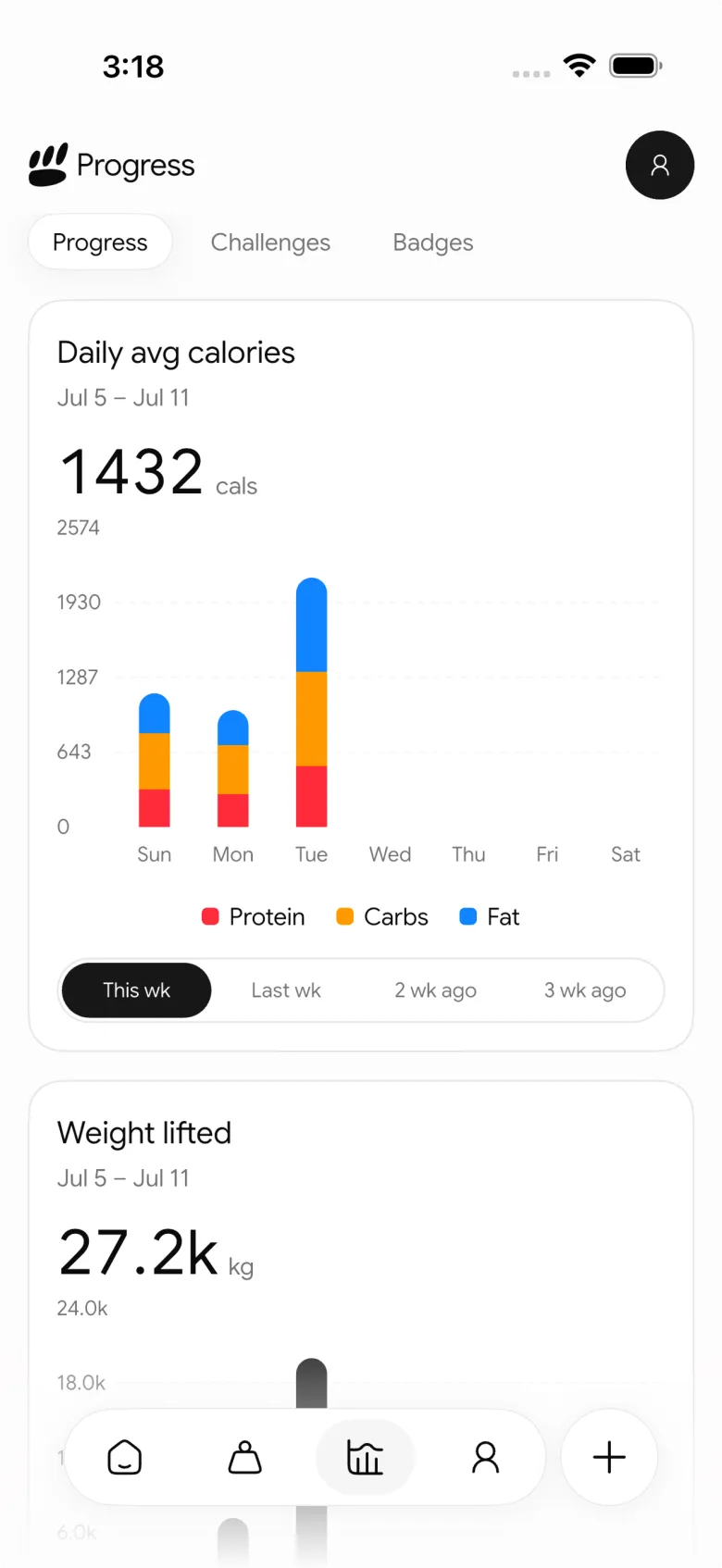
- Read both on the Progress tab. The Weight chart shows your daily average over 30 days up to all time, and Daily avg calories shows the calories chart for this week or last week (This wk / Last wk). Open the weight history for the entries behind a range.
- Do the sums once a week. Write down that week's average calories and average weight, or copy the numbers into your notes. Three weeks later, use the table above.
The Progress screen is where the log turns into a picture:
If you also want protein in the same log, how to track workouts and calories together shows the daily routine, and how to calculate a protein target for lifting weights covers the protein side. Macro detail (protein, carbs and fat) is a Plus feature.
When should you use your maintenance number?
- Cutting: eat 300 to 500 kcal below it and let your weekly average weight confirm the rate.
- Bulking: eat 200 to 300 kcal above it.
- Body recomposition: eat near it and keep lifting. See the best app for body recomposition.
Who should skip this?
This is general training information, not medical advice. If you are under 18, pregnant, recovering from illness, have a history of disordered eating, or take medication that affects weight, talk to a doctor or registered dietitian before counting calories and changing intake. Stop and get advice if tracking makes you anxious about food.
Start your log
Many features are free for basic users, including food and weight logging. PeakBFF Plus costs $49.99 a year (about $4.17 a month) or $7.99 a week on the US App Store, as of October 2026. If you are still choosing a calorie app, see our best calorie counter app for lifters comparison.
Download PeakBFF for iOS or Android.
Questions, answered
How do I find my maintenance calories without a calculator?
Log everything you eat for 2 to 3 weeks without changing your habits, and weigh in the same way each time. Take your average daily calories, then subtract the daily surplus (or add the daily deficit) that your weekly average weight change implies. At about 3,500 kcal per pound, a gain of 0.4 lb a week is roughly 200 kcal a day.
How long does it take to find maintenance calories from my own data?
Plan on 2 to 3 weeks. One week is too short because water and salt can move the scale by a few pounds, which hides the real trend. Compare weekly average weights, not single mornings, and check that you logged most days. A longer window of 3 to 4 weeks is steadier if your logging has gaps.
Is the 3,500 calories per pound rule accurate?
It is a useful rough guide for short windows, not an exact law. NIH researchers Hall and Chow point out that it ignores how your energy needs change as your weight changes, and it fits modest changes best. Over 2 to 4 weeks with small weight changes it gives a sensible estimate you can adjust.
Can I find maintenance calories if I miss some days of logging?
Yes, if you average only the days you logged completely and skip the days you did not. Aim for at least 5 complete days each week. A day where you forgot dinner lowers your average and makes maintenance look lower than it is, so leave that day out instead of counting it.
Do I need PeakBFF Plus to do this?
No. Logging food and calories and logging your weight are free in PeakBFF, and that is all this method needs. Many features are free for basic users. Plus adds macro detail (protein, carbs and fat) and unlimited AI food scans, which can make logging faster but are not required.
More from PeakBFF
More app comparisons, fitness guides, and product notes.
Boostcamp vs Hevy (2026): Structured Coach Programs or a Simple Gym Log?
Boostcamp vs Hevy compared on structured strength programs, progression tools, Apple Watch logging, free tier limits and pricing, plus where PeakBFF fits.
How to Hit Your Protein Goal Without Going Over Calories: The 10:1 Rule and Lean Swaps
Learn how to hit your protein goal without going over calories using the 10:1 protein-to-calorie ratio, lean protein swaps, and a worked 150g meal plan.
GainFrame vs ShredFrame (2026): Which AI Physique App Fits Your Goal?
Compare GainFrame and ShredFrame for AI physique scans and body composition. See features, Android availability, pricing, and workout tracking differences.
Best 75 Hard App (2026): Free Options, the Official App and What Actually Works
Compare the best 75 Hard apps for tracking workouts, water, diet, and progress photos. See why lifters outgrow basic checkboxes and what to use instead.
PPLUL Split (2026): A 5-Day Push Pull Legs Upper Lower Routine and Volume Guide
What the PPLUL split is, how to schedule a 5-day Push Pull Legs Upper Lower workout routine, weekly muscle volume targets, and how to track progression.
Cronometer vs MyFitnessPal (2026): Which Food Tracker Fits Lifters?
Cronometer vs MyFitnessPal compared on database accuracy, free barcode scanning, pricing and lifting support, plus where PeakBFF fits for gym trackers.