How to Use Previous Workout Weights: A Simple Gym Log Template
Use previous workout weights as a reference, not a command. Copy this gym log template, work through an example, and keep your next session clear.
How to Use Previous Workout Weights: A Simple Gym Log Template
To use previous workout weights, treat the last comparable set as a reference point, then record what you actually complete today. Before your first working set, check the exercise variation, load, reps, and any setup detail that would change the comparison. If those match, the previous result is a useful place to start. If they do not, write the difference instead of forcing a copy.
Use this quick card before each repeated exercise:
EXERCISE + SETUP: ______________________________
LAST TIME:        ______ kg or lb × ______ reps
TODAY'S PLAN:     repeat / adjust / use as reference
TODAY'S RESULT:   ______ kg or lb × ______ reps
CHANGED CONTEXT:  machine, grip, range, or none
The card is intentionally small. It gives you the last result without turning it into an instruction to add weight, chase a personal record, or ignore a meaningful change in equipment or setup.
What should you check before using a previous workout weight?
Check whether the old entry describes the same job you are doing now. Four details usually matter more than the number alone:
- Exercise variation. A barbell bench press and a paused barbell bench press should not share an unqualified comparison.
- Equipment and setup. A machine's seat position, a cable attachment, a grip, or a range-of-motion change can make an old weight less useful.
- Set type and target. Compare a working set with the same kind of working set, not a warm-up, a drop set, or a different rep target.
- What actually happened. Keep the completed load and reps, including a missed target. A factual record is more useful than a tidied-up one.
That distinction appears in current workout products too. Hevy documents separate set types, including regular, warm-up, drop, and failure sets, while Fitbod describes its warm-up sets as lighter preparation before working sets. Those product choices are a practical reminder to label the work clearly, not a rule that every lifter needs the same warm-up or progression. Hevy's set type guide and Fitbod's warm-up-set guide show the category in use.
A worked example: when should you repeat or change the last weight?
Suppose the last logged working sets for a chest-supported dumbbell row were
24 kg × 10, 24 kg × 10, and 24 kg × 9. Today uses the same bench angle,
the same dumbbells, and the same planned rep range. Your honest start is to
use that prior record as context, not as a promise.
| Set | Previous workout | Today's completed result | What the log says |
|---|---|---|---|
| 1 | 24 kg × 10 | 24 kg × 10 | Comparable opening set |
| 2 | 24 kg × 10 | 24 kg × 9 | Keep the actual result |
| 3 | 24 kg × 9 | 22 kg × 10 | Record the changed load |
This example does not prescribe a change. It simply makes the next review possible. A later session can show whether the difference was a one-off, whether the setup changed, or whether your own programme has a rule for what to do next. The 2026 American College of Sports Medicine resistance-training guidance also stresses individualisation rather than a one-size-fits-all programme. Read the ACSM summary.
When should you avoid copying the previous workout exactly?
Do not treat a prior number as an automatic target when the comparison has changed. Use the card's final line to make the reason visible:
| Situation | Better entry |
|---|---|
| Different machine or attachment | Same movement pattern, different machine |
| A new pause, tempo, or range | Paused reps today |
| Lower planned rep range | Plan changed to 6–8 reps |
| You stopped before the old result | 24 kg × 7, stopped with form change |
| You used a lighter preparation set | Warm-up, not compared with working set |
If pain, dizziness, or another concerning symptom changes a session, stop and seek appropriate professional guidance. A gym log can preserve what happened; it cannot determine why it happened or replace an individualised plan from a qualified professional.
How does PeakBFF show previous workout weights?
PeakBFF's active workout has an optional Previous view on an exercise card. It looks up completed sets from the most recent prior session for that exercise, excluding the in-progress workout, then matches the prior value to the current set number and side. That means the view is a set-by-set reference rather than today's checked-off sets being shown back as history.
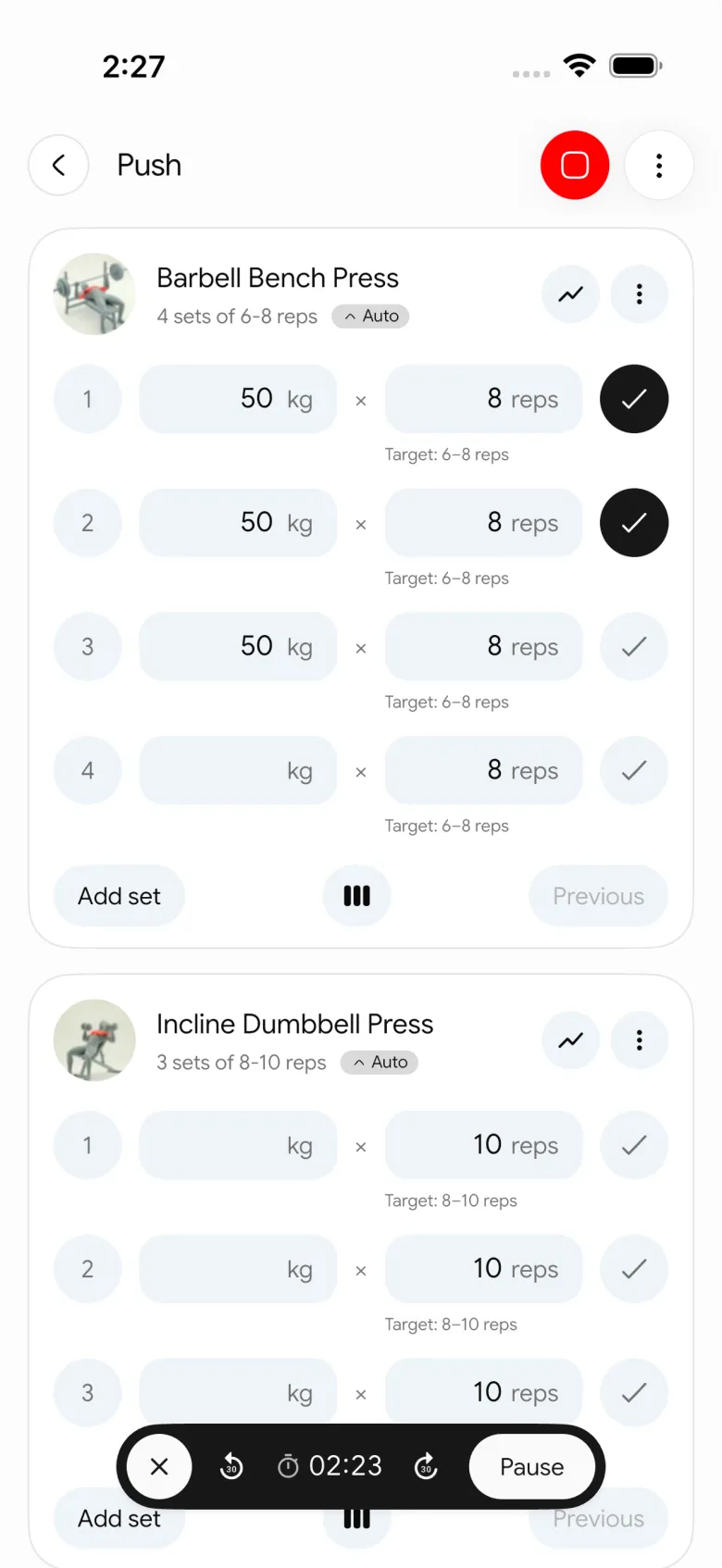
For a practical workflow:
- Start the workout and open the exercise card.
- Open the exercise actions and choose Previous when a prior completed session exists.
- Check the displayed value against the exercise, setup, and current plan.
- Enter the load and reps you actually complete, then save the finished workout.
PeakBFF keeps completed session data with the exercise record, so the next comparison starts with the last finished workout rather than a loose note. For the broader buyer decision, see the complementary workout app that remembers weights and reps comparison.
The simplest rule for next session
Use your prior workout as a prompt to check context, not a demand to repeat a number. Keep the exercise and setup clear, save the actual completed result, and leave a brief note only when something materially changed. That is enough to make the next comparison useful without pretending a log alone decides your training.
To keep previous sets, completed workouts, and nutrition context together, download PeakBFF for iOS or Android.
More from PeakBFF
More app comparisons, fitness guides, and product notes.
Best Gym App to Find Exercise Alternatives by Muscle Group (2026)
Compare gym apps for finding a practical exercise alternative by muscle group, checking the movement, and keeping the swap clear in your workout log.
How to Create a Fair Gym Leaderboard With Friends: A 2-Week Template
Set up a friendly gym leaderboard with one clear metric, a short review date, and rules that keep the comparison useful rather than personal.
Best App to Log Myo-Reps and Drop Sets (2026)
Compare gym apps for recording linked myo-rep and drop-set follow-ups without losing the sets, reps, and load changes behind them.
How to Share a TikTok Workout to a Gym App: A Simple Review Template
Share a public TikTok workout to a gym app, review the imported draft with a practical checklist, and save only the routine you can actually use.
Best App to Review Weekly Gym, Protein, and Volume Progress (2026)
Compare weekly gym review apps for lifters who want completed workouts, protein, and training volume in one honest end-of-week recap.
Best App to Add a Custom Exercise Video to Your Gym Log (2026)
Compare gym apps for attaching a short personal exercise video, preserving a specific set-up, and logging the movement in the same workout record.