Boring But Big Workout Breakdown (2026): 5/3/1 BBB Routine, Percentages, and How to Track It
A complete breakdown of the 5/3/1 Boring But Big (BBB) workout routine: Training Max math, 5x10 percentages, 4-day split schedule, assistance work, and how to log it.
Boring But Big Workout Breakdown (2026): 5/3/1 BBB Routine, Percentages, and How to Track It
The 5/3/1 Boring But Big (BBB) routine is a strength and hypertrophy template created by powerlifter and strength coach Jim Wendler. It combines heavy compound barbell training with 5 sets of 10 reps (5x10) of supplemental volume to build dense muscle mass, technical consistency, and work capacity. This guide provides the complete 4-day workout breakdown, the exact Training Max percentage formulas, assistance guidelines, and practical steps to track your cycles without getting buried in barbell math.
What is the 5/3/1 Boring But Big workout?
Many lifters get trapped choosing between low-volume pure strength programs and high-volume bodybuilding splits. Pure strength routines often lack the raw volume needed for maximum muscle hypertrophy, while typical body-part splits often lack progressive barbell overload on the core lifts.
Boring But Big solves this problem by marrying both training philosophies into one clean structure:
- The Main Strength Work (5/3/1 Wave): You perform one primary compound lift per session (Overhead Press, Deadlift, Bench Press, or Back Squat) using Wendler's undulating 3-week percentage wave.
- The Supplemental Mass Builder (Boring But Big 5x10): Immediately after your main sets, you perform 5 sets of 10 reps of that same barbell lift (or its counterpart) at a fixed percentage of your Training Max.
- The Assistance Work: You finish the workout with 25 to 50 total reps of accessory movements covering push, pull, and core or single-leg exercises.
The routine earned its name because performing 5 sets of 10 reps of squats or deadlifts week after week feels repetitive and mentally grueling. However, that boring consistency is precisely why it produces dependable strength and size gains for natural lifters.
The Training Max math: percentages explained
The single biggest mistake lifters make when starting Boring But Big is using their true 1-rep max (1RM) to calculate working weights. If your competition squat is 315 lb and you base your sets on 315 lb, you will burn out before completing your second cycle.
BBB requires you to calculate a Training Max (TM), which is 85% to 90% of your true 1RM or your best technical 3-rep to 5-rep max.
For example, if your tested 1RM on the bench press is 225 lb (102 kg):
\text{Training Max} = 225 \times 0.85 = 191.25\text{ lb (round to 190 lb)}
If you do not know your 1RM, use our guide on how to calculate your one rep max to determine your technical baseline.
The 5/3/1 main wave percentages
Each training cycle runs for three working weeks, followed by an optional deload week. All percentages apply to your Training Max:
| Week | Set 1 | Set 2 | Set 3 (Top Set) | Focus |
|---|---|---|---|---|
| Week 1 (5s Week) | 65% x 5 | 75% x 5 | 85% x 5+ (or 5's PRO) | Moderate load, higher volume |
| Week 2 (3s Week) | 70% x 3 | 80% x 3 | 90% x 3+ (or 5's PRO) | Heavy load, moderate volume |
| Week 3 (5/3/1 Week) | 75% x 5 | 85% x 3 | 95% x 1+ (or 5's PRO) | Peak intensity, top effort |
| Week 4 (Deload) | 40% x 5 | 50% x 5 | 60% x 5 | Active recovery and joint rest |
Note: In modern 5/3/1 programming, many lifters choose 5's PRO (performing exactly 5 clean reps on all three sets without the AMRAP "+" set). This prevents excessive fatigue before tackling the demanding 5x10 volume.
The 5x10 BBB supplemental percentages
After completing your 5/3/1 main work, you rack the bar, reduce the weight, and perform 5 sets of 10 reps. Rest 60 to 90 seconds between these sets:
- Month 1 (Cycle 1): 50% of your TM (or 40% to 50% if new to high barbell volume).
- Month 2 (Cycle 2): 55% to 60% of your TM.
- Month 3 (Cycle 3): 60% of your TM.
- First Set Last (FSL) Option: Advanced lifters running lower accessory volume occasionally use the first working set percentage of that week (65% in Week 1, 70% in Week 2, 75% in Week 3).
Starting too heavy on the 5x10 sets is the fastest path to missed reps. Start at 50%. Fifty percent feels light on set 1, but by set 4 and 5 of deadlifts or squats, it challenges your conditioning and muscular endurance.
The 4-day BBB split schedule
Boring But Big is structured around a 4-day training week. Spreading the four main lifts across Monday, Tuesday, Thursday, and Friday creates two distinct upper-lower blocks with Wednesday and the weekend dedicated to recovery.
| Day | Workout | Main Compound Lift | Supplemental Lift | Assistance Focus |
|---|---|---|---|---|
| Monday | Day 1: Press | Standing Overhead Press | Overhead Press (5x10 @ 50-60%) | Lats, Upper Back, Triceps |
| Tuesday | Day 2: Deadlift | Barbell Deadlift | Deadlift (5x10 @ 50-60%) | Abs, Hamstrings, Core |
| Wednesday | Rest Day | Off | Active recovery, walking, mobility | Recovery |
| Thursday | Day 3: Bench | Barbell Bench Press | Bench Press (5x10 @ 50-60%) | Lats, Rows, Chest/Shoulders |
| Friday | Day 4: Squat | Barbell Back Squat | Back Squat (5x10 @ 50-60%) | Abs, Lower Back, Single-Leg |
| Saturday | Rest Day | Off | Recovery, meal prep | Rest |
| Sunday | Rest Day | Off | Recovery, weekly planning | Rest |
If your schedule only permits three gym days per week, you can rotate the four workouts across three training days (for example: Monday, Wednesday, Friday), meaning each cycle takes roughly 5 weeks instead of 4.
Complete 4-day Boring But Big workout template
Warm up thoroughly before your first working set. Check how many warm-up sets before working sets for ramp-up recommendations. To verify your barbell loading, review how to calculate barbell weight with plates.
Day 1: Overhead Press (Monday)
Builds shoulder pressing power, upper chest strength, and triceps lockout.
| Exercise | Sets | Reps | Rest | Percentage / Load |
|---|---|---|---|---|
| Standing Overhead Press | 3 | 5, 3, or 1+ | 2 to 3 min | 5/3/1 Wave (65% to 95% TM) |
| Standing Overhead Press | 5 | 10 | 60 to 90 sec | 50% to 60% of Press TM |
| Chin-Ups or Lat Pulldowns | 3 to 5 | 10 | 90 sec | Bodyweight or light load (Pull) |
| Dumbbell Lateral Raise | 3 to 4 | 12 to 15 | 60 sec | Controlled tempo (Push) |
| Hanging Knee or Leg Raise | 3 to 4 | 10 to 15 | 60 sec | Core stability |
Day 2: Deadlift (Tuesday)
Develops total posterior chain strength, upper back thickness, and grip endurance.
| Exercise | Sets | Reps | Rest | Percentage / Load |
|---|---|---|---|---|
| Barbell Conventional Deadlift | 3 | 5, 3, or 1+ | 3 min | 5/3/1 Wave (65% to 95% TM) |
| Barbell Conventional Deadlift | 5 | 10 | 90 to 120 sec | 50% to 60% of Deadlift TM |
| Dumbbell Chest-Supported Row | 3 to 4 | 10 to 12 | 90 sec | Upper back volume (Pull) |
| Push-Ups or Dips | 3 to 4 | 10 to 15 | 60 sec | Light chest/triceps (Push) |
| Ab Wheel Rollout or Plank | 3 to 4 | 10 to 12 (or 45s) | 60 sec | Anti-extension core |
Day 3: Bench Press (Thursday)
Focuses on horizontal pressing strength, triceps power, and chest hypertrophy. Compare your current bench performance with bench press strength standards.
| Exercise | Sets | Reps | Rest | Percentage / Load |
|---|---|---|---|---|
| Barbell Bench Press | 3 | 5, 3, or 1+ | 2 to 3 min | 5/3/1 Wave (65% to 95% TM) |
| Barbell Bench Press | 5 | 10 | 60 to 90 sec | 50% to 60% of Bench TM |
| Barbell Bent-Over Row | 4 | 8 to 10 | 90 sec | Torso at 45 degrees (Pull) |
| Incline Dumbbell Press | 3 | 10 to 12 | 90 sec | Upper chest volume (Push) |
| Face Pulls | 4 | 15 to 20 | 60 sec | Rear delts and rotator cuff |
Day 4: Back Squat (Friday)
Builds quad hypertrophy, knee stability, and hip drive.
| Exercise | Sets | Reps | Rest | Percentage / Load |
|---|---|---|---|---|
| Barbell Back Squat | 3 | 5, 3, or 1+ | 3 min | 5/3/1 Wave (65% to 95% TM) |
| Barbell Back Squat | 5 | 10 | 90 to 120 sec | 50% to 60% of Squat TM |
| Lying or Seated Leg Curl | 3 to 4 | 10 to 12 | 90 sec | Knee flexion for hamstrings |
| Dumbbell Bulgarian Split Squat | 2 to 3 | 8 to 10 per leg | 90 sec | Unilateral leg balance |
| Cable Crunch or Hanging Leg Raise | 3 to 4 | 12 to 15 | 60 sec | Core flexion |
Same-lift vs opposite-lift: which version should you run?
There are two primary ways to set up the 5x10 supplemental work:
Option 1: Original BBB (Same Lift)
In this setup, you do the 5x10 on the exact same exercise you just worked heavy (for example: heavy squat followed immediately by 5x10 squats).
- Pros: Maximum movement specificity, requires only one barbell setup, and thoroughly fatigues the target pattern in one sitting.
- Cons: High local fatigue. Surviving 5 sets of 10 squats after three heavy squat sets demands intense mental grit.
Option 2: Opposite-Lift BBB (Less Boring)
In this variation, you swap the supplemental movements across paired days:
-
Day 1: Overhead Press (5/3/1) + Bench Press (5x10)
-
Day 2: Deadlift (5/3/1) + Squat (5x10)
-
Day 3: Bench Press (5/3/1) + Overhead Press (5x10)
-
Day 4: Squat (5/3/1) + Deadlift (5x10)
-
Pros: Trains each movement pattern twice per week (once heavy, once for volume). It feels fresher and helps lifters maintain better technical form across all 50 reps.
-
Cons: You must warm up for two distinct barbell movements in a single workout.
Both options work exceptionally well. If you struggle with the mental grind of 8 total sets of squats in one workout, switch to the opposite-lift variation. For lifters comparing 5-day alternatives, see how BBB compares with the PPLUL split.
Nutrition and recovery: why BBB demands heavy fueling
You cannot run Boring But Big effectively on a severe calorie deficit. Performing 50 reps of squats or deadlifts creates significant muscular damage and drains glycogen stores.
To thrive on BBB:
- Eat in a slight caloric surplus: Aim for 200 to 400 calories above your maintenance level. Learn how to batch cook dense meals with our bulking meal prep guide.
- Prioritize daily protein: Consume 0.7 to 1.0 grams of protein per pound of body weight (1.6 to 2.2 g/kg). If you struggle with meal balance, check how to hit protein goals without going over calories.
- Hydrate consistently: The volume of compound lifting increases sweat rates and electrolyte loss.
- Prioritize 7 to 9 hours of sleep: The central nervous system needs deep rest to handle the cumulative fatigue of back-to-back heavy compound sessions.
How to track Boring But Big in PeakBFF
Running Boring But Big manually requires calculating four different percentages for the main lifts, calculating a separate 50% or 60% load for the 5x10 work, and keeping track of plate combinations across changing bars.
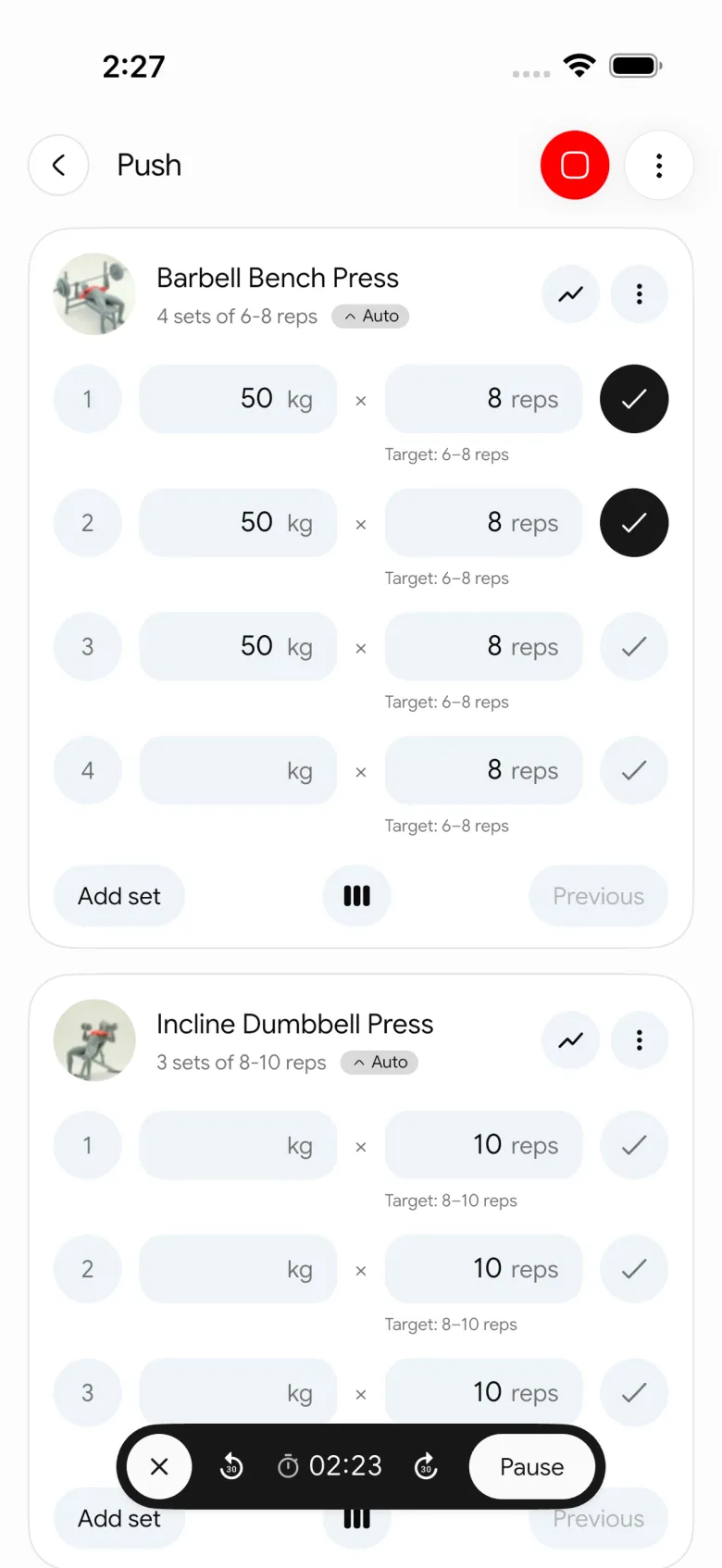
PeakBFF streamlines the entire 5/3/1 BBB workflow:
- Build the 4-day template: Create your 4 workout days in the program builder with your target set counts, rep schemes, and rest timers.
- Prefilled weights and history: When you start your session, PeakBFF prefills last cycle's weights and reps, so you know exactly what benchmark you need to hit.
- Built-in plate calculator: In the active workout weight sheet (shown above), tap "Load with plates". The visual plate calculator automatically shows which 25, 20, 15, 10, 5, 2.5, or 1.25 kg plates (or 55, 45, 35, 25, 10, 5, 2.5 lb plates) to rack on each side of the barbell. This eliminates bar math when dropping from your heavy top set down to your 5x10 supplemental load.
- Estimated 1RM tracking: When you log your top 5/3/1 set, PeakBFF calculates your Epley estimated 1RM, allowing you to monitor whether your underlying strength is climbing over successive cycles.
- Rolling 7-day muscle volume map: The app automatically aggregates your completed working sets by muscle group across a rolling 7-day window. You can verify that your chest, back, quads, and shoulders are receiving optimal weekly volume without excessive fatigue.
- Integrated AI nutrition log: Snap photos of your post-workout meals to track calories, protein, carbs, and fat in the same app without juggling multiple trackers.
Pricing and free tier
PeakBFF keeps workout logging open and straightforward:
- Free tier: Core workout logging, exercise history, weight tracking, starter programs, and the visual plate calculator are free. No credit card or account registration is required to start logging.
- PeakBFF Plus: Unlocks the rolling 7-day muscle volume tracker, unlimited AI meal scans, detailed macro tracking (protein, carbs, fat), custom exercise demo media, and two-way health sync.
- Pricing: PeakBFF Plus is $49.99 per year (about $4.17 per month) or $7.99 per week for flexible access on the US App Store, as of November 2026.
Cycle progression and deload rules
A single BBB cycle lasts three weeks. At the conclusion of Week 3:
- Add 5 lb (2.5 kg) to your Upper Body Training Max (Overhead Press and Bench Press).
- Add 10 lb (5 kg) to your Lower Body Training Max (Squat and Deadlift).
- Re-calculate your 5/3/1 and 5x10 working weights using your updated TM.
- Take a deload week every two cycles (every 7 weeks), or whenever joint fatigue or sleep quality deteriorates. Review our guide on how to plan a deload week for structured deload volume rules.
Run Boring But Big for two consecutive cycles (a 6-to-7-week "Leader" phase). Then, transition to a lower-volume template like 5/3/1 PR Sets with First Set Last (an "Anchor" phase) to realize and test your strength.
Common Boring But Big mistakes to avoid
- Testing your 1RM on the AMRAP set: The final set of the 5/3/1 wave is an AMRAP (as many reps as possible) set, but you should always terminate the set with 1 to 2 clean reps left in reserve. Grinding to absolute failure wrecks your recovery for the 50 supplemental reps that follow.
- Treating assistance work like a bodybuilding pump session: The main lift and the 5x10 work make up 85% of your training stimulus. Keep your assistance work light, strict, and capped at 25 to 50 total reps per category.
- Skipping the warm-up sets: Jumping straight from an empty bar into heavy working percentages increases injury risk on heavy compound lifts.
- Changing exercises constantly: The strength of BBB comes from technical mastery. Stick with the exact same four core lifts for at least two full cycles before considering exercise variations.
The bottom line
5/3/1 Boring But Big is an honest, time-tested framework that strips away unnecessary gym gimmicks. By anchoring your training to progressive barbell overload on four core movements and layering 50 reps of disciplined volume on top, you build reliable size and strength.
Calculate an honest Training Max, start your 5x10 sets at 50%, eat to support recovery, and let progressive overload do its job week after week.
Download PeakBFF on the App Store or Google Play to set up your 4-day Boring But Big program and track your barbell progress.
Questions, answered
What is the 5/3/1 Boring But Big workout?
5/3/1 Boring But Big (BBB) is a popular strength and hypertrophy program created by Jim Wendler. It pairs the core 5/3/1 strength progression on the four main barbell lifts (overhead press, deadlift, bench press, and squat) with 5 sets of 10 reps of supplemental volume to build muscle mass and work capacity.
What percentage should you use for the 5x10 sets on BBB?
Start your 5 sets of 10 reps at 50% of your Training Max (TM). If you are new to high barbell volume, start at 40% to 50% for your first cycle. Intermediate lifters with high work capacity can progress to 60% of their TM. Advanced lifters sometimes run First Set Last (FSL) percentages (65% to 75%), but 50% to 60% remains the gold standard for sustainable muscle growth.
How do you calculate your Training Max for Boring But Big?
Your Training Max (TM) is set to 85% to 90% of your true 1-rep max (1RM), or calculated from a solid 3-rep or 5-rep max using the formula: Weight x Reps x 0.0333 + Weight. Every percentage in the 5/3/1 wave and the 5x10 supplemental work is based on this Training Max, not your gym PR.
What is the difference between original BBB and opposite-lift BBB?
In original BBB, you perform the 5x10 volume on the same lift you just trained heavy (for example, heavy bench press followed by 5x10 bench press). In opposite-lift BBB (sometimes called Less Boring), you swap the supplemental lifts (heavy bench followed by 5x10 overhead press, and heavy squat followed by 5x10 deadlift). Opposite-lift gives each movement pattern twice-per-week frequency.
Can you run Boring But Big while cutting calories?
Boring But Big is designed for muscle mass and requires heavy recovery. Performing 5 sets of 10 on squats and deadlifts in a caloric deficit often leads to severe central nervous system fatigue and stalled progress. If you are in a cutting phase, consider lower-volume templates like 5/3/1 First Set Last (3x5) or 5's PRO with reduced assistance.
How do you track 5/3/1 Boring But Big in PeakBFF?
Build the 4-day template in PeakBFF's workout program builder, specifying your sets, rep targets, and rest timers. During your session, PeakBFF prefills last cycle's weights, provides a visual plate calculator in the active weight sheet to load 50% and 60% sets quickly, calculates estimated 1RM, and tracks your rolling 7-day muscle volume.
More from PeakBFF
More app comparisons, fitness guides, and product notes.
Double Progression Method: How It Works, Rep Ranges, and Log Template
Master the double progression method: increase reps first, then weight. Learn rep ranges, standard vs dynamic double progression, worked tables, and how to track it.
Lose It vs MyFitnessPal (2026): Which Calorie Tracker Fits Lifters?
Lose It vs MyFitnessPal compared on database accuracy, free barcode scanning, pricing, and gym tracking, plus where PeakBFF fits for lifters who want both.
Best Before and After Photo App for Gym Progress (2026): 4 Options Compared
Compare the best before and after photo apps for gym lifters in 2026: Progress, SnapTrack, Hevy, and PeakBFF, covering sliders, ghost overlays, privacy, and prices.
FitSaver vs Prept (2026): Which Workout Saver App Fits Lifters?
Compare FitSaver and Prept for turning TikTok, Instagram Reels, and YouTube videos into gym routines, with real prices and feature trade-offs.
Best Jefit Alternative (2026): 4 Gym Workout Trackers Compared
Compare the best Jefit alternatives for lifters who want exercise demo videos, clean workout logging, and honest pricing without ad clutter.
Bench Press Strength Standards: By Bodyweight, Sex, and How to Calculate Your Rank
Check bench press strength standards by body weight and sex. Learn how to calculate your strength rank from working sets without testing a risky 1RM.