Double Progression Method: How It Works, Rep Ranges, and Log Template
Master the double progression method: increase reps first, then weight. Learn rep ranges, standard vs dynamic double progression, worked tables, and how to track it.
Double Progression Method: How It Works, Rep Ranges, and Log Template
The double progression method is a structured progressive overload system where you advance repetitions across a set rep bracket before increasing the weight on the bar or dumbbells. Instead of trying to add load every workout, you keep the weight constant across sessions until you hit the top of your target rep range on every working set, and only then increase the weight. This two-phase progression removes the rapid plateaus, form breakdown, and joint irritation caused by aggressive linear progression, making it the most reliable progression model for hypertrophy and accessory lifting.
Progressive overload is the foundation of muscular growth, but lifters often misunderstand how to apply it outside of beginner barbell programs. This guide breaks down how double progression works, compares standard versus dynamic double progression, provides recommended rep ranges for every movement category, and shares a worked 5-week tracking template you can apply immediately.
What is the double progression method?
Most beginners start with single progression, also known as linear progression. In linear progression, you fix the repetitions (for example, 3 sets of 5 reps) and attempt to add 5 lb (2.5 kg) to the bar every single workout.
Linear progression works well for a few months on heavy barbell compound lifts while your nervous system adapts. However, it quickly runs into mathematical and physiological reality:
- Percentage jumps become unsustainable: Adding 5 lb to a 250 lb squat is a manageable 2.0 percent jump. Adding 5 lb to a 30 lb dumbbell shoulder press is a massive 16.7 percent leap in load. No lifter can sustain 16.7 percent strength jumps week over week.
- Technique deteriorates: When the mandate is adding weight every workout, lifters cut depth, use momentum, or shorten ranges of motion just to claim progression.
- Accumulated joint fatigue: Constantly training at maximum load without volume variation creates systemic fatigue and joint wear, particularly on elbows and shoulders.
The double progression method solves this by introducing two variables that progress sequentially:
- Variable 1 (Volume / Repetitions): You keep the weight completely fixed and work on adding repetitions across workouts until you hit the ceiling of your designated rep bracket.
- Variable 2 (Intensity / Load): Once all sets achieve the target rep ceiling with pristine form, you increase the load by the smallest possible increment, which knocks your repetitions back down toward the bottom of the bracket.
By alternating between rep increases and weight increases, you earn the right to lift heavier weights through demonstrated mastery of the lighter load.
How double progression works: step by step
Implementing double progression requires five repeatable steps:
[Pick Rep Bracket] ──> [Hit Bottom of Bracket] ──> [Add Reps Each Session] ──> [Hit Ceiling on All Sets] ──> [Increase Weight & Reset]
   (e.g. 8-12)              (3x8 at 50 lb)             (9, 8, 8 -> 11, 10, 9)          (3x12 at 50 lb)             (3x8 at 55 lb)
Step 1: Select your rep bracket and set count
Choose a rep bracket with a 2 to 5 rep spread. Common brackets include:
- 6 to 8 reps: Heavy compound barbell lifts (bench press, barbell row).
- 8 to 12 reps: Primary dumbbell and machine compound exercises (incline dumbbell press, lat pulldown, leg press).
- 10 to 15 reps: Isolation exercises and joint-sensitive movements (lateral raises, tricep extensions, hamstring curls).
Fix your set count between 3 and 4 working sets per exercise. Keep the set count consistent throughout the entire progression cycle.
Step 2: Establish your baseline weight
Select a weight that allows you to complete all prescribed sets near the bottom of your chosen rep range with 1 to 2 reps in reserve (RIR). If your bracket is 8 to 12 reps for 3 sets, your initial session might look like 8 reps, 8 reps, and 8 reps at 50 lb. If your first set is an absolute grinding failure at 8 reps, the weight is too heavy to start the cycle.
Step 3: Add repetitions while holding weight strictly constant
In each subsequent workout, your sole objective is adding total repetitions across your sets. Even adding a single rep across your entire workout (for example, moving from 9, 8, 8 to 9, 9, 8) represents genuine progressive overload and higher training volume.
Keep every other training variable strictly identical:
- Same rest intervals (use a gym rest timer to avoid accidental extra recovery).
- Same tempo and range of motion.
- Same exercise order in your routine.
Step 4: Trigger the weight increase
Only when every single working set hits the ceiling of your rep bracket do you graduate to a heavier load. If your target is 3 sets of 12 reps, scores of 12, 12, 11 or 12, 11, 10 do not qualify. You remain at that weight until you hit 12, 12, 12 with full range of motion and no momentum.
Step 5: Increase load by the minimum increment and reset
Once you hit the ceiling across all sets, increase the weight by the smallest increment available in your gym:
- Barbells: Add 5 lb (2.5 kg) total, or 2.5 lb (1.25 kg) using fractional plates.
- Dumbbells: Move up to the next dumbbell pair (usually a 5 lb jump per hand).
- Cables and pin-loaded machines: Move down one pin plate or add a micro-weight adder plate (typically 2.5 to 5 lb).
The heavier load will naturally drop your completed reps back toward the bottom of the rep bracket (for example, from 12, 12, 12 at 50 lb down to 8, 8, 8 at 55 lb). From there, the cycle restarts.
Standard vs dynamic double progression: which should you use?
There are two primary variations of double progression: Standard Double Progression (SDP) and Dynamic Double Progression (DDP). Both follow the rep-then-weight principle, but handle inter-set fatigue differently.
| Feature | Standard Double Progression (SDP) | Dynamic Double Progression (DDP) |
|---|---|---|
| Weight rule | All working sets use the exact same weight | Each working set can use a different weight |
| Progression trigger | Every set must hit the rep ceiling in the same workout | Each set advances independently once it hits the ceiling |
| Complexity | Very simple; easy to log in a notebook or app | Moderate; requires tracking different weights per set |
| Best suited for | Beginners, intermediates, and barbell compound lifts | Dumbbell exercises, accessories, and advanced lifters |
| Fatigue handling | High fatigue on later sets can delay weight jumps | Prevents first set from feeling too easy while later sets catch up |
Understanding Standard Double Progression
In standard double progression, you wait for your weakest, most fatigued set to reach the rep ceiling before touching the weight.
For example, on a 3-set exercise with an 8 to 12 target:
- Session 1: 50 lb x 12, 10, 8 (Stay at 50 lb)
- Session 2: 50 lb x 12, 11, 10 (Stay at 50 lb)
- Session 3: 50 lb x 12, 12, 11 (Stay at 50 lb)
- Session 4: 50 lb x 12, 12, 12 (Target achieved; move all 3 sets to 55 lb next workout)
The advantage of SDP is its psychological simplicity. You only have one number to remember for your working weight.
Understanding Dynamic Double Progression
In dynamic double progression, each set operates on its own progression clock. Because muscular fatigue causes rep drop-off across sets, waiting for set three to hit 12 reps can cause set one to feel sub-maximal for several workouts.
Under DDP, as soon as set one hits the top of the bracket, set one moves up in weight next session, regardless of what sets two and three achieved:
- Session 1: 50 lb x 12, 50 lb x 10, 50 lb x 8
- Session 2: 55 lb x 8 (Set 1 moved up), 50 lb x 11, 50 lb x 9
- Session 3: 55 lb x 9, 50 lb x 12 (Set 2 hit ceiling), 50 lb x 10
- Session 4: 55 lb x 10, 55 lb x 8 (Set 2 moved up), 50 lb x 11
DDP is especially valuable for dumbbell bench presses, dumbbell rows, and overhead presses where set-to-set fatigue is pronounced.
Best rep ranges for double progression by movement type
Choosing the wrong rep range for an exercise creates unnecessary friction. Heavy squats in a 12 to 15 rep range often fail due to cardiovascular fatigue rather than leg strength, while dumbbell lateral raises in a 4 to 6 rep range place excessive strain on connective tissue.
Use this breakdown to match your exercises with the right rep brackets:
| Movement category | Exercise examples | Recommended rep bracket | Ideal weight increment |
|---|---|---|---|
| Heavy Barbell Compounds | Back squat, bench press, deadlift, overhead press | 6 to 8 reps or 6 to 10 reps | 5 lb (2.5 kg) total using barbell plate loading |
| Dumbbell & Machine Compounds | Incline dumbbell press, dumbbell row, leg press, hack squat | 8 to 12 reps | 5 lb (2.5 kg) per hand or next machine pin |
| Cable & Machine Accessories | Lat pulldown, seated cable row, chest press machine | 8 to 12 reps or 10 to 12 reps | 5 lb to 10 lb machine plate |
| Upper Body Isolations | Bicep curls, tricep pushdowns, cable flyes | 10 to 15 reps | 2.5 lb to 5 lb increments |
| Shoulder Delts & Small Muscles | Dumbbell lateral raises, rear delt flyes, calf raises | 12 to 15 reps or 12 to 20 reps | 2.5 lb micro-plates or 2.5 lb dumbbell jumps |
When calculating progression jumps for barbell compound movements, refer to our benchmarks on bench press strength standards and our guide on how many warm up sets before working sets to ensure your warm-up ramp prepares you for the heavier working sets without generating premature fatigue.
Worked 5-week tracking log: dumbbell incline press example
Here is a realistic 5-week progression log for an intermediate lifter using standard double progression on the dumbbell incline bench press with a target bracket of 3 sets of 8 to 12 reps:
| Week | Load per dumbbell | Set 1 reps | Set 2 reps | Set 3 reps | Total volume | Progression status |
|---|---|---|---|---|---|---|
| Week 1 | 50 lb (22.5 kg) | 9 reps | 8 reps | 8 reps | 25 reps (2,500 lb) | Baseline established; all sets in range. Keep weight at 50 lb. |
| Week 2 | 50 lb (22.5 kg) | 11 reps | 9 reps | 8 reps | 28 reps (2,800 lb) | +3 reps total volume. Set 1 near ceiling, but Sets 2-3 need work. Stay at 50 lb. |
| Week 3 | 50 lb (22.5 kg) | 12 reps | 11 reps | 9 reps | 32 reps (3,200 lb) | Set 1 hits ceiling. Sets 2 and 3 improve. Stay at 50 lb. |
| Week 4 | 50 lb (22.5 kg) | 12 reps | 12 reps | 12 reps | 36 reps (3,600 lb) | Target achieved! All 3 sets hit 12 clean reps. Increase load next week. |
| Week 5 | 55 lb (25 kg) | 8 reps | 8 reps | 7 reps | 23 reps (2,530 lb) | Cycle resets with +5 lb per hand. Reps drop to bottom of bracket. Begin rep climb. |
Notice the volume progression: total work moved from 2,500 lb in Week 1 to 3,600 lb in Week 4 on the exact same pair of dumbbells. By the time the lifter touched the 55 lb dumbbells in Week 5, their chest and triceps had built the muscular capacity required to handle the heavier load safely.
How to handle plateaus and missed reps
Even with structured double progression, strength progress is not infinite. Stalls occur when muscular fatigue outpaces recovery or when an increment is too large for the muscle group.
Use these rules to troubleshoot a stalled exercise:
1. Apply the 3-session plateau rule
If you perform three consecutive workouts with the exact same weight and fail to add a single repetition across any set (for example, logging 11, 10, 9 three sessions in a row), you have hit a true plateau.
Do not force ego reps with shortened range of motion. Instead, choose one of these adjustments:
- Micro-loading: If you are using barbells, use 1.25 lb fractional plates to make a 2.5 lb total jump instead of 5 lb. For dumbbells, attach 1.25 lb magnetic weights to the dumbbell heads.
- Widen the rep bracket: If you stalled at an 8 to 10 rep bracket, expand it to 8 to 12 reps. Building work capacity to 12 reps provides more runway before jumping weight.
- The 10 percent reset: Drop the working weight by 10 percent for one session, focus on explosive concentric tempo and controlled eccentric lowering, and climb back up over the following two weeks.
2. Differentiate technical failure from muscular failure
Every repetition logged toward double progression must meet strict form standards:
- Full range of motion (touching chest on bench, parallel or below on squats, full stretch on curls).
- Controlled eccentric phase (no bouncing off pins or chest).
- Consistent rest periods.
If you hit 12 reps by heaving your back or cutting depth, you did not achieve double progression. Logging false reps sets you up for failure when you jump to a heavier weight.
3. Take a planned deload
If multiple exercises stall simultaneously across your routine, your central nervous system or muscular recovery is compromised. Follow our guide on how to plan a deload week to drop your volume and intensity for 7 days before starting your next progression block.
How to track double progression in PeakBFF
Tracking double progression manually requires remembering your previous session's reps, calculating set-by-set totals, and evaluating whether your weakest set met the qualification threshold.
PeakBFF streamlines this workflow directly inside your live gym session:
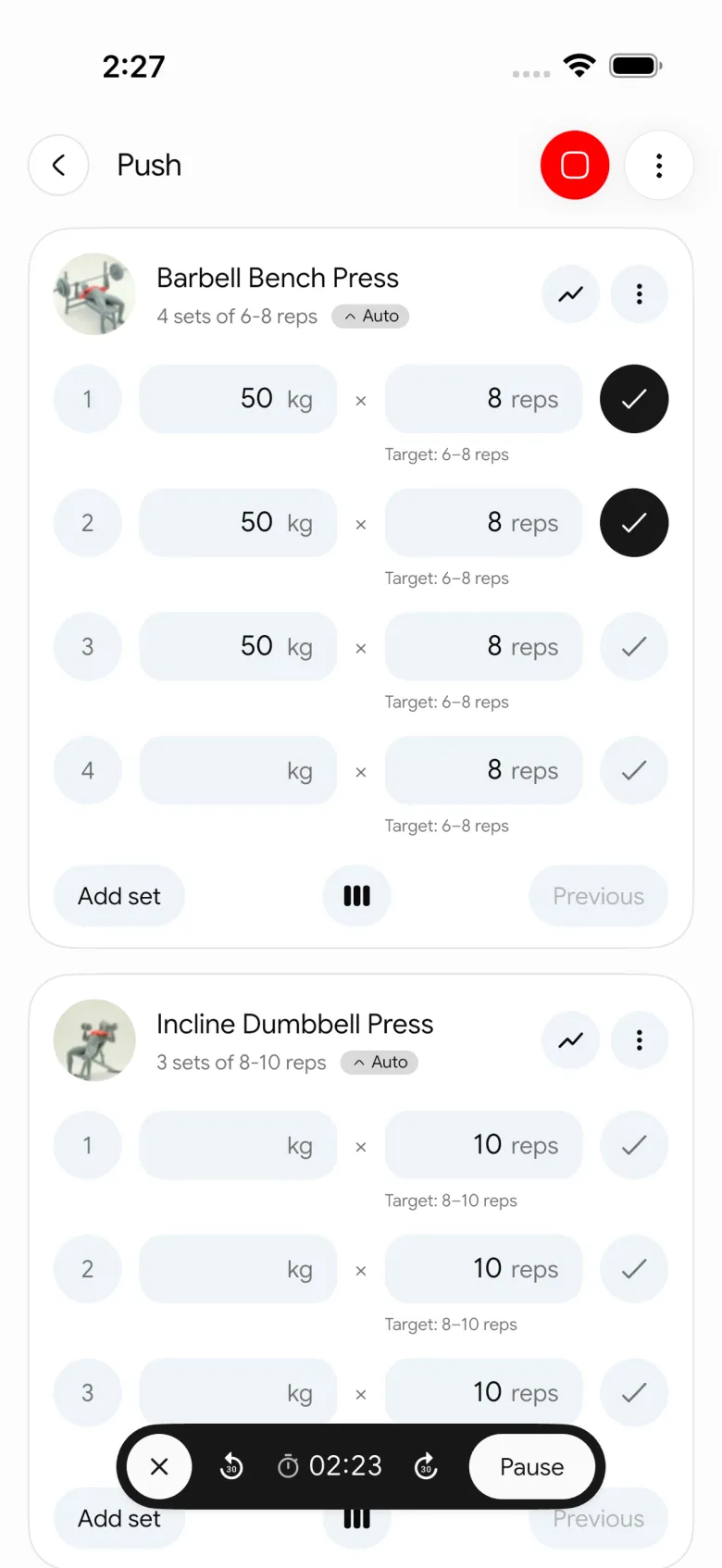
Built-in double progression workflow
- Preset rep ranges in your programs: When creating or editing a workout routine in PeakBFF, assign target rep ranges (such as 8 to 12 reps) and rest intervals to each exercise.
- Automatic set prefill: When you open an active workout, PeakBFF prefills your weight and reps from the previous session's completed working sets. You instantly see what you lifted last time without opening historical charts.
- Explicit Try more progression: When every prescribed working set lands inside your rep range at one weight, PeakBFF displays a Try more chip. Tapping it opens a clear review with two choices:
- More reps: Keeps the weight identical and suggests one more rep than your weakest set.
- More weight: Appears only when you reach the top of your prescribed rep range, suggesting the appropriate equipment increment (capped at a safe 10 percent jump).
- Lifter in control: PeakBFF never auto-adjusts weights behind your back. You review the suggestion and apply it with one tap to your remaining unfinished sets.
- Built-in plate calculator: In the active weight sheet, tap Load with plates to see the exact plate breakdown for 20 kg (45 lb) bars, eliminating mental bar math during heavy compound sessions.
- Rolling 7-day muscle volume map: As you log completed sets, PeakBFF maps your weekly volume across every muscle group, ensuring that progressing on your chest and shoulder presses does not create muscular imbalances.
- Integrated nutrition tracking: Progressive overload requires adequate caloric energy and protein synthesis. PeakBFF combines your workout log with AI photo and barcode nutrition tracking, keeping your training and nutrition logs in one unified app.
Pricing and availability
PeakBFF core logging features are completely free to use:
- Free basic tier: Log unlimited workouts, track sets and reps, use starter workout programs, access exercise demos for over 220 movements, and track basic daily calories and water intake. No subscription or credit card is required to begin.
- PeakBFF Plus: Unlocks macro tracking (protein, carbs, and fat), unlimited AI meal scans, the AI workout plan generator, workout imports from TikTok, Instagram, and YouTube, physique progress tracking with photo comparisons, and two-way Apple Health and Health Connect sync.
- $49.99/year (about $4.17/month) on the US App Store and Google Play (as of November 2026).
- $7.99/week for flexible short-term tracking.
Download PeakBFF on iOS and Android to automate your progressive overload tracking:
For more training and progression strategies, explore our guides on how to track progressive overload, running the 5/3/1 Boring But Big breakdown, and finding the best gym tracker apps.
Questions, answered
What is the double progression method in weightlifting?
Double progression is a progressive overload strategy where you advance two training variables in sequence: repetitions first, then load. You select a target rep bracket, such as 8 to 12 reps, and keep your working weight constant across sessions until you can complete all prescribed sets at the top of that bracket. Only then do you increase the weight.
What is the difference between standard and dynamic double progression?
In standard double progression, you keep every set at the same weight until every single set hits the top of the rep range. In dynamic double progression, you advance each set independently. For example, if set one hits 12 reps while set two hits 10, next workout you increase weight only on set one while set two remains at the previous weight.
What rep range works best for the double progression method?
The optimal rep bracket depends on the movement. Compound barbell movements such as squats, bench presses, and overhead presses work best in a 6 to 8 or 6 to 10 rep bracket. Dumbbell presses and cable rows thrive in an 8 to 12 rep bracket. Smaller isolation movements like lateral raises, bicep curls, and tricep pushdowns work best in a 10 to 15 rep bracket.
How much weight should you add when you hit your target reps?
Increase weight by the smallest available increment that preserves clean technique. For barbells, add 5 lb (2.5 kg) total using microplates or 2.5 lb plates per side. For dumbbells, move up to the next dumbbell pair, which is typically a 5 lb jump per hand. If the weight jump knocks your reps below the bottom of your range, the increase was too large.
What should you do if you stall on a weight during double progression?
If you fail to add a single rep across three consecutive workouts at the same weight, check your recovery, sleep, and caloric intake first. If nutrition is on point, reduce the working weight by 10 percent for one week to execute a reset, then build back up with clean technique. Alternately, rotate to a slight variation of the movement.
How do you track double progression in PeakBFF?
Set up your workout routine in PeakBFF with your chosen rep ranges and rest targets. During your workout, PeakBFF prefills last session's completed weights and reps. When all sets land at the top of your range, the explicit Try more chip prompts you to review an increase in reps or weight, automatically updating unfinished sets while keeping your historical log accurate.
More from PeakBFF
More app comparisons, fitness guides, and product notes.
Lose It vs MyFitnessPal (2026): Which Calorie Tracker Fits Lifters?
Lose It vs MyFitnessPal compared on database accuracy, free barcode scanning, pricing, and gym tracking, plus where PeakBFF fits for lifters who want both.
Best Before and After Photo App for Gym Progress (2026): 4 Options Compared
Compare the best before and after photo apps for gym lifters in 2026: Progress, SnapTrack, Hevy, and PeakBFF, covering sliders, ghost overlays, privacy, and prices.
Boring But Big Workout Breakdown (2026): 5/3/1 BBB Routine, Percentages, and How to Track It
A complete breakdown of the 5/3/1 Boring But Big (BBB) workout routine: Training Max math, 5x10 percentages, 4-day split schedule, assistance work, and how to log it.
FitSaver vs Prept (2026): Which Workout Saver App Fits Lifters?
Compare FitSaver and Prept for turning TikTok, Instagram Reels, and YouTube videos into gym routines, with real prices and feature trade-offs.
Best Jefit Alternative (2026): 4 Gym Workout Trackers Compared
Compare the best Jefit alternatives for lifters who want exercise demo videos, clean workout logging, and honest pricing without ad clutter.
Bench Press Strength Standards: By Bodyweight, Sex, and How to Calculate Your Rank
Check bench press strength standards by body weight and sex. Learn how to calculate your strength rank from working sets without testing a risky 1RM.