InBody vs DEXA Scan (2026): Accuracy, Cost, and Which Is Best for Lifters?
Compare InBody and DEXA scans for body composition in 2026. Explore accuracy, cost, water fluctuations, and how to track progress between clinic visits.
If you need the clinical gold standard for measuring body fat percentage, visceral adipose tissue, and bone mineral density, a DEXA scan is the definitive benchmark. If you want a quick, inexpensive test at your local gym to check whether your muscle mass is moving in the right direction, an InBody scan provides convenient directional feedback. And if you need a practical way to track body composition every week without spending seventy-five dollars per appointment, combining rolling weight averages, weekly photos, and training logs bridges the gap between laboratory visits.
Short answer: DEXA (Dual-Energy X-ray Absorptiometry) is the reference standard in body composition science, offering an error margin of roughly 1% to 2% and direct measurements of bone density and visceral fat. InBody uses Bioelectrical Impedance Analysis (BIA), which estimates fat and muscle by measuring electrical resistance through water. InBody is fast (under 60 seconds) and affordable ($15 to $30 or included in gym memberships), but hydration shifts, pre-workout stimulants, and meal timing can alter the results by 4% to 8%. Most lifters use DEXA once or twice annually for baselines, InBody every two months for directional trends, and PeakBFF weekly to track gym volume, macros, and physique photos in one place.
InBody vs DEXA Scan vs PeakBFF at a glance
Prices and capabilities reflect standard United States commercial availability as of November 2026.
| Metric | InBody Test (BIA) | DEXA Scan | PeakBFF (Weekly Tracking) |
|---|---|---|---|
| Core technology | Multi-frequency bioelectrical impedance | Dual-energy X-ray absorptiometry | Multi-metric tracking (photos, scale average, volume) |
| Measurement method | Standing on footpads while holding hand electrodes | Lying stationary on a padded scanning bed | Camera check-in photos, gym log, rolling scale weight |
| Error margin | Moderate (roughly $\pm 4%$ to $8%$) | Very low (roughly $\pm 1%$ to $2%$) | Qualitative trend analysis + quantitative scale average |
| Typical body fat readout | Frequently reads 3% to 6% lower than DEXA | Accurate absolute percentage | Estimated range via AI physique rating and photo check-in |
| Bone mineral density | Estimated estimate only | Direct clinical measurement (T-scores) | None |
| Visceral fat tracking | Estimated via body-water algorithm | Direct regional measurement (VAT area/mass) | None (monitors waist-to-shoulder ratio proxy) |
| Scan duration | 45 to 60 seconds | 10 to 15 minutes | Under 30 seconds on your smartphone |
| Typical US cost | $15 to $30 (often free with gym membership) | $75 to $150 per scan | Many features free; Plus is $49.99/yr or $7.99/wk |
| Testing frequency | Every 6 to 8 weeks under identical conditions | 1 to 2 times per year | Weekly photos, daily scale average, every workout |
| Hydration sensitivity | Very high (water swings skew results immediately) | Very low (bone and fat attenuation remain stable) | Rolling 7-day average filters daily water retention |
| Nutrition & workout log | Separate app required | Separate app required | Built-in AI meal scanner, macro targets, and workout log |
| Best suited for | Fast directional gym checks on a budget | Clinical baseline validation and bone health audits | Daily and weekly recomposition and calorie management |
1. InBody scan: fast, accessible, and sensitive to hydration
InBody machines (most commonly the InBody 270, 570, and 770 models) have become the default body composition tool in commercial fitness centres, personal training studios, and sports clinics. The user steps barefoot onto metal footplates, grasps hand electrodes with thumbs resting on dedicated sensors, and remains still for roughly 45 to 60 seconds while the unit pulses low-level alternating currents through the body.
How InBody measures your body
The machine measures bioelectrical impedance: the resistance and reactance encountered by electrical currents as they travel through cellular tissue. Lean muscle tissue contains high concentrations of water and electrolytes, allowing electric currents to pass through with low impedance. Adipose tissue (body fat) contains very little water and acts as an insulator, creating higher electrical resistance.
Higher-end commercial InBody models use multi-frequency currents (ranging from 1 kHz to 1000 kHz) to assess intracellular water (fluid inside your muscle cells) and extracellular water (fluid outside cells). The unit then applies proprietary regression equations to convert your total body water, height, and bodyweight into estimates of dry lean mass, skeletal muscle mass, and body fat mass.
The major strengths of InBody
- Zero friction: You do not need to undress beyond removing shoes and socks, and the entire test takes under a minute.
- Segmental analysis: InBody breaks down lean mass distribution across five body segments: right arm, left arm, trunk, right leg, and left leg. This helps lifters detect left-to-right muscular imbalances after injuries.
- Low cost: Many gym chains (including Anytime Fitness, Crunch, and Equinox) provide complimentary InBody scans to members or charge a nominal fee ($15 to $25).
Why InBody numbers fluctuate
The greatest limitation of InBody is its dependence on total body water. The machine does not measure fat tissue directly; it measures electrical resistance and calculates fat by subtracting estimated water-bearing tissue from your total scale weight.
If you test after drinking a litre of water, your body water rises, the current conducts faster, and the machine may register that extra fluid as temporary lean muscle mass. Conversely, if you test while dehydrated after a sweaty workout or a night of drinking, electrical resistance spikes, and the algorithm may estimate that your body fat jumped by 3% to 5% in twenty-four hours. For meaningful results, you must standardise your testing protocol: first thing in the morning, fasted, well-hydrated, post-void, and before lifting.
2. DEXA scan: the clinical gold standard for absolute body composition
DEXA (Dual-Energy X-Ray Absorptiometry) was originally engineered as an imaging diagnostic for bone mineral density and osteoporosis detection. Over the last two decades, medical researchers and sports scientists adapted whole-body DEXA scanning (using machines from GE Lunar or Hologic) into the primary reference standard for human body composition research.
How a DEXA scan works
During a DEXA scan, you lie flat on your back on a padded scanner bed while a motorised imaging arm passes slowly over your body from head to toe. The scanner emits two distinct, low-dose X-ray beams with different energy levels (typically around 40 keV and 70 keV).
Because bone mineral, fat tissue, and lean soft tissue attenuate (absorb) X-ray photons at mathematically predictable rates based on their physical density, the detectors on the scanner bed record the exact energy differential passing through every square millimetre of your body.
+-------------------------------------------------------------------+
|                        DEXA 3-COMPARTMENT MODEL                   |
|                                                                   |
|  [ Bone Mineral Content ] + [ Fat Mass ] + [ Lean Soft Tissue ]   |
|         (Direct X-ray)        (Direct)          (Direct)          |
+-------------------------------------------------------------------+
                                 vs
+-------------------------------------------------------------------+
|                       INBODY 2-COMPARTMENT PROXY                  |
|                                                                   |
|        [ Total Body Water ] ---> Estimated Lean Mass               |
|        [ Total Scale Weight ] - Estimated Lean = Calculated Fat   |
+-------------------------------------------------------------------+
The core advantages of DEXA
- True 3-compartment analysis: While bioelectrical impedance groups tissue into fat versus fat-free mass, DEXA directly measures bone mineral content, lipid mass, and non-bone lean soft tissue independently.
- Sub-millimetre regional precision: A DEXA scan provides precise fat and lean mass breakdowns for individual regions (android trunk, gynoid hip/thigh, arms, and legs), showing exactly where your genetics store subcutaneous fat.
- Visceral adipose tissue (VAT): DEXA accurately measures visceral fat, the metabolically dangerous fat surrounding your internal organs that correlates with cardiovascular risk.
- Bone mineral density scores: Lifters receive true T-scores and Z-scores for bone density, providing critical diagnostic feedback for long-term athletic longevity.
The trade-offs of DEXA
- Expense: A single DEXA scan typically costs between $75 and $150. Booking scans every four weeks quickly becomes cost-prohibitive.
- Inconvenience: You must schedule an appointment at an imaging centre, university exercise physiology laboratory, or mobile testing van (such as BodySpec or DexaFit).
- Radiation: While the radiation dose is extremely low (around 1 to 5 microsieverts, roughly equivalent to eating two bananas or taking a cross-country commercial flight), it is strictly contraindicated during pregnancy.
3. The accuracy gap: why InBody and DEXA show different numbers
One of the most frequent surprises for lifters is testing on both machines in the same week and receiving wildly divergent numbers. A lifter might step off an InBody 570 showing 14.5% body fat, then lie down on a DEXA scanner 48 hours later and receive a readout of 19.8%.
+-----------------------------------------------------------------------------+
|                      WHY THE READINGS DISAGREE                              |
|                                                                             |
|  Lifter reality: 185 lb, athletic build, moderate subcutaneous fat          |
|                                                                             |
|  InBody 570 result:   14.2% Body Fat   (BIA counts intramuscular water     |
|                                         and glycogen as lean tissue)        |
|                                                                             |
|  DEXA scan result:    18.9% Body Fat   (X-ray detects all adipose lipids,   |
|                                         including essential intramuscular)  |
|                                                                             |
|  Difference:          +4.7% Body Fat   (Normal discrepancy; not a failure)  |
+-----------------------------------------------------------------------------+
This discrepancy does not mean either machine is broken. It happens because they measure fundamentally different physical properties:
- Hydration confusion: BIA algorithms assume healthy human lean tissue is consistently 73.2% water. Heavy strength training increases intramuscular glycogen and water retention. InBody interprets that extra conductive water as pure muscle mass, which mathematically drives down the calculated body fat percentage.
- Lipid detection: DEXA measures all fat tissue, including essential fat surrounding organs, yellow bone marrow fat, and intramuscular lipids. BIA equations frequently underestimate these deeper fat deposits.
- Algorithm baselines: Many gym BIA machines use calibration formulas tuned to general population samples. When applied to athletic, muscular lifters, the formulas often underestimate fat mass.
The rule of thumb for serious lifters: trust DEXA for your true absolute body fat percentage, and treat InBody strictly as a directional indicator. If your InBody body fat drops from 16% to 14% over three months while testing under identical fasted conditions, you lost fat, even if a DEXA scan would record your true level at 18%.
4. PeakBFF: bridging the gap with daily and weekly tracking
Neither a quarterly InBody test nor an annual DEXA scan solves the day-to-day question lifters face every morning: Am I eating the right amount to lose fat while keeping my muscle?
Booking laboratory scans every seven days is financially impractical, and daily InBody tests generate confusing noise due to normal water shifts. To bridge the multi-month gap between laboratory benchmarks, lifters need three practical layers:
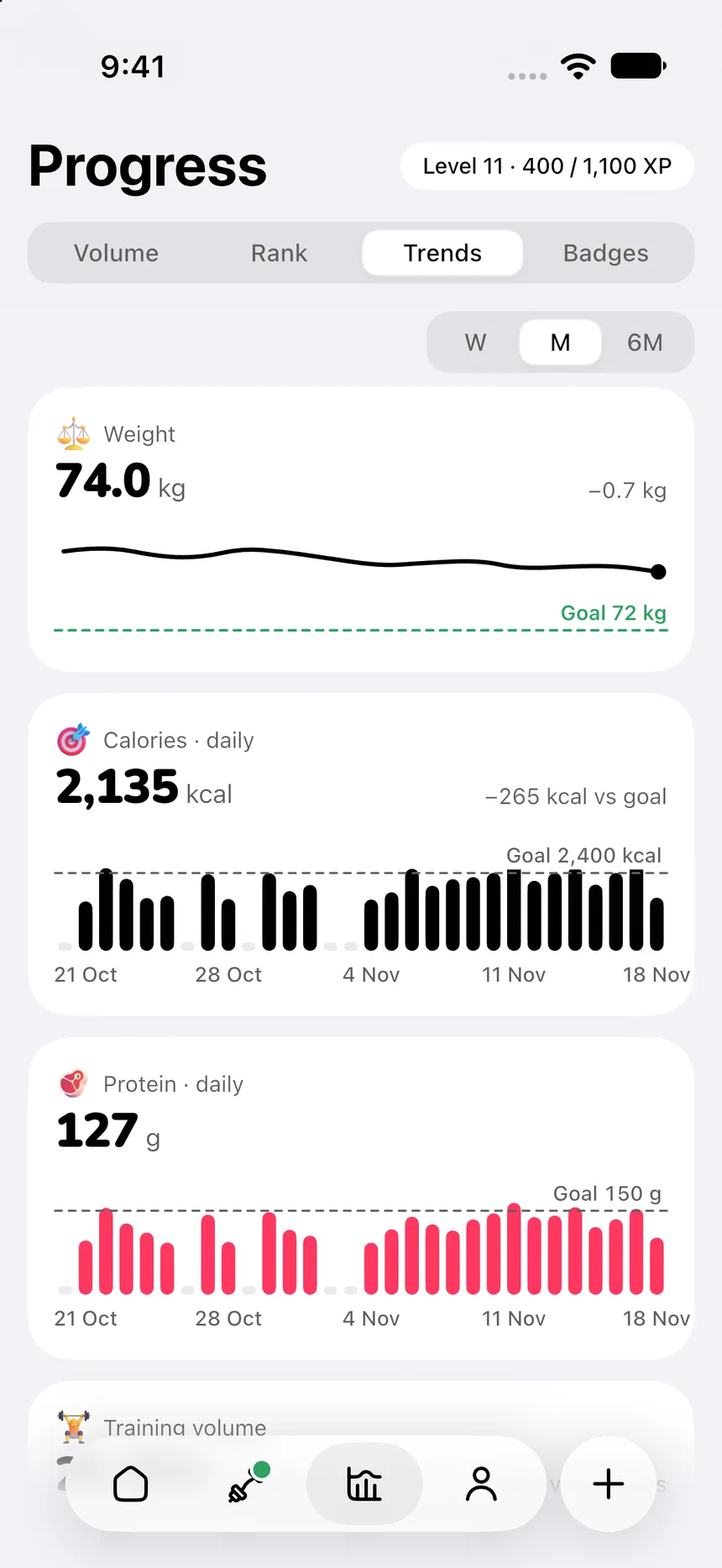
- A rolling 7-day scale weight average: Tracking your weight every morning and looking at the 7-day average filters out salt, carb, and hydration spikes. If your 7-day average drops by 0.5 to 1.0 pound per week, your calculated calorie deficit is working.
- Standardised weekly progress photos: Taking front, side, and back photos in consistent morning lighting provides visual proof of muscle definition and abdominal vascularity that calipers and scales miss.
- Progressive overload verification: If your training volume and lift numbers stay stable or increase while your scale average trends downward, you are preserving lean tissue during your cut.
How PeakBFF complements your body composition testing
PeakBFF serves as an all-in-one gym and nutrition log designed specifically to replace fragmented single-purpose tracking apps. Here is how it supports your body composition goals:
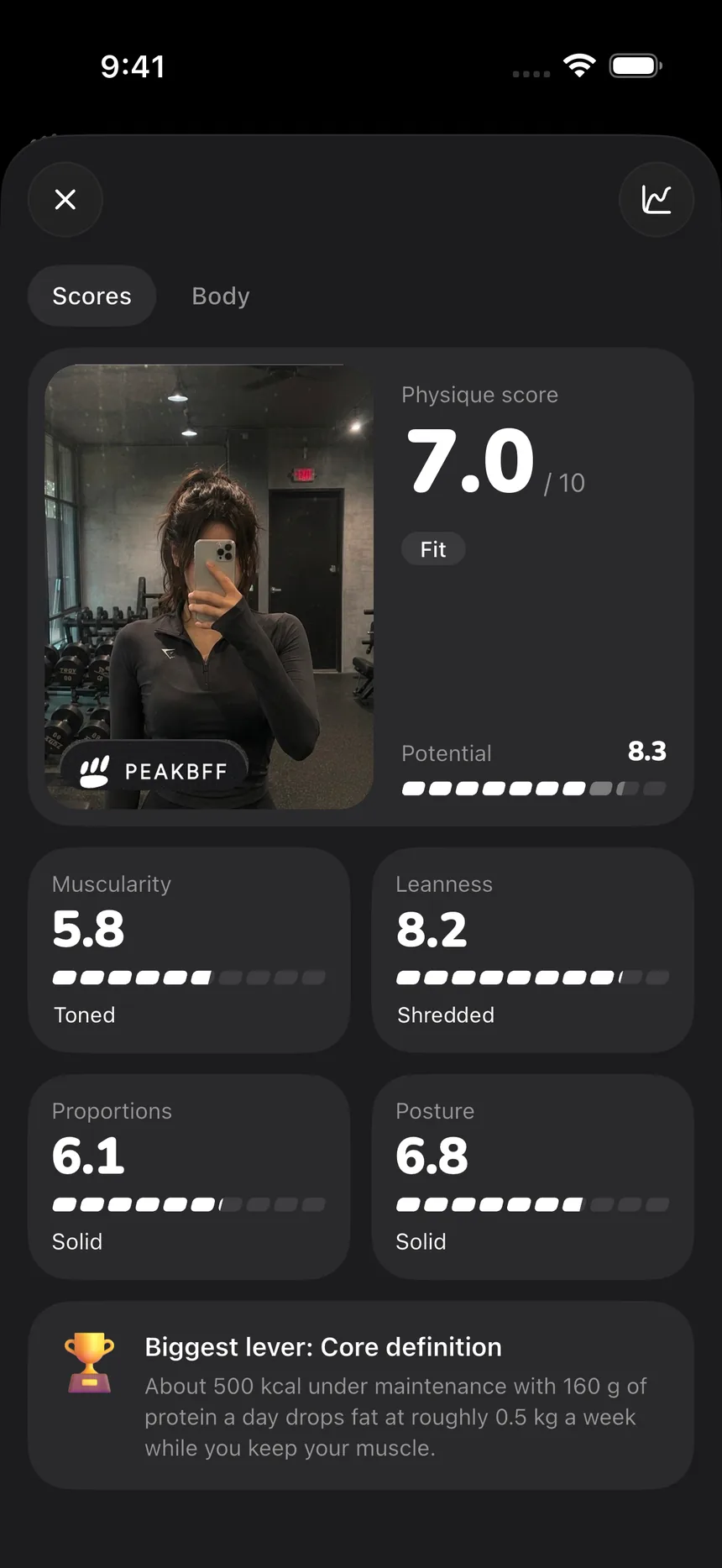
- Rate My Physique visual scans: Upload front and back photos to receive an AI-powered visual assessment scored across six body categories (chest, back, shoulders, arms, legs, and waist-to-shoulder ratio) alongside an estimated body fat range. Once you complete two or more scans, an automatic draggable before-and-after slider visualises your progress side by side.
- On-device photo privacy: Your progress photos remain stored securely on your personal device rather than exposed in public fitness feeds, providing a safe vault for weekly physique check-ins. For more private photo workflows, explore our guide on the best private progress photo apps.
- Consolidated nutrition tracking: Getting an accurate DEXA scan does not change your body fat unless your daily nutrition aligns with your goals. PeakBFF features an integrated photo meal scanner with hybrid vector lookup: photograph your plate to log calories on the free tier, with full protein, carb, and fat breakdowns on Plus.
- Rolling volume and workout history: Monitor your training stimulus with a rolling 7-day muscle volume map. By checking your weekly sets per muscle group alongside your weigh-ins, you can ensure you are hitting the minimum effective volume necessary to preserve muscle while dieting, as detailed in our guide on how to track muscle growth.
- Transparent pricing: Many core features (including manual workout logging, starter routines, and calorie tracking) are completely free for basic users. PeakBFF Plus unlocks unlimited AI meal scans, detailed macro targets, physique transformation insights, and social workout imports for $49.99 per year (roughly $4.17 per month) or $7.99 per week on the US App Store.
Which method should you choose?
Your body composition strategy should match your budget, timeline, and current training phase:
- Book a DEXA scan once or twice per year if you want to establish an indisputable clinical baseline, check bone mineral density, or measure visceral fat before a major bulking or cutting phase.
- Use InBody at your gym every 6 to 8 weeks if you want quick, low-cost segmental feedback. Ensure you step onto the platform first thing in the morning, fasted, well-hydrated, and before exercising.
- Use PeakBFF every week to track the daily variables that actually determine your body composition: your training volume, daily protein intake, rolling scale average, and private progress photos.
Ready to take control of your body composition and gym progression in a single app? Download PeakBFF on the App Store or Google Play today.
Questions, answered
Is DEXA more accurate than an InBody scan?
Yes. DEXA is the clinical gold standard with an error margin around one to two per cent. It uses dual-energy X-rays to separate fat mass, lean tissue, and bone mineral density. InBody relies on electrical impedance, which is sensitive to hydration and often swings by four to eight per cent.
Why does InBody show a lower body fat percentage than DEXA?
InBody estimates body fat by sending electrical currents through body water. If you carry excess water, glycogen, or intramuscular hydration, the algorithm categorises that conductive volume as lean mass, which artificially deflates your calculated fat percentage. DEXA measures fat mass directly, resulting in higher but more realistic numbers.
How much does an InBody scan cost compared to a DEXA scan?
An InBody scan typically costs between fifteen and thirty dollars, and many commercial gyms offer scans free with membership. A DEXA scan generally costs between seventy-five and one hundred and fifty dollars per appointment at medical imaging centres, university sports labs, or specialised mobile testing facilities.
How often should you get a DEXA scan or InBody test?
Most lifters benefit from a DEXA scan once or twice per year to establish an accurate baseline and verify long-term body recomposition. InBody tests work best every six to eight weeks under identical fasting and hydration conditions to observe general directional trends rather than precise numbers.
How can you track body composition progress between scans?
You can track progress between scans by pairing a rolling seven-day scale weight average with weekly check-in photos and gym performance. Apps like PeakBFF consolidate daily workout volume, protein intake, and AI physique ratings so you can verify changes without paying for monthly clinic visits.
More from PeakBFF
More app comparisons, fitness guides, and product notes.
Hybrid Training Split: How to Build Muscle and Run Without Burnout
A complete guide to structuring a hybrid training split. Learn how to balance heavy lifting with running, manage fatigue, and avoid the interference effect.
Boostcamp vs Caliber (2026): Coach Programmes or Free Strength Log?
Compare Boostcamp and Caliber for strength training in 2026. Explore coach spreadsheet programmes, free workout tracking, exercise tutorials, and nutrition gaps.
How to Calculate a Calorie Deficit: Step-by-Step Formula, Pace Chart, and Deficit Calculator
Calculate your daily calorie deficit to lose weight safely with the step-by-step formula, bodyweight pace chart, and deficit calculator without losing muscle.
JEFIT vs Fitbod (2026): Exercise Library or AI Workout Generator?
Compare JEFIT and Fitbod for gym tracking, AI workout generation, exercise libraries, and pricing, plus how PeakBFF unifies lifting and macros.
How to Track Muscle Growth: What to Measure, Realistic Rates, and Progress Log Template
Learn how to track muscle growth accurately: gym performance proxies, tape measurements, progress photos, and rolling scale weight. Includes audit template.
MacroFactor vs Cronometer (2026): Adaptive Macro Coach or Micronutrient Tracker?
MacroFactor vs Cronometer compared for lifters in 2026. Explore adaptive TDEE coaching, 80+ micronutrient tracking, food logging UX, pricing, and how PeakBFF compares.