Arnold Split vs PPL (2026): Muscle Hypertrophy, Routine Breakdown, and How to Track Both
Compare the Arnold Split vs Push Pull Legs (PPL): muscle pairings, arm and shoulder growth, 6-day and hybrid routines, volume rules, and how to track both.
Arnold Split vs PPL (2026): Muscle Hypertrophy, Routine Breakdown, and How to Track Both
When choosing a 6-day hypertrophy routine, the debate usually comes down to two proven frameworks: the Arnold Split (Chest and Back, Shoulders and Arms, Legs) and Push Pull Legs (PPL) (Push, Pull, Legs). The Arnold Split gives you dedicated arm days and intense antagonist upper-body pumps, while PPL organizes training by biomechanical movement patterns to reduce joint overlap.
Here is the direct answer: if your primary goal is bringing up lagging arms and shoulders while chasing upper-body density, the Arnold Split is the superior choice. If your priority is heavy compound progressive overload, balanced systemic recovery, and simpler scheduling, PPL is the safer foundation. Many lifters also run the viral PPL x Arnold Split hybrid, which combines the strengths of both systems across a 6-day training week.
This guide breaks down the biomechanics of both splits, compares their recovery demands, provides complete workout templates, and shows you how to track your weekly volume to ensure steady muscle growth.
What is the difference between the Arnold Split and PPL?
The core difference between the Arnold Split and Push Pull Legs lies in how they pair upper-body muscle groups.
PPL groups muscles by movement pattern:
- Push Day: Chest, Anterior and Lateral Deltoids, Triceps
- Pull Day: Lats, Upper Back, Rear Deltoids, Biceps
- Leg Day: Quads, Hamstrings, Glutes, Calves
Because pressing movements (like bench press and overhead press) recruit the front delts and triceps as secondary movers, PPL exhausts all pushing muscles in one session. This gives those muscles 48 to 72 hours of uninterrupted rest before their next workout.
In contrast, the classic Arnold Split, popularized by Arnold Schwarzenegger during the Golden Era of bodybuilding, groups muscles by anatomical opposition:
- Day 1: Chest and Back. You train opposing torso muscles together, often alternating between a press and a row.
- Day 2: Shoulders and Arms. You train your lateral deltoids, rear deltoids, biceps, and triceps with complete focus.
- Day 3: Legs. You train your entire lower body (quads, hamstrings, and calves).
The fundamental advantage of the Arnold Split is that your arms and shoulders are completely fresh on Day 2. You are not trying to curl after 12 heavy sets of pull-ups and rows, or perform skull crushers with triceps already pre-exhausted from heavy incline benching.
Head-to-head comparison: muscle pairings, frequency, and recovery
| Feature | Arnold Split | Push Pull Legs (PPL) | PPL x Arnold Hybrid |
|---|---|---|---|
| Day 1 Focus | Chest & Back | Push (Chest, Delts, Triceps) | Push (Heavy Compound) |
| Day 2 Focus | Shoulders & Arms | Pull (Back, Rear Delts, Biceps) | Pull (Heavy Compound) |
| Day 3 Focus | Legs & Abs | Legs & Calves | Legs (Heavy Compound) |
| Day 4 Focus | Chest & Back | Push (Chest, Delts, Triceps) | Chest & Back (Antagonist) |
| Day 5 Focus | Shoulders & Arms | Pull (Back, Rear Delts, Biceps) | Shoulders & Arms (Hypertrophy) |
| Day 6 Focus | Legs & Abs | Legs & Calves | Legs & Calves (Volume) |
| Day 7 | Rest | Rest | Rest |
| Arm Growth Priority | High (Dedicated arm day) | Moderate (Trained after compounds) | High (Second half of week) |
| Antagonist Pump | High (Chest & back supersets) | Low (All pushing or pulling) | High on Day 4 and Day 5 |
| Shoulder Joint Stress | Higher (Shoulders work Day 1 & 2) | Lower (Pressing grouped on Push) | Moderate |
| Ideal Experience Level | Intermediate to Advanced | Beginner to Advanced | Intermediate to Advanced |
Which split builds more muscle: hypertrophy and arm specialization
From a pure hypertrophy standpoint, scientific research demonstrates that total weekly volume (hard sets per muscle group per week taken within 1 to 3 reps in reserve) is the primary driver of muscle growth, assuming frequency is at least twice per week.
Both the 6-day Arnold Split and the 6-day PPL hit every muscle group twice every seven days. However, the quality of your volume differs significantly across specific body parts:
1. Bicep and tricep hypertrophy
On a standard PPL split, your triceps are already fatigued from flat dumbbell presses, incline barbell presses, and dips before you touch a cable rope pushdown. Similarly, your biceps are fatigued from chin-ups and chest-supported rows before you start barbell curls. While this synergistic fatigue is efficient, it means your direct arm work is performed with lower absolute loads and compromised central nervous system drive.
On the Arnold Split, you walk into the gym on Day 2 with fresh elbows, shoulders, and grip. You can load heavy barbell curls, overhead triceps extensions, and weighted dips with maximum intensity. Lifters who struggle with arm growth frequently see faster progress after switching to an Arnold split for 8 to 12 weeks.
2. The antagonistic chest and back pump
Training chest and back in the same session creates massive reciprocal blood flow. When you alternate a heavy pressing exercise (such as an incline dumbbell press) with a heavy rowing movement (such as a chest-supported T-bar row), the antagonist muscle actively stretches while the agonist contracts. This reduces joint stiffness in the shoulder girdle and provides exceptional mind-muscle connection.
3. Recovery and joint management
The primary drawback of the Arnold Split is potential shoulder irritation. If you bench press heavy on Monday, your anterior deltoids and triceps take a beating. If you then perform heavy overhead military presses and heavy triceps work on Tuesday, your rotator cuffs and elbow tendons receive continuous loading without a 48-hour recovery window.
To make the Arnold Split work as a natural lifter, focus your Shoulder & Arm day on lateral raises (cable and dumbbell), rear delt flyes, and direct arm work, while relying on your Chest day for anterior deltoid stimulation. If you prefer training five days instead of six, check our PPLUL split guide for a balanced 5-day alternative.
The 6-day Arnold Split routine template
Here is a practical, evidence-based 6-day Arnold Split designed for natural lifters. It keeps daily exercise selection to 5 or 6 movements to avoid junk volume, ensuring you finish within 50 to 60 minutes.
Before jumping into working weights, make sure you ramp up properly using our guide on how many warm-up sets before working sets.
Day 1 & Day 4: Chest & Back
| Exercise | Muscle Target | Sets | Reps | Rest |
|---|---|---|---|---|
| Incline Dumbbell Bench Press | Upper Chest | 3 | 6 to 8 | 2 to 3 min |
| Chest-Supported T-Bar Row | Upper Back & Lats | 3 | 6 to 8 | 2 to 3 min |
| Flat Barbell Bench Press | Mid Chest | 3 | 8 to 10 | 2 min |
| Lat Pulldown (Neutral Grip) | Lats | 3 | 10 to 12 | 2 min |
| Cable Chest Flyes | Lower / Mid Chest | 2 | 12 to 15 | 90 sec |
| Dumbbell Pullover | Lats & Serratus | 2 | 12 to 15 | 90 sec |
Check your baseline pushing numbers against our bench press strength standards to ensure your loading matches your lifting rank.
Day 2 & Day 5: Shoulders & Arms
| Exercise | Muscle Target | Sets | Reps | Rest |
|---|---|---|---|---|
| Standing Dumbbell Lateral Raise | Lateral Delts | 4 | 10 to 12 | 90 sec |
| Incline Dumbbell Bicep Curl | Biceps (Long Head) | 3 | 8 to 10 | 90 sec |
| Overhead Cable Triceps Extension | Triceps (Long Head) | 3 | 10 to 12 | 90 sec |
| Barbell Preacher Curl | Biceps (Short Head) | 3 | 10 to 12 | 90 sec |
| Triceps Rope Pushdown | Triceps (Lateral Head) | 3 | 12 to 15 | 90 sec |
| Reverse Pec Deck Flyes | Rear Delts | 3 | 12 to 15 | 90 sec |
Day 3 & Day 6: Legs & Calves
| Exercise | Muscle Target | Sets | Reps | Rest |
|---|---|---|---|---|
| Barbell Back Squat | Quads & Glutes | 3 | 6 to 8 | 3 min |
| Romanian Deadlift (RDL) | Hamstrings & Glutes | 3 | 8 to 10 | 2 to 3 min |
| Leg Press | Quads | 3 | 10 to 12 | 2 min |
| Seated or Lying Leg Curl | Hamstrings | 3 | 10 to 12 | 90 sec |
| Standing Calf Raise | Calves | 4 | 12 to 15 | 60 sec |
| Hanging Leg Raise | Core | 3 | 12 to 15 | 60 sec |
For guidance on structuring your exercise order and pacing, refer to how many exercises per workout.
The viral PPL x Arnold Split hybrid
If you cannot decide between the compound efficiency of PPL and the arm-specialization benefits of the Arnold Split, the PPL x Arnold hybrid offers the best of both worlds.
In this structure, the first three days focus on heavy compound strength using PPL principles. The second three days transition into an Arnold split to maximize muscle fullness, arm volume, and antagonist pumps before your Sunday rest day:
- Monday (Push): Heavy Barbell Bench Press, Overhead Press, Incline Dumbbell Press, Triceps accessory.
- Tuesday (Pull): Deadlifts or Heavy Barbell Rows, Weighted Pull-Ups, Cable Rows, Biceps accessory.
- Wednesday (Legs - Quad Focused): Barbell Squats, Bulgarian Split Squats, Leg Extensions, Calves.
- Thursday (Chest & Back): Incline Dumbbell Press superset with Chest-Supported Rows, Cable Crossovers superset with Lat Pulldowns.
- Friday (Shoulders & Arms): Dedicated lateral deltoids, biceps, and triceps supersets.
- Saturday (Legs - Posterior Focused): Romanian Deadlifts, Leg Curls, Hip Thrusts, Calves.
- Sunday: Complete Rest and Recovery.
This hybrid model avoids shoulder overuse because heavy overhead pressing and heavy benching only occur on Monday, leaving Friday free for isolated shoulder raises and arm work.
How many weekly sets per muscle group should you run?
Running six days a week makes it easy to accidentally perform too much volume. If you do 20 sets per workout, you will accumulate 120 weekly sets, which often exceeds natural recovery capabilities.
Aim for the following weekly target ranges across your six training days:
| Muscle Group | Optimal Weekly Sets | Distribution Over 2 Sessions |
|---|---|---|
| Chest | 10 to 14 sets | 5 to 7 sets per session |
| Back (Lats & Upper Back) | 12 to 16 sets | 6 to 8 sets per session |
| Quads | 10 to 14 sets | 5 to 7 sets per session |
| Hamstrings | 8 to 12 sets | 4 to 6 sets per session |
| Side & Rear Deltoids | 12 to 16 sets | 6 to 8 sets per session |
| Biceps | 10 to 14 sets | 5 to 7 sets per session |
| Triceps | 10 to 14 sets | 5 to 7 sets per session |
| Calves & Abs | 6 to 10 sets | 3 to 5 sets per session |
Apply the double progression method on all your accessories: pick a rep range (such as 8 to 12 reps), keep the weight constant until you can hit 12 reps on all sets with solid form, and then increase the weight by 5 lb (2.5 kg).
How to track the Arnold Split in PeakBFF
When you train six days per week, tracking your volume and progressive overload is critical. Forgetting what you lifted on your last Chest & Back day leads to stagnant workouts and wasted effort.
PeakBFF gives you a dedicated gym log and muscle tracking system designed specifically for structured training splits:
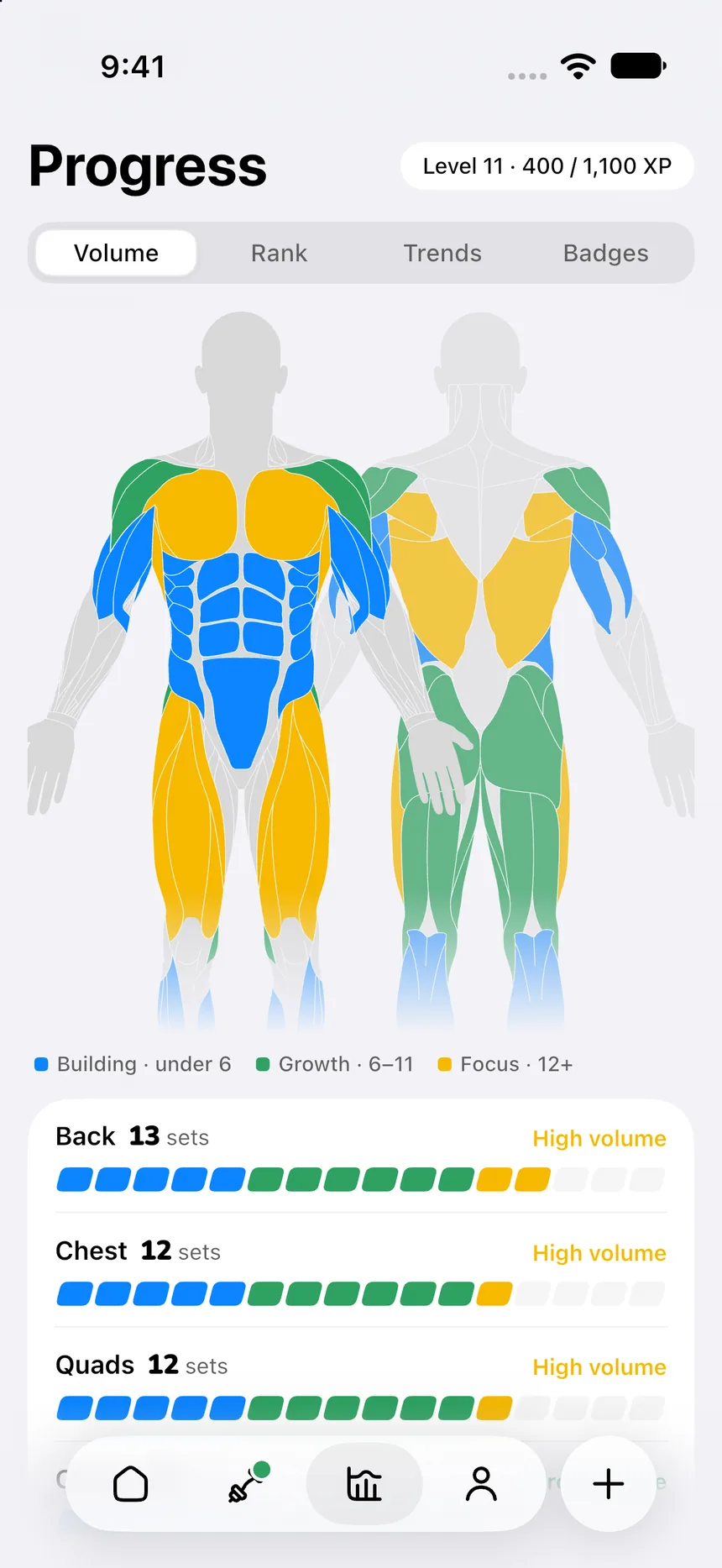
Here is how to set up and track your Arnold Split or PPL routine in PeakBFF:
- Build your split template: Open the workout tab and create your custom 6-day split (Chest & Back, Shoulders & Arms, Legs) or PPL days. PeakBFF includes a built-in library of over 220 exercises with video demonstrations and written form cues.
- Monitor rolling muscle volume: As you log workouts, PeakBFF updates your rolling 7-day muscle volume map. If your chest volume is at 14 sets but your hamstrings are lagging at 4 sets, the visual map highlights the imbalance immediately so you can adjust your upcoming sessions.
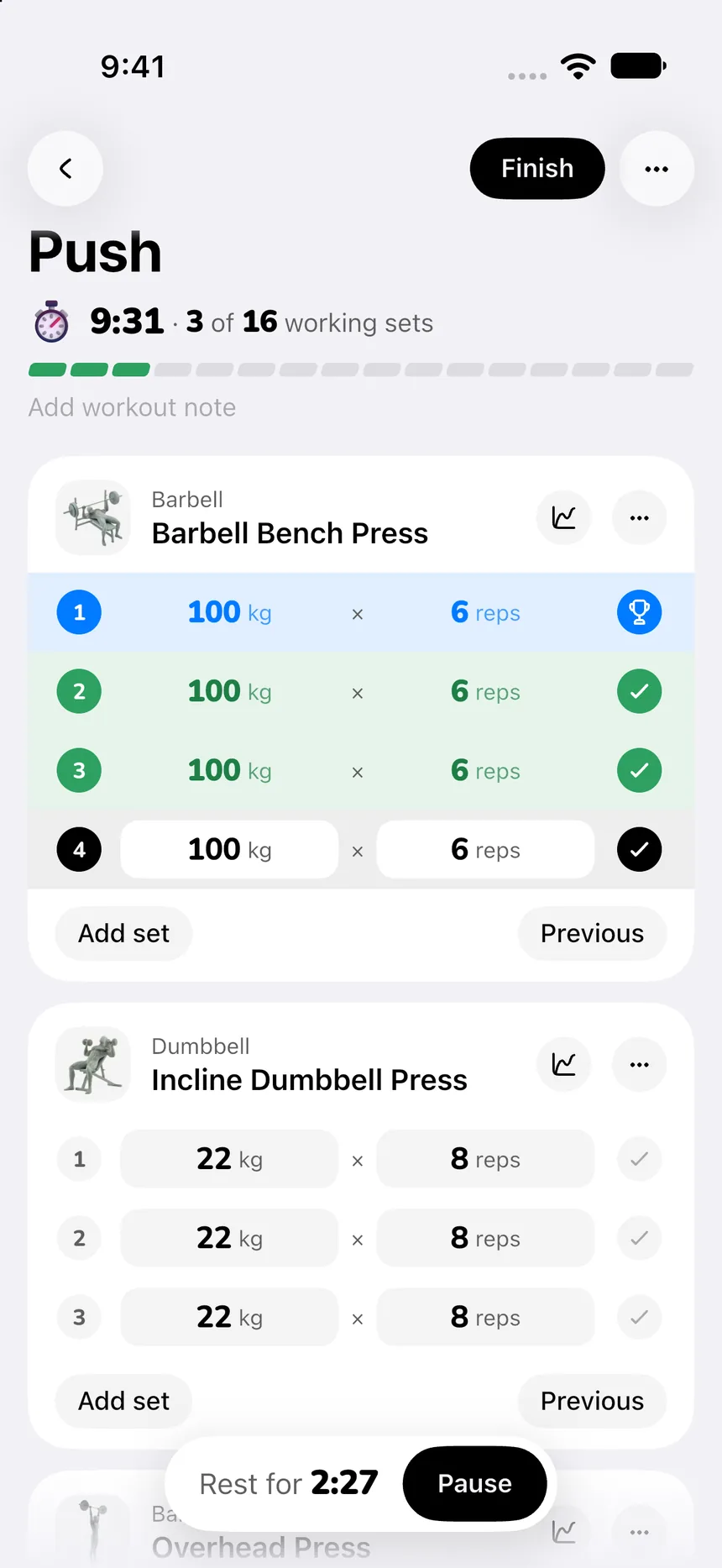
- Log sets with prefilled weights: When you start a workout, PeakBFF automatically prefills the exact weight and reps you completed in your previous session. You never have to scroll through old logs or guess what dumbbell you used.
- Use the built-in rest timer and plate math: Set your rest interval (for example, 2 minutes for compound lifts, 90 seconds for supersets). The rest timer counts down automatically between sets. The visual plate calculator in the active weight sheet tells you exactly which plates to load onto a 45 lb (20 kg) barbell.
- Apply Try more progressive overload: When you hit the top of your target rep range, PeakBFF presents a Try more prompt suggesting a slight weight increase for your next session, helping you progress methodically without burning out.
PeakBFF also includes AI food photo logging so you can track your daily calories and protein intake right alongside your training logs. Many core features, including workout logging, prefilled weights, and basic food logging, are free to use without an account or credit card. PeakBFF Plus ($49.99/year, about $4.17/month) unlocks full macronutrient breakdowns (protein, carbs, fat), custom routine imports, AI workout plans, and health sync.
Who should choose the Arnold Split vs PPL?
Choose the Arnold Split if:
- Arm and shoulder hypertrophy is your number one priority: You want dedicated days where your arms are not exhausted from heavy benching or rowing.
- You love antagonist supersets: You enjoy the massive upper-body pump of pairing chest presses with back rows.
- You are an intermediate lifter: You already have a solid foundation of compound strength and want to prioritize aesthetic balance.
Choose Push Pull Legs (PPL) if:
- Joint longevity is a concern: You want clean 48-hour recovery windows for your anterior deltoids and elbow joints.
- Your primary focus is compound strength: You want your bench press, squat, and deadlift to progress without interference from previous upper-body sessions.
- You prefer training 3 to 5 days: PPL adapts more naturally into a 3-day, 4-day, or 5-day schedule than the strict 6-day Arnold Split.
Choose the PPL x Arnold Split hybrid if:
- You love heavy compound progression early in the week, but want a dedicated high-volume arm and shoulder workout on Friday before the weekend.
Download PeakBFF for iOS or Android to set up your split, track your rolling weekly muscle volume, and hit your progressive overload targets every session.
Questions, answered
What is the main difference between the Arnold Split and PPL?
The Arnold Split groups antagonistic muscle pairs: Chest and Back on Day 1, Shoulders and Arms on Day 2, and Legs on Day 3. PPL (Push, Pull, Legs) groups synergistic muscles by movement pattern: Chest, Shoulders, and Triceps on Push; Back, Rear Delts, and Biceps on Pull; and Quads, Hamstrings, and Calves on Legs.
Which split builds bigger arms: Arnold Split or PPL?
The Arnold Split generally produces superior arm and shoulder development for intermediate and advanced lifters. Because biceps, triceps, and delts have their own dedicated training day, you hit them with fresh energy instead of training them at the end of exhausting compound presses and rows as you do on PPL.
Is the Arnold Split good for natural lifters?
Yes, provided you manage your weekly volume. Arnold Schwarzenegger famously trained six days per week with extreme volume, but natural lifters should cap their volume at 10 to 16 hard working sets per muscle group each week. Keeping each session to 5 or 6 exercises prevents joint strain in the shoulders and elbows.
What is the PPL x Arnold Split hybrid routine?
The PPL x Arnold Split is a popular 6-day hybrid rotation. Days 1 through 3 run classic Push, Pull, and Legs with heavy compound loading. Days 4 through 6 switch to Chest and Back, Shoulders and Arms, and Legs. This setup delivers heavy compound strength early in the week and dedicated upper-body pump work later in the week.
How do I track the Arnold Split or PPL in PeakBFF?
You can build either routine in PeakBFF with custom exercises, prefilled previous weights, and automatic rest timers. PeakBFF tracks your rolling 7-day sets per muscle group on the muscle volume tracker to prevent overtraining, and provides Try more progression suggestions when you hit your rep targets.
More from PeakBFF
More app comparisons, fitness guides, and product notes.
JEFIT vs Fitbod (2026): Exercise Library or AI Workout Generator?
Compare JEFIT and Fitbod for gym tracking, AI workout generation, exercise libraries, and pricing, plus how PeakBFF unifies lifting and macros.
How to Track Muscle Growth: What to Measure, Realistic Rates, and Progress Log Template
Learn how to track muscle growth accurately: gym performance proxies, tape measurements, progress photos, and rolling scale weight. Includes audit template.
MacroFactor vs Cronometer (2026): Adaptive Macro Coach or Micronutrient Tracker?
MacroFactor vs Cronometer compared for lifters in 2026. Explore adaptive TDEE coaching, 80+ micronutrient tracking, food logging UX, pricing, and how PeakBFF compares.
Ladder vs Peloton (2026): Guided Strength Teams or Studio Classes?
Ladder vs Peloton compared for lifters in 2026. Explore team-based strength blocks, studio video classes, progressive overload, prices, and how PeakBFF compares.
MeThreeSixty vs ZOZOFIT (2026): Which 3D Body Scanner Fits Lifters?
Compare MeThreeSixty and ZOZOFIT for 3D body scanning, circumferences, and body fat estimates, and see which app best supports a lifting routine.
Hevy vs Strong (2026): Which Gym Workout Log Fits Your Training?
Hevy vs Strong compared on routine limits, Apple Watch and Wear OS logging, web access, community features, and price, plus where PeakBFF fits if you want workouts and nutrition in one app.