Best Water Tracker App for Gym Workouts and Recovery (2026): 4 Options Compared
Compare top hydration apps for fitness enthusiasts to track water intake alongside workouts, nutrition, and wearables for better gym recovery.
Best Water Tracker App for Gym Workouts and Recovery (2026): 4 Options Compared
The best water tracker app for gym workouts is PeakBFF if you want to track daily water intake alongside your lifting sets, nutrition, and recovery metrics in one unified app. With Plus health sync it exports logged water to Apple Health and Health Connect, so hydration can sit beside the data from your wearable, and in the app it sits beside your training volume, protein, and calories without a separate habit tracker. PeakBFF has no watch app, so for wrist logging WaterMinder (two-way Apple Health, watchOS complications) is the better wearable fit, and Hydro Coach syncs with both Apple Health and Health Connect. MyFitnessPal suits food-diary habits.
| PeakBFF | WaterMinder | Hydro Coach | MyFitnessPal | |
|---|---|---|---|---|
| Best for | Lifters tracking water, nutrition, and workouts together | Dedicated Apple Watch complications and reminders | Cross-platform standalone hydration reminders | Basic water logging inside an existing food diary |
| Water entry methods | Quick presets (250 ml, 500 ml) or positive custom amounts | Custom cup sizes, pre-defined icons, and multiple beverage types | Quick buttons, custom milliliters/ounces, and beverage types | Quick add presets (8 oz, 16 oz, 24 oz) or custom totals |
| Workout context | Unified home dashboard with lifting volume and exercise logs | Separate from lifting workouts (relies on external health sync) | Separate from lifting workouts (relies on external health sync) | Secondary widget inside calorie counting diary |
| Health platform sync | Apple Health export (iOS) and Health Connect export (Android), with Plus health sync | Two-way Apple Health sync, watchOS complications, widgets | Apple Health (iOS) and Android Health Connect support | Apple Health and Health Connect integration settings |
| Pricing (2026) | Free water and workout tracking; $49.99/yr for PeakBFF Plus | $4.99 one-time purchase or WaterMinder Plus ($9.99/yr) | Free with ads; PRO upgrade $4.99 to $9.99 (one-time or yearly) | Free basic water log; Premium food diary $19.99/mo or $79.99/yr |
| Key limitation | No standalone watchOS app; manual watch entry not supported | Does not log gym sets, barbell weights, or meal calories | Standalone hydration tool with no strength training features | Water tracking is basic; app interface is heavily food-centric |
1. PeakBFF: best for lifters who want one daily record
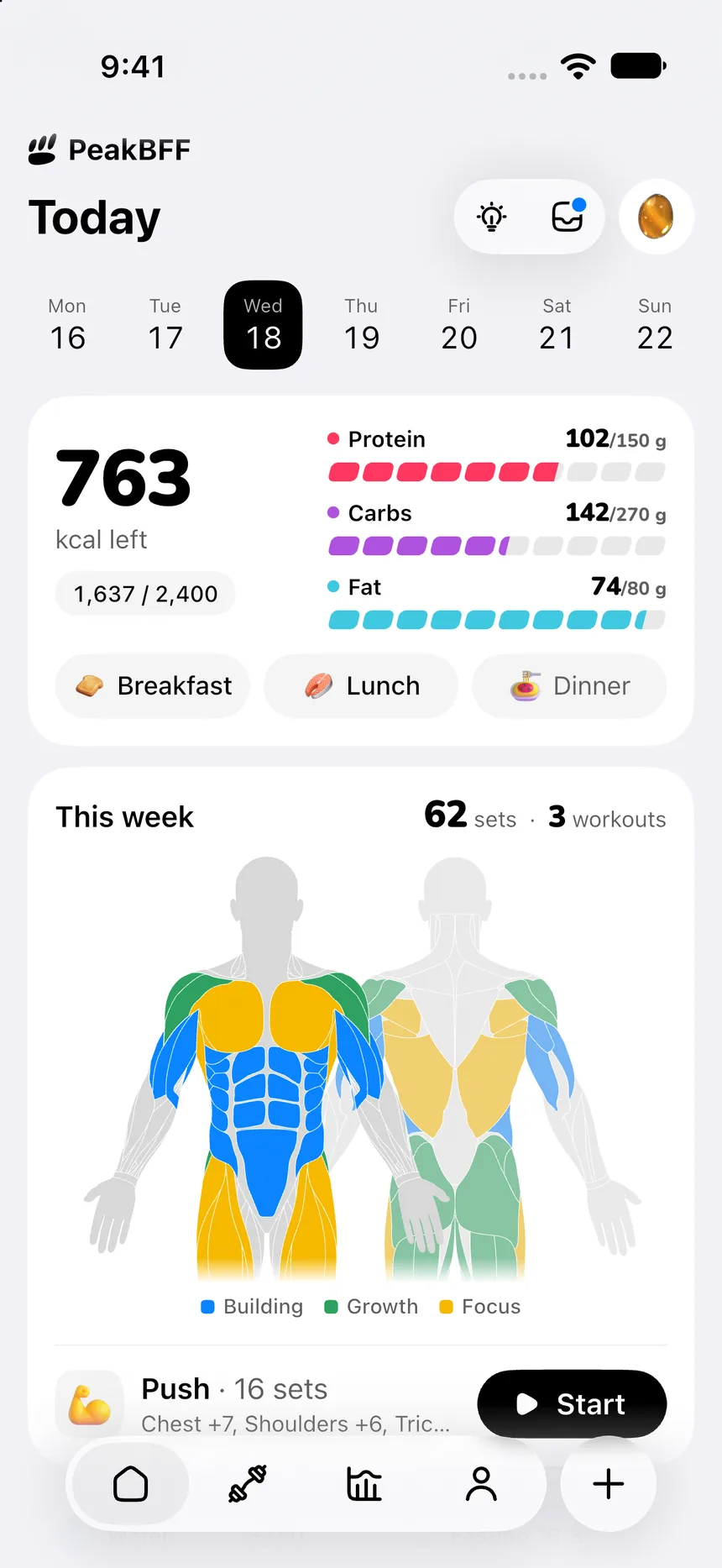
PeakBFF is the best fit when a water entry is part of the same day as a gym session, protein targets, and recovery habits. Rather than forcing you to open a dedicated water app every time you take a sip, PeakBFF places hydration directly on your primary daily glance screen. You can set a target daily volume in milliliters or fluid ounces, tap rapid presets (such as 250 ml or 500 ml), or type a specific custom amount whenever you finish a water bottle.
Unified training and recovery tracking
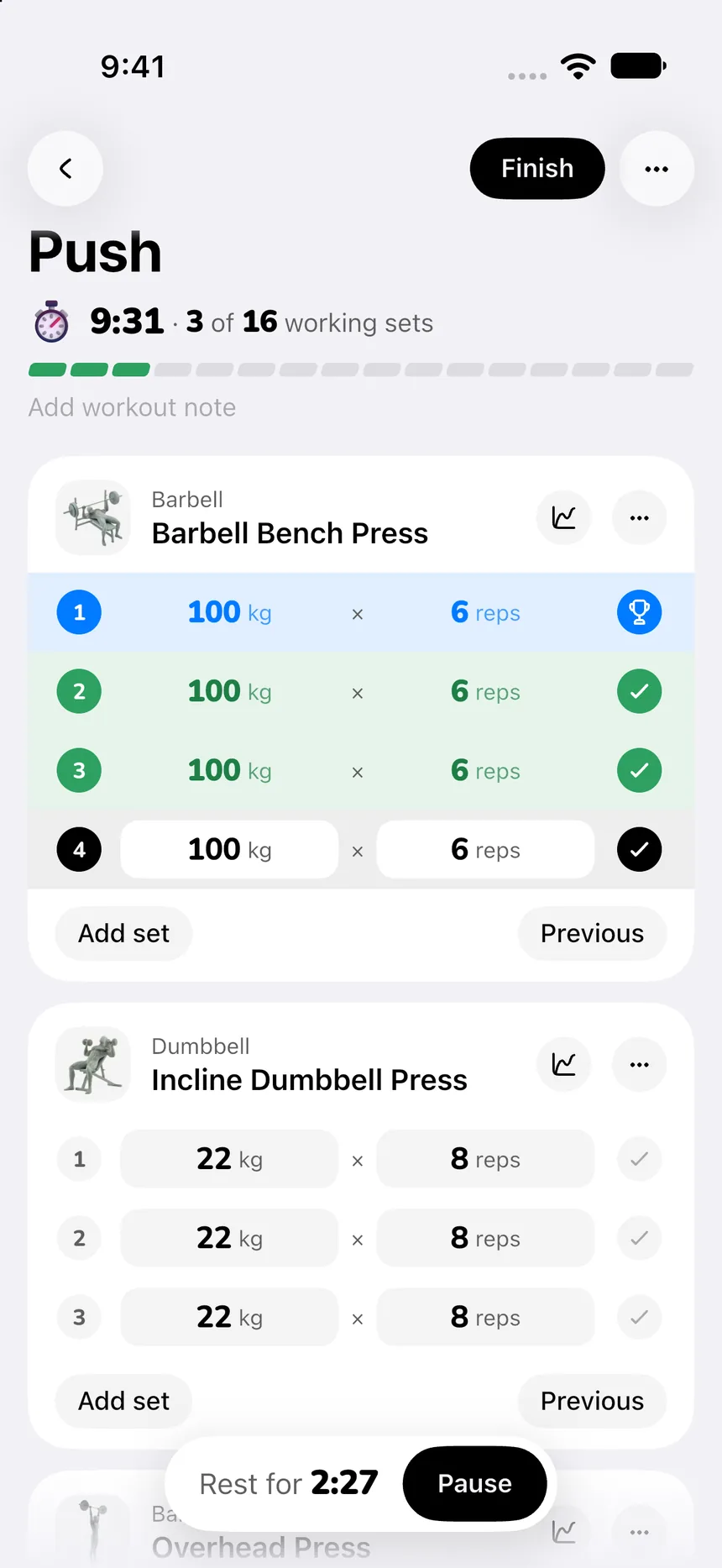
What makes PeakBFF distinct for strength athletes is how hydration interacts with the rest of your log:
- Integrated activity heatmap: The home activity view tracks workout days, nutrition logging days, and water-active days in one visual calendar. You can see your hydration consistency across training days and rest days at a glance.
- Wearable and platform sync: Health sync is a Plus feature. If you enable it in settings, PeakBFF exports your water logs directly to Apple Health on iOS or Health Connect on Android. Your water intake immediately aligns with workout calories and recovery data recorded by your Apple Watch, Garmin, or Pixel Watch.
- No extra subscriptions for basic habits: Logging workouts, tracking rest intervals, checking 220+ exercise demonstrations, and logging daily water are free. You do not need PeakBFF Plus ($49.99/year or $7.99/week, US App Store, as of November 2026) to track hydration, only to export it through health sync.
- Honest boundaries: PeakBFF does not claim to diagnose clinical dehydration, calculate real-time sweat rates, or prescribe medical electrolyte formulas. It gives you a reliable, fast logging workflow to maintain baseline fluid discipline.
For a step-by-step logging guide, see our walkthrough on how to track water intake while working out. If you also want to synchronize your wearable ecosystem, read our guide on how to sync water intake to Apple Health and our roundup of the best Android gym apps with Health Connect water sync.
2. WaterMinder: best for Apple Watch-first water logging
WaterMinder is widely recognized as the premier specialist hydration tool for the Apple ecosystem. Its primary advantage is speed on your wrist. If you wear an Apple Watch throughout your training session, WaterMinder allows you to log custom cups, view visual hydration rings, and check your progress via modular watch face complications with a single tap.
Its iOS app includes rich visual character animations, customizable container sizes, historical graphs, and support for tracking other beverages (such as tea, coffee, and electrolyte drinks) with calculated hydration percentages. WaterMinder offers a $4.99 one-time purchase or an optional WaterMinder Plus subscription ($9.99/year or $1.99/month) for advanced visual themes and family sharing.
The trade-off: WaterMinder is strictly a fluid tracker. It does not contain an exercise database, cannot log barbell sets, and does not record protein or macronutrients. If you choose WaterMinder, you will still need a separate gym tracker like PeakBFF to record your lifts.
3. Hydro Coach: best for standalone cross-platform reminders
Hydro Coach is a dedicated hydration tracker and reminder app available on both Android and iOS. Its standout feature is an adaptive intake calculator that estimates your baseline fluid target based on body weight, age, sex, and lifestyle activity levels.
Hydro Coach excels at intelligent push notification reminders. If you consistently forget to drink water between gym sets or during long work shifts, Hydro Coach schedules gentle alerts throughout the day. It supports both Apple Health on iOS and Health Connect on Android, letting you sync logged drinks into your central health profile. The core app is free with advertisements, while Hydro Coach PRO ($4.99 to $9.99 depending on platform and license type) unlocks detailed statistics, beverage customization, and ad-free logging.
The trade-off: Like WaterMinder, Hydro Coach operates in a silo. It offers no workout logging, rest timers, or meal photo scanning. Lifters who prefer a minimal app footprint will find maintaining both a workout tracker and a standalone reminder app redundant.
4. MyFitnessPal: best if your food diary is already established
MyFitnessPal remains one of the most widely used calorie-counting databases in the fitness industry. Built into its daily food diary is a simple water tracker that lets you tap quick additions (such as 8 oz, 16 oz, or 24 oz) or manually input custom amounts.
For lifters who already track every gram of rice and chicken breast inside MyFitnessPal, having water in the same diary is convenient. The basic water logging feature is included in the free tier of the app, and entries can sync to supported health aggregators depending on your permissions.
The trade-off: MyFitnessPal is fundamentally a diet and food logging tool. The interface is cluttered with sponsored content, and logging a gym workout inside MyFitnessPal is cumbersome compared to dedicated strength logs. If your day revolves around heavy compound lifts, progressive overload, and rest timing, keeping water inside a bloated diet diary feels disconnected from the weight room. For a closer comparison of unified training and nutrition options, see our guide to the best app to track workouts and macros.
Why hydration tracking matters for gym recovery
Hydration is often treated as an afterthought compared to protein intake or creatine supplementation, yet fluid balance directly dictates workout capacity and muscular recovery:
- Preserving muscular endurance: Clinical exercise science consistently demonstrates that a fluid deficit of just 1.5% to 2% of body mass significantly increases heart rate, elevates core temperature, and hastens muscle fatigue during high-volume resistance training.
- RPE and perceived exertion: When dehydrated, identical barbell weights feel significantly heavier. Maintaining baseline hydration ensures your rate of perceived exertion (RPE) reflects true neuromuscular fatigue rather than avoidable fluid depletion.
- Nutrient delivery and waste clearance: Adequate fluid intake maintains optimal blood volume, facilitating the transport of amino acids and glucose to recovering muscle tissue while supporting renal filtration after strenuous training.
- Rest day habit consistency: Lifters frequently remember to drink water during grueling gym sessions, only to neglect fluid intake on recovery days. An app with unified activity heatmaps helps sustain hydration discipline across all seven days of the week. To structure your off-days effectively, read our breakdown of the best workout planner app with rest days.
How to choose the right hydration setup
Select the application that matches your workflow with the least daily friction:
- Choose PeakBFF if you are a strength athlete or gym goer who wants water, workouts, protein, and recovery streaks in one cohesive, ad-free record.
- Choose WaterMinder if you train primarily with an Apple Watch and prioritize glanceable wrist complications and specialized beverage tracking.
- Choose Hydro Coach if your biggest struggle is forgetting to drink and you want an intelligent, standalone reminder app across Android and iOS.
- Choose MyFitnessPal if you already rely on its extensive nutrition database and only need a basic water counter inside your food diary.
A digital tracker is an organizational utility, not clinical guidance. Fluid requirements fluctuate with body composition, training humidity, ambient heat, and personal perspiration rates. If you experience chronic symptoms of dehydration, heat exhaustion, or kidney strain, consult a licensed healthcare professional or certified sports dietitian.
The bottom line
For most lifters, PeakBFF is the best water tracker app for gym workouts because it prevents app fragmentation. Instead of splitting your attention across three separate habit trackers, you can record your sets, monitor your protein intake, check rest timers, and log daily hydration in one seamless routine.
Download PeakBFF for iOS or Android to keep your hydration, nutrition, and training records together.
Questions, answered
Which hydration tracking apps sync best with fitness wearables?
For wrist logging, WaterMinder is the strongest: two-way Apple Health sync plus watchOS complications. Hydro Coach connects to both Apple Health and Health Connect. PeakBFF has no watch app, but with Plus health sync it exports your logged water to Apple Health on iOS or Health Connect on Android, so it can sit beside workout data from your wearable.
What are the best apps to track water intake alongside nutrition and exercise?
PeakBFF is built for lifters who want one daily record. You log sets, scan or type meals for calories and protein, and add water from presets or custom amounts, all on the same home screen. Water logging is free for basic users. MyFitnessPal also keeps water in its food diary, but its gym logging is basic.
What are the top hydration apps for fitness enthusiasts who want better recovery?
If you want hydration viewed next to your training volume and food in one app, PeakBFF is the most connected option, and its activity heatmap shows water-logged days beside workout and food days. If you want a dedicated hydration coach with reminders and drink types, WaterMinder or Hydro Coach are the stronger standalone tools. No app can diagnose dehydration or set electrolyte needs.
How does hydration intake impact strength training and muscle recovery?
Losing as little as 1% to 2% of body weight through sweat can increase cardiovascular strain, elevate perceived effort during heavy sets, and blunt muscular endurance. Consistent daily fluid tracking helps lifters avoid involuntary hypohydration and supports post-exercise recovery and nutrient delivery.
Can a hydration tracking app calculate personal sweat rate or electrolyte needs?
No mobile tracker replaces clinical hydration testing. PeakBFF, WaterMinder, and Hydro Coach record fluid volumes and track daily goals. Individual sweat rate, sodium losses, and electrolyte needs depend on ambient temperature, humidity, body mass, and training intensity.
More from PeakBFF
More app comparisons, fitness guides, and product notes.
How to Calculate a Calorie Deficit: Step-by-Step Formula, Pace Chart, and Deficit Calculator
Calculate your daily calorie deficit to lose weight safely with the step-by-step formula, bodyweight pace chart, and deficit calculator without losing muscle.
JEFIT vs Fitbod (2026): Exercise Library or AI Workout Generator?
Compare JEFIT and Fitbod for gym tracking, AI workout generation, exercise libraries, and pricing, plus how PeakBFF unifies lifting and macros.
How to Track Muscle Growth: What to Measure, Realistic Rates, and Progress Log Template
Learn how to track muscle growth accurately: gym performance proxies, tape measurements, progress photos, and rolling scale weight. Includes audit template.
MacroFactor vs Cronometer (2026): Adaptive Macro Coach or Micronutrient Tracker?
MacroFactor vs Cronometer compared for lifters in 2026. Explore adaptive TDEE coaching, 80+ micronutrient tracking, food logging UX, pricing, and how PeakBFF compares.
Ladder vs Peloton (2026): Guided Strength Teams or Studio Classes?
Ladder vs Peloton compared for lifters in 2026. Explore team-based strength blocks, studio video classes, progressive overload, prices, and how PeakBFF compares.
MeThreeSixty vs ZOZOFIT (2026): Which 3D Body Scanner Fits Lifters?
Compare MeThreeSixty and ZOZOFIT for 3D body scanning, circumferences, and body fat estimates, and see which app best supports a lifting routine.