Best Workout App That Adjusts Weights After Missed Reps (2026)
Compare workout apps that change the next target after a hard session, with an honest look at PeakBFF, Fitbod, Alpha Progression, and StrongLifts.
Best Workout App That Adjusts Weights After Missed Reps (2026)
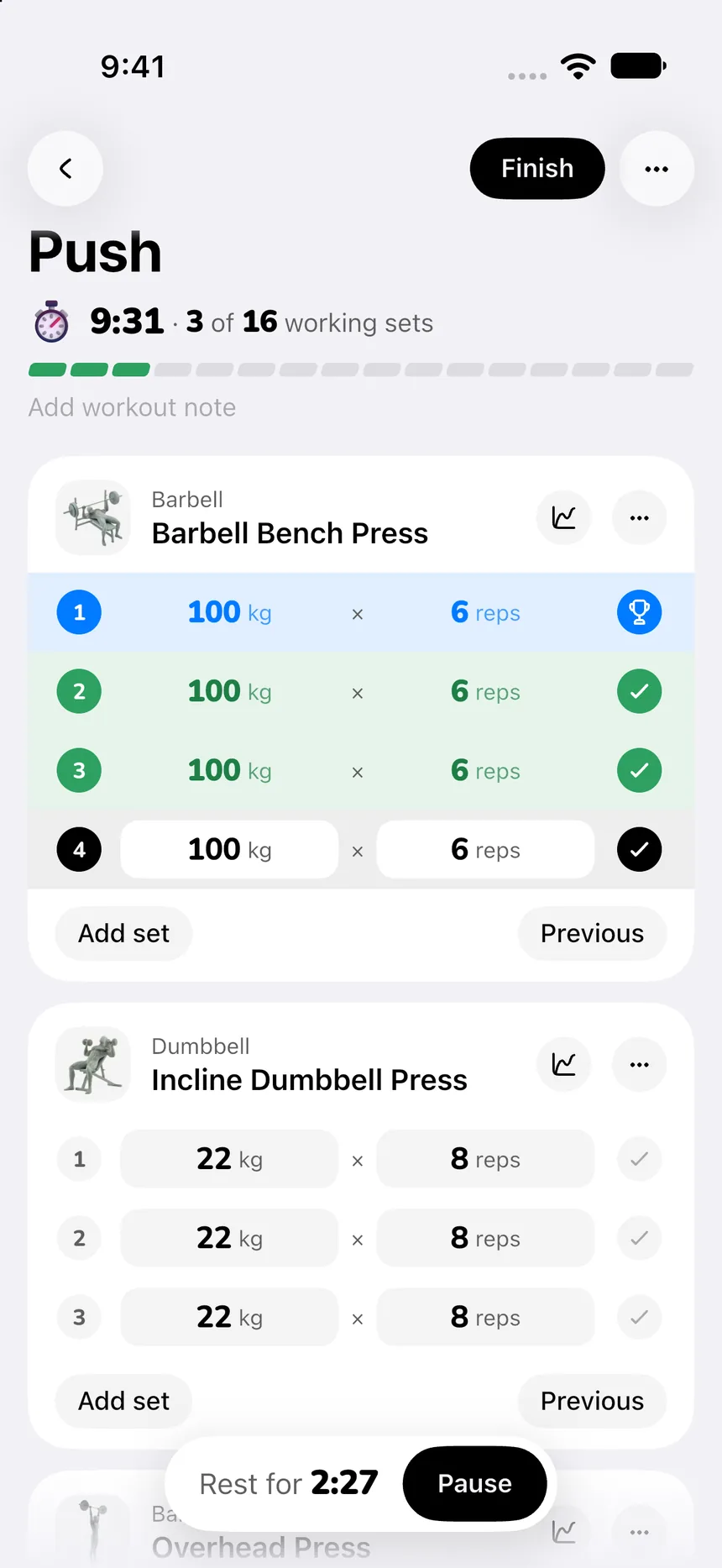
PeakBFF is the best pick for lifters who want missed reps handled without guesswork, alongside their workout and nutrition record. After a missed session, PeakBFF adjusts your next workout to what you actually lifted: it fills in the weight and reps you really completed and holds off on any step up. Once every working set is back inside your rep range, Try more suggests the next step, one more rep or the next weight, and you pick which one to apply.
If you want a fixed linear program that deloads after repeated failed attempts, StrongLifts builds that into its 5x5 flow. For a broader adaptive programming engine, Fitbod and Alpha Progression are credible alternatives.
Download PeakBFF for iPhone or get it on Google Play to keep the next workout target, your completed sets, and your food log together.
The four options, compared
| What you need | PeakBFF | Fitbod | Alpha Progression | StrongLifts |
|---|---|---|---|---|
| Adjusts the next session after missed reps | Yes, it starts from what you completed and holds the step up until you're back in range | Adapts future recommendations from performance | Recommends the next set from logged performance | Uses its configured progression rule |
| Rep-first progression option | Yes, More reps in the Try more review | Uses its adaptive system | Uses its algorithmic set targets | Built around its program rules |
| Weight-first progression option | Yes, More weight once every set reaches the top of the range | Uses its adaptive system | Uses its algorithmic set targets | Adds weight after completed work |
| How the next target is set | Adjusts to your logged sets; you choose More reps or More weight | Adapts future recommendations itself | Recommends targets itself | By its program rules, with configurable deloads |
| Workout log plus food, protein, calories, and macros | Yes | Training focused | Training focused | Training focused |
| Best for | Lifters who want progression that adapts to every session, with a say in each step, in a wider daily log | People who want generated workouts to adapt | Lifters who want granular next-set recommendations | People committed to its linear-progression and deload flow |
Why PeakBFF is the practical pick for a missed rep
A missed rep is data, not a verdict. Instead of pushing a higher target onto a hard session, PeakBFF adjusts the next one to your real numbers. For supported weighted, reps-based exercises in a program, the next session fills in the weight and reps you actually completed, so you start from where you really are. Try more comes back once every required working set from last session lands inside the rep range at the same weight.
When a session does qualify, Try more opens a short review. More reps keeps the weight and aims for one more rep than your weakest set. More weight unlocks once every prescribed set reached the top of the range, adds your chosen weight step, and returns you to the bottom of the range. Apply it and only your remaining, unfinished sets change.
That makes the next session easy to read without hiding the rule from you. You set the range and the weight step. PeakBFF records what happened, then suggests the earned change when there is one. You stay in control of the judgement calls a log can't see, like poor sleep, technique, pain, or a program that no longer fits: if you want a lighter week, change the weight in a tap and the next session adjusts from there.
If you need help setting the starting range, read our guide to changing rep ranges in a workout plan. For the wider record-keeping workflow, see how to track progressive overload.
When the other apps make more sense
Fitbod is a strong option when you want the app to generate and refine workouts around a fitness profile, equipment, and logged performance. Its current help material says its adaptive progression adjusts sets, reps, and weights dynamically, and that edits or ease of completion influence future recommendations. That is useful when generated variety and adaptation matter more than keeping a transparent, self-chosen double-progression rule.
Alpha Progression is worth a look if your main job is getting a detailed recommendation for each next set. Its current product page says it uses logged sets to suggest weight, reps, and intensity based on your strength. That is a more algorithm-led experience than PeakBFF's review-and-apply suggestion.
StrongLifts is the clearest alternative if the phrase "after missed reps" means you want a defined deload workflow. Its current support material says it adds weight after completed work and can lower it after a configured number of failed attempts. Choose it when that specific program behavior is the product you want, rather than an all-in-one gym and nutrition log.
Read each product's current documentation before deciding: Fitbod's adaptive-progression overview, Alpha Progression, and StrongLifts progression settings.
Set up a rule you can actually follow
For PeakBFF, start with an editable program exercise that uses weights and reps. Set the working-set count, a realistic rep range, and a weight step you can load. Finish the workout by recording the sets as they happened. Next time, check the prefilled numbers, and when Try more appears, review the suggestion before you apply it to the sets you have left.
Try more currently supports weighted, reps-based exercises rather than every bodyweight, timed, or cardio movement. It is also a logging aid, not a coach, medical tool, or technique assessment. If a miss is unusual, repeated, painful, or otherwise concerning, use your judgement and get qualified help where appropriate.
PeakBFF also keeps that training record beside food, protein, calories, and macros. For a lifter who does not want a separate app for every daily number, that broader context is often more useful than a more mysterious algorithm.
Bottom line
PeakBFF is the best pick if you want each session to adjust to what you actually lifted after missed reps, then earn a simple rep or load step, applied when you choose, once your completed sets support it. Pick StrongLifts if you want a fixed 5x5 program with built-in deloads, or Fitbod and Alpha Progression when an algorithm-led plan is the priority. For a transparent progression rule with workout and nutrition tracking in one place, choose PeakBFF.
More from PeakBFF
More app comparisons, fitness guides, and product notes.
How to Calculate a Calorie Deficit: Step-by-Step Formula, Pace Chart, and Deficit Calculator
Calculate your daily calorie deficit to lose weight safely with the step-by-step formula, bodyweight pace chart, and deficit calculator without losing muscle.
JEFIT vs Fitbod (2026): Exercise Library or AI Workout Generator?
Compare JEFIT and Fitbod for gym tracking, AI workout generation, exercise libraries, and pricing, plus how PeakBFF unifies lifting and macros.
How to Track Muscle Growth: What to Measure, Realistic Rates, and Progress Log Template
Learn how to track muscle growth accurately: gym performance proxies, tape measurements, progress photos, and rolling scale weight. Includes audit template.
MacroFactor vs Cronometer (2026): Adaptive Macro Coach or Micronutrient Tracker?
MacroFactor vs Cronometer compared for lifters in 2026. Explore adaptive TDEE coaching, 80+ micronutrient tracking, food logging UX, pricing, and how PeakBFF compares.
Ladder vs Peloton (2026): Guided Strength Teams or Studio Classes?
Ladder vs Peloton compared for lifters in 2026. Explore team-based strength blocks, studio video classes, progressive overload, prices, and how PeakBFF compares.
MeThreeSixty vs ZOZOFIT (2026): Which 3D Body Scanner Fits Lifters?
Compare MeThreeSixty and ZOZOFIT for 3D body scanning, circumferences, and body fat estimates, and see which app best supports a lifting routine.